
Rental income insurance replaces the rent you lose when a tenant stops paying, breaks the lease, absconds, or when the property becomes uninhabitable. Most policies pay out for a defined indemnity period, often a few months for tenant-default cover, with longer terms available for damage-related loss of rent. The exact amount you receive depends on your chosen limit, the excess, and the exclusions written into your specific policy.
TL;DR:
- Rental income insurance covers lost rent due to tenant default, property damage, early lease termination, absconding, or uninhabitable property events.
- Coverage limits depend on the indemnity period and monetary cap, with longer periods and higher caps increasing protection and premiums.
- Exclusions include pre-existing arrears, damage from neglect, unregistered tenancies, and breaches of eviction procedures, which can void claims.
- Claims require prompt, complete documentation such as tenancy agreements, evidence of default, photos, and legal records, with delays often caused by incomplete submissions.
- Landlords should calculate their needed coverage based on rent, eviction timelines, legal costs, and desired buffer to avoid under-insuring and ensure effective protection.
Table of Contents
- How much does renters insurance cover for landlords?
- How much will renters insurance cost to cover your exposure?
- What reduces or prevents a payout?
- How do you make a claim for lost rent?
- How much cover do you actually need?
- Publisher perspective: what most landlords get wrong
- Protect your rental income with a tailored quote
- Sources
How much does renters insurance cover for landlords?
Rental income insurance for landlords is built around a handful of core triggers, and understanding which one applies to your situation determines whether a claim succeeds. The policy responds differently depending on whether the tenant stopped paying, the property became unfit to live in, or the lease ended early.
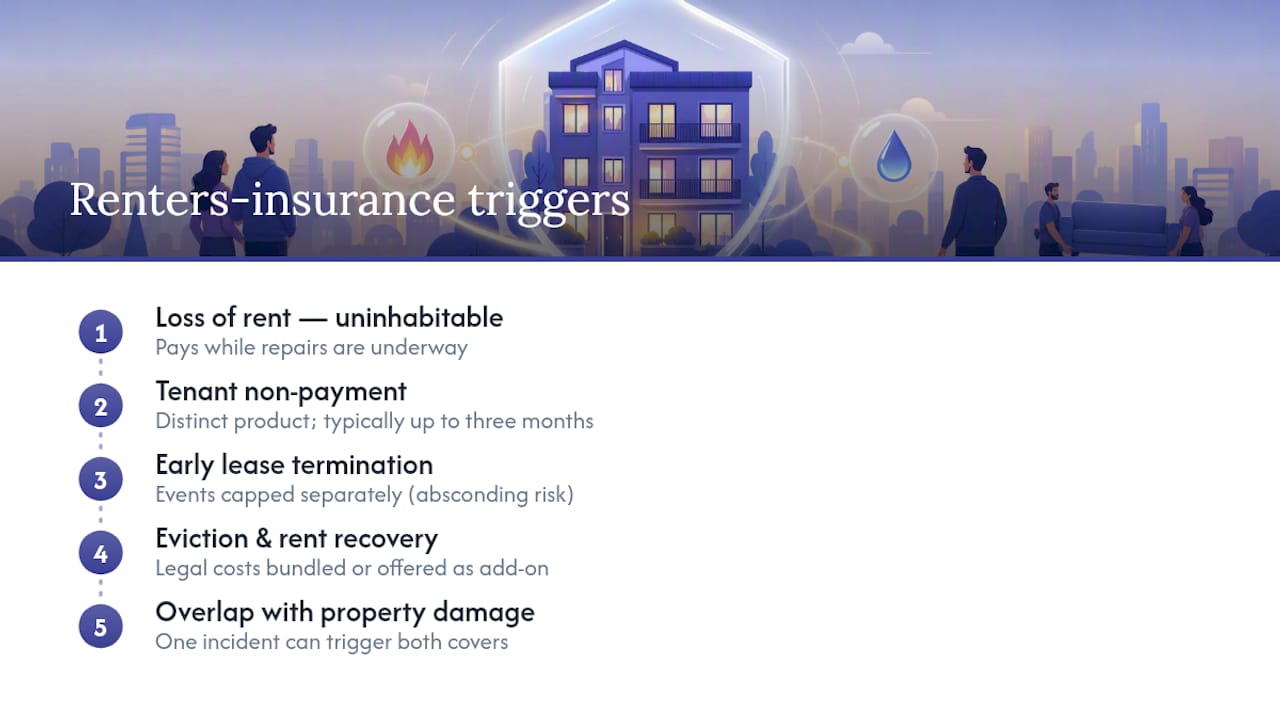
Loss of rent when the property is uninhabitable. This applies when an insured peril, fire, storm damage, burst geyser, and similar events, forces a tenant to vacate. Cover is paid up to the limits set in the policy while repairs are underway.
Tenant non-payment or rent guarantee cover. This is a distinct product from loss-of-rent cover. It responds to default rather than damage, and typically pays for up to three months before the indemnity period expires.
Early lease termination and absconding. Insurers usually cap these events separately, since a tenant who vanishes overnight creates a different risk profile to one who serves proper notice.
Legal costs for eviction and rent recovery. Some insurers bundle this in; others treat it as an add-on, so check the wording carefully.
Overlap with property damage cover. A single incident, a fire that damages a unit and prompts the tenant to leave, can trigger both a loss-of-rent claim and a property damage claim simultaneously. Rental Income Insurance also extends into personal liability coverage, giving landlords broader protection alongside the rent-loss element.
How much will renters insurance cost to cover your exposure?
Two mechanisms decide your payout: the indemnity period (how many months of rent the insurer will pay) and the monetary cap (a fixed rand ceiling regardless of how long the vacancy runs). Some policies use one, some use both, and deductibles and waiting periods reduce the final amount you actually receive.
A rough sense of the market:
- Tenant-default cover often runs for a few months of rent, sometimes extending further for a higher premium.
- Loss-of-rent cover tied to property damage can stretch to the full repair period, provided you have selected an adequate limit.
- Legal-cost add-ons for eviction usually carry their own separate cap, distinct from the rent-loss figure.
Pro Tip: Always ask for the insurer’s sample policy wording before signing. The definition of “indemnity period” varies enough between providers that two policies quoting the same premium can pay out very differently.
Here’s a worked example. Say your monthly rent is a certain amount and you want a few months of cover as a buffer against a slow eviction process. Your recommended limit would reflect that amount multiplied by the months chosen, before adding any legal-cost cover on top. Landlords with higher-value properties or slower court backlogs in their province often extend to six months for extra breathing room.
What reduces or prevents a payout?
An excess (or deductible) is the portion of a claim you carry yourself before the insurer pays the rest. A waiting period is the gap between when the loss starts and when cover kicks in, often 30 days for non-payment claims. Both mechanics exist to filter out short, easily-absorbed losses and keep premiums realistic.
Common exclusions that catch landlords out include:
- Rent already in arrears before the policy started
- Non-payment where no formal lease agreement exists
- Losses linked to unregistered or informal tenancies
- Damage caused by ongoing neglect rather than a sudden event
Policy breaches can also void cover entirely. Skipping the correct eviction procedure, or letting the property fall into disrepair, gives the insurer grounds to decline. The full exclusions breakdown is worth reading properly before you need it, not after.
How do you make a claim for lost rent?
Insurers move faster when the paperwork arrives complete the first time. Gather your evidence in this order:
- Collect the paper trail immediately. Tenancy agreement, rent statements, written notices, WhatsApp or email correspondence, and photographs of any damage.
- Report the incident promptly. Delayed notification is one of the most common reasons claims stall.
- Submit what the insurer requests. For rent-loss and eviction claims, that typically means proof of the tenancy, evidence of default, and legal filing records where an eviction was pursued.
- Show reasonable mitigation. Insurers expect you to have taken sensible steps to limit the loss, re-advertising promptly, following up on arrears, rather than letting the situation drift.
- Track the timeline. Assessment and payment usually follow within weeks of a complete submission, but incomplete documentation is the single biggest cause of delay.
How much cover do you actually need?
Work through four numbers before choosing a limit: your monthly rent, the typical vacancy or eviction timeline in your area, expected legal costs if it goes to court, and how much of a buffer you want beyond the minimum.
A practical checklist:
- Months of cover. Match this to realistic eviction timelines, not the fastest-case scenario.
- Excess level. A higher excess lowers your premium but raises what you carry yourself.
- Tenant-default option. Confirm whether this is bundled or needs adding separately.
- Legal-cost cover. Check whether eviction costs sit inside the main limit or as an add-on.
A simple formula: monthly rent × desired indemnity months = base cover level, then add your estimated legal costs on top. For an example with a given monthly rent, a few months of cover, and anticipated legal fees, you can calculate your total exposure to insure against accordingly.
Transparent pricing examples make this comparison easier, and a broker or the insurer directly can tailor the figure once they know your property type and province. For a structured way to work through the numbers, the rental coverage assessment checklist walks through each variable in sequence. External tools like a rent versus buy calculator can also help frame the underlying maths insurers use when weighing lost income against ongoing costs.
Publisher perspective: what most landlords get wrong
The mistake I see repeatedly is landlords buying the cheapest available limit and assuming it will stretch to cover a worst-case eviction. It rarely does. Rental Income Insurance specialises in exactly this gap, tenant non-payment, early termination, absconding, because generic policies often treat these as afterthoughts rather than core risks. The real trade-off isn’t cover versus no cover; it’s a longer indemnity period against a higher premium, and most landlords underestimate how long a contested eviction can actually run.
— Coert
Protect your rental income with a tailored quote
Rental Income Insurance is built specifically for landlords who need more than a generic policy bolted onto a buildings quote. It covers tenant non-payment, early lease termination, absconding, eviction and legal fees, and property damages, giving you one policy rather than several overlapping ones with different excesses and different insurers to chase after a claim.

Getting a quote takes a few basics: your monthly rent, property type, and the indemnity period you want. Turnaround is quick because pricing is transparent from the outset rather than buried in fine print. If you’ve worked through the formula above and want a figure that reflects your actual property rather than a generic estimate, request a quote and get a tailored number back. For a deeper look at how limits and indemnity periods interact before you commit, the rental income protection guide covers the mechanics in full. You can also watch this
for a quick walkthrough of how the cover works in practice.