
For landlords, “cover” means rental income protection: a policy paying out for tenant non-payment, early lease termination, absconding tenants, eviction and legal fees, and loss of rent when a property becomes uninhabitable. Most policies cap monthly payouts around R30,000 and cover one to three months, with eviction costs typically capped between R10,000 and R40,000.
TL;DR:
- Most policies cap monthly payouts at around R30,000 with a one to three-month maximum, and eviction costs are typically limited between R10,000 and R40,000.
- Rental income protection usually kicks in after two consecutive missed payments, requiring documentation such as lease agreements and demands before claims are processed.
- Accurate policy matching depends on ensuring the payout limit covers your mortgage, and understanding how tenant default and property damage are separately triggered.
- Exclusions common to policies include routine damage, wear and tear, unreported illegal activity, and delays caused by waiting periods or incomplete documentation.
- Premium rates generally start at about 5% of the monthly rent, with higher limits or extended cover periods increasing premiums proportionally.
Table of Contents
- What does rental income protection actually include?
- What are the common exclusions and limits to check?
- How does a rental income claim actually work?
- How do you choose the right policy for your property?
- What do premiums and cover limits typically look like?
- How Rental Income Insurance approaches this cover
- When is rental income cover actually worth the premium?
- How to get a tailored quote from Rental Income Insurance
- Sources
What does rental income protection actually include?
Rental income protection exists to close the gap between a signed lease and actual cash landing in your bank account. It typically pays out from the second consecutive missed payment, which means one late payment won’t trigger a claim, but a pattern of non-payment will.
Here’s what a well-structured policy usually pays for:
- Tenant arrears: cover kicks in after two consecutive missed rent payments, once a letter of demand has been issued.
- Early lease break and absconding: the shortfall between what’s owed on the lease and what you actually recover from a tenant who leaves early or vanishes.
- Loss of rent from an insured peril: fire, storm damage, or a burst pipe that makes the unit unliveable while repairs happen.
- Eviction and legal costs: many policies fold these in rather than treating them as an add-on, which matters given how slow eviction proceedings can run.
- Temporary vacancy and re-letting support: some products extend cover while you find a new tenant, with a recovery clause if the original tenant later pays up.
The two threads worth separating here are loss-of-rent cover (triggered by property damage) and tenant default cover (triggered by non-payment regardless of the property’s condition). GeoAfrika’s breakdown of this distinction is worth reading if your quote bundles both under one label, because the trigger conditions differ.
What are the common exclusions and limits to check?
Policy wording varies more than most landlords expect, and the exclusions are where cash-flow gaps hide. Routine maintenance failures, gradual wear and tear, and deliberate damage are almost universally excluded rather than covered as insured perils.
Before signing anything, check for these:
- Waiting periods: a one to three month wait before cover activates is standard, so don’t expect a payout on day one of a dispute.
- Proof requirements: insurers generally want a valid lease agreement, a formal letter of demand, and evidence of the arrears before accepting a claim.
- Monthly and absolute caps: a R30,000 monthly limit sounds generous until you’re renting out a commercial unit at R60,000 a month.
- Actions that void cover: unreported subletting, undisclosed illegal activity on the property, or letting to a tenant without proper screening can all invalidate a claim.
Letting a property changes how insurers assess risk, and it’s worth confirming your existing homeowner policy hasn’t quietly excluded letted use altogether.
How does a rental income claim actually work?
Claims move fastest when the paperwork is in order before you call your insurer, not after. Here’s the sequence that typically plays out:
- Trigger point: usually the second consecutive missed payment after a formal letter of demand, or an insured event (fire, storm, flood) that makes the unit uninhabitable.
- Immediate documentation: issue the letter of demand, log the arrears with dates, and arrange a property inspection if damage is involved.
- Submit required documents: insurers typically ask for the signed lease, an arrears statement, any court papers already filed, and repair invoices where relevant.
- Assessment and payout: turnaround varies, but delays usually stem from incomplete arrears records or a lease that was never formally signed.
- Recovered rent: if the tenant eventually pays outstanding amounts after your claim settles, that money typically gets repaid to the insurer, not kept by you.
Pro Tip: Keep a dated paper trail from the first missed payment, not just from when things get serious. Insurers move faster when the arrears timeline is already documented rather than reconstructed after the fact.
How do you choose the right policy for your property?
Matching the policy to your actual mortgage exposure matters more than chasing the cheapest premium. A R30,000 monthly cap is meaningless if your bond repayment on the rental unit is R38,000.
Work through these points before comparing quotes:
- Cap versus liability: line up the monthly payout limit and maximum cover period against your mortgage and other fixed costs on the property.
- Legal and re-letting cover: confirm whether eviction costs and short-term re-letting support are bundled in or sold as extras.
- Definitions matter: ask exactly how “uninhabitable” is defined and what proof you’d need to supply.
- Reimbursement clauses: understand how recovered rent from a tenant affects your settlement, since some insurers will reclaim what they paid out.
- Premium structure: compare a percentage-of-rent premium against a fixed monthly premium, and factor in the excess on each.
Pro Tip: Ask for the policy wording document before you pay a deposit, not after. The gap between a broker’s verbal summary and the actual exclusions clause is where most disappointed claims start.
What do premiums and cover limits typically look like?
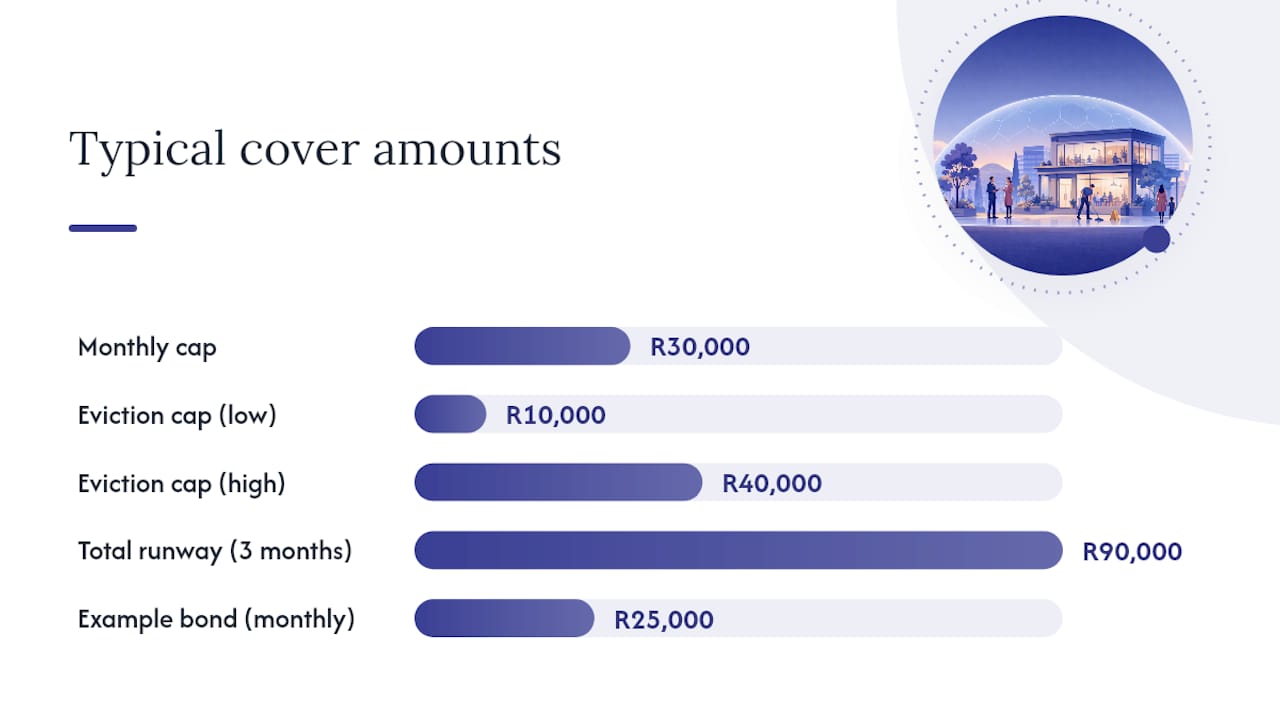
Market examples give a useful anchor for judging whether a quote is reasonable. Reported premiums start from around 5% of the monthly rental amount, scaling up depending on the cover limit and the perils included.
Typical benchmarks worth comparing your quote against:
- Monthly cap: R30,000 is a commonly cited example limit, with cover running one to three months.
- Eviction cost caps: sample ranges sit between R10,000 and R40,000, depending on the insurer and the legal process involved.
- Excess and waiting periods: a longer waiting period or higher excess usually brings the premium down, but increases your out-of-pocket exposure during a dispute.
- Higher caps, higher premium: extending the cover period beyond three months or adding perils like malicious damage pushes the premium up proportionally.
A R30,000 monthly cap with a three month limit gives you R90,000 of runway. For a bond of R25,000 a month, that’s roughly three and a half months of breathing space while you sort out a defaulting tenant, which is often enough time to complete an eviction process.
How Rental Income Insurance approaches this cover
Some insurance providers build policies around the outcomes landlords actually need protected: tenant non-payment, early lease termination, absconding tenants, eviction and legal costs, and property damage. The aim is straightforward, cover that reflects what actually goes wrong during a tenancy, not a generic liability product retrofitted for landlords.
If you want the fuller picture before requesting numbers, the complete guide to rental income protection walks through policy comparisons and worked examples in more depth than a single article can. Landlords weighing up liability exposure alongside income protection may also find the public liability guidance for landlords useful context, since the two covers address different risks. Readers ready to see numbers against their own property can request policy wording directly rather than guessing from published examples.
When is rental income cover actually worth the premium?
Cover earns its premium fastest for landlords with thin cash reserves, furnished short-lets exposed to higher tenant turnover, or properties in areas with elevated vacancy risk. If a missed rent payment would put your own bond at risk within a month or two, that’s the clearest signal you need this protection rather than a nice-to-have.
Landlords sitting on several months of reserves, or those who screen tenants rigorously through agencies with strong vetting, may find the premium harder to justify. That’s a legitimate call to make, not a mistake. What isn’t optional is reading the policy wording properly. The gap between what a broker describes and what the exclusions clause actually says is where most landlords get caught out, usually at the worst possible moment.
— Coert
How to get a tailored quote from Rental Income Insurance
Some insurance providers build cover around your actual exposure, not a generic template, so you get a quote shaped by your property type, rental amount, and risk profile rather than a one-size number pulled from a rate card.

The process usually starts with a straightforward step: telling the insurer about your property and lease terms, so they can work out where the gaps in your current protection sit. This may include reviewing whether eviction costs and re-letting support are already bundled or need adding, and confirming the monthly cap matches your mortgage exposure rather than a rough estimate. It’s often possible to request a full copy of the policy wording upfront, so there are no surprises buried in a clause you never saw before signing.
For a closer look at how the numbers work in practice, watch this walkthrough:
.

Ready to see what cover would cost for your specific property? Request a tailored quote from Rental Income Insurance and get a policy wording review alongside it, or visit the main Rental Income Insurance site to see the full scope of protection on offer.
Sources
- Property rental insurance: insuring rental income against risk of tenant default | Insurance Biz
- What is Rental Income Insurance? – GeoAfrika
- Rental income insurance – protecting your assets and liabilities – bbrief