
Rental income protection replaces the rent you lose when a tenant stops paying, absconds or breaks a lease early, and it commonly extends to legal costs for eviction and rent recovery. It suits landlords whose mortgage repayments or household budgets depend directly on rent arriving on time. If that describes you, this cover fills the exact gap that a standard building or contents policy leaves open.
TL;DR:
- Rental income protection typically covers up to three months of unpaid rent, with premiums around 3.5 to 5% of the monthly rent.
- The cover activates after the second consecutive missed payment if a formal demand letter is issued, and recovery can offset payouts if the tenant repays arrears later.
- This insurance specifically targets tenant non-payment, absconding, or early lease termination, and does not cover physical property damage.
- Proper claim processing requires prompt action, thorough documentation, and adherence to legal procedures, as delays or missing paperwork stall payouts.
- It is most beneficial for landlords managing multiple units or relying heavily on rent income to cover mortgage repayments or household budgets.
Table of Contents
- What is landlords contents insurance versus rental income protection?
- How does rental income protection actually work?
- Typical limits, premiums and what they mean for your cash flow
- Do you actually need this cover, and what should you ask insurers?
- How to claim and keep the process moving
- Why we think every income-reliant landlord should look at this
- How Rentalincomeinsurance can help you get covered
- Where to read more on rental income protection
- Sources
What is landlords contents insurance versus rental income protection?
Here’s where confusion creeps in. Landlords contents insurance covers physical items you own inside a rental property, things like carpets, curtains, appliances, and any furniture supplied with a furnished let. Rental income protection covers none of that. It covers the cash flow you lose when a tenant simply stops paying, disappears, or walks away from a lease before its term ends.
Two flavours of rental income cover exist, and knowing which one you’re buying matters.
- Loss of rent after damage. Pays out when a property becomes uninhabitable following an insured event such as fire or a burst geyser, so you keep receiving rent while repairs happen.
- Tenant default or rent guarantee cover. Pays out when a tenant fails to pay, absconds, or terminates a lease early, regardless of whether the property itself is damaged.
Most South African landlords buying this cover want the second type. It typically treats tenant non‑payment, absconding, and early termination as separate triggers, each with its own documentation requirements, and it usually bundles in legal‑fee cover for eviction and rent recovery. A landlord contents policy will never pay a cent towards any of that, because arrears aren’t property damage. If your real worry is a tenant vanishing owing three months’ rent, contents cover was never going to help you anyway.
How does rental income protection actually work?
Insurers don’t pay out the moment a tenant misses one payment. Most policies build in a waiting period and a defined trigger before a claim becomes valid, which protects both sides from premature disputes.
- Confirm eligibility first. You’ll usually need a valid, signed lease agreement, and many insurers require tenant credit checks and proof of affordability completed before the tenancy started, not after arrears appear.
- Wait for the trigger. Cover commonly activates from the second consecutive missed payment, provided you’ve issued a formal letter of demand.
- Gather your paperwork. Insurers typically ask for the lease, proof of the demand letter, bank statements showing the missed payments, and, where eviction proceeds, the relevant court papers.
- Understand the recovery clause. If the insurer later recovers arrears from the tenant through legal action, that recovery usually reduces or offsets what you’re repaid, since the policy is there to bridge your cash flow, not to double-pay you.
Skip any one of these steps and a legitimate claim can stall for weeks. The paperwork feels tedious, but it’s what turns a stressful situation into a straightforward payout.
Typical limits, premiums and what they mean for your cash flow
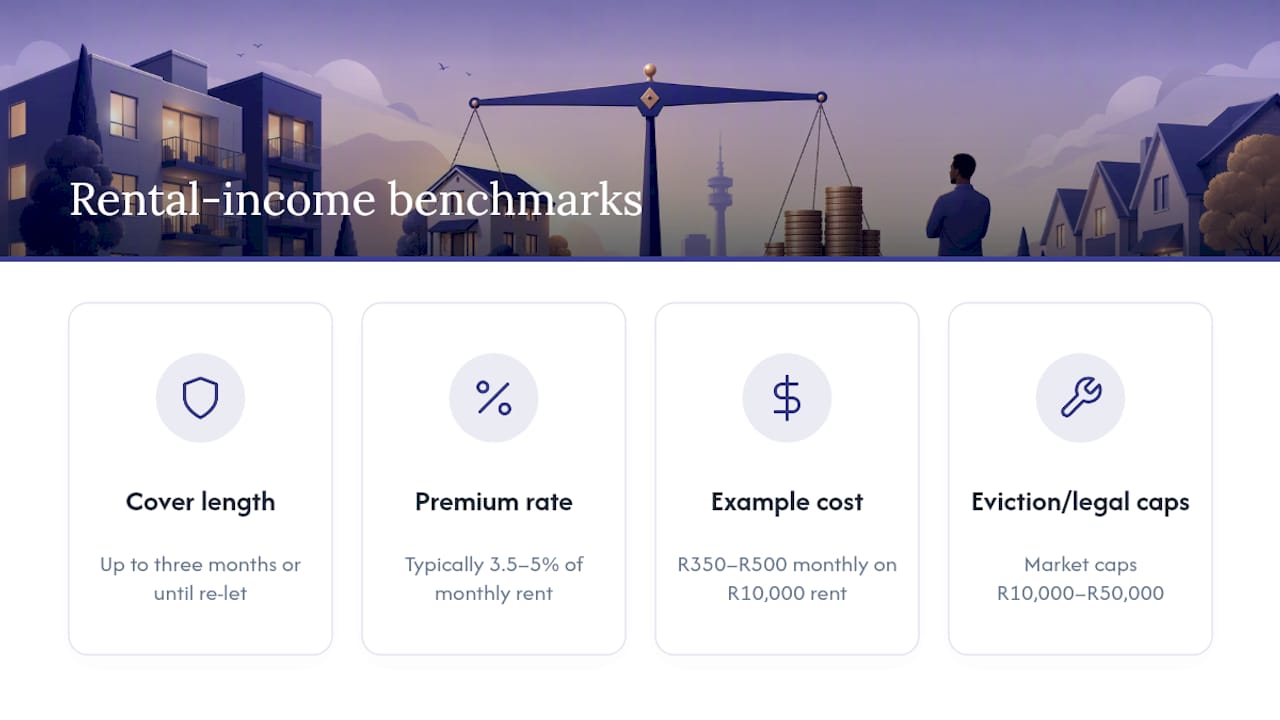
Most rental income policies pay out for up to three months’ rent or until the property is re‑let, whichever happens first, with premiums typically running 3.5–5% of monthly rent.
On a R10,000 monthly rental, that works out to roughly R350 to R500 a month, a modest cost against the risk of losing three months’ income outright while you also cover eviction costs out of pocket. Eviction and legal‑fee caps vary by product and by whether the property is residential or commercial, with market examples showing caps between R10,000 and R50,000. Waiting periods and excesses also differ, so a cheaper premium sometimes hides a longer wait before you can claim.
Your tenant’s risk profile shifts the price too. A tenant with a strong credit history and a stable income usually earns a lower premium than one with a thin credit file, and a longer lease term can sometimes soften the rate compared with month-to-month arrangements. None of these numbers are fixed across the market, so treat them as a starting benchmark rather than a quote.
Do you actually need this cover, and what should you ask insurers?
Not every landlord needs rental income protection, but a few honest questions usually settle it fast. If a missed rent payment would strain your own mortgage repayment, or if you’re managing multiple units where one bad tenant shouldn’t sink your whole portfolio, this cover earns its premium quickly.
Before you sign anything, ask each insurer these questions directly:
- What exactly triggers a valid claim, and how many consecutive missed payments does it take?
- How many months of rent will you actually pay, and is it capped at a rand amount or a percentage of rent?
- Does eviction and legal cover form part of the base premium, or is it an add-on?
- What tenant vetting or credit-check standard do you require before cover applies?
- What waiting period and excess apply, and do they change based on lease length?
- If you recover arrears from the tenant later, how does that affect what I’ve already been paid?
Watch for exclusions too. Some policies exclude short-term or holiday lets entirely, and others exclude certain tenant categories, such as tenants without a fixed income or those on informal leases.
Pro Tip: Ask for the policy wording, not just the brochure summary. The exclusions that catch landlords out are almost always buried in the fine print, never in the marketing page.
How to claim and keep the process moving
The moment a payment is missed, your actions in the first few weeks decide how smoothly the claim runs later.
- Issue a letter of demand immediately once a payment is late, rather than waiting to see if the tenant catches up.
- Log every communication with the tenant, including calls, messages, and any promises to pay, with dates attached.
- Build your documentation file early: lease agreement, proof of the demand letter, bank statements, and any correspondence.
- Notify your insurer as soon as the trigger point is reached, don’t wait until you’ve already started eviction proceedings independently.
- Coordinate eviction and legal steps with the insurer, since many policies require you to use approved legal processes for the legal-cost cover to apply.
Industry commentary is consistent on this point: landlords who document missed payments and issue demand letters promptly experience far fewer disputes with insurers than those who try to reconstruct a paper trail after the fact. Sloppy records are the single biggest reason legitimate claims get delayed.
Why we think every income-reliant landlord should look at this
We built our view on a simple observation: more South African landlords are turning to rental income cover specifically to protect cash flow, not property, because a missed rent cheque hurts faster than a cracked ceiling. That’s the gap Rentalincomeinsurance exists to close, covering non‑payment, absconding, and early termination as distinct, clearly defined triggers. But cover isn’t a substitute for proper tenant vetting; treat it as backup for when good screening still isn’t enough.
— Coert
How Rentalincomeinsurance can help you get covered
Rentalincomeinsurance is the practical route for landlords who want rental cash flow protected without wading through generic insurance jargon. We cover tenant non‑payment, early lease termination, absconding, and eviction or legal fees, all under one policy built specifically for South African landlords rather than adapted from a general household product.

Getting a quote takes a few minutes. Have your lease agreement, monthly rental amount, and basic tenant details ready, and you’ll get a realistic sense of premium and limits straight away. Before you commit to any insurer, compare the months of rent payable, the waiting period, and the exclusions line by line, they’re where policies genuinely differ. Request a personalised quote and see exactly what protection would cost against your current rental income.
For a broader look at how rental income cover differs from contents and liability products, our guide on understanding landlord versus rental income insurance walks through the distinctions in plain terms. You can also watch this short explainer:
Where to read more on rental income protection
- The Rental Income Protection FAQ sets out standard policy triggers and inclusions in plain language.
- Insurance Biz’s coverage of tenant default cover gives realistic premium and payout benchmarks.
- Private Property’s landlord insurance guide explains how income protection differs from contents and liability cover.
- Rentalincomeinsurance’s product explainer covers policy detail for landlords ready to compare terms.
Sources
- Property rental insurance: insuring rental income against risk of tenant default | Insurance Biz
- Rental income insurance – protecting your assets and liabilities – BBrief