
TL;DR:
- Rentalincomeinsurance in South Africa provides specialized protection for landlords against tenant non-payment, lease termination, and absconding. Properly assessing costs involves understanding property risks, choosing consistent quotes, and calculating adequate cover limits based on fixed costs and financial buffers. Having precise documentation and understanding policy trigger conditions help ensure claims are valid and timely.
Specialist rental income insurance in South Africa typically costs a moderate monthly amount that varies depending on your property, cover limits, and insurer. Landlord policies usually cost about 20% more than equivalent owner-occupied cover, reflecting the additional tenant risk they carry. That range is wide because location, monthly rent, waiting period, and the cover structure you choose all shift the final figure considerably.
Three things to check before you do anything else:
- Waiting period: confirm how many months must pass before a claim becomes payable.
- Cover measurement: check whether the policy pays in months of rent or a fixed rand amount, as these produce very different payouts.
- Your actual rent figure: get a quote using your real monthly rental, not a round estimate, so the premium and cover limit are accurate.
Table of Contents
- What drives the cost of landlord insurance in South Africa?
- How do insurers price cover, and what will you actually pay?
- What does rental income insurance cover, and what does it exclude?
- How to get an accurate quote in South Africa
- Practical ways to lower your premium without losing cover
- How does a claim for unpaid rent actually proceed?
- How much cover do you actually need?
- Why Rentalincomeinsurance is built for South African landlords
- Key takeaways
- Why specialist cover matters more than most landlords realise
- Useful South African sources and further reading
- Rentalincomeinsurance: specialist cover for South African landlords
What drives the cost of landlord insurance in South Africa?
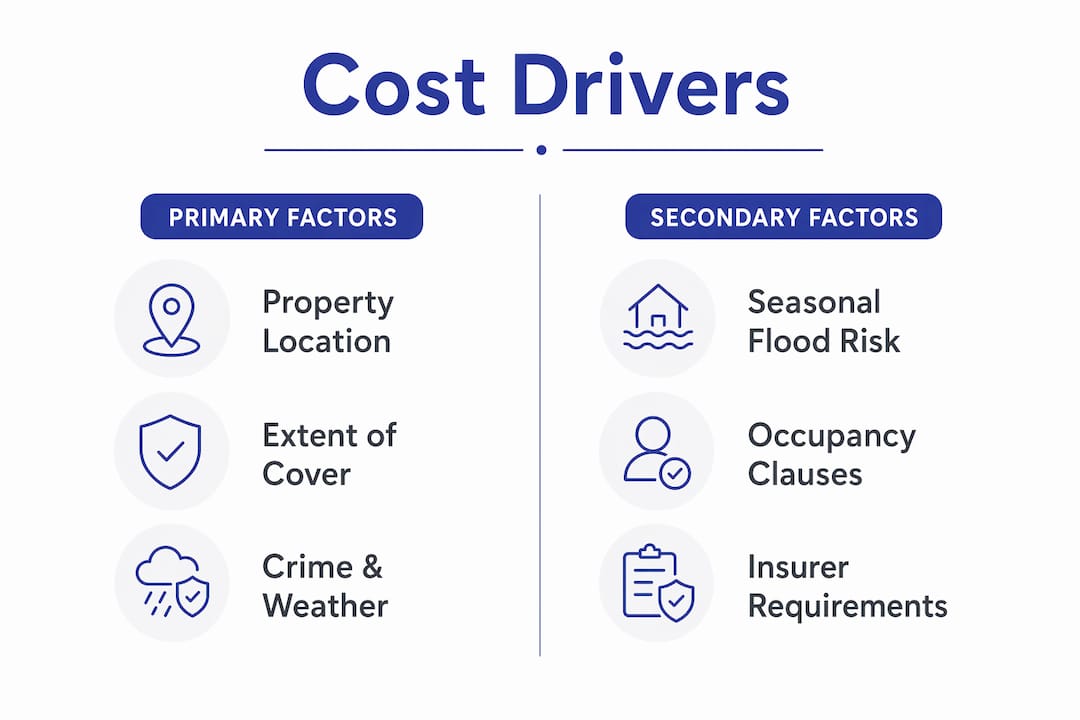
Several factors shape your premium: property location, extent of cover, crime and weather exposure, and your rental income amount. Understanding each one helps you present your property accurately and avoid surprise exclusions.
| Cost driver | How it affects your premium |
|---|---|
| Property location | High-crime or flood-prone areas attract higher premiums |
| Monthly rental amount | Higher rent means a larger potential claim, so premiums rise |
| Tenant profile and vetting | Formally screened tenants reduce perceived risk |
| Cover type | Rental income only vs. combined building and liability cover |
| Waiting period and excess | Longer waiting periods and higher excesses lower premiums |
| Cover limit (months of rent) | More months insured means a higher premium |
| Security measures | Alarm systems and burglar bars can reduce your rate |
| Claims history | Prior claims signal higher risk to underwriters |
| Number of properties | Multi-property portfolios may attract volume discounts |
Secondary factors include seasonal flood risk, minimum-occupancy clauses, and whether the insurer requires the landlord to have previously resided at the property before certain claims are valid.
Pro Tip: Before requesting any quote, run a quick risk-factor check: note your suburb’s crime rating, list your security features, confirm your tenant’s vetting status, and decide your preferred excess and waiting period. Arriving at a quote conversation with this information cuts delays and reduces the chance of a declined claim later. Tailoring cover to your property’s specific risks is what separates a policy that pays out from one that does not; learn more about how to adapt your homeowner’s insurance to a changing environment.
How do insurers price cover, and what will you actually pay?
Insurers use three common pricing models: a fixed monthly premium, a percentage of monthly rental income, or a tiered premium scaled by the number of months of rent insured. Each produces a different result at different rent levels.
The three models explained:
- Fixed monthly premium: a flat fee regardless of rent level, typically suited to lower-value properties. Simple to budget, but may underinsure a high-rent property.
- Percentage of monthly rent: the premium is calculated as a percentage of your rental income. As rent rises, so does the premium and, proportionally, the cover.
- Tiered by months of rent insured: you choose how many months of lost rent the policy covers (e.g. three or six months), and the premium scales accordingly.
Worked examples using a percentage-of-rent model:
| Monthly rent | Indicative premium rate | Estimated monthly premium | Annual premium |
|---|---|---|---|
| — | percentage of rent | R150 | — |
| — | percentage of rent | — | — |
| — | percentage of rent | — | — |

Note: rates are illustrative. Your actual rate depends on location, cover limits, waiting period, and insurer underwriting rules. Always request a quote with your exact rent figure.
Simple formula: Monthly premium = Monthly rent × Insurer’s rate (%). For a tiered model, multiply the monthly rent by the number of months insured to get your cover limit, then apply the insurer’s rate to that limit.
To make quotes comparable across insurers, always request them on the same cover limit, the same waiting period, and the same excess. Comparing a three-month cover policy against a six-month one at different excesses tells you nothing useful.
What does rental income insurance cover, and what does it exclude?
Standard homeowners policies exclude tenant-related risks and rental income losses. Specialist landlord cover is designed to fill exactly those gaps.
Typical inclusions:
- Unpaid rent for the number of months specified in the policy
- Early lease termination by the tenant
- Tenant absconding without notice
- Legal costs for eviction or debt recovery (where included in the policy)
- Rental income lost while the property is uninhabitable following an insured peril such as fire or flood
Common exclusions to watch for:
- Pre-existing damage or wear and tear
- Deliberate tenant damage (often limited or excluded)
- Claims arising before the waiting period has elapsed
- Properties where the landlord has not met a minimum prior-residency requirement
- Tenants who were not formally vetted or referenced before occupation
Example claim scenario: A tenant stops paying rent in month one of a three-month cover policy with a two-month waiting period. The insurer will not pay until two full months of non-payment are confirmed. The landlord must provide a signed lease, bank statements showing missed payments, and proof that a formal demand or legal notice was issued. Once documentation is submitted, assessment typically takes two to four weeks, with payment following shortly after approval. Understanding how tenant non-payment cover works before you sign a policy prevents this kind of surprise.
How to get an accurate quote in South Africa
Preparation makes the difference between a fast, accurate quote and a frustrating back-and-forth. Gather the following before you contact any insurer or broker.
Quote checklist:
- Exact monthly rental amount
- Copy of the current signed lease agreement
- Tenant ID and formal vetting or credit-check results
- Property address and suburb crime-rating awareness
- List of installed security measures (alarm, burglar bars, electric fence)
- Your recent claims history (past three years)
- Preferred waiting period and excess amount
Questions to ask every insurer:
- Is cover measured in months of rent or a fixed rand amount?
- How many consecutive missed payments trigger a payout?
- Are there minimum-tenancy or landlord-residency clauses?
- How are legal costs handled — included, capped, or excluded?
- What is the excess, and does it apply per claim or per policy period?
- What documentation is required to open a claim?
Checking insurance basics for rental agents and landlords before your quote call gives you the vocabulary to ask the right questions and spot vague policy wording early.
Practical ways to lower your premium without losing cover
Reducing your premium is not about buying less cover. It is about presenting a lower-risk property to the insurer.
- Install a monitored alarm system and burglar bars — these two measures together tend to carry more weight with underwriters than CCTV alone.
- Use a formal tenant vetting and credit-referencing service before every tenancy.
- Bundle multiple properties under one policy where the insurer offers volume pricing.
- Accept a higher excess or a longer waiting period to reduce the monthly premium, but calculate the out-of-pocket exposure before agreeing.
- Maintain detailed maintenance records; a well-documented property signals lower structural risk.
- Keep your lease agreement watertight — a complete lease agreement with clear payment terms and breach clauses supports faster claims.
Pro Tip: The most cost-effective security combination for most South African insurers is a SAIDSA-compliant alarm linked to an armed-response company, combined with burglar bars on all accessible windows. CCTV alone rarely moves the premium needle. Pair that with a formal tenant credit check and you address the two biggest risk signals underwriters look for.
The trade-off is real: a longer waiting period or higher excess lowers your monthly cost but raises your exposure if a claim arises early in the policy period. Choose the level you can genuinely absorb.
How does a claim for unpaid rent actually proceed?
Knowing the process before you need it means you collect the right evidence from day one.
- Incident occurs: tenant misses a rental payment. Note the date immediately.
- Notify your insurer: most policies require notification within a specified number of days of the first missed payment. Late notification is one of the most common reasons claims are declined.
- Collect evidence: signed lease, rent ledger or statements, bank records showing non-payment, copies of written demands or legal notices sent to the tenant.
- Insurer assessment: the insurer reviews documentation and confirms the waiting period has been met. This typically takes two to four weeks.
- Payout: approved claims are settled within the timeframe stated in the policy, usually within 30 days of approval.
Common reasons claims are denied:
- Notification given too late after the first missed payment
- Lease agreement missing key clauses (payment terms, breach provisions)
- Waiting period not yet elapsed at the time of claim
- Homeowners policy used instead of a specialist rental income protection policy
- Tenant was not formally vetted before occupation
Some insurers require two or more months of missed payments before a claim becomes payable, and some require the landlord to have previously resided at the property. Read the trigger conditions in the policy wording before you sign.
How much cover do you actually need?
Work through this short calculation to set a sensible cover limit.
- List your fixed monthly costs: bond repayment, rates and taxes, levies, property management fees.
- Total those costs: this is the minimum monthly shortfall if rent stops.
- Decide your financial buffer: how many months of that shortfall could you absorb from savings before it creates serious strain?
- Set your cover limit: the number of months beyond your buffer is the minimum cover you need.
| Scenario | Monthly rent | Fixed costs | Buffer (months) | Recommended cover limit |
|---|---|---|---|---|
| Landlord with bond, no savings buffer | — | — | 0 | 3–6 months |
| Landlord with bond, 1-month savings | — | — | 1 | 2–4 months |
| Landlord, no bond, some savings | — | — | 2 | 1–3 months |
Underinsuring is a real risk. If your policy covers three months of rent but the eviction process takes five, you carry the shortfall personally. Choosing the right cover limit for your specific financial position is worth the extra few minutes of calculation.
Why Rentalincomeinsurance is built for South African landlords
Rentalincomeinsurance specialises in protecting landlords against the three risks that matter most: tenant non-payment, early lease termination, and absconding. Here is what that means in practice:
- Cover designed around South African lease law and eviction timelines
- Policies measured in months of rent, so your cover scales with your income
- Support through the claims process, from first missed payment to payout
- Early lease termination cover protecting two to three months of rent when a tenant breaks their lease
To get started, request a tailored quote with your exact monthly rent and lease details. The quote process is straightforward, and having your lease, tenant vetting results, and security details ready will speed things up considerably.
Watch this short overview to see how rental income protection works in practice:

Key takeaways
Specialist rental income insurance in South Africa typically costs a moderate monthly amount that varies depending on your property, cover limits, and insurer. On average, landlord policies cost about 20% more than standard homeowners insurance for the same home when owner-occupied. The right cover limit depends on your fixed costs, bond obligations, and how many months of lost rent you can absorb without financial strain.
| Point | Details |
|---|---|
| Typical monthly cost | Landlord policies cost about 20% more than equivalent owner-occupied homeowners cover for the same property. |
| Primary cost drivers | Location, monthly rent, tenant vetting, waiting period, and excess all shift your premium. |
| Compare on identical terms | Always request quotes on the same cover limit, waiting period, and excess to compare fairly. |
| Cover limit calculation | Add up fixed monthly costs, assess your buffer, and insure the gap you cannot absorb. |
| Rentalincomeinsurance | Offers specialist cover for tenant non-payment, early lease termination, and absconding — request a quote with your exact rent figure. |
Why specialist cover matters more than most landlords realise
Most landlords discover the limits of a standard homeowners policy only when a claim is declined. The policy wording that excludes tenant-related losses is rarely highlighted at point of sale, and by the time a tenant stops paying, it is too late to switch. What strikes me about the South African rental market specifically is how long the formal eviction process can take, often several months, which means the gap between a tenant’s first missed payment and a landlord recovering possession is precisely where financial damage accumulates. A specialist rental income policy is not a luxury for high-value properties; it is the only product designed to cover that specific window. The waiting period and trigger conditions in the policy wording are where most landlords get caught out, not the premium itself. Read those clauses before you sign, not after.
Useful South African sources and further reading
When checking policy wording, these sources are worth bookmarking:
- PrivateProperty landlord insurance guide: covers pricing models, waiting periods, and trigger conditions in plain language. Check the section on minimum non-payment months before comparing policies.
- Auto & General building insurance guide for landlords: explains how to tailor building cover to a rental property’s specific risk profile, including natural perils and structural add-ons.
- Mzansibaze landlord insurance overview: useful for understanding the gap between homeowners and landlord policies, and for a plain-language explanation of rental income cover triggers.
- Rentalincomeinsurance exclusions guide: the most practical starting point for understanding what is not covered and why claims are commonly declined.
For template documents, a signed lease with clear payment terms and a rent ledger are the two most commonly requested items in a claim. Lease agreement essentials and a simple spreadsheet rent ledger cover both requirements.
Rentalincomeinsurance: specialist cover for South African landlords
Losing rental income to a non-paying or absconding tenant is one of the most financially damaging things that can happen to a landlord, and a standard homeowners policy will not help. Rentalincomeinsurance is built specifically for this situation, covering tenant non-payment, early lease termination, and absconding under one specialist policy designed for the South African rental market.
If you own one rental property or several, the starting point is a quote based on your actual monthly rent. Request your tailored quote today and have your lease, tenant vetting results, and security details ready. Cover can be in place sooner than you might expect, and the peace of mind that comes with it is worth every rand of the premium.