
TL;DR:
- Rental income insurance claims in South Africa split into Loss of Rent and Rent Guarantee types, each requiring different evidence. Proper documentation, timely notification, and understanding insurer verification processes are essential for successful claims. Prevention through thorough tenant screening and record-keeping can reduce risks and improve claim outcomes.
A rental income insurance claim in South Africa follows one of two distinct paths: a Loss of Rent claim (triggered when property damage makes your unit uninhabitable) or a Rent Guarantee/Indemnity claim (triggered when a tenant defaults on payment). Both claim types protect you as the landlord, but they require different evidence and follow different processes.
Quick reference:
- Loss of Rent: You need proof of an insured event (fire, storm, burst pipe), evidence the unit is uninhabitable, inspection reports, and contractor invoices.
- Rent Guarantee/Indemnity: You need a valid signed lease, a rent ledger showing non-payment, formal written demand letters, and proof of the tenant’s default.
Verdict: Claiming makes practical sense when your loss is material, the peril is covered under your policy wording, or tenant default has persisted long enough to exceed your waiting period and policy excess. For minor shortfalls, absorbing the loss and protecting your claims record is often the wiser call.
Table of Contents
- What triggers a rental income insurance claim in South Africa?
- How do you file a rental income insurance claim step by step?
- What do insurers verify and how are payouts calculated?
- Common exclusions and red flags that lead to claim denial
- What is the typical timeline for a claim in South Africa?
- Practical steps to strengthen claims and reduce rental income risk
- How Rentalincomeinsurance helps South African landlords
- Key takeaways
- Why landlords should treat claims as a process, not a shortcut
- Protect your rental income with Rentalincomeinsurance
- Useful South African sources for landlords making a claim
What triggers a rental income insurance claim in South Africa?
Rental income insurance draws a clear line between two types of insured events, and knowing which side your situation falls on determines everything that follows.
Loss of Rent triggers arise from physical damage to the property itself. A fire, storm, burst geyser, or burst pipe that floods a unit and renders it unliveable will activate this cover. The key test is uninhabitability: the tenant cannot legally or safely occupy the property during the repair period. Loss of Rent cover typically sits inside a comprehensive landlord or building policy rather than as a standalone product.
Rent Guarantee/Indemnity triggers are entirely separate. Here, the property is intact but the tenant has stopped paying. Non-payment, abandonment, or a proven inability to pay are the common triggers. Some providers also require that the tenant met specific eligibility criteria (such as a credit check) at the time the lease was signed before they will offer this cover. Rent Guarantee is often sold as a standalone product or an add-on to a landlord policy.
- Example A: A burst geyser floods your flat and the tenant moves out during repairs. You claim under Loss of Rent.
- Example B: Your tenant stops paying for three consecutive months and ignores demand letters. You claim under Rent Guarantee/Indemnity (if your policy includes it).
How do you file a rental income insurance claim step by step?
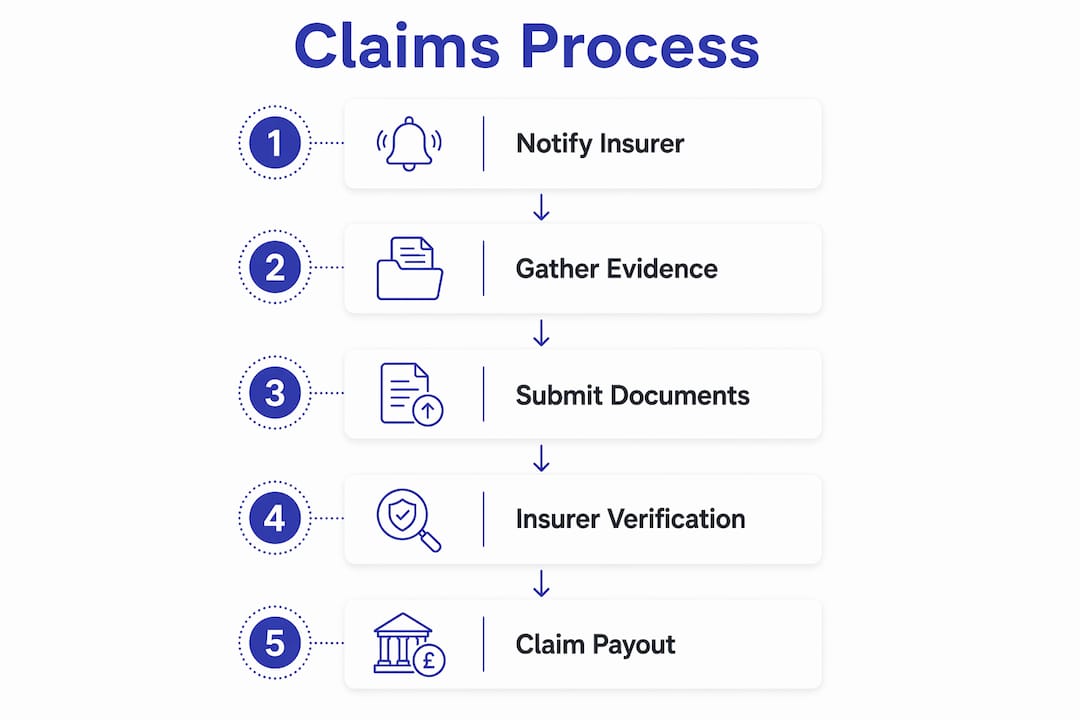
Speed and accuracy at the start of a claim directly affect how quickly you receive a settlement. Follow this sequence.
After a damage event
- Secure the property to prevent further loss — board up broken windows, shut off water at the mains, and remove valuables if safe to do so.
- Photograph and timestamp all damage before any repairs begin. Use a smartphone with location data enabled.
- Obtain at least one contractor quote for repairs as soon as possible.
- Notify your insurer within the notification window stated in your policy. Some insurers require notification within 30 days of the event; missing this window can result in rejection.
- File a police report within 24 hours if the damage involves theft, malicious damage, or bodily injury.
After discovering tenant non-payment
- Issue a formal written demand to the tenant immediately. Keep a copy with a date stamp.
- Update your rent ledger to reflect every missed payment with dates.
- Preserve all bank statements showing the absence of rental deposits.
- Retain the signed lease and all tenant contact records.
- Lodge the claim via your insurer’s online portal, banking app, or phone line.
Documents checklist
| Document | Loss of Rent claim | Rent Guarantee/Indemnity claim |
|---|---|---|
| Signed lease agreement | Required | Required |
| Rent ledger / bank statements | Supporting | Required |
| Formal demand letters | Not applicable | Required |
| Inspection report / photos | Required | Supporting |
| Contractor repair invoices | Required | Not applicable |
| Police report (theft/malicious damage) | Required where applicable | Not applicable |
| Proof of uninhabitability | Required | Not applicable |
Pro Tip: Create a dated digital claim pack from day one. A single folder containing timestamped photos, contractor quotes, demand letters, and your rent ledger will cut an adjuster’s assessment time significantly and reduce back-and-forth requests.
What do insurers verify and how are payouts calculated?
An adjuster will work through a structured checklist before authorising any settlement. Understanding their process helps you set realistic expectations.
What insurers verify:
- Proof the insured event actually occurred (inspection report, photos, weather data for storm claims)
- Proof the tenant was legally occupying the property under a valid lease
- Payment history showing the rent amount and any arrears prior to the event
- Evidence you took reasonable steps to mitigate further loss
- Contractor invoices confirming the repair scope and cost
- Compliance with the notification window in your policy
Payout calculation factors:
| Factor | What it means | Evidence required |
|---|---|---|
| Insured rent amount | The monthly rent stated in your policy endorsement | Policy schedule, signed lease |
| Waiting period | The period before benefit payments begin | Policy wording |
| Policy limit / cap | Maximum months or rand value the insurer will pay | Policy schedule |
| Excess / deductible | Your share of the loss, payable before repairs begin | Policy schedule |
| Mitigation credit | Reduction if you failed to limit further loss | Adjuster assessment |
Worked example (generic figures): Suppose your insured rent is a fixed monthly amount, your policy has a waiting period, a cap on the number of months covered, and an excess amount payable before repairs begin. Repairs take longer than the waiting period and cap, so the insurer pays for the covered months less the excess, resulting in your net settlement. Some Rent Guarantee products also include legal costs for eviction and rent recovery, which can meaningfully offset your total out-of-pocket expense.
Common exclusions and red flags that lead to claim denial
Knowing what insurers will not pay for is as useful as knowing what they will.
Frequent exclusions:
- Pre-existing rent arrears at the time the policy was taken out
- Wear and tear or maintenance failures (a leaking roof that was never repaired, for example)
- Earthquakes, floods, and other perils that are specifically excluded in the policy document
- Wilful acts by the landlord that caused or contributed to the loss
- Invalid, unsigned, or undisclosed tenancy arrangements
- Tenant default that began before the policy’s inception date
Red flags that trigger closer scrutiny:
- Late notification of the insured event
- Missing police report for theft or malicious damage
- Inconsistent records between your lease, rent ledger, and bank statements
- No evidence of formal demand letters before lodging a default claim
- Failure to mitigate damage (for example, leaving a burst pipe unrepaired for weeks)
One practical note: if the potential payout is only marginally above your excess, weigh the impact on your future premium before filing. Small claims can affect your renewal terms more than the settlement is worth.
What is the typical timeline for a claim in South Africa?
Processing times vary by insurer and claim complexity, but you can expect a broadly consistent sequence.
- Notification window: Typically within 30 days of the insured event per most policy wordings; theft and malicious damage often require a police report within 24 hours.
- Adjuster visit: Usually scheduled within a few business days of lodging a damage claim; remote assessment via photos and documents is increasingly common for straightforward cases.
- Decision window: Insurers are expected to communicate a decision or request further information within a reasonable period; complex claims may take several weeks.
- Benefit commencement: For Loss of Rent, payments typically begin after the waiting period stated in your policy. For Rent Guarantee, the waiting period often starts from the date of the first missed payment or the date of formal demand.
If your claim is declined or stalls, South Africa’s escalation path is clear. Start with your insurer’s internal dispute resolution process — the insurer must provide a written reason for any rejection. If that fails, escalate to the Ombudsman for Short-term Insurance (OSI), which handles complaints against short-term insurers at no cost to you. The Financial Sector Conduct Authority (FSCA) provides regulatory oversight and guidance for broader conduct complaints. Keep all written correspondence with your insurer, as this documentation is critical if you escalate.
Practical steps to strengthen claims and reduce rental income risk
Prevention and preparation are the two levers that most reliably improve claim outcomes.
- Screen tenants thoroughly before signing a lease. Identity verification, a credit bureau check, employment confirmation, and references reduce the probability of default significantly. Our tenant screening guide outlines the key steps for South African landlords.
- Use a properly drafted lease that includes the insured rent amount, payment dates, and a clear default clause. Review our lease agreement essentials to confirm yours covers the required elements.
- Conduct a move-in inspection with photos, a written inventory, and signatures from both parties. This becomes your baseline for any future damage claim.
- Maintain a monthly rent ledger regardless of whether payments are received. A clean, consistent record is one of the most persuasive documents you can submit to an adjuster.
- Confirm your policy endorsement reflects the current insured rent amount. If you have increased rent since inception, update the endorsement or your payout will be calculated on the lower figure.
- Compile a claim pack immediately after any event. Gather photos, quotes, demand letters, and correspondence in one dated folder before lodging.
How Rentalincomeinsurance helps South African landlords
Rental income protection from Rentalincomeinsurance is designed specifically around the risks South African landlords face: tenant non-payment, early lease termination, and absconding. Cover typically addresses the income gap that arises when a tenant defaults or vacates without notice, giving you a financial buffer while you pursue recovery or find a replacement tenant.
Before buying any rental income cover, ask your provider:
- Does the policy include legal costs for eviction and rent recovery proceedings?
- What is the waiting period before benefits commence?
- How is the insured rent amount calculated and when must it be updated?
- Are floods and earthquakes excluded, and under what conditions?
- What is the claim notification window and what happens if I miss it?
- What evidence must I submit for a tenant-default claim specifically?
These questions will surface the differences between products quickly and help you choose cover that actually pays when you need it. Whether you are protecting a single flat or a portfolio of properties, the right policy wording makes the difference between a settled claim and a rejected one.
Key takeaways
A successful rental income insurance claim depends on matching the right claim type to the right evidence from the moment an event occurs.
| Point | Details |
|---|---|
| Two distinct claim types | Loss of Rent requires proof of damage and uninhabitability; Rent Guarantee requires a valid lease and proof of default. |
| Notification deadlines matter | Missing your insurer’s notification window (often 30 days, 24 hours for theft) is one of the most common causes of rejection. |
| Excess reduces your payout | The policy excess is deducted from your settlement and is typically payable before repairs begin. |
| Exclusions are policy-specific | Floods, earthquakes, pre-existing arrears, and wear and tear are commonly excluded; always read the policy document. |
| Rentalincomeinsurance covers the key risks | Rentalincomeinsurance provides cover for tenant non-payment, early lease termination, and absconding for South African landlords. |
Why landlords should treat claims as a process, not a shortcut
The landlords who struggle most with claims are those who treat the process as something that happens to them rather than something they actively manage. A claim is not a form you fill in after the fact. It is the culmination of every record you kept, every demand letter you sent, and every mitigation step you took from the moment the problem arose.

The most common mistake is waiting too long to notify the insurer, either because the landlord hopes the situation will resolve itself or because they are unsure whether the loss is worth claiming. Both instincts are understandable, but both can be costly. Notification deadlines are contractual, not advisory.
The longer view matters too. Your relationship with your insurer is a long-term one. Submitting well-documented, legitimate claims builds a track record that works in your favour at renewal. Submitting poorly evidenced claims, or claiming for losses that fall just above the excess, does the opposite. Treat your insurer as a professional partner, keep your records clean, and the process becomes far less stressful when you genuinely need it.
Protect your rental income with Rentalincomeinsurance

If you are a South African landlord and tenant non-payment, early lease termination, or absconding is keeping you up at night, Rentalincomeinsurance offers cover built around exactly those risks. We give you the financial protection and peace of mind to manage your property with confidence, knowing your income is not entirely at the mercy of a single tenant’s circumstances.
Request a quote today to see what cover is available for your property, or visit Rentalincomeinsurance to explore the full range of products. Getting started takes minutes and could save you months of lost income.
Watch our short overview to see how rental income protection works in practice:
Useful South African sources for landlords making a claim
When lodging, following up, or appealing a claim, these resources are worth bookmarking.
- Ombudsman for Short-term Insurance (OSI): The first port of call if your insurer rejects a claim and internal dispute resolution has not resolved the matter. The OSI handles complaints at no cost to the policyholder.
- Financial Sector Conduct Authority (FSCA): South Africa’s market conduct regulator for financial institutions, including short-term insurers. Useful for understanding your rights and lodging conduct complaints.
- South African Police Service (SAPS): File a police report for theft, malicious damage, or bodily injury. Most insurers require this within 24 hours of the incident.
- What does renters insurance cover?: A useful general primer on the types of insured events that activate loss of rent style cover in practice.
- Your insurer’s policy document: Always the primary reference for notification windows, excess amounts, and exclusions specific to your cover.
Keep a local contact list ready: your insurer’s claims line, a preferred contractor for emergency repairs, your adjuster’s direct number, and a legal adviser familiar with the Rental Housing Act. Having these to hand before an event occurs means you can act within the critical first 24 hours rather than spending that time searching.
This article is general information for South African landlords and does not constitute legal, financial, or insurance advice. Confirm the specific terms of your policy and your legal obligations with a qualified professional or your insurer directly.
Recommended
- Insurance claims explained: guide for South African landlords – Rental Income Insurance
- Explaining direct loss insurance for SA landlords – Rental Income Insurance
- Claim Rental Insurance Process: Step-by-Step for Landlords
- What Is Claims Process for Landlords: Step-by-step Guide – Rental Income Insurance