
Whether it feels “more expensive” depends entirely on which pricing model your insurer uses and how much risk sits behind your specific property. Most providers charge either a percentage of monthly rent or a fixed monthly fee, and that 2% to 5% band is the benchmark worth comparing every quote against. On a R10,000 monthly rent, that works out to roughly R200 to R500 a month, a modest premium set against months of lost income if a tenant stops paying.
Key Takeaways
| Point | Details |
|---|---|
| Cost verdict | Premiums typically run 2% to 5% of monthly rent, cheap compared with the cost of even one missed month. |
| Main cost drivers | Location risk, tenant vetting quality, cover limits, waiting periods and claims history all shift your quote. |
| Action one | Document tenant vetting (credit checks, payslips, references) to qualify for better underwriting rates. |
| Action two | Compare quotes using the same checklist: waiting period, missed-month rule, excess and legal-cost limits. |
| Next step | Request a quote from Rentalincomeinsurance and compare terms before committing. |
Table of Contents
- What does rental income insurance actually cover?
- How do insurers price rental income cover?
- What factors push your premium up or down?
- Which small-print terms decide if you actually get paid?
- How can you bring your premium down?
- Is rental income insurance worth the cost?
- What should you ask before choosing a policy?
- Our take on balancing cost against protection
- How Rental Income Insurance can protect what you’re already earning
- Sources
What does rental income insurance actually cover?
We use “rental income insurance” here to mean cover for lost rent, not a policy for your building’s bricks and mortar. It pays out when a tenant stops paying, breaks the lease early, disappears without notice, or when your unit sits empty during essential repairs. This is a distinct product from the physical damage or liability cover many landlords already carry, and mixing the two up is the most common reason people misjudge what they’re paying for.
Typical policies pay out for:
- Tenant non-payment of rent, once any waiting period has passed
- Early lease termination, where a tenant vacates before the fixed term ends
- Tenant absconding, leaving the property without warning or a forwarding address
- Loss of rent while the property is uninhabitable during repairs
- Legal costs tied to eviction proceedings, where the policy includes this
Picture a landlord in Gauteng renting a two-bedroom flat for R12,000 a month. The tenant stops paying in month three, and it takes six weeks to secure an eviction order. Rental income cover with rent-loss protection would pay the missed rent from the point the waiting period ends, plus contribute towards the legal fees for the eviction, turning a potential R30,000+ loss into a manageable excess payment.
How do insurers price rental income cover?
Three pricing structures dominate the South African market, and each suits a different kind of landlord. The most common approach ties your premium directly to your rent roll: the more you charge tenants, the more you pay for cover, but the payout scales with it too. Fixed monthly fees suit landlords who want a predictable line item regardless of rent fluctuations, while tiered packages cap both the premium and the maximum payout, appealing to those managing several units under one policy.
| Pricing model | How it’s calculated | Best suited to | Typical range |
|---|---|---|---|
| Percentage of rent | A set percentage of monthly rental income | Landlords with one or two properties wanting cover that scales with rent | 2% to 5% of monthly rent |
| Fixed monthly fee | A flat rand amount regardless of rent level | Landlords wanting predictable budgeting across properties of different values | Varies by insurer, often bundled with excess options |
| Tiered/packaged cover | A set fee per tier, with capped payout months and legal-cost limits | Portfolio landlords wanting simplicity across multiple units | Tier price plus capped payout months |
Run the numbers on a R15,000 monthly rent. At 3%, you’re paying R450 a month, or R5,400 a year. Add an excess of one week’s rent per claim, and the maths still favours the policy holder heavily against even a single month of unpaid rent plus legal fees.
What factors push your premium up or down?
Underwriters price these policies much like any other risk product: they look at exposure and history before quoting a number. A handful of variables explain why two landlords with similar properties can receive very different quotes.
- Location and area risk: properties in higher-crime or economically volatile areas tend to attract higher premiums because default and vacancy risk rise with them
- Tenant risk profile: insurers often ask about credit checks, references and employment verification before quoting, since a poorly vetted tenant raises the odds of a claim
- Cover limits and waiting periods: higher payout caps and shorter waiting periods both push the premium up
- Claims history: a landlord who has claimed multiple times in recent years usually pays more at renewal
- Property type and portfolio size: single dwellings versus multi-unit blocks carry different risk weightings, and insuring several properties under one policy can shift pricing either way
- Included legal-expense cover: bundling eviction legal costs into the policy adds to the premium but removes a separate, often larger, expense later
Pro Tip: Insurers increasingly reward documented tenant vetting with better rates. Landlords who can show a credit check, payslips and prior landlord references on file often qualify for improved premiums, because that paperwork demonstrably lowers the insurer’s own risk.
Which small-print terms decide if you actually get paid?
The premium is only half the story. The terms buried in the policy document decide whether a claim pays out in full, partially, or not at all, and this is where many landlords get caught out.
Waiting periods and residency rules. Many policies require the tenant to have lived in the property for a set period, commonly three months, before a claim becomes eligible. A tenant who defaults in month two of a brand-new lease may not be covered at all under this kind of rule.

Minimum missed-month thresholds. Some insurers only trigger a payout once a tenant has missed two consecutive months of rent, not one. Picture a tenant who pays late every month but never quite hits the missed-month threshold; the policy may never pay a cent despite the ongoing cash flow strain.
Caps, limits and excess. Most policies limit payouts to a set number of months, often between three and twelve, and many cap legal-cost contributions separately. Your excess, the amount you carry before the insurer contributes, reduces the payout on every claim, so a policy with a low premium but a high excess may cost more in practice than one priced slightly higher upfront.
Exclusions worth checking. Insufficient or undocumented tenant vetting is a common exclusion trigger, as is tenant insolvency in some policy wordings. Before signing anything, confirm the waiting period in days, the minimum missed-month rule, the excess amount per claim, and whether legal costs sit inside or outside the cover limit.
How can you bring your premium down?
Reducing your premium without gutting your cover comes down to reducing the insurer’s perceived risk, and most of the levers are within your control.
- Screen tenants thoroughly with credit checks, employer verification and prior landlord references before signing a lease
- Ask for longer fixed-term leases where the market allows, since shorter turnover raises vacancy and default exposure
- Bundle multiple properties under a single multi-property policy to access portfolio pricing
- Increase your excess if you can absorb a larger upfront cost per claim, in exchange for a lower monthly premium
- Keep maintenance and inspection records up to date, since a well-maintained property reduces repair-related vacancy claims
- Ask insurers directly about loyalty discounts or reduced rates for renewing without a claims history
Pro Tip: When you ask an insurer how much a discount your vetting practices are worth, be specific about the evidence you can produce: a credit bureau report, three months of payslips, and a signed reference from the tenant’s previous landlord. Insurers price documented proof very differently from a verbal assurance.
There’s a trade-off worth naming honestly. Raising your excess to cut the premium means carrying more of a small claim yourself, and shortening your cover limit to save money means less protection if a dispute drags on for months. Cheaper isn’t automatically better if it leaves a genuine gap exactly when you need the payout.
Is rental income insurance worth the cost?
It’s generally worth buying if you depend on rental income to service a bond, if your area has slower eviction timelines, or if you’ve been burned by a non-paying tenant before. It’s less essential if you hold significant cash reserves and could comfortably absorb two or three months of lost rent without financial strain.
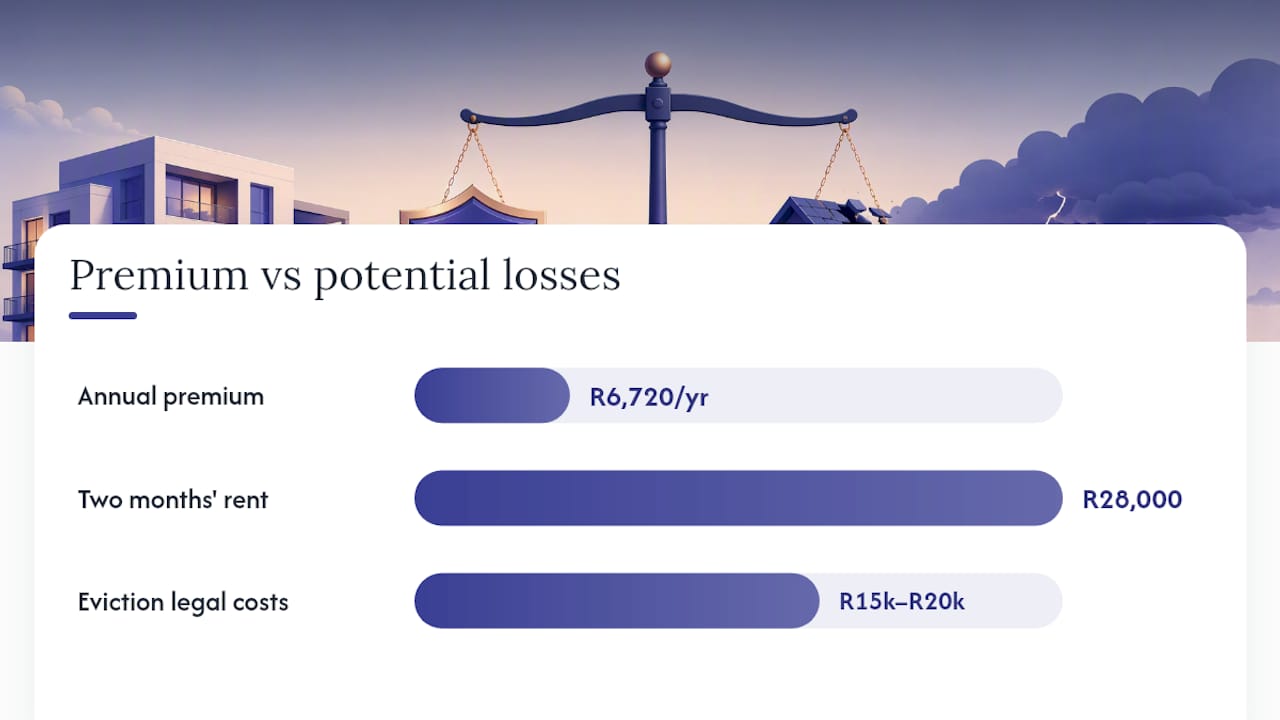
That’s R560 a month, or R6,720 a year. Set that against a realistic worst case: two months of unpaid rent (R28,000) plus an eviction process running R15,000 to R20,000 in legal costs. The annual premium covers a fraction of that potential loss, which is the core argument for buying cover in the first place.
Buy if rental income directly services a mortgage or forms a core part of your monthly budget. Consider it if you own multiple properties and want consistent protection across your portfolio. Skip it if you hold enough reserve cash to comfortably absorb several months of missed rent and legal fees without disruption, and your tenant vetting process is already rigorous enough to keep default risk low.
What should you ask before choosing a policy?
Comparing quotes properly means asking the same set of questions every time, not just checking the headline premium.
- What is the exact waiting period, in days, before a claim becomes eligible?
- How many months of missed rent must occur before payout is triggered?
- What is the maximum number of months the policy will pay out for?
- What excess applies per claim, and does it apply once or every month?
- What tenant vetting documentation do you require to qualify for standard rates?
- Are eviction legal costs included, and if so, up to what limit?
- Is there a discount for insuring more than one property?
Copy these questions into a spreadsheet with one row per insurer and one column per question. Laying quotes out this way makes the real cost, waiting period included, obvious in a way that comparing premiums alone never will.
Our take on balancing cost against protection
At Rentalincomeinsurance, we built our pricing around a simple principle: the premium should never feel like a bigger gamble than the risk it’s covering. We publish our rental income protection guide precisely so landlords can see the maths before they commit, rather than discovering waiting periods and exclusions only after a tenant stops paying. If you’re weighing up whether cover makes sense for your property, requesting a quote costs nothing and gives you a real number to compare against the risk you’re currently carrying unprotected.
This short explainer video walks through how rental income cover works in practice and is worth watching before you compare quotes:
.
How Rental Income Insurance can protect what you’re already earning
There are other ways to manage tenant-payment risk, from stricter vetting processes to holding larger cash reserves, and both have their place. But if you’d rather transfer that risk than self-insure it, Rentalincomeinsurance gives you a straightforward alternative: transparent, percentage-based or fixed-fee pricing with no hidden tiers designed to confuse comparison shopping.

Our cover addresses the exact scenarios landlords worry about most: tenant non-payment, early lease termination, absconding tenants and the legal costs that come with eviction. We support single-property landlords and portfolio owners alike, with multi-property options that simplify cover across several units under one policy. Before you buy anywhere, read our rental income protection guide to see exactly how waiting periods and payout limits work, then request a personalised quote to see what cover would cost for your specific property. Compare it against at least one other quote, confirm the terms line up with what matters to you, and decide from there.
Sources
- Landlord insurance: Protect your rental investment
- Rental Insurance In South Africa – ZABENEFITS
- LANDLORD’S RENTAL INCOME PROTECTION AND ALTERNATIVES EXPLAINED:
This article is general information, not a substitute for advice from a qualified financial advisor. Consult a qualified financial professional about your own circumstances before acting on anything here.