
Rental income insurance in South Africa typically costs between 2% and 5% of your monthly rent, according to industry data. In rand terms, that translates directly into monthly premiums you can estimate right now:
- R6,000 rent → R120–R300 per month
- R8,000 rent → R160–R400 per month
- R10,000 rent → R200–R500 per month
- R15,000 rent → R300–R750 per month
Premiums may be structured as a percentage of rent or as a fixed monthly fee. Either way, most policies require you to meet a waiting period and provide documented proof of missed payments before a claim is paid. For a landlord asking how much is contents insurance for renters in the South African context, the correct product is rental income insurance — cover that protects your income stream, not your tenant’s belongings. The rental income insurance premiums explained guide breaks down the percentage framework in full.
Key takeaways
| Point | Details |
|---|---|
| Typical premium band | 2%–5% of monthly rent; R10,000 rent costs R200–R500 per month. |
| Two pricing models | Percentage-of-rent scales with rent increases; fixed monthly fee suits standardised portfolios. |
| Waiting period matters | Many insurers require two or more missed months before a claim is payable — confirm this before buying. |
| Eviction and legal costs | Always check whether this cover is included; it materially changes the policy’s value. |
| Rentalincomeinsurance | Covers tenant non-payment, early lease termination, and absconding — request a quote with your lease and rent figure ready. |
Table of Contents
- How do insurers calculate your rental income insurance premium?
- What factors push your premium up or down?
- What does rental income insurance cover — and what does it exclude?
- How to estimate your premium quickly
- Worked examples: percentage ranges converted to rand
- How to buy rental income insurance in South Africa
- Common pitfalls and red flags when buying this cover
- Numbers and assumptions used in this article
- Why rental income insurance matters more than most landlords realise
- Rentalincomeinsurance protects your rental income from day one
- Sources
How do insurers calculate your rental income insurance premium?
Two pricing models dominate the South African market, as confirmed by PrivateProperty’s landlord insurance guide.
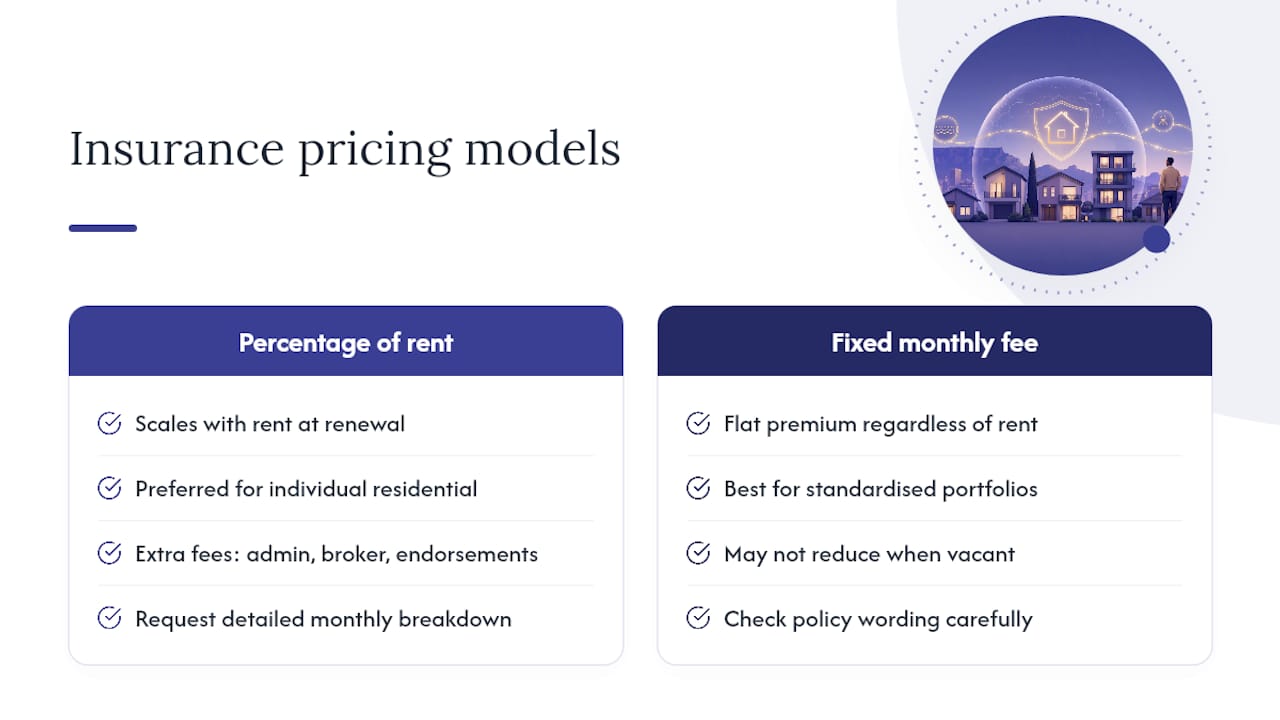
The premium scales automatically if your rent increases at lease renewal, which is why many insurers prefer this structure for individual residential properties.
Fixed monthly fee model. Some insurers offer a flat premium regardless of rent level. This suits landlords with standardised portfolios where rents are similar across multiple units. The trade-off is that the fee may not adjust downward if a unit sits vacant, so check the policy wording carefully.
Beyond the base rate, additional fees such as administration, broker, or endorsements for eviction and legal-cost cover can affect the premium and value, so always confirm this when comparing quotes. A detailed monthly cost breakdown can help you benchmark what you are quoted.
What factors push your premium up or down?
PrivateProperty’s guidance identifies several underwriting variables that directly affect what you pay:
- Property location. High-crime suburbs or areas with frequent flooding attract higher premiums. A well-located property in a low-risk area can sit at the lower end of the 2%–5% band.
- Extent of cover. A policy that includes eviction costs, legal fees, and absconding cover costs more than basic non-payment cover alone.
- Tenant profile. Insurers consider whether you have conducted credit checks and obtained references. A vetted tenant reduces perceived risk.
- Claims history. Previous claims on the same property or portfolio push rates up.
- Security features. Alarm systems, security gates, and access-controlled complexes can support a lower premium.
- Weather and crime exposure. Coastal properties or those in flood-prone areas may carry surcharges.
- Excess level. Choosing a higher voluntary excess lowers the monthly premium but increases your out-of-pocket cost at claim time.
- Waiting period. Policies with shorter waiting periods before a claim is payable tend to carry higher premiums.
Pro Tip: Before requesting a quote, run a free void-cost calculation using a void cost calculator to quantify exactly what several months of unpaid rent would cost you. That figure makes it far easier to decide how much cover and what excess level makes financial sense.
What does rental income insurance cover — and what does it exclude?
Rental income insurance in South Africa typically covers:
- Tenant non-payment of rent, subject to a waiting period and documented proof
- Early lease termination by the tenant before the agreed end date
- Tenant absconding without notice or forwarding address
- Eviction and legal costs (where this endorsement is included in the policy)
Payout conditions matter as much as the cover itself. Industry practice confirms that some insurers only pay after two or more consecutive months of missed rent. You will also need to supply a signed lease, payment records, and written evidence of the missed payments before a claim proceeds.
Common exclusions to check: Policies frequently exclude deliberate tenant damage to the property, short-term arrears that fall within the waiting period, and situations where the landlord delayed initiating recovery action. Caps on the total payout period (for example, a maximum of three or six months’ rent) are standard. Read the rental income protection exclusions page before signing any policy.
Understanding what tenant non-payment means legally and what documentation you need is the single most practical step you can take before a problem arises.
How to estimate your premium quickly
A simple formula gives you a working estimate before you speak to any insurer:
Estimated monthly premium = Monthly rent × Premium rate
Documents and information to gather before requesting a quote
- Current signed lease agreement (informal leases are often rejected)
- Monthly rent amount and any scheduled increases
- Tenant credit-check results or reference letters
- Property address and suburb
- Security features installed (alarm, gates, access control)
- Your claims history on this or other properties
- Desired excess amount
- Preferred cover scope (basic non-payment only, or including eviction/legal costs)
For a fixed-fee quote, provide the same information. The insurer will assess whether the flat fee is viable given your property’s risk profile. A landlord expenses checklist can help you organise these figures alongside your other property costs before the call.
Worked examples: percentage ranges converted to rand
All examples assume no excess and full cover including eviction and legal costs. The “insured loss avoided” column shows six months of unpaid rent as a reference point for value.
At R8,000 rent and a 3% premium, you pay R2,880 per year to protect against a potential R48,000 loss from six months of non-payment plus eviction costs — a ratio that most landlords find straightforward to justify, as noted by the Landlords Association of South Africa. For a full rental property insurance comparison across cover types, the Rentalincomeinsurance site sets out the options clearly.
How to buy rental income insurance in South Africa
Follow these steps to move from estimate to active cover:
- Gather your documents using the checklist in the previous section.
- Decide your cover scope — basic non-payment only, or full cover with eviction and legal costs.
- Choose your excess level — a higher excess reduces the monthly premium but increases your liability at claim time.
- Request quotes in both percentage and fixed-fee formats so you can compare like for like.
- Check waiting periods and exclusions before accepting any quote.
- Complete the application and first payment to activate cover.
GeoAfrika’s industry guidance recommends contacting a reputable insurer directly for an accurate cost estimate, because premiums are property-specific and generic percentages are a starting point, not a final price.
Questions to ask every insurer or broker
- What is the waiting period before a claim is payable?
- Does the policy include eviction and legal costs, or is that an add-on?
- What is the maximum payout period (months of rent covered)?
- What documentation is required to lodge a claim?
- How does the premium change if the rent increases?
- What are the cancellation terms and any short-period penalties?
- Are there any administration or policy fees on top of the base premium?
A guide on how to get renters insurance for your apartment in South Africa walks through the application process step by step if you want a more detailed walkthrough.
Common pitfalls and red flags when buying this cover
- Vague definition of non-payment. If the policy does not specify exactly when non-payment is triggered, you may face disputes at claim time.
- Excessive waiting periods paired with short payout caps. A policy that requires three months of arrears before paying and then caps the payout at two months offers very limited protection.
- Missing eviction and legal-cost cover. Eviction through the courts is expensive. A policy without this endorsement leaves a significant gap.
- Informal or unsigned lease documents. Most insurers will not accept a claim without a properly executed lease. Verbal or WhatsApp agreements are routinely rejected.
- Late notification of arrears. Delays in reporting missed payments to the insurer can void a claim entirely.
- No evidence trail. Keep bank statements, payment reminders, and written correspondence with the tenant from the first missed payment.
Pro Tip: Negotiate the excess versus premium trade-off deliberately. Accepting a higher excess on a property with a reliable, long-term tenant can reduce your monthly premium meaningfully. On a property with a new or unverified tenant, keep the excess low so a claim does not leave you exposed.
Numbers and assumptions used in this article
- The 2%–5% premium band reflects industry practice for rental income insurance in South Africa and is not a guaranteed rate for any specific property.
- All worked examples assume no excess and full cover including eviction and legal costs. Policies with a higher excess or narrower cover scope will produce lower premiums.
- All figures are in South African rand (ZAR).
- Examples cover residential rental properties only. Commercial or mixed-use properties may attract different underwriting criteria.
- The “insured loss avoided” column in the worked examples uses six months of unpaid rent as a reference scenario. Actual losses depend on how quickly eviction proceedings conclude.
- Local underwriting may adjust percentages upward for high-crime suburbs, flood-prone areas, or properties without security features.
- This article covers rental income insurance for landlords. It does not cover tenants’ personal contents insurance, which is a separate product with a different purpose and audience.
Why rental income insurance matters more than most landlords realise
Most landlords I speak with have thought carefully about buildings insurance and bond repayments, but rental income insurance sits lower on the list until the first missed payment arrives. That is the wrong order of priority.
The cashflow maths are unambiguous. Six months of non-payment, plus the legal and court costs of a contested eviction, can easily exceed R70,000. The premium is not a luxury; it is the cost of keeping your investment from becoming a liability.

What I find underappreciated is the documentation discipline that good rental income insurance forces on landlords. To qualify for a claim, you need a signed lease, a paper trail of missed payments, and prompt notification to the insurer. Those habits also make you a better landlord in every other respect: they reduce disputes, support faster eviction proceedings, and give you leverage in any legal process. The insurance, in that sense, pays twice.
The one area where landlords consistently underestimate risk is early lease termination. Non-payment gets the attention, but a tenant who breaks a lease three months in can leave you with a vacant property, re-letting costs, and a gap in income that compounds quickly. Cover for early lease termination is worth including in your policy scope from day one.
Rentalincomeinsurance protects your rental income from day one
Rentalincomeinsurance covers South African landlords against the three risks that most damage rental cashflow: tenant non-payment, early lease termination, and absconding.

To get an accurate quote, have your signed lease, monthly rent figure, tenant references, and property address ready. Then visit the request a quote page to submit your details and receive a premium specific to your property and risk profile. For a fuller explanation of how the cover works, watch the short overview at
or explore the complete rental income protection guide on the Rentalincomeinsurance website.
Sources
- Is Rental Insurance Worth It In South Africa?
- Landlord insurance: Protect your rental investment
- What is Rental Income Insurance? – GeoAfrika
This article is general information, not a substitute for advice from a qualified financial advisor. Consult a qualified financial professional about your own circumstances before acting on anything here.
Recommended
- Rental income insurance cost per month in South Africa – Rental Income Insurance
- Best rental insurance options for landlords – Comparison 2025
- Benefits of Rental Income Insurance for South Africans – Rental Income Insurance
- How much is landlord insurance in South Africa? 2026 guide – Rental Income Insurance