
Rental income protection covers you for lost rent when a tenant stops paying, leaves early, or absconds — and it pays eviction and legal costs while the process runs its course under South African law. This is income-replacement cover, not building or contents insurance.
Core cover lines at a glance:
- ✅ Consecutive missed rental payments (tenant non-payment)
- ✅ Early lease termination by the tenant
- ✅ Tenant abandonment or absconding
- ✅ Eviction and legal costs during the PIE Act process
- ✅ Temporary re-letting shortfalls in some products
South Africa’s Prevention of Illegal Eviction Act (PIE Act) means evictions can take months, sometimes longer. Rental income protection is what keeps your cash flow intact during that period. Landlord Legal subscription schemes and underwritten products from providers such as those reviewed on Fanews both address this risk, though they do so differently.
Key takeaways
Rental income protection is income-replacement cover for South African landlords, paying out for non-payment, early termination, and abandonment while eviction proceeds under the PIE Act.
| Point | Details |
|---|---|
| Core cover lines | Non-payment, early termination, abandonment, and eviction costs up to R40,000 are the standard cover lines. |
| Monthly cap | Most products cap covered rent at R30,000/month for up to three months or until the property is re-let. |
| Typical cost | Premiums run from approximately 5% of monthly rent or a flat R198/month for subscription schemes. |
| Eligibility must-haves | A valid signed lease, tenant screening records, and no existing arrears at policy start are required. |
| Rentalincomeinsurance | Covers non-payment, early termination, and abandonment for qualifying South African landlords. |
Table of Contents
- What does landlord insurance cover you for in South Africa?
- How rental income protection works in South Africa
- What rental income protection normally does not cover
- How much does rental income protection cost in South Africa?
- Underwritten insurance or subscription scheme — what is the difference?
- Who qualifies for rental income protection?
- Step-by-step: what to do when a tenant stops paying
- How to choose the right rental income protection product
- Tax implications of landlord insurance premiums and claim payouts
- Why rental income protection is non-negotiable risk management
- Rentalincomeinsurance covers what matters most to South African landlords
- Sources
What does landlord insurance cover you for in South Africa?
Rental income protection pays out against specific lost-rent events. Here is how each cover line typically works, with the numeric limits common in the South African market.
| Cover line | What is paid | Typical limit |
|---|---|---|
| Tenant non-payment | Monthly rent while tenant is in default | Typically with a cap on monthly rent and limited duration until re-let |
| Early lease termination | Rent for the unexpired portion of the lease | Usually 2–3 months’ rent |
| Abandonment / absconding | Rent from the date of abandonment | Same monthly and duration caps as non-payment |
| Eviction and legal costs | Attorney fees, court costs, process serving | R10,000–R40,000 per event |
| Re-letting shortfall | Difference between old and new rent | Product-specific; not universal |
Market examples show cover caps at R30,000 monthly and eviction-cost cover ranging from R10,000 to R40,000, with premiums from 5% of monthly rent. Legal and tracing expenses during eviction can form a significant share of a landlord’s total outlay, which is why specialist support from partners like Traced is often needed alongside the insurance cover.
Pro Tip: Cover definitions hinge on a valid, signed lease and documented proof of demand. Without both, most products will not pay out — regardless of how clear-cut the default appears.
How rental income protection works in South Africa
The claims process follows a predictable sequence once a tenant misses a payment. Understanding the timeline helps you act quickly and protect your claim.
South Africa’s PIE Act governs how and when a landlord can evict a non-paying tenant. Because the legal process can run for several months, the insurer pays covered rent during that period — functioning, as industry commentary describes it, much like motor insurance pays for a vehicle while repairs proceed.
Typical timeline:
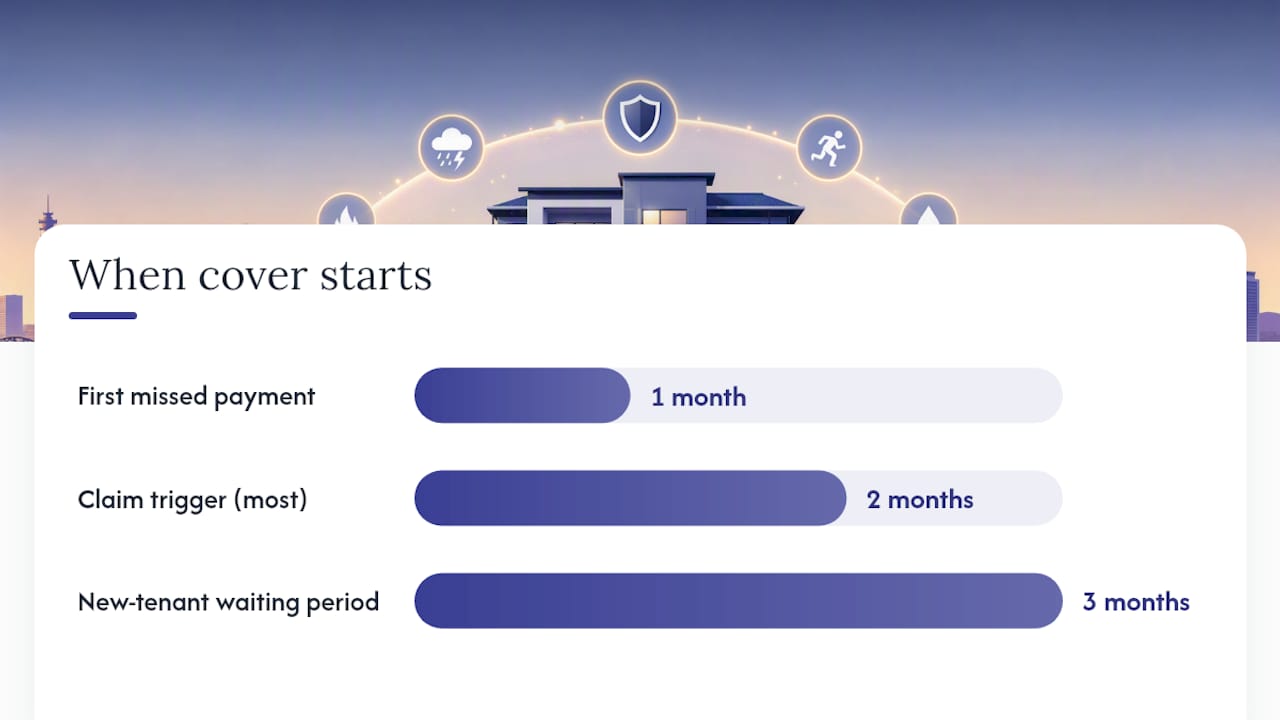
- Month 1: Tenant misses payment. Issue a written letter of demand immediately.
- Month 2: Second consecutive missed payment triggers the claims window for most products.
- Claim lodgement: Submit claim with lease, demand letters, rent statements and screening records.
- Insurer pays: Covered monthly rent continues while eviction proceedings run under the PIE Act.
- Eviction resolved: Legal costs claimed separately up to the policy cap.
Agency mandate and eligibility:
- Many products, including subscription schemes, require a mandated letting agent to lodge the claim on the landlord’s behalf.
- Self-managed landlords may not qualify for certain subscription-based products.
- The tenant’s deposit must usually be applied to arrears before a claim is accepted.
Some schemes carry a three-month waiting period for new tenants, meaning cover does not apply to defaults in the first three months of a new tenancy. Private Property’s market review confirms this is a common feature of subscription legal-protection products.
What rental income protection normally does not cover
Knowing the exclusions is as important as knowing the cover. Common exclusions include:
| Exclusion | Why it matters |
|---|---|
| Existing arrears at policy start | Cover only applies to defaults arising after inception |
| No valid written lease | Claims require a signed, legal lease agreement |
| Deliberate owner actions | Landlord-caused vacancies or forced exits are excluded |
| Rent increases not agreed in advance | Only the insured rent amount is covered |
| Failure to follow eviction law | Non-compliance with the PIE Act can void a claim |
| Deposit not first applied | Tenant deposit must offset arrears before a claim pays |
| Fraudulent landlord applications | Misrepresentation voids the policy |
| Recovered rent after claim settlement | If the tenant later pays, that amount is repayable to the insurer |
For high-rent properties, the R30,000 monthly cap is a practical constraint. A landlord renting at R45,000 per month carries R15,000 of uninsured exposure each month the property is in default.
How much does rental income protection cost in South Africa?
Pricing takes two main shapes in the South African market: a percentage of monthly rent, or a flat monthly subscription.
| Pricing model | Example | Best suited to |
|---|---|---|
| Percentage of rent | ~5% of monthly rent | Landlords with higher-value rentals |
| Flat subscription | R198/month (Landlord Legal example) | Landlords with lower-to-mid-range rentals |
The R198/month subscription is cheaper at that rent level, but may carry different caps and waiting periods.
Factors that affect your premium:
- Declared monthly rent and the cap you select
- Property location and local vacancy risk
- Tenant vetting quality and credit screening records
- Whether a mandated letting agent holds the mandate
- Claims history on the portfolio
- Property type (sectional title, freehold, cluster)
For a full pricing breakdown, the 2026 landlord insurance pricing guide covers how premiums scale across different portfolio sizes.
Pro Tip: If your monthly rent is below R4,000, a flat subscription will almost always be cheaper than a percentage-based premium. Above R10,000, the maths can go either way depending on the caps and waiting periods each product carries.
Underwritten insurance or subscription scheme — what is the difference?
Not every product marketed as “rental income protection” is an underwritten insurance policy. Some are subscription legal-protection schemes that deliver similar outcomes but operate differently.
Underwritten insurance is regulated by the Financial Sector Conduct Authority (FSCA), carries a policy document, and the insurer is contractually obligated to pay valid claims up to the stated limits. If the insurer becomes insolvent, the Policyholder Protection Rules offer some recourse.
Subscription schemes collect a monthly fee and provide legal services and some income-replacement benefits. They are not always regulated as insurance products. Practitioner commentary warns that many subscription schemes are not true underwritten insurance and often require an agency mandate.
Three quick checks before you buy:
- Ask: “Is this product underwritten by a licensed South African insurer?”
- Check whether the provider holds an FSCA licence or operates under a binder agreement.
- Confirm whether claims are paid from an insurance fund or from a subscription pool.
Who qualifies for rental income protection?
Eligibility conditions vary by product, but these are the standard requirements across the South African market.
Eligibility checklist:
- ✅ Valid, signed written lease agreement in place
- ✅ Tenant credit and background screening completed before lease start
- ✅ No existing arrears at the time of policy inception
- ✅ Mandated letting agent holds the mandate (required by some products)
- ✅ Property is a residential rental in South Africa
- ✅ Rent is within the product’s monthly cap (e.g. R30,000)
Documents to keep on file:
- Signed lease agreement
- Tenant screening and credit report
- Proof of demand letters (written, dated)
- Rent payment statements and bank records
- Deposit receipt and deposit account details
- All written communications with the tenant
A valid lease and tenant vetting records are the two prerequisites most commonly cited as reasons for declined claims when they are absent. Keep these documents from day one.
Step-by-step: what to do when a tenant stops paying
Acting quickly and in the right order protects both your claim and your legal position under the PIE Act.
- Issue a written letter of demand on the first day of default. Date it, keep a copy, and send it by registered post or email with read receipt.
- Retain all communications — every message, email, and call log with the tenant from this point forward.
- Check the deposit — confirm the deposit amount held and whether it can be applied to the arrears.
- Notify your insurer or letting agent as soon as the second consecutive payment is missed.
- Submit your claim with: signed lease, demand letters, rent statements, screening report, deposit records and bank statements.
- Instruct eviction attorneys if the tenant remains in occupation. Your policy’s eviction-cost cover applies from this point, up to the stated cap.
- Track insurer response — most products acknowledge claims within a few business days; payment timelines depend on the eviction process under the PIE Act.
If the tenant later pays the outstanding rent after your claim has been settled, that recovered amount is typically repayable to the insurer. Note this in your records from the outset.
How to choose the right rental income protection product
Use these questions when comparing products or subscription schemes.
Key dimensions to compare:
- What events are covered, and are all four core lines included?
- What is the waiting period, and does it apply to existing tenants?
- What is the monthly premium and how does it scale with rent?
- Is an agency mandate required, and do you have one in place?
- What are the monthly and per-claim caps?
- How quickly does the insurer pay once a claim is approved?
Questions to ask providers directly:
- Are legal services in-house or outsourced, and who appoints the attorneys?
- What is the cap on eviction costs, and does it include tracing fees?
- If the tenant pays after settlement, how is the reimbursement calculated?
- Is the product underwritten by a licensed South African insurer?
Red flags to avoid:
- Unclear or absent waiting-period disclosure
- Ambiguous exclusion language around “valid lease” definitions
- No FSCA licence or binder agreement disclosed
- Requirement to use provider-appointed attorneys with no oversight or cost cap
For a side-by-side view of top landlord insurance providers in South Africa, the market overview covers the main product families and their positioning.
Tax implications of landlord insurance premiums and claim payouts
Rental income protection premiums are generally tax-deductible for South African landlords, because they are a cost incurred in the production of rental income. Under the Income Tax Act, expenses directly related to earning rental income can be deducted against that income when completing your annual tax return with SARS.
Claim payouts, however, are treated as income replacement. Because the payout substitutes for rent you would otherwise have declared as taxable income, the amount received is typically included in your gross income for the tax year in which it is received. The same applies to eviction-cost reimbursements that offset expenses you would otherwise have deducted.
Two practical points follow from this. First, keep your premium invoices and proof of payment as part of your rental income records — they are deductible expenses. Second, if you receive a claim payout and subsequently repay part of it to the insurer because the tenant settled arrears, that repayment may reduce the taxable income you originally declared. Confirm the treatment with a registered tax practitioner, as the timing of receipt and repayment across tax years can affect your assessment. SARS guidance on rental income and deductions is available at Sars.
Why rental income protection is non-negotiable risk management
The conventional wisdom among landlords is that a good tenant and a solid deposit are enough protection. They are not. South Africa’s PIE Act means that even a straightforward eviction can take three to six months, and no deposit covers six months of lost rent plus R30,000 in legal fees. The landlords who feel the sharpest pain are not those with bad properties — they are those who assumed the risk was manageable without cover.
What I find most underestimated is the compounding effect: a missed month triggers legal costs, which trigger cash-flow pressure, which can affect bond repayments on the property. Rental income protection breaks that chain at the first link. It does not prevent a bad tenant, but it prevents a bad tenant from becoming a financial crisis.

Pro Tip: Combine tenant credit screening, a deposit equivalent to two months’ rent, and rental income protection as a three-layer defence. Each layer reduces the likelihood of needing the next one — and if you do need the last one, the claim is far easier to substantiate.
Rentalincomeinsurance covers what matters most to South African landlords

Lost rent, early lease exits, and absconding tenants are the three events that cause the most financial damage to South African landlords — and they are precisely what Rentalincomeinsurance is built to cover. Our rental income protection pays out for tenant non-payment, early lease termination, and abandonment, and covers eviction and legal costs for qualifying landlords. You keep your cash flow intact while the PIE Act process runs its course. Getting covered takes minutes. Request a quote today and find out exactly what your rental income is worth protecting.
Sources
Primary sources used in this article:
- Property rental insurance: Peace of mind that your rental income is secure from the risk of defaulting tenants
- As a landlord should you take out ‘renters’ insurance?
- Traced
▶️ Watch:
This article is general information, not a substitute for advice from a qualified financial advisor. Consult a qualified financial professional about your own circumstances before acting on anything here.
Recommended
- How to get landlord insurance in South Africa: 2026 guide – Rental Income Insurance
- Property Owner Insurance Types for Landlords – Rental Income Insurance
- What does renters insurance cover for landlords in SA? – Rental Income Insurance
- Top landlord insurance providers 2025: SA landlords’ guide – Rental Income Insurance