
Many landlords wrongly assume the distinction between residential and commercial rentals hinges solely on tenant type. This costly error exposes property owners to substantial financial and legal risks. Misclassification could cause landlords to lose over R500,000 due to inappropriate income protection. This guide clarifies the critical differences between residential and commercial rental properties in South Africa, empowering you to protect your rental income effectively and make informed insurance decisions.
Table of Contents
- Introduction To Residential And Commercial Rentals In South Africa
- Legal Definitions And Regulatory Framework For Rentals
- Lease Duration, Terms, And Tenant Profiles: Comparing Residential And Commercial Rentals
- Risk Profiles And Income Protection Strategies According To Rental Type
- Common Misconceptions And Clarifications For South African Landlords
- Real-World Examples And Case Studies From South African Rentals
- Applying The Knowledge: Practical Guide For South African Landlords
- Protect Your Rental Income With South Africa’s Leading Insurance Solutions
- Frequently Asked Questions
Key Takeaways
| Point | Details |
|---|---|
| Legal Frameworks Differ | Residential rentals fall under the Rental Housing Act, while commercial properties follow common law and the Consumer Protection Act. |
| Lease Terms Vary Significantly | Residential leases typically run 6-12 months, whereas commercial agreements often span 3-5 years or longer. |
| Risk Profiles Require Tailored Insurance | Commercial properties face 20-30% higher vacancy rates, demanding distinct income protection strategies. |
| Misclassification Triggers Financial Loss | Applying incorrect legal frameworks and insurance products can result in losses exceeding R500,000. |
Introduction to Residential and Commercial Rentals in South Africa
Understanding how South African law categorizes rental properties forms the foundation of effective property management and income protection. The legal distinction between residential and commercial rentals extends far beyond the obvious difference in tenant type.
Residential rentals refer to properties leased primarily for housing purposes. The Rental Housing Act governs these agreements, prioritizing tenant protections such as security of tenure and habitability standards. These properties serve as homes for individuals and families, creating specific legal obligations for landlords around maintenance, notice periods, and tenant rights.
Commercial rental properties in South Africa are defined as leased primarily for business purposes and regulated by common law and the Consumer Protection Act, not the Rental Housing Act. These properties house offices, retail spaces, warehouses, or other business operations. The legal framework governing commercial leases offers greater flexibility in lease structuring but imposes different compliance requirements.
The classification you assign your property directly shapes your legal obligations, lease negotiations, and insurance needs. Consider these fundamental distinctions:
- Residential tenants occupy properties as homes, while commercial tenants operate businesses
- Different regulatory bodies oversee compliance for each rental type
- Insurance products and coverage requirements vary substantially between classifications
- Lease termination procedures and dispute resolution mechanisms differ significantly
Pro Tip: Document your property’s primary use clearly in all agreements to establish the correct legal classification from the outset and avoid future disputes.
Legal Definitions and Regulatory Framework for Rentals
The Rental Housing Act 50 of 1999 forms the cornerstone of residential lease protections in South Africa, establishing mandatory tenant rights around habitability, security of tenure, and dispute resolution. This legislation creates a safety net for tenants while imposing specific maintenance and notice obligations on landlords. You cannot contract out of these protections, they apply universally to residential leases.
Commercial leases operate in a fundamentally different legal environment. Commercial properties follow common law principles and Consumer Protection Act provisions, allowing parties far greater freedom to negotiate terms. Health and safety standards differ markedly, reflecting the diverse nature of business operations versus residential living.
These legal distinctions create practical implications for your daily management responsibilities:
- Residential landlords must maintain properties to strict habitability standards, including functioning plumbing, electrical systems, and structural integrity
- Commercial lease agreements can allocate maintenance responsibilities more flexibly between landlord and tenant
- Eviction procedures follow entirely different timelines and legal requirements depending on rental classification
- Residential tenants enjoy automatic protections regardless of lease wording, while commercial terms rely heavily on contract specifics
The regulatory divide shapes how you formulate leases, handle disputes, and protect your income. Understanding which framework governs your property allows you to structure agreements that comply with applicable laws while maximizing your financial security. For comprehensive guidance on protecting rental income across different property types, explore our rental income security guide.
Misapplying residential protections to commercial situations, or vice versa, exposes you to legal challenges and financial losses. The governing legislation determines your rights, obligations, and available remedies when tenant relationships deteriorate.

Lease Duration, Terms, and Tenant Profiles: Comparing Residential and Commercial Rentals
Lease structure varies dramatically between residential and commercial rentals, directly impacting your income predictability and risk exposure. Residential leases typically run 6-12 months with limited scope for term negotiation due to tenant protection laws. This shorter duration provides flexibility for tenants but creates more frequent turnover risks for landlords.
Commercial leases flip this dynamic entirely. Business tenants commonly commit to 3-5 year agreements, with some arrangements extending beyond 10 years. These longer terms offer landlords greater income stability but require careful tenant vetting, as business failure mid-lease can trigger substantial losses.
| Aspect | Residential Rentals | Commercial Rentals |
|---|---|---|
| Typical Duration | 6-12 months | 3-5+ years |
| Tenant Type | Households, individuals | Businesses, corporations |
| Negotiation Flexibility | Limited by regulation | Extensive contract freedom |
| Early Termination | Strict notice requirements | Negotiable penalties |
| Renewal Terms | Month-to-month common | Multi-year options typical |
Tenant profiles shape lease negotiations fundamentally. Residential tenants prioritize living conditions, location convenience, and affordability. Commercial tenants evaluate properties based on business viability, foot traffic, zoning regulations, and potential for revenue generation. This distinction influences everything from deposit amounts to permitted property modifications.
Commercial agreements allow you to negotiate terms reflecting specific business risks. You might structure escalation clauses tied to inflation, require personal guarantees from business owners, or include revenue-sharing arrangements. These options rarely exist in residential contexts due to protective legislation. Understanding your rental agreement protection options helps you structure contracts that balance flexibility with income security.
The lease structure you select directly affects your vulnerability to income disruption and the type of insurance coverage you need. Shorter residential leases create frequent transition points where non-payment risks spike. Longer commercial terms concentrate risk in single tenant relationships, making business failure protection critical.
Risk Profiles and Income Protection Strategies According to Rental Type
Residential and commercial rentals expose you to fundamentally different income threats, demanding tailored protection strategies. Residential landlords primarily combat tenant non-payment, property damage from misuse, and early lease termination. These risks typically stem from personal financial difficulties, relationship breakdowns, or employment changes affecting individual tenants.
Commercial rentals introduce business-related vulnerabilities. Commercial properties in South Africa have 20-30% higher vacancy rates than residential, affecting income protection needs. Business failure, economic downturns, industry disruptions, and market saturation create income interruption risks that dwarf typical residential concerns.
Key risk differences between rental types include:
- Residential tenants may skip payments but rarely abandon properties suddenly, while commercial tenants can cease operations overnight
- Property damage in residential settings usually involves normal wear versus commercial tenant improvements that may decrease property value
- Residential vacancy periods average 2-4 weeks, while commercial spaces can sit empty for months or years
- Economic recessions hit commercial tenants harder and faster than residential occupants
Insurance products reflect these distinct risk profiles. Residential rental income protection typically covers tenant non-payment, early termination costs, and damage repair expenses. Commercial policies must address longer vacancy periods, business interruption, and the higher financial stakes involved in commercial lease breaches.
Effective income protection matches coverage to your specific rental classification. Commercial policies often include extended vacancy cover recognizing the difficulty of finding replacement business tenants. They may also provide business failure protection, covering lost rent when tenant companies enter liquidation. Residential policies focus more heavily on rapid tenant replacement and legal cost coverage for eviction proceedings.
Pro Tip: Regularly review your rental classification when updating insurance to avoid coverage gaps that emerge when property use changes or your portfolio expands into new rental categories.
Our comprehensive income protection methods guide explores strategies tailored to each rental type, helping you build a protection framework that addresses your actual risk exposure rather than generic landlord concerns.
Common Misconceptions and Clarifications for South African Landlords
Several persistent myths about rental classifications lead landlords into costly errors. The most dangerous misconception suggests tenant type alone determines whether a property qualifies as residential or commercial. Legal classification actually hinges on the property’s primary intended use as defined by zoning regulations, lease agreements, and regulatory frameworks, not simply who occupies the space.
Many landlords incorrectly assume insurance products work interchangeably across rental types. This belief creates dangerous coverage gaps. A residential policy applied to commercial property typically excludes business-related risks like extended vacancy periods, business failure, and commercial tenant improvements. The reverse scenario leaves commercial landlords paying for protections they cannot legally claim under commercial lease frameworks.
Common classification errors include:
- Believing short-term residential rentals automatically qualify for residential insurance despite operating as commercial ventures
- Assuming home-based business tenants fall under residential protections when lease permits commercial activity
- Thinking lease length alone determines classification, ignoring the critical role of intended property use
- Expecting commercial lease flexibility in residential agreements or vice versa
Lease terms differ far more dramatically than most landlords recognize. Residential agreements carry mandatory provisions you cannot negotiate away, regardless of tenant agreement. Commercial leases operate almost entirely on negotiated terms, creating both opportunity and risk. Conflating these frameworks leads to unenforceable lease clauses, compliance violations, and insurance claim denials.
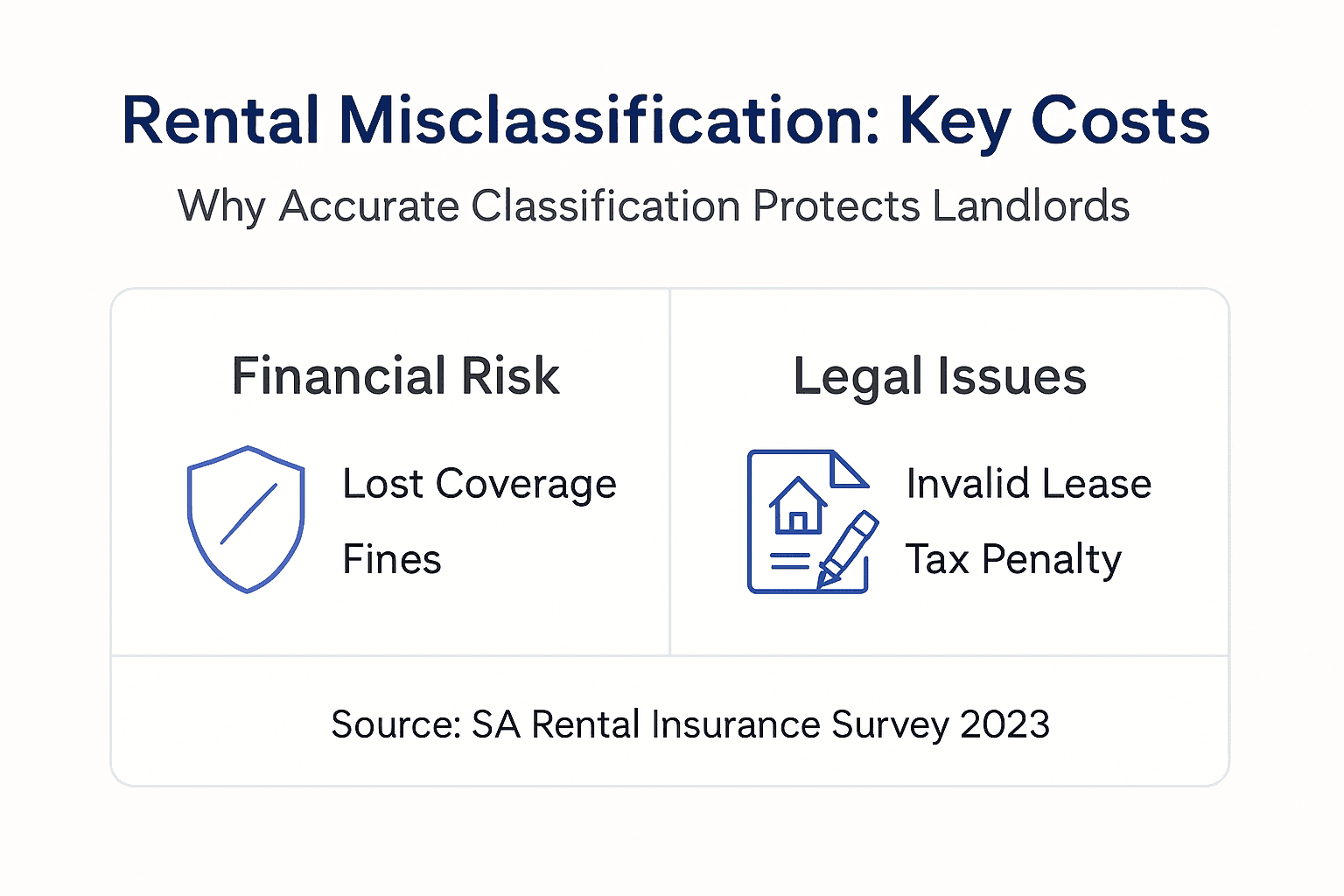
Misclassification triggers a cascade of problems. You might purchase inappropriate insurance, structure legally invalid lease terms, or fail to meet regulatory requirements for your actual rental type. Each error compounds your financial exposure.
Pro Tip: Consult legal definitions and review lease documents with a property attorney to verify rental classification before purchasing insurance or signing leases, especially when converting properties between residential and commercial use.
The consequences of classification errors extend beyond insurance. They affect your tax obligations, maintenance standards, dispute resolution options, and legal liability. Getting the classification right from the start protects you from these interconnected risks.
Real-World Examples and Case Studies from South African Rentals
Real landlord experiences illustrate why rental classification demands serious attention. Consider these contrasting outcomes that demonstrate the financial stakes involved.
-
The Costly Misclassification: A Johannesburg landlord suffered over R500,000 in losses after misapplying residential protections to what should have been classified as a commercial lease. The property owner leased a converted residence to a small business, using a standard residential agreement. When the business failed after 18 months, the landlord discovered their residential rental insurance excluded commercial tenant situations. The policy denied coverage for six months of lost rent, business-related property damage, and legal costs pursuing the business owner. The residential lease structure also limited the landlord’s ability to pursue personal guarantees that commercial agreements typically include.
-
The Protection Success: A Cape Town property owner with mixed residential and commercial holdings properly classified each property and purchased appropriate coverage for both rental types. When a retail tenant experienced financial difficulties, the landlord’s commercial policy covered four months of lost income while they secured a replacement tenant. The coverage included legal expenses for early lease termination negotiations and minor property restoration costs. Total claim payout exceeded R180,000, protecting the landlord’s cash flow during a difficult transition period.
-
The Insurance Alignment Win: A Durban landlord converting residential units to commercial office space updated their insurance classification immediately upon lease type change. Six months later, when the new commercial tenant’s business partner dispute led to abandonment, the revised policy covered extended vacancy costs and tenant improvement removal. The landlord avoided what would have been a R200,000+ out-of-pocket expense had they maintained residential coverage.
These cases reveal critical lessons. Clear rental classification enables appropriate insurance selection, which directly determines your financial protection when tenant relationships deteriorate. The legal frameworks governing each rental type create distinct remedies and obligations that insurance products must match. Understanding rental income insurance benefits specific to your property classification helps you avoid the devastating losses suffered by misclassified landlords. Proactive classification review, especially during property conversions or portfolio expansion, safeguards your income across all holdings. For comprehensive protection strategies, review our detailed income protection methods for landlords guide.
Applying the Knowledge: Practical Guide for South African Landlords
Translate classification knowledge into action with this systematic approach to protecting your rental income.
-
Determine Your Property’s Legal Classification: Review zoning certificates, municipal records, and intended use declarations. Contact your local municipality if zoning status remains unclear. The property’s legal designation, not current tenant type, establishes your classification baseline. Properties zoned for residential use but leased to businesses may require rezoning applications or special use permits.
-
Analyze Lease Structure and Duration: Examine your current agreements. Leases exceeding two years with business tenants strongly indicate commercial classification requiring commercial protections. Month-to-month residential agreements need residential coverage regardless of tenant occupation. Match your insurance and legal framework to actual lease terms, not assumptions about property type.
-
Assess Tenant Profile and Risk Factors: Business tenants operating retail, office, or industrial activities trigger commercial classification even in residentially zoned properties where permitted. Evaluate tenant financial stability using business credit reports, financial statements, and industry conditions. This assessment guides both classification decisions and coverage level selection.
-
Select Appropriate Income Protection Products: Purchase insurance explicitly designed for your verified rental classification. Commercial policies must cover extended vacancy, business failure, and commercial tenant improvements. Residential policies should address rapid tenant turnover, personal tenant issues, and standard residential damage. Never assume coverage transfers between rental types.
-
Document Classification Decisions: Maintain written records explaining your classification rationale, including legal consultations, zoning confirmations, and insurance policy selections. This documentation protects you during audits, claim disputes, or legal challenges about appropriate coverage application.
-
Schedule Annual Classification Reviews: Property use evolves. Tenant changes, property modifications, or zoning updates can shift appropriate classification. Review your portfolio annually, updating insurance and legal frameworks to match current property use. Major tenant transitions, lease renewals, or property improvements should trigger immediate classification verification.
Pro Tip: Regularly update classification and insurance with portfolio changes or law updates, setting calendar reminders for annual reviews to catch shifts in property use before they create coverage gaps.
Strategic rental management combines accurate classification with proactive risk mitigation. Understanding your properties’ true legal status enables informed insurance purchases, compliant lease drafting, and effective tenant relationship management. These practices collectively protect your rental income against the specific threats your property classification attracts. For detailed guidance on building comprehensive protection, explore our rental income protection guide.
Protect Your Rental Income with South Africa’s Leading Insurance Solutions
Understanding residential versus commercial rental distinctions provides the foundation, but comprehensive income protection requires expert insurance solutions tailored to your specific property classification. Our specialized rental income insurance addresses both residential and commercial needs, covering tenant non-payment, early lease termination, property damage, and extended vacancy periods that threaten your cash flow.
We recognize that classification complexity creates real financial risks for South African landlords. Our policies align precisely with your rental type, eliminating coverage gaps that standard insurance overlooks. Whether you manage residential properties, commercial spaces, or a mixed portfolio, we provide protection matching your actual risk exposure. Ready to safeguard your rental income? Request a personalized quote today and discover how proper classification combined with expert coverage protects your investment. Learn more about how rental income insurance works or explore the specific benefits available to South African landlords.
Frequently Asked Questions
What legal framework governs residential rentals in South Africa?
The Rental Housing Act 50 of 1999 governs residential leases, establishing mandatory tenant protections including security of tenure, habitability standards, and dispute resolution procedures. This legislation applies universally to properties leased for housing purposes, regardless of individual lease terms.
How do commercial lease durations differ from residential agreements?
Commercial leases typically span 3-5 years or longer, reflecting business planning horizons and tenant improvement investments. Residential leases usually run 6-12 months due to tenant mobility needs and protective legislation limiting long-term commitments.
Why does correct rental classification matter for landlords?
Misclassification leads to inappropriate insurance coverage, invalid lease terms, and regulatory non-compliance. These errors can cost landlords over R500,000 in uncovered losses, legal penalties, and missed protection opportunities when tenant relationships fail.
Can residential rental insurance cover commercial property risks?
No, residential policies explicitly exclude commercial tenant situations, business failure risks, and extended commercial vacancy periods. Commercial properties require specialized coverage addressing business-related income threats that residential insurance does not contemplate.
What unique risks do commercial rental properties face?
Commercial properties experience 20-30% higher vacancy rates, longer tenant search periods, business failure exposure, and economic sensitivity that residential rentals avoid. These factors demand insurance products specifically designed for commercial income protection and extended vacancy coverage.
How often should landlords review their rental property classification?
Conduct annual classification reviews at minimum, with immediate verification during tenant changes, property modifications, lease renewals, or zoning updates. Regular reviews prevent coverage gaps that emerge when property use evolves without corresponding insurance adjustments.
Recommended
- Defining Property Damages – Impact on SA Landlords – Rental Income Insurance
- Why Rental Leases Matter for South African Landlords – Rental Income Insurance
- Role of Rental Contracts for Landlords in South Africa – Rental Income Insurance
- Rental Income Tax Tips: Complete Guide for SA Landlords – Rental Income Insurance