
A monthly premium for rental income insurance is the recurring payment you make to keep your cover active against tenant non-payment, early lease termination and absconding. Indicative market pricing sits between about 2% and 5% of monthly rent, and quotes a starting range. Final quotes still depend on underwriting, cover limits and policy wording.
TL;DR:
- At R10,000 rent, planning estimates run from R300 monthly at 3% to R500 at 5%; underwriting can move the final price higher.
- Insurers weigh tenant credit, employment, tenancy length, property condition, prior claims, desired rent coverage, legal fee limits, and the excess you accept.
- Policies usually cap unpaid rent by months and eviction legal fees by amount; exclusions can include existing arrears, landlord misconduct, and certain force majeure losses.
- Before signing, get full policy wording and written limits, confirm waiting periods and missed payment rules, and ask what evidence claims require.
- Premiums may be tax deductible when incurred to produce rental income, but individual circumstances matter; confirm eligibility with a tax adviser and keep receipts.
Table of Contents
- How insurers price rental income premiums using a percentage of rent
- Main factors that influence your monthly premium
- What your premium usually pays for, and where the limits sit
- Tax and regulatory points worth checking before you buy
- A simple method to estimate your monthly premium before you get a quote
- Pre-purchase checklist: questions to ask your insurer or broker
- What a monthly premium means in health insurance
- Typical health insurance premium ranges
- What actually moves a health insurance premium
- How plan type changes what you pay each month
- What a health insurance premium typically buys
- How the premium connects to deductibles, copayments and out-of-pocket maximums
- Why clear premium wording saves landlords money and stress
- If you want a tailored quote, here is how we can help
- FAQ
- Sources
How insurers price rental income premiums using a percentage of rent
Most insurers price rental income cover as a slice of your monthly rent rather than a flat fee, because rent is the clearest measure of what you stand to lose if a tenant stops paying or vanishes. A higher rent means a larger potential claim, so the premium scales with it.
Published guidance puts the typical market band at 2% to 5% of monthly rent, and quotes a starting range. These figures are indicative starting points, not fixed prices, because every application still goes through underwriting.
A few things commonly move a quote away from the headline percentage:
- The number of months’ rent you want covered if a tenant defaults.
- The size of the legal-fee limit for eviction proceedings.
- The excess you are willing to carry on a claim.
- Any history of previous claims on the property.
Main factors that influence your monthly premium
Once you move past the percentage-of-rent starting point, several specific details shape the number that lands on your quote.
Tenant-related factors carry real weight. A tenant’s credit history, employment stability, length of tenancy and any record of previous evictions all feed into how an insurer assesses the likelihood of default. A long-standing, employed tenant with no arrears history is a lower risk than a new tenant with a thin credit file.
Property factors matter too: location, security features, the type and condition of the property, and whether the property itself has a claims history all play a part. An insurer weighs these alongside the tenant profile rather than in isolation.
Your own cover choices move the price as well:
- How many months of unpaid rent you want covered.
- The cap you select for legal fees tied to eviction.
- The excess amount you are prepared to pay per claim.
- Whether you add cover for damage linked to an eviction.
Policy mechanics also affect pricing, including the waiting period before cover activates and the documentation an insurer will want to see at claim stage. Behind all of this sit the insurer’s own actuarial models, reinsurance arrangements and appetite for a given type of property or tenant, which is why two insurers can quote noticeably different premiums for the same risk.
Pro Tip: Ask for a written breakdown of how your quote splits between rent cover, legal fees and excess, so you can see exactly which choice is driving the price.
What your premium usually pays for, and where the limits sit
A rental income premium buys a defined package of protection, not an open-ended guarantee. Reading the schedule carefully, rather than assuming cover matches what you imagined, avoids disappointment at claim time.
Common inclusions are:
- Unpaid rent, usually capped at a set number of months.
- Legal fees for the eviction process, up to a stated limit.
- In some policies, damage linked directly to the eviction.
Typical limits sit alongside these inclusions: a cap on months’ rent payable, a per-claim limit on legal fees, an annual aggregate limit, and an excess you carry on each claim.
Equally, most policies carry exclusions worth knowing upfront:
- Disputes or arrears that existed before the policy started.
- Losses caused by a wilful act on the landlord’s part.
- Certain force majeure situations, where the wording excludes them.
Before you sign anything, ask for the full policy schedule and wording, not just a summary. Our explainer on rental income insurance sets out the scope of cover and the usual exclusions in more detail.
Tax and regulatory points worth checking before you buy
Two official bodies shape how your premium behaves on paper and in practice, and both are worth a quick check before you commit to a policy.
On the tax side, SARS treats rental income as taxable, and expenses incurred in producing that income, which can include insurance premiums, may be deductible. Because deductibility depends on your specific circumstances, it is worth getting tax advice rather than assuming the premium is automatically deductible.
On the regulatory side, FSCA prudential material sets out how insurers must govern their products and manage pricing, and it notes that a policy can lapse if a premium goes unpaid. Checking the grace period and reinstatement terms before you buy means a missed payment does not quietly leave you uninsured.
Practical takeaways:
- Keep receipts and records of premiums paid for your tax file.
- Confirm with your adviser how apportionment rules apply to your case.
- Ask exactly when cover starts, and when it would stop.
A simple method to estimate your monthly premium before you get a quote
You can sketch a realistic budget before approaching an insurer, using nothing more than your rent and a bit of arithmetic.
- Take your advertised monthly rent as the base figure for the calculation.
- Apply a conservative and an upper percentage, commonly 3% and 5%, to that rent figure.
- Adjust upward if you already know your tenant history is thin, your property carries extra risk, or you want higher legal-fee limits or a lower excess.
A R10,000 monthly rent at a 3% rate works out to around R300 a month, or roughly R3,600 a year, while the same rent at a 5% rate comes to about R500 a month, or R6,000 a year. These are planning figures, not firm quotes: a patchy tenant history or a request for higher legal-fee cover would likely push your real quote toward the upper end of that band.
Before you request a firm quote, gather:
- A signed tenancy agreement.
- Proof of tenant identity and employment.
- Details of any previous claims on the property, if applicable.
Pre-purchase checklist: questions to ask your insurer or broker
A short list of direct questions, asked before you sign, saves far more time than reading the full wording after a dispute has already started.
Confirm these points with any insurer or broker:
- Which events are insured, and how “tenant default” is defined.
- The length of the waiting period before cover activates.
- The number of months’ rent covered, and the legal-fees limit.
- The excess amount, and exactly how it applies per claim.
Then ask about the practical side:
- What tenant-screening evidence they expect before accepting the risk.
- What documentation you will need to support a claim.
- How a missed premium payment is handled, including grace periods.
- Whether a cooling-off period or reinstatement option exists.
Treat vague answers as a warning sign. An insurer that cannot define “tenant default” clearly, will not specify limits in writing, or hesitates to hand over full policy wording is one to question closely before you commit.
What a monthly premium means in health insurance
It is worth pausing on a different use of the phrase “monthly premium”, because the term also appears widely in health insurance, where it means something distinct from rental income cover.
In that context, a monthly premium is the recurring payment a person or employer makes to an insurer to keep a health plan active, regardless of whether any medical care is used that month. It is separate from the other costs a health plan carries, such as a deductible, copayments or an out-of-pocket maximum. The premium is the price of keeping the policy in force; those other costs only apply once care is actually received.
The two concepts, rental income premiums and health insurance premiums, share only the mechanism, a recurring payment that keeps a policy active. The risks they cover, the way they are priced and the people who buy them are entirely different, and landlords evaluating rental income cover do not need health insurance pricing to make a sound decision on their own policy.
Typical health insurance premium ranges
Health insurance premiums vary enormously by country, insurer, plan design and the age and health profile of the people covered, which makes a single universal figure unreliable. Rather than quote a specific amount here, the honest summary is that health premium levels depend heavily on local market structure, whether cover is individual or employer-sponsored, and the richness of the benefits selected.
What stays constant across markets is the underlying logic: insurers set the premium to reflect the expected cost of claims across the pool of people covered, plus their own administration and margin. A younger, healthier group with modest benefits will generally see a lower premium than an older group with a richer benefit package, though the exact figures are a matter for each market’s own insurers and regulators rather than a global rule of thumb.
Readers who need a specific premium figure for their own market and plan are better served by a quote from a licensed health insurer or a government health exchange for their jurisdiction, where current, locally accurate pricing is published.
What actually moves a health insurance premium
A handful of factors do most of the work in setting a health insurance premium, and they recur across most markets even though the exact weighting differs by insurer and regulation.
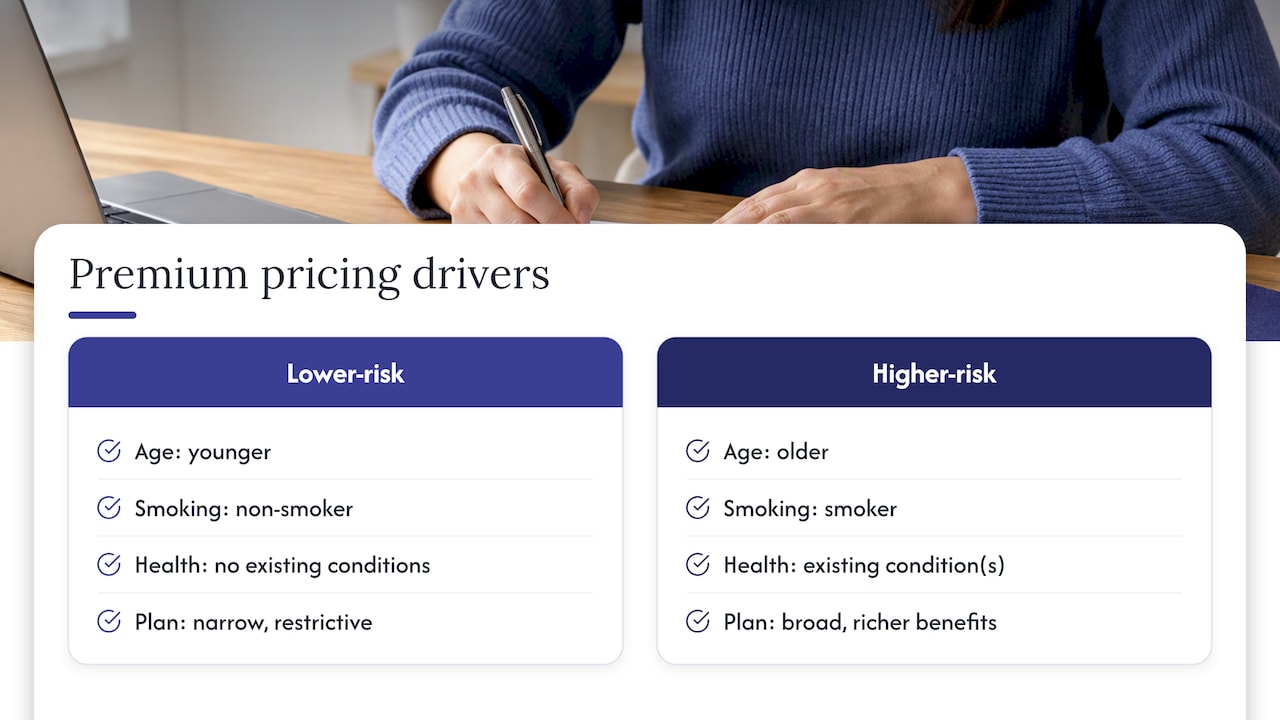
Age is one of the strongest drivers, since the likelihood and cost of claims rises with age in most populations. Health status, where insurers are permitted to consider it, affects pricing because a person with existing conditions is statistically more likely to claim. Plan type changes the number directly too: broader networks and richer benefits cost more to insure than a narrower, more restrictive plan.
Location plays a part because the cost of medical care itself varies by region and by country, and insurers price to the local cost of claims. Smoking status is a well-known factor in many markets, since smoking is linked to higher rates of certain conditions, and insurers that are allowed to rate on it typically charge smokers more than non-smokers for comparable cover.
None of these factors acts alone. A younger non-smoker in a lower-cost region, on a narrow plan, sits at one end of the pricing scale, while an older smoker with an existing condition, on a broad plan in a higher-cost region, sits at the other. The exact gap between those two points depends on the insurer and the regulatory rules of the market in question.
How plan type changes what you pay each month
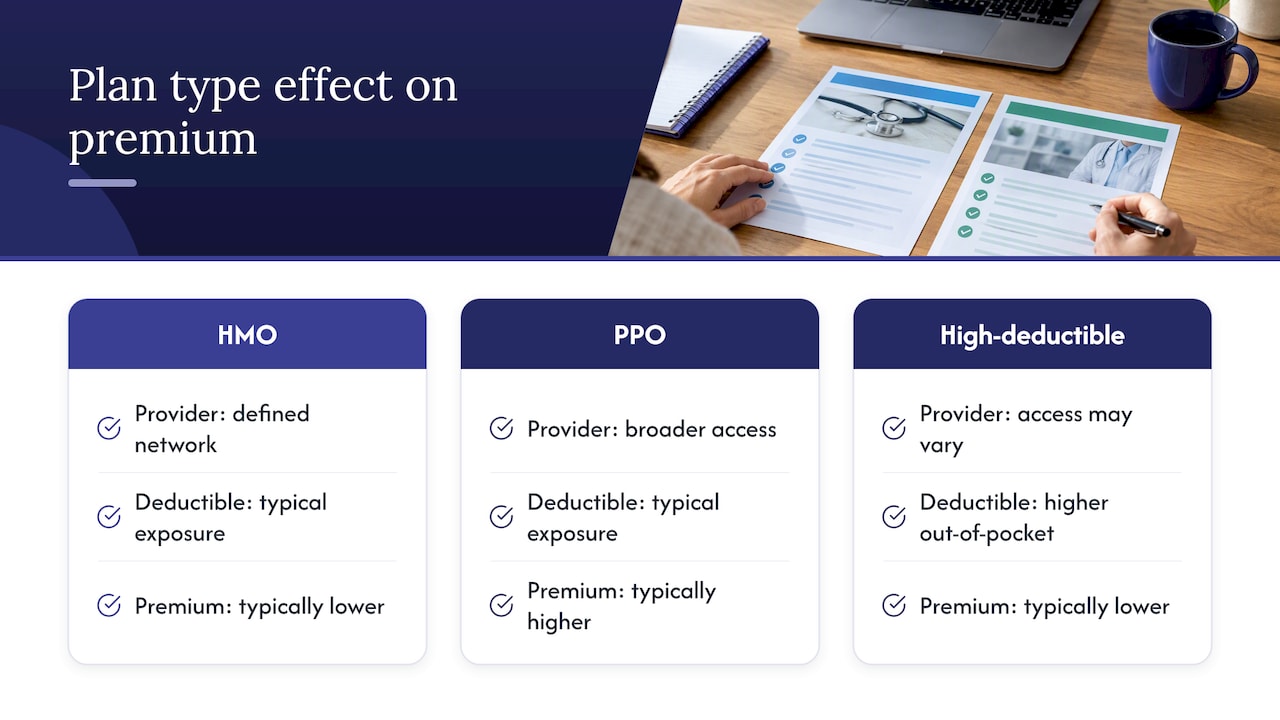
The structure of a health plan, not just the person buying it, has a direct effect on the premium charged. Three broad plan types illustrate the pattern.
An HMO-style plan, built around a defined network of providers and a requirement to coordinate care through a primary doctor, tends to carry a lower premium because the insurer has more control over costs and utilisation. A PPO-style plan, which gives members more freedom to see providers outside a fixed network, typically carries a higher premium in exchange for that flexibility. A high-deductible plan shifts the balance the other way: the member agrees to pay more out of pocket before the insurer’s cover kicks in, and in exchange the monthly premium is usually lower.
None of these structures is objectively better. A plan with a lower premium and a high deductible suits someone who rarely needs care and wants to minimise the monthly outlay, while a plan with a higher premium and a low deductible suits someone who expects to use medical care regularly and wants to smooth out the cost. The right choice depends on expected usage as much as on the headline monthly figure.
What a health insurance premium typically buys
Paying a health insurance premium keeps a policy active, and in return the plan contributes toward the cost of a defined set of medical services once you need them.
Common inclusions across most plans are routine medical visits, a defined allowance for prescription medication, and cover for hospital stays when they are medically necessary. Many plans also extend to diagnostic tests, specialist referrals and a range of preventive services, though the exact list and the share the insurer pays varies by plan and by market.
The premium itself does not usually pay for care directly. It keeps the policy in force, and the plan’s other cost-sharing elements, a deductible, copayments and coinsurance, determine how much the member pays at the point of care once the premium has done its job of keeping cover active.
How the premium connects to deductibles, copayments and out-of-pocket maximums
A monthly premium and the other costs on a health plan work as a linked system, not as separate, unrelated charges.
The premium is paid every month regardless of whether care is used. The deductible is the amount a member pays out of pocket before the plan starts contributing toward most services. A copayment is a fixed amount paid at the point of a visit or prescription, often even after the deductible has been met. The out-of-pocket maximum is the ceiling on what a member pays in a given period, after which the plan covers approved costs in full.
These elements typically move in opposite directions to the premium. A plan with a low monthly premium commonly carries a higher deductible and a higher out-of-pocket maximum, shifting more of the cost onto the member if care is actually needed. A plan with a higher premium commonly carries a lower deductible, smaller copayments and a lower out-of-pocket ceiling, spreading the cost more evenly across the year rather than concentrating it at the point of care. Choosing between them is really a choice about where you would rather carry the cost: in a steady monthly payment, or in a larger bill if and when you need treatment.
Why clear premium wording saves landlords money and stress
The costliest surprises we see do not come from the premium amount, they come from wording nobody read closely: an unclear definition of default, or a waiting period nobody budgeted for. A premium you understand, with limits and exclusions spelled out, is worth more than a slightly cheaper one you do not.
We built our published starting ranges as a practical planning tool for exactly that reason: a number you can budget against before you ever request a quote.
— Coert
If you want a tailored quote, here is how we can help
We offer Rental Income Insurance, along with Eviction Insurance, Residential Rental Insurance, Commercial Rental Insurance, Group Rental Insurance and Tenant Insurance, each built around the specific risks landlords face rather than a one-size policy.

Rental Income Insurance starts from an indicative range of 3.5% to 5% of monthly rent, though your own figure depends on your tenant, property and the cover limits you choose. If the estimate method above has given you a working budget, the next step is a firm number.
- Request a tailored quote through the request-a-quote page.
- Review how cover applies to your situation on the rental income insurance explainer.
- Check a fuller cost breakdown on the monthly cost guide.
For landlords managing the property side alongside insurance, this investment property checklist covers the operational tasks that sit next to a good policy.
FAQ
What is a reasonable monthly premium for rental income insurance?
A reasonable premium typically falls between 2% and 5% of your monthly rent, with a typical starting range sitting within that band. The exact figure depends on your tenant profile, property and the cover limits you select.
Can I deduct my rental income insurance premium from tax?
Premiums may be deductible where they are incurred in producing rental income, according to SARS guidance on rental income. Because deductibility depends on individual circumstances, it is worth confirming your position with a tax adviser.
What happens if I miss a premium payment?
Missing a payment can cause your policy to lapse, and FSCA material on product governance notes that insurers set their own grace-period and reinstatement rules. Always confirm these terms with your insurer before a missed payment leaves you without cover.
Does rental income insurance cover eviction legal fees?
Most policies include legal fees for the eviction process up to a stated limit, alongside cover for a capped number of months of unpaid rent. The exact limit varies by insurer and by the cover level you choose, so check the schedule before buying.
Is a monthly premium the same for health insurance and rental income insurance?
Both use the same mechanism, a recurring payment that keeps a policy active, but they cover entirely different risks. Rental income insurance protects a landlord’s rent against tenant non-payment, while health insurance contributes toward the cost of medical care.
Watch more on landlord insurance basics:
Sources
- Is rental insurance worth it in South Africa?
- Tax on rental income (SARS)
- FSCA consultation material (policy lapse and product governance)