
TL;DR:
- Insurance dispute resolution involves a structured process from internal complaints to court to settle disagreements over claims fairly.
- For South African landlords, understanding each stage, deadline, and evidence requirement helps protect rental income and property investments.
Insurance dispute resolution is the formal process through which disagreements between policyholders and insurers over claims or coverage are settled fairly and systematically. For South African landlords and businesses, understanding this process is not optional. A denied claim or an underpaid settlement can threaten your rental income, your property investment, and your financial stability. The standard escalation path moves from internal complaints to ombudsman intervention, and finally to litigation if necessary. Knowing each stage, the timelines involved, and the evidence required gives you a real advantage when a dispute arises.
What are the common causes of disputes in insurance claims?
Most insurance disputes do not start with bad faith. They start with a gap between what the policyholder expected and what the insurer agreed to cover. Recognising these triggers early helps you respond with the right strategy rather than frustration.
The most frequent causes of insurance claims disputes include:
- Coverage denials and exclusions. Insurers reject claims when they believe the loss falls outside the policy’s scope. This is especially common with property damage claims where wear and tear exclusions are applied broadly.
- Disagreements over claim valuation. You believe your property damage is worth R85,000. The insurer’s assessor values it at R42,000. This gap in valuation is one of the most common dispute triggers in South Africa.
- Delayed claim processing. When an insurer takes weeks or months to respond without clear communication, policyholders often escalate out of necessity rather than disagreement.
- Inadequate or missing documentation. Claims fail when supporting evidence is incomplete. Missing photographs, absent repair quotes, or unsigned lease agreements all give insurers grounds to reduce or deny a payout.
- Policy language disputes. Ambiguous wording in a contract can lead to genuine disagreements about what is covered. Denied or underpaid claims require policyholders to treat the situation as a negotiation starting point, not a final verdict.
For South African landlords specifically, disputes frequently arise from tenant non-payment claims, early lease termination disagreements, and property damage assessments. Each of these involves a layer of contractual interpretation that can easily become contentious.
How does the insurance dispute resolution process work step by step?
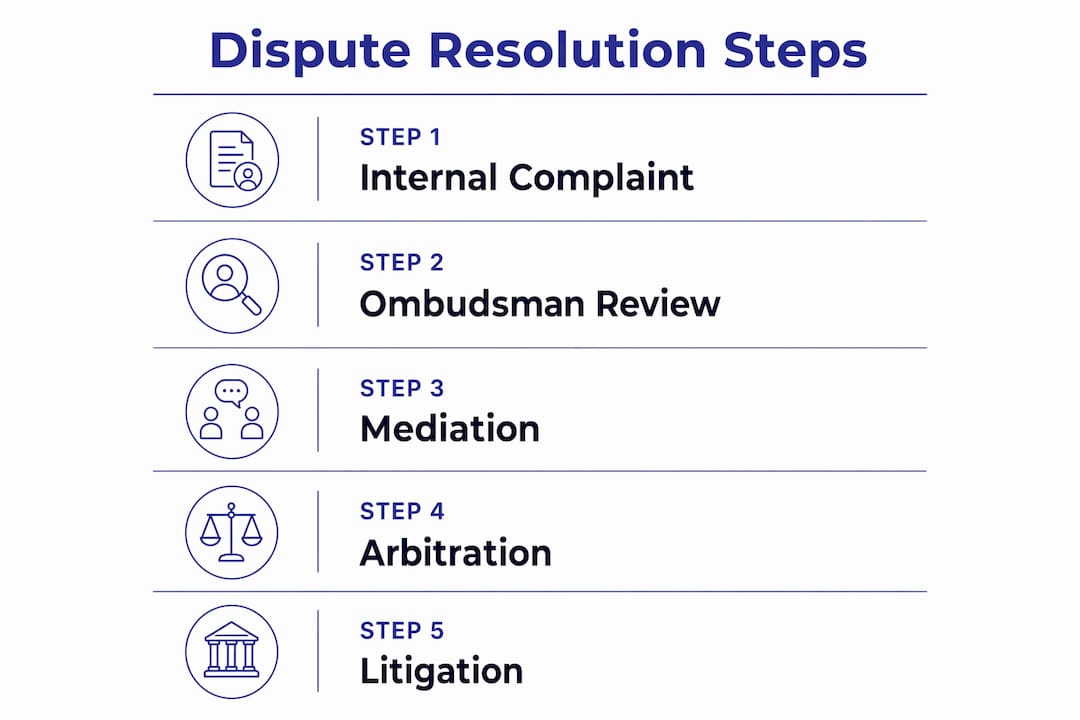
The standard escalation path for insurance disputes follows a clear sequence. Skipping a stage or missing a deadline can forfeit your right to independent review.
-
Submit a formal internal complaint. Your first step is always to raise the dispute directly with your insurer in writing. Reference the specific policy clauses you believe support your claim. Insurers must provide a final decision within 8 weeks of receiving a formal complaint before escalation becomes appropriate.
-
Request a detailed refusal explanation. If your claim is denied, do not rely solely on the denial letter. Request a written explanation that cites the specific policy clauses used to justify the refusal. This explanation becomes your roadmap for the entire dispute. It also prevents the insurer from shifting justifications later in the process.
-
File a complaint with the ombudsman. South Africa’s Short-Term Insurance Ombudsman and the Ombudsman for Long-Term Insurance provide free, independent dispute resolution services. Complaints must be filed within strict time windows. Missing filing deadlines forfeits your right to independent review, often within 6 months of the insurer’s final decision letter.
-
Consider alternative dispute resolution (ADR). If the ombudsman process does not resolve the matter, mediation and arbitration are available. Mediation is non-binding and focuses on facilitated negotiation. Arbitration is quasi-judicial and typically produces a binding outcome. Both are faster and less costly than going to court.
-
Pursue litigation as a last resort. Court proceedings are expensive and slow. Most insurance disputes settle before trial, but when they do proceed, trials can last days to weeks and appeals can add months or years to the process.
Pro Tip: Keep a dedicated folder, physical or digital, for every document related to your claim. Date-stamp every communication. This single habit makes every subsequent stage of the dispute process significantly stronger.

What role does evidence play in resolving insurance disputes?
Evidence is the foundation of every successful insurance dispute. Legal success in insurance disputes depends on objective, well-documented evidence rather than emotional arguments. This is the single most important principle to internalise before you begin any dispute process.
The most effective types of evidence include:
- Photographs and videos taken immediately after the loss event, with timestamps intact.
- Repair estimates from at least two independent, registered contractors.
- Medical records for personal injury or health-related claims.
- Lease agreements and correspondence for landlord disputes involving tenant non-payment or property damage.
- A detailed communication timeline recording every call, email, and visit, including dates, names, and what was discussed.
Maintaining a comprehensive communication timeline provides the strongest leverage during any stage of dispute resolution. This factual record is far more persuasive to an ombudsman or arbitrator than a verbal account of events.
A common mistake is submitting evidence piecemeal. Gather everything before you engage. An insurer who receives a complete, well-organised evidence pack at the outset has far less room to dispute the facts. For property damage claims, the property damage claims process involves specific documentation requirements that are worth understanding before you file.
Pro Tip: An affidavit can strengthen your evidence submission significantly. Notarised insurance documents carry more weight in formal dispute proceedings than unverified statements.
How do mediation, arbitration, and litigation compare?
Understanding the differences between these three methods is central to choosing the right path. Each has a distinct cost profile, timeline, and level of formality.
Mediation is a non-binding process that facilitates settlement discussions between the parties. A neutral mediator guides the conversation but cannot impose a decision. It is the least formal option and typically the fastest. Arbitration, by contrast, is quasi-judicial. An arbitrator hears both sides and issues a decision that is usually binding on both parties. It is more formal than mediation but less costly and time-consuming than court.
Litigation is the most formal and most expensive route. It involves the full court process, including discovery, hearings, and potentially an appeal. Most disputes that reach this stage do so because coverage itself is in dispute, not just the value of a loss.
One important distinction: the appraisal process resolves disputes over the value of a loss only. Appraisal cannot resolve coverage disputes. If your insurer denies a claim entirely on coverage grounds, appraisal is not available to you. You must use mediation, arbitration, or litigation instead.
| Method | Binding? | Typical timeline | Cost level | Best suited for |
|---|---|---|---|---|
| Mediation | No | Days to weeks | Low | Valuation disagreements |
| Arbitration | Usually yes | Weeks to months | Moderate | Complex claim disputes |
| Litigation | Yes | Months to years | High | Coverage denials |
| Ombudsman | Yes (within scope) | 6–12 weeks | Free | Consumer complaints |
Key takeaways
Effective insurance dispute resolution requires a structured approach: document everything, meet every deadline, and escalate methodically from internal complaint to ombudsman to ADR before considering litigation.
| Point | Details |
|---|---|
| Follow the escalation path | Start with an internal complaint, then the ombudsman, then ADR, and only then litigation. |
| Meet filing deadlines | Ombudsman complaints must typically be filed within 6 months of the insurer’s final decision. |
| Evidence wins disputes | Photographs, repair estimates, and a communication timeline outperform emotional arguments every time. |
| Know your ADR options | Mediation is non-binding; arbitration is usually binding. Choose based on the nature of your dispute. |
| Appraisal has limits | Appraisal resolves value disputes only. Coverage denials require mediation, arbitration, or court. |
Why I treat every dispute as an evidence-gathering mission
Most people approach an insurance dispute as an argument. They want to be heard, they want to express frustration, and they want the insurer to admit they were wrong. I understand that instinct completely. But in my experience, that approach almost never works.
The insurers who handle disputes every day are not moved by emotion. They are moved by policy language and documented facts. The moment you shift your mindset from “I deserve this payout” to “here is the evidence that proves this payout is contractually required,” the entire dynamic changes.
One thing I have seen make a real difference is engaging a public adjuster early. Many policyholders do not realise this option exists. Public adjusters organise evidence, interpret policy language, and negotiate on your behalf. They are particularly valuable when the claim is large or the documentation is complex.
The ombudsman route is also underused. It is free, it is independent, and it carries genuine weight. Before you spend money on legal fees, exhaust the ombudsman process fully. South African landlords dealing with rental disputes often find that a well-prepared ombudsman complaint resolves the matter without ever reaching a courtroom.
Stay composed, stay factual, and let the policy language do the work.
— Coert
How Rentalincomeinsurance supports South African landlords through claims
Disputes over rental income claims are stressful, time-consuming, and financially damaging if handled poorly. Rentalincomeinsurance is built specifically for South African landlords who need reliable cover and clear support when things go wrong.
Whether you are dealing with tenant non-payment, early lease termination, or property damage, Rentalincomeinsurance provides cover that is designed to hold up when you need it most. The claims process is structured to give you the documentation and support you need at every stage of a dispute. Request a personalised quote today and find out exactly what your rental income protection covers. You can also visit Rentalincomeinsurance to learn more about the full range of cover options available to South African landlords.
FAQ
What is insurance dispute resolution?
Insurance dispute resolution is the formal process used to settle disagreements between a policyholder and an insurer over a claim or coverage decision. It follows a structured path from internal complaints to ombudsman intervention and, if necessary, litigation.
How long does an insurer have to respond to a complaint?
Insurers must provide a final decision within 8 weeks of receiving a formal internal complaint. After that, you have the right to escalate to an independent ombudsman or alternative dispute resolution body.
What is the difference between mediation and arbitration in insurance disputes?
Mediation is non-binding and relies on a neutral facilitator to help both parties reach a voluntary agreement. Arbitration is quasi-judicial and typically produces a binding decision that both parties must accept.
When should I contact the insurance ombudsman?
Contact the ombudsman after your insurer has issued a final decision and you remain unsatisfied. File within the required time window, typically 6 months of the final decision letter, or you may lose the right to independent review.
Can I resolve a coverage dispute through appraisal?
No. The appraisal process only resolves disagreements over the value of a loss. Coverage disputes, where the insurer denies the claim entirely, must be handled through mediation, arbitration, or litigation.
Recommended
- Insurance claims explained: guide for South African landlords – Rental Income Insurance
- Explaining insurance exclusions for SA landlords – Rental Income Insurance
- Role of rental agents in claims: South African guide – Rental Income Insurance
- Understanding insurance deductibles: smart guidance for SA landlords – Rental Income Insurance