
Rental income insurance typically costs between R200 and R500 for every R10,000 of monthly rent, which works out to roughly 3.5% to 5% of your rent each month. That premium usually covers tenant non-payment, early lease termination and absconding, with optional legal or eviction support added on. The sections below show how to turn those figures into a real number for your property, plus the tax treatment that can lower your net cost.
TL;DR:
- Rental income insurance premiums typically range from R200 to R500 per R10,000 of rent, equating to about 3.5% to 5% of monthly rent.
- Higher rent levels lead to proportionally higher premiums, with a R15,000 rent costing roughly R300 to R750 monthly.
- Choosing a higher excess reduces premiums but increases out-of-pocket costs when making a claim, whereas policies with legal support tend to be more expensive.
- Premiums are influenced by tenant screening, property type, location, and coverage features like payout period and trigger conditions.
- Tax deductions can offset part of the premium cost, as SARS permits insurance expenses to reduce taxable rental income.
Table of Contents
- 1. How much landlords pay in practice: monthly and annual bands
- 2. What moves your premium: the rating drivers you can and cannot control
- 3. Quick estimator and two worked examples you can use now
- 4. How tax and policy rules change the net cost
- 5. Publisher proof points and how we arrive at our figures
- 6. Average premiums by landlord and property size
- 7. How benefit triggers shape what you pay
- 8. Comparing policy types and their pricing
- 9. How tenant screening and property risk affect your quote
- 10. Policy features that change the price
- 11. Why your property’s location and type affect the price
- 12. When rental income insurance makes the most sense
- How to get a quote from Rental Income Insurance
- FAQ
- Sources
1. How much landlords pay in practice: monthly and annual bands
Once you apply the pricing rule to an actual rent, the numbers become easier to picture. A landlord charging R5,000 a month would typically pay somewhere between R100 and R250 a month for cover, or roughly R1,200 to R3,000 a year. At the national average rent of R9,715, reported in the PayProp Rental Index, the same rule produces a monthly premium of around R194 to R486, or about R2,330 to R5,830 annually. Move up to a R15,000 rent and you are looking at R300 to R750 a month, or R3,600 to R9,000 a year.
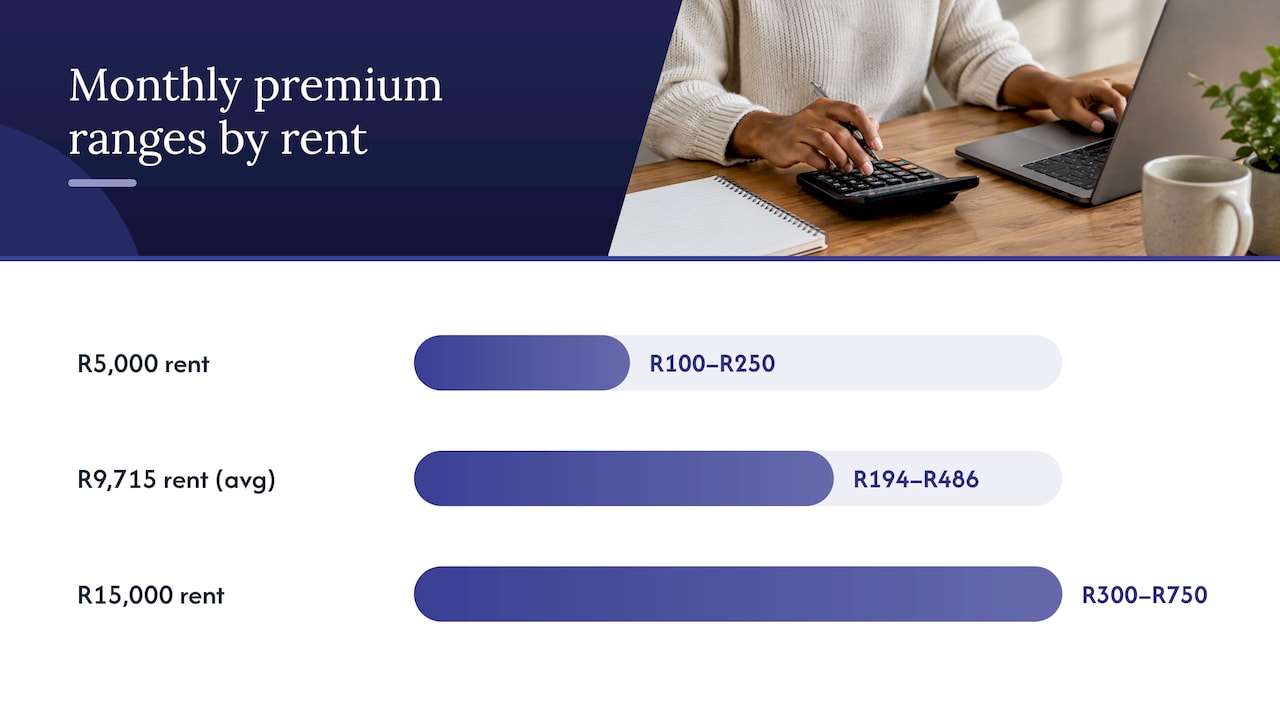
Rental income cover for a typical monthly rent runs to roughly R194 to R486 monthly, which is a manageable addition to most landlords’ running costs when weighed against even one missed month’s rent.
What differs across these price bands is not just the number, it is what you get for it:
- Lower-priced policies often carry a higher excess and a shorter benefit period, so they suit landlords who can absorb a month or two of lost rent before the claim kicks in.
- Mid-range policies usually balance a moderate excess with a longer payout period, covering several months of non-payment plus basic legal costs for eviction.
- Higher-priced policies tend to include extended legal and eviction support, higher claim ceilings and fewer exclusions, which matters more for landlords with multiple units or less tolerance for vacancy risk.
Choosing a higher excess is the simplest way to bring your premium down, since you are effectively agreeing to cover the first part of any loss yourself. For a closer look at how these bands apply across different rent levels, our guide to monthly landlord insurance costs walks through the detail.
2. What moves your premium: the rating drivers you can and cannot control
Your premium is not a fixed number. It reflects a handful of factors that insurers weigh differently depending on the policy.
- Rent level and sum insured: the higher your declared rent, the higher the rand value at risk, so the premium scales with it directly.
- Excess and claims history: a higher excess lowers your premium, while a history of claims usually pushes it up.
- Property type and tenancy structure: a flat in a sectional title scheme, a freestanding house, and a short-let unit each carry different risk profiles, and insurers price accordingly.
- Tenant screening: landlords who can show credit checks and reference verification are often viewed as lower risk.
- Market conditions: rental arrears tend to rise when affordability tightens, and insurers adjust pricing cycles to reflect that.
- Policy features: adding eviction or legal assistance, extending the cover period, or insuring a group of units under one policy all change the final price.
Pro Tip: Ask for a quote with two excess levels side by side. Seeing the rand difference between, say, a R1,000 and a R3,000 excess makes the trade-off concrete rather than theoretical.
For more detail on how eviction and legal support specifically affect pricing, see our explainer on eviction cover.
3. Quick estimator and two worked examples you can use now
You do not need a broker call to get a workable estimate before you request a formal quote. Follow these steps:
- Pick your method. Use either the percentage rule (3.5% to 5% of monthly rent) or the per-R10,000 rule (R200 to R500 for every R10,000 of rent). Both rules land in a similar range.
- Apply it to your rent. Multiply your monthly rent by 0.035 and 0.05 to get your low and high estimate.
- Adjust for extras. A higher excess can pull your estimate towards the lower end; adding legal or eviction cover can push it towards the higher end, sometimes by a further 10% to 20%.
Using the average South African rent of R9,715, the percentage method gives a monthly premium of roughly R340 to R486. A landlord renting out a smaller unit at R5,000 a month would land closer to R175 to R250, while one letting a larger property at R15,000 a month would sit between R525 and R750.
This calculation gives you a sense check before you commit, not a binding figure. Your actual premium depends on the insurer’s assessment of your specific property and tenant profile, so treat this as a starting point and confirm the real number through a request for quote.
4. How tax and policy rules change the net cost
Two sets of rules shape what you actually pay once the dust settles.
First, tax. SARS guidance on rental income treats certain insurance premiums as a permissible expense when producing rental income, which means the premium can typically be deducted against your rental earnings. That lowers your effective cost below the sticker price of the policy, though the exact benefit depends on your marginal tax rate and overall rental income position.
Second, disclosure. The Short-Term Insurance Act’s Policyholder Protection Rules require insurers to clearly disclose premium amounts, payment frequency and any additional fees, and they do not permit hidden charges layered on top of the quoted premium.
Two practical steps follow from this:
- Work out your post-tax cost by applying your marginal tax rate to the premium, so you are comparing the real burden rather than the headline figure.
- Ask any insurer for a written fee schedule before you sign, confirming there are no undisclosed administration charges on top of the premium.
5. Publisher proof points and how we arrive at our figures
We price rental income cover using two consistent rules of thumb: roughly R200 to R500 for every R10,000 of monthly rent, or about 3.5% to 5% of rent as a simpler shortcut. Both rules sit behind the figures used throughout this guide, and they apply whether you are insuring a single flat or a small portfolio.
The cover is built around the risks landlords face: tenant non-payment, early lease termination, absconding, and the legal costs that come with pursuing an eviction. This is structured as Rental Income Insurance, Eviction Insurance, Residential Rental Insurance, Commercial Rental Insurance and Group Rental Insurance, so the structure matches the property type and portfolio size involved.
You can see how these product lines differ on our rental income insurance page, and request a tailored number through our quote request form.
6. Average premiums by landlord and property size
Premiums scale with the rent you are protecting rather than with a fixed age band, since this cover responds to the rand value of rental income at risk, not to a tenant’s age or health. A landlord insuring a single flat at a modest rent pays a correspondingly modest premium, while a landlord with a larger property or several units pays more because the insured sum is higher.
Applying the 3.5% to 5% rule across a few common rent levels illustrates this clearly:
| Monthly rent | Estimated monthly premium |
|---|---|
| R5,000 | R175 to R250 |
| R9,715 | R340 to R486 |
| R15,000 | R525 to R750 |
A landlord with five units renting at R9,715 each would see a materially larger total premium than one with a single unit at the same rent, simply because the total sum insured is five times higher. This is why group policies, which bundle several units under one schedule, often come with a more efficient rate per unit than insuring each property separately.
7. How benefit triggers shape what you pay
The trigger that activates your payout has a direct bearing on price. A policy that pays out as soon as a tenant misses a single month’s rent costs more than one that only pays after a longer arrears period, because the insurer is taking on risk sooner and for longer.
Similarly, a policy that pays out for absconding, where a tenant vacates without notice and stops paying, tends to price this risk separately from simple late payment, since recovery and legal costs for absconding cases are usually higher. Early lease termination triggers, where a tenant breaks the lease before its agreed end date, add a further layer of cost because the insurer is also covering the income gap while you find a replacement tenant.
The practical takeaway is that the fewer conditions attached to a payout, and the sooner it activates, the higher the premium will sit within the R200 to R500 per R10,000 band. Landlords who can tolerate a short delay before a claim pays out, perhaps because they hold a reserve fund, can usually secure a lower premium by choosing a policy with a longer trigger period.
8. Comparing policy types and their pricing
Not all rental income cover is structured the same way, and the differences affect both price and what you can claim for.
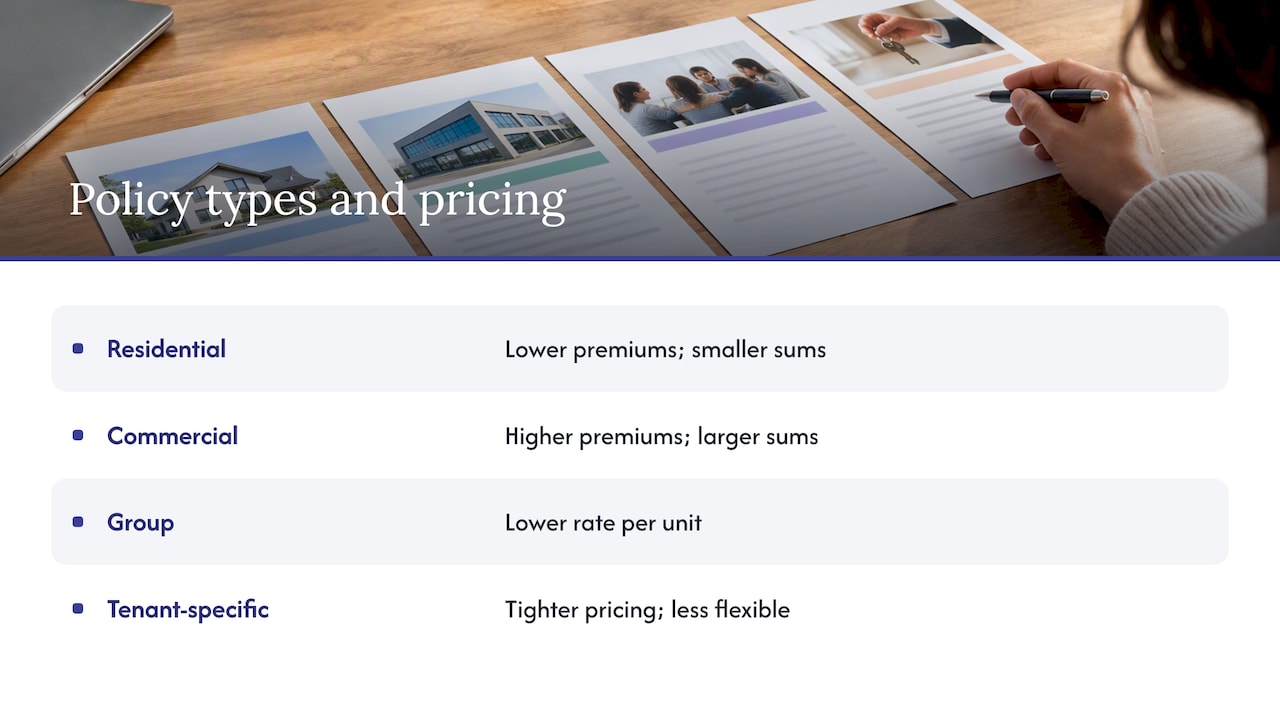
Residential cover, aimed at single flats and houses let to individual tenants, tends to sit at the lower end of the pricing band because the insured sums are typically smaller. Commercial cover, protecting rent from business tenants in retail or office space, usually carries a higher premium because commercial leases involve larger monthly sums and more complex eviction processes. Group policies, which bundle multiple residential or commercial units under a single schedule, often achieve a lower rate per unit than insuring each property individually, since the insurer spreads risk across a larger pool.
Tenant-specific policies, which focus narrowly on a single tenant’s payment behaviour rather than the broader tenancy, can be priced more tightly but may offer less flexibility if your portfolio changes. Choosing between these structures is less about finding the cheapest option and more about matching the policy type to how your properties are actually let. A landlord with one flat and a landlord with a block of ten units face genuinely different risk profiles, and the pricing reflects that. For a side-by-side look at how these structures compare, our rental insurance options guide sets out the detail.
9. How tenant screening and property risk affect your quote
Unlike personal insurance lines that rely on medical underwriting, rental income cover is priced on the risk profile of the tenancy and the property, not an individual’s health. What insurers do assess closely is the quality of your tenant screening process. Landlords who can demonstrate credit checks, affordability assessments and reference verification before signing a lease are generally seen as a lower risk, which can translate into a more favourable premium.
Property type plays a similar role. A unit in a managed sectional title scheme with an active body corporate often presents lower risk than an independently managed freestanding property, simply because there are more checks in place around maintenance and tenant conduct. Short-let or informally let properties tend to attract a higher premium than those on a standard long-term lease, since the turnover of tenants and the informality of some arrangements increase the chance of a dispute or non-payment.
The practical lesson is that tightening your own screening process before you apply for cover can work in your favour just as much as negotiating the excess, since both levers speak directly to the risk the insurer is being asked to carry.
10. Policy features that change the price
A handful of structural features, beyond the headline percentage, do much of the work in setting your final premium.
The waiting period, or the time between a missed payment and when a claim can be lodged, is one of the biggest levers. A shorter waiting period means faster support but a higher premium, while a longer one brings the cost down for landlords who can carry a short gap themselves. Cover duration, meaning how many months of rent the policy will pay out for a single claim, works the same way: a longer payout ceiling costs more than a policy capped at two or three months.
Legal and eviction assistance, where the policy covers the cost of pursuing a formal eviction rather than just the lost rent, adds a further layer of premium but can save considerably more in legal fees if a dispute drags on. Some policies also offer inflation-linked adjustment to the insured rent each year, which keeps the cover aligned with rising rents but nudges the premium upward over time compared with a flat sum insured. Weighing these features against your own risk tolerance is a more useful exercise than simply chasing the lowest quoted number.
11. Why your property’s location and type affect the price
Where a property sits and what kind of tenant it attracts both feed into the rating, since arrears patterns are not uniform across regions or property types. Areas where rental growth is outpacing affordability tend to see more pressure on tenants’ ability to pay, and insurers adjust their pricing cycles in response. The PayProp Rental Index recorded national rental growth of 5.2% year on year in the second quarter of 2026, with some regions outpacing others, a pattern that feeds directly into how insurers assess ongoing affordability risk.
Interest rate movements compound this effect. Rising rates squeeze household budgets, and commentary on the rental market has linked affordability pressure to higher tenant arrears, which in turn supports the case for rental income cover regardless of where a property is located. Commercial properties in areas with higher business turnover may also see different pricing than residential units in the same area, since the nature of the tenant, not just the postcode, shapes the risk.
12. When rental income insurance makes the most sense
In our view, cover earns its premium fastest once you are carrying more than one unit or more rent than you could comfortably absorb losing for two or three months. Below that threshold, some landlords choose to self-insure by holding a cash reserve instead, and that can work, provided the reserve is genuinely set aside rather than theoretical.
What tips the balance for most landlords is the legal and eviction support bundled into a policy, since pursuing a non-paying tenant through the courts alone often costs more in time and legal fees than a year of premiums. Run the numbers for your own rent, then request a quote to see where you actually land.
— Coert
How to get a quote from Rental Income Insurance
Getting a tailored number is faster than most landlords expect, and it gives you something more useful than a rule-of-thumb estimate. Various product lines exist for different property types and portfolio sizes, so whichever shape your portfolio takes, there is a product line built around it.

Before you request a quote, it helps to have a few details ready:
- Your monthly rent per unit, or the total across your portfolio if you are insuring several properties.
- The number of units or properties you want covered under a single policy.
- Your preferred excess level, since this is the quickest way to shift your premium up or down.
Once you have those figures, head to our request a quote page and we will work through the detail with you. If you want to understand the product structure first, our page on what rental income insurance covers sets out the basics before you commit to a figure.
FAQ
What is a typical premium for rental income insurance?
Premiums typically fall between R200 and R500 for every R10,000 of monthly rent, which is roughly 3.5% to 5% of rent each month. The exact figure depends on your excess, the property type and the policy features you choose.
Can I deduct the premium against my rental income for tax?
Certain insurance premiums are treated as a permissible expense against rental income under SARS guidance, which can lower your effective cost. The exact benefit depends on your marginal tax rate and overall rental income position, so it is worth confirming with a tax practitioner.
Does a higher excess really lower my premium?
Yes, choosing a higher excess generally brings your premium down, since you are agreeing to cover the first portion of any loss yourself. Lower-excess policies tend to sit at the higher end of the typical pricing band.
What is covered under rental income insurance?
Cover generally extends to tenant non-payment, early lease termination and absconding, with optional legal or eviction support added on. We structure these as Rental Income Insurance, Eviction Insurance, Residential Rental Insurance, Commercial Rental Insurance and Group Rental Insurance to suit different property types and portfolio sizes.
Are insurers allowed to add extra fees on top of the premium?
No, the Short-Term Insurance Act’s Policyholder Protection Rules require clear disclosure of the premium and do not permit hidden additional charges. Always ask for a written fee schedule before signing a policy.
Sources
- Tax on rental income | South African Revenue Service
- PayProp Rental Index: Rental growth outpaces inflation as Western Cape sets the pace