
A lease term is the contract’s start to end period, the dates the tenancy runs and it can be either fixed or ongoing. Whether the lease is fixed term or periodic determines your notice rights, many statutory protections and what happens the day after the lease expires. Getting this one distinction right before you sign changes how much control you have later.
TL;DR:
- Fixed-term leases automatically end on the specified date unless renewed, while periodic leases continue month to month until proper notice is given.
- Vague escalation clauses or deposit terms can lead to enforcement issues, so clear formulas and itemized charges are essential for compliance.
- Notices should align with payment cycles for periodic leases, and proper legal procedures must be followed for eviction to avoid delays and legal costs.
- Statutory provisions require specific lease details, and missing standard clauses like defect annexures or accurate notice clauses can significantly increase legal and financial risks.
- Rental income insurance best protects landlords against non-payment, early termination, and eviction costs, compensating for poorly drafted lease terms.
Table of Contents
- Common lease clauses and what they actually mean
- How the law shapes what a lease can and cannot say
- Fixed-term, periodic and commercial lease structures
- Ending a lease: notice, renewal and eviction basics
- Money clauses: escalation, deposits and hidden charges
- Reading, querying and negotiating lease terms before signing
- Why clear lease terms protect your rental income
- What years of lease disputes teach us
- How rental income insurance helps when lease terms let you down
- Sources
- FAQ
Common lease clauses and what they actually mean
Most leases repeat the same clauses in different words, and knowing what each one controls helps you read the document instead of skimming it.
- Term, commencement and expiry: the dates the tenancy starts, when occupation begins and when the agreement ends.
- Rent and escalation: the amount, the payment frequency and the formula used to increase rent each year.
- Deposit rules: how much is required, how it is invested, whether interest is paid and when it must be refunded.
- Use, maintenance and subletting: what the property may be used for, who repairs what and whether subletting needs written consent.
- Insurance, liability and renewal: who insures the contents and structure, who carries liability for injury or damage, and whether there is an option to renew.
Reading these five areas closely tells you almost everything about how the lease will play out in practice. For a deeper look at the vocabulary landlords and tenants use, our guide to residential leasing terms breaks down the language clause by clause.
How the law shapes what a lease can and cannot say
Certain provisions are not negotiable, no matter what the printed lease says. The Rental Housing Act requires written leases to include the names and addresses of both parties, the rent amount and escalation, deposit details, the duration and each party’s obligations, along with an annexure listing any existing defects. These are the standard provisions a lease is expected to carry, and their absence does not remove the tenant’s rights. It simply leaves a gap the Act fills by default.
Fixed-term agreements carry a separate constraint under the Consumer Protection Act, which limits unreasonably long fixed terms unless the landlord can show a demonstrable benefit to the tenant, and gives consumers certain cancellation protections during the term.
Any clause that tries to contract out of these defaults, for instance by removing a tenant’s cancellation right or skipping the defects annexure, will generally fail if tested. The safer approach is to treat statutory minimums as the floor, then negotiate everything else above them.
Fixed-term, periodic and commercial lease structures
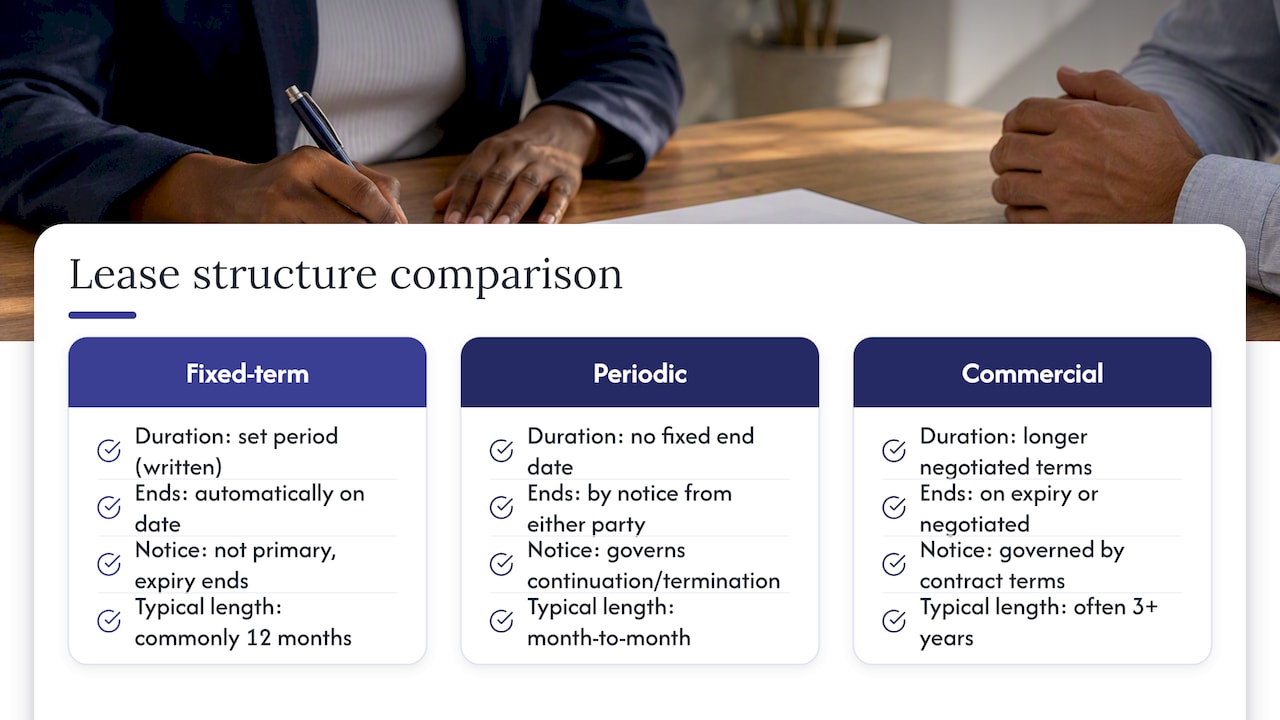
A fixed-term lease runs for a set period agreed in writing, commonly 12 months for residential property or longer for commercial premises, and it ends automatically on the stated date unless renewed. A periodic lease has no fixed end date and simply continues month to month until either party gives notice.
Periodic tenancies often arise by accident rather than design. When a tenant stays on after a fixed-term lease expires with the landlord’s knowledge, the arrangement typically becomes periodic on the same terms, with notice requirements taking over from the original expiry date.
Commercial leases tend to run longer, often three years or more, and put more weight on negotiated points such as escalation percentages, renewal options and who carries responsibility for structural repairs. A sample industrial lease schedule shows how these clauses are typically structured in longer-form agreements.
Ending a lease: notice, renewal and eviction basics
Knowing how a lease ends matters as much as knowing how it starts, since most disputes happen in the final weeks of a tenancy.
- Calculate notice correctly. For a periodic lease, notice is generally one calendar month, and it should align with the payment cycle rather than an arbitrary date.
- Understand what happens at expiry. If a tenant remains beyond the fixed term with the landlord’s consent, case law confirms the arrangement is deemed a periodic lease on the existing terms, requiring at least one month’s written notice to end it. This deeming rule is treated as a starting assumption rather than an absolute rule, so it can be challenged with evidence of a different agreement.
- Follow proper eviction procedure. Removing an occupier without a court order is not an option; the Prevention of Illegal Eviction Act requires formal notice and court consideration of the occupier’s circumstances before any eviction can proceed.
Skipping these steps rarely speeds things up. It tends to delay matters further and adds legal cost on top of lost rent.
Money clauses: escalation, deposits and hidden charges
Financial terms are where vague drafting causes the most damage, because a loosely worded clause is hard to enforce later.
Escalation clauses should state a fixed percentage or clear formula tied to an anniversary date, never a vague reference to “market rates” that both parties will interpret differently. Deposit clauses need to specify the amount, confirm it will be invested in an interest bearing account, and set out exactly when it will be refunded after move out, along with any deductions process. Watch for charge breakdowns too: rates, taxes and service fees should be itemised rather than bundled into one unexplained figure, since bundled charges are the most common source of billing disputes later in the tenancy.
Reading, querying and negotiating lease terms before signing
A short pre-signing check catches most problems before they become expensive ones.
- Confirm every date: commencement, occupation and expiry should match across all pages of the lease.
- Query vague notice wording: ask for the exact number of days or months and the method of delivery.
- Ask for the escalation formula in numbers, not a general reference to inflation or market conditions.
- Check deposit and maintenance clauses against the Rental Housing Act requirements before you sign.
- Keep every signed document and the defects annexure for the full length of the tenancy.
Our lease agreement checklist walks through these points in more detail if you want a document to work from.
Pro Tip: Photograph every room on move-in day, date the images and attach them to a signed annexure so there is no dispute about condition when the lease ends.

Why clear lease terms protect your rental income
Ambiguous clauses do not just create arguments, they create financial exposure. A vague notice period or an undefined escalation formula makes it harder to act quickly when a tenant stops paying or leaves early, and that delay is where landlords lose money. Rental income insurance is designed to complement good lease practice by covering tenant non-payment, early lease termination, and eviction-related legal costs, helping to mitigate losses from problematic lease clauses. Our rental agreement essentials guide pairs well with this article if you are drafting a new lease.
What years of lease disputes teach us
The costliest mistakes are rarely dramatic. They are a missing defect annexure, a notice clause nobody defined properly, or a deposit refund date left blank. Keep signed copies, document condition at every handover and get unclear wording fixed before you sign, not after.
— Coert
How rental income insurance helps when lease terms let you down
Even a carefully worded lease cannot stop a tenant from defaulting, leaving early or refusing to vacate, and that is the gap Rental Income Insurance is designed to close. Cover extends to tenant non-payment, early lease termination and legal costs tied to the eviction process, giving you a financial backstop while the lease terms themselves work through their statutory notice periods.

If you are weighing up how a tenanted property affects a future sale, this property-sale considerations guide is a useful companion read. When you are ready to see how cover works for your situation, request a quote and get a policy structured around your lease.
This article is general information, not a substitute for advice from a qualified financial advisor. Consult a qualified financial professional about your own circumstances before acting on anything here.
Sources
- General Notice, Notice 2111 of 1998 (Rental Housing Act provisions)
- Luanga v Perthpark Properties Ltd (2018)
FAQ
What is the meaning of a lease?
A lease is a written or verbal agreement giving a tenant the right to occupy a property for a set period in exchange for rent. It sets out both parties’ obligations, including rent, duration and maintenance responsibilities.
How many months is a 3 year lease?
Commercial leases commonly run for several years and often include a renewal option.
What is a lease term example?
A common example is a 12 month fixed-term residential lease starting on the 1st of a month and ending on the last day of the 12th month. Commercial leases tend to run longer, often three years or more, as shown in standard commercial lease schedules.
What are the three main types of leases?
The main structures are fixed-term leases, which end on a set date, periodic leases, which continue month to month until notice is given, and longer commercial leases with negotiated renewal terms. Which one applies depends entirely on what the written agreement states, or what happens after a fixed term expires.
Watch: understanding rental income protection
For a visual walkthrough of how rental income protection fits into good lease management, watch this video: