
TL;DR:
- Many South African landlords underestimate the importance of clear, legally compliant escalation clauses to protect their income.
- Properly drafted clauses that specify the method, percentage, and effective date prevent disputes, vacancies, and legal challenges.
Many South African landlords sign lease agreements with escalation clauses they only partially understand, and that gap costs them. Whether you are collecting rent on a sectional title flat in Cape Town or a commercial space in Johannesburg, explaining rental escalation clauses properly is the first step to protecting what you have built. Get the clause wrong and you face disputes, vacancy risk, or increases that simply cannot hold up in court. Get it right and you have a reliable, legally sound mechanism that shields your income against inflation year after year.
Table of Contents
- Key takeaways
- Explaining rental escalation clauses: what they are and how they work
- The legal framework governing rent increases in South Africa
- Risks and challenges landlords face with escalation clauses
- Best practices for drafting and managing escalation clauses
- Applying escalation clauses: notices, disputes, and resolution
- My perspective on escalation clauses and tenant relations
- Protect your rental income beyond the clause
- FAQ
Key takeaways
| Point | Details |
|---|---|
| Escalation clauses are legally binding | They must be explicitly drafted in the lease to allow any rent increase during a fixed term. |
| No national rent cap exists | South African law requires increases to be fair and market-supported, not capped at a set percentage. |
| Notice timing is non-negotiable | Landlords must give one calendar month’s notice for month-to-month leases and 20 business days for CPA-covered renewals. |
| High escalations increase vacancy risk | Over 50% of commercial tenants cannot sustain increases above 4%, making aggressive escalation counterproductive. |
| Clear drafting prevents litigation | Poorly worded clauses are a leading cause of landlord-tenant disputes in South Africa. |
Explaining rental escalation clauses: what they are and how they work
A rental escalation clause is a provision written into a lease agreement that allows the landlord to increase the rent by a specified amount or method at agreed intervals. It is one of the most important rental clause definitions you will ever need to understand, and it does one fundamental job: it protects your income from being eroded by inflation, rising municipal costs, or shifts in the property market.
In South Africa, lease agreement escalation provisions typically take one of three forms:
- Fixed percentage increase. The rent rises by a set percentage each year, say 8% or 10%, regardless of what the broader economy is doing. This is the most common format in residential leases and offers both parties complete certainty about future costs.
- CPI-linked increase. The increase is tied to the Consumer Price Index, meaning rent moves in line with official inflation figures. This approach feels fairer to many tenants but introduces variability that landlords need to plan for.
- Market review clause. The rent is reviewed against prevailing market rates at a given date and adjusted accordingly. These clauses are more common in commercial leases and require an agreed methodology for determining current market values.
Understanding rental escalation also means recognising how these clauses differ between lease types. Residential leases tend to use fixed percentages because simplicity suits the relationship. Commercial leases often include market reviews or CPI linkage because the financial stakes and negotiating sophistication of the parties involved are higher. The wording in each case matters enormously. A clause that reads “rent shall be increased annually” without specifying the percentage or method is almost certainly unenforceable.
Pro Tip: Always include both the escalation percentage and the effective date of increase within the clause itself. Ambiguity about either will be interpreted against you as the landlord if a dispute reaches the Rental Housing Tribunal.
The legal framework governing rent increases in South Africa
Understanding the law is not optional for landlords. How rental escalation works in a legal sense determines whether your clause will hold up when challenged, and South African law has specific rules you must follow.
Here is a structured view of the key legal principles that govern landlord rental increase rules in this country:
-
No national rent cap applies. There is no fixed national cap on rent increases in South Africa, but any increase must be fair, reasonable, and either agreed in the lease or justifiable on market grounds. You cannot increase rent arbitrarily simply because you want to.
-
Fixed-term leases require an explicit clause. Landlords cannot increase rent during a fixed lease term unless the escalation clause explicitly permits it. If your lease is silent on increases, you are bound by the original rent until the term ends.
-
Notice requirements differ by lease type. Written notice is mandatory in all cases. For month-to-month leases, one full calendar month’s notice is required. For leases covered by the Consumer Protection Act, landlords must give 20 business days’ notice before a renewal increase takes effect.
-
The Consumer Protection Act does not apply universally. This is where many landlords get caught out. A 2026 Supreme Court of Appeal judgment clarified that the CPA only covers leases where the landlord’s rental activity forms part of their ordinary business. Private individuals leasing out a single property may fall outside its scope entirely.
-
The Rental Housing Act sets baseline fairness standards. Even where the CPA does not apply, the Rental Housing Act requires landlords to act fairly and in good faith. Any increase that shocks the conscience of the court or the Tribunal will not stand.
-
Poorly drafted clauses invite litigation. Consulting property law specialists when drafting or revising escalation clauses significantly improves enforceability and reduces your exposure to costly disputes.
Pro Tip: Have your lease reviewed by a property attorney every two years. South African case law evolves, and a clause that was solid in 2022 may now be vulnerable given the 2026 Supreme Court of Appeal rulings on CPA applicability.
Risks and challenges landlords face with escalation clauses
Even a legally sound clause can create real problems if it is applied without judgment. Negotiating rental clauses is not purely a legal exercise. It is also a financial and relationship exercise.
The risks are well documented:
- Vacancy risk from aggressive increases. Over 50% of commercial tenants in South Africa cannot sustain escalations above 4% annually, according to 2026 TPN Credit Bureau data. Landlords who default to 8% or 10% annual increases without considering tenant affordability are trading short-term income for long-term vacancies.
- Disputes from unclear wording. If your clause does not specify when the increase applies, how it is calculated, or how it will be communicated, you create room for disagreement. Disagreement leads to Tribunal referrals and, in some cases, legal action.
- Mismatch with market conditions. A fixed 10% clause looks reasonable when CPI is running at 7%. It looks predatory when CPI drops to 3.5% and your tenant knows it.
- CPI volatility creating unpredictable income. CPI-linked clauses protect tenants from feeling overcharged but expose landlords to years of very low increases. Your municipal rates and levies do not follow CPI on your schedule.
- Non-renewal as the real cost. When a long-standing tenant leaves because of an unaffordable increase, you absorb agent fees, a void period, and the risk of a weaker replacement tenant. That cost often exceeds what you would have gained from the higher rent.
“Landlords who adapt escalation strategies to tenant affordability achieve better renewal outcomes amid rising cost pressures.” This finding from the 2026 TPN report is a reminder that retention is as important as rate.
The rental insurance trends in 2025 and into 2026 reflect these pressures directly. More landlords are seeking protection not just from non-payment but from the cascade of problems that follow an escalation dispute.
Best practices for drafting and managing escalation clauses
Getting the clause right from the start is far cheaper than fixing it later. Here is how to structure escalation clauses that hold up legally and work practically:
-
Ground your percentage in data. Use current CPI figures or local market rental data to set a percentage that is both justifiable and competitive. A clause linked to CPI plus one percentage point is often more defensible than a flat 10%.
-
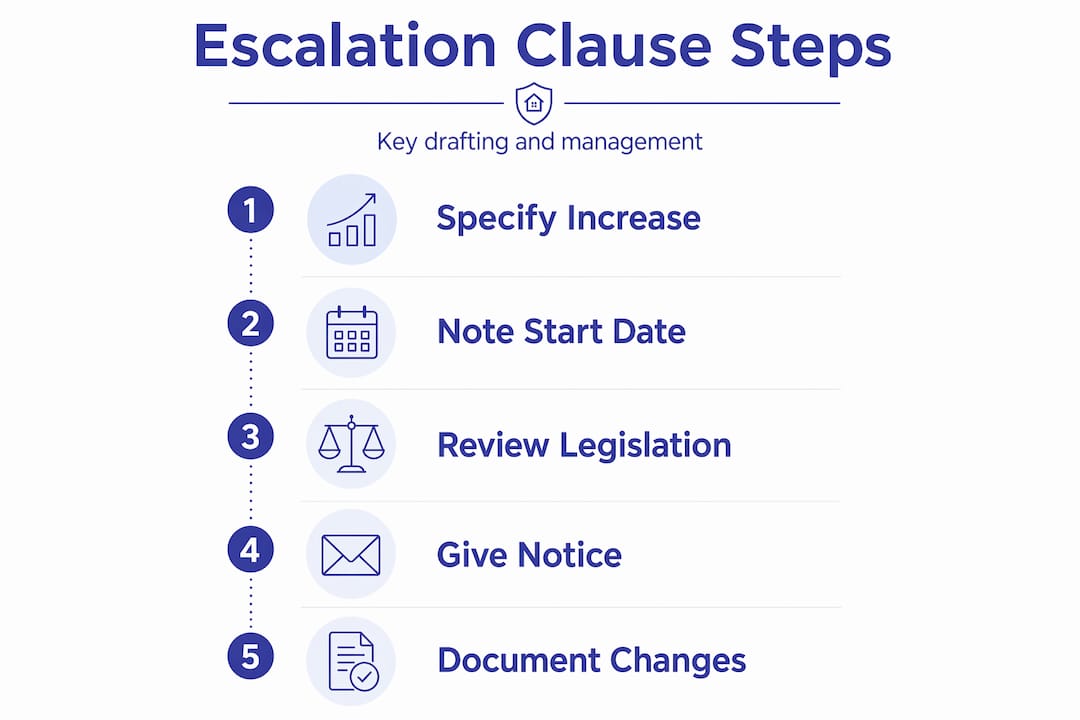
Specify the exact mechanism and date. Your clause should state the escalation percentage, when it becomes effective, and how it is calculated. Vague language like “rent shall escalate annually as agreed” will not protect you.
-
Comply with notice requirements from day one. Build notice periods into your leasing calendar. Set a reminder 60 days before each escalation date so you have time to issue proper written notice and document it correctly.
-
Negotiate flexibility into longer leases. Tenant renewal decisions increasingly hinge on perceived value and affordability. If your property is strong, consider offering a slightly lower escalation in exchange for a longer committed term. You sacrifice a little on rate and gain on security.
-
Keep records of every communication. Written correspondence about increases, acknowledgements of notice, and any negotiated adjustments should be filed. If a dispute arises, your paper trail is your first line of defence.
For further guidance on structuring your leases well, the rental agreement protection steps resource covers how well-structured clauses reduce disputes and protect income over time.
Pro Tip: Do not treat the escalation clause as a set-and-forget provision. Review it every time a lease comes up for renewal. What worked two years ago may expose you now, particularly given the evolving CPA case law.

Applying escalation clauses: notices, disputes, and resolution
Drafting the clause is only half the job. Applying it correctly is where many landlords stumble.
When the escalation date approaches, your process should follow these steps:
- Issue written notice well ahead of time. For month-to-month tenancies, send your notice at least one calendar month before the new amount takes effect. For CPA-covered renewals, give at least 20 business days. Use email and keep delivery confirmation.
- State the new amount clearly in your notice. Include the current rent, the escalation percentage, the new monthly amount, and the effective date. Avoid language that requires the tenant to calculate anything themselves.
- Invite dialogue before it becomes a dispute. If you anticipate pushback, reach out to the tenant before sending the formal notice. A conversation ahead of time is far more productive than a letter that lands cold.
- Respond to objections in writing. If a tenant disputes the increase, acknowledge their concern in writing and state your legal basis clearly. Reference the lease clause and attach the relevant section.
- Use the Rental Housing Tribunal when needed. The Tribunal has authority to mediate disputes over rent increases and enforce compliance without the cost of litigation. Filing a Tribunal complaint is accessible and relatively fast compared to court proceedings.
The Tribunal route is often underused by landlords who assume it favours tenants. In practice, a landlord with a well-drafted clause, proper notices, and documented communication will be in a strong position before any mediator.
My perspective on escalation clauses and tenant relations
I have seen landlords treat escalation clauses as a mechanism for maximising annual income, almost like a contractual entitlement to squeeze out every rand. In my view, that approach is short-sighted and, increasingly, financially dangerous.
The data from 2026 is clear. Most tenants simply cannot absorb increases above 4% without that affordability pressure affecting their renewal decision. When a good tenant walks because you pushed through a 10% increase during a market where 5% was defensible, you have not protected your income. You have damaged it.
What I have learned over time is that the best escalation clauses are the ones tenants barely notice, because they are fair, predictable, and communicated early. Landlords who pair a reasonable escalation with a proactive relationship with their tenants retain income over years, not just in any given month.
Legal compliance matters enormously, and I would never suggest skipping the legal review. But compliance is the floor, not the ceiling. The landlords who manage escalation well treat it as one part of a broader strategy for rental income protection rather than as an isolated annual exercise.
The enforceability of escalation clauses depends on precise drafting and full compliance with both the Rental Housing Act and the Consumer Protection Act. That is not bureaucracy. That is the foundation of a professional landlord’s business.
— Coert
Protect your rental income beyond the clause
A well-drafted escalation clause protects your income on paper. But what happens when a tenant disputes the increase and simply stops paying? Or when they vacate early to avoid the new rate?

That is exactly the gap that Rentalincomeinsurance is built to fill. When escalation disputes tip into non-payment, early lease termination, or tenant absconding, your rental income should not be the casualty. Rentalincomeinsurance covers landlords against precisely these scenarios, giving you a financial safety net that sits beneath your lease agreement, not instead of it. Whether you are managing one property or a growing portfolio, the right cover means one difficult tenant does not derail your entire income plan. Request a personalised quote today, or visit Rentalincomeinsurance to learn more about what rental income insurance covers.
FAQ
What is a rental escalation clause?
A rental escalation clause is a lease provision that allows a landlord to increase rent at specified intervals by an agreed percentage or method. Without this clause, rent cannot be increased during a fixed-term lease in South Africa.
Is there a maximum rent increase allowed in South Africa?
There is no fixed national cap on rent increases in South Africa. Increases must be fair, reasonable, market-supported, and explicitly permitted by the lease agreement.
How much notice must a landlord give before raising rent?
Landlords must provide at least one calendar month’s written notice for month-to-month leases and 20 business days for leases covered by the Consumer Protection Act.
Does the Consumer Protection Act cover all rental agreements?
No. A 2026 Supreme Court of Appeal ruling confirmed that the CPA only applies where letting property forms part of the landlord’s ordinary business activity. Private landlords leasing a single property may fall outside its scope.
What can a tenant do if they dispute a rent increase?
Tenants can refer the matter to the Rental Housing Tribunal, which has authority to mediate disputes over rent increases and enforce compliance without the need for costly court proceedings.
Watch this short video for more on protecting your rental income:
https://youtu.be/LlbS8kqwxJw
Recommended
- How to Enforce Lease Clauses for Reliable Rental Income – Rental Income Insurance
- Key Rental Property Terms Explained for SA Landlords – Rental Income Insurance
- Effective Rental Agreement Protection Steps for Landlords – Rental Income Insurance
- Rental Indemnity Explained: Safeguarding South African Landlords – Rental Income Insurance