
Public indemnity insurance for landlords, more accurately called rental income insurance, pays out when a tenant stops paying rent, ends a lease early without notice, or disappears from the property altogether. It commonly extends to legal and eviction costs, though every policy sets its own limits, waiting periods and evidence requirements. Those details decide whether a claim pays in full, in part, or not at all.
TL;DR:
- Rental income insurance covers non-payment, early lease termination, and absconding, but each incident requires specific evidence like notices or site reports.
- It excludes property damage, routine repairs, and loss of market rent, focusing solely on lost income and legal eviction costs.
- Claims must follow a strict process involving prompt notification, proof submission, and lawful eviction procedures, which can take several months in South Africa.
- Waiting periods, policy limits, and required documents significantly influence whether a claim is paid and how much is covered.
- Premium costs depend on the insured rent amount, claims history, tenant vetting, and length of indemnity period, with proper screening reducing premiums.
Table of Contents
- 1. Which incidents usually trigger a payout
- 2. What the cover leaves out and how it differs from other policies
- 3. How claims work and why tribunal timelines matter
- 4. A policy checklist: limits, waiting periods and proof
- 5. What drives the cost of your premium
- 6. How to choose a policy and what to ask before buying
- Why rental indemnity is a safety net, not your first defence
- How we help if a tenant stops paying or disappears
- FAQ
- Sources
1. Which incidents usually trigger a payout
Insurers structure cover around three core events: non-payment, early termination and absconding. Each has its own definition, and knowing it helps you tell early whether an incident qualifies.
Non-payment typically means rent is overdue by a set number of days, often 7 to 14, before a waiting period starts counting down. Early termination usually requires written proof, such as a signed notice or an exchange of messages confirming the tenant intends to vacate before the lease ends. Absconding is judged more strictly: insurers generally want evidence that the tenant has left without notice, which might include a site visit report, a police statement, or attempts to trace the tenant through known contacts.
Legal and eviction costs form the fourth pillar of cover. These typically include:
- Attorney fees for drafting and serving eviction notices
- Sheriff fees for delivering court documents and executing an eviction order
- Court or tribunal filing fees tied to the eviction application
- Costs linked to obtaining an eviction order once the Rental Housing Tribunal process or a magistrate’s court concludes
Each of these items is usually reimbursed only once you can show the process followed lawful eviction steps from start to finish.
2. What the cover leaves out and how it differs from other policies
Rental income insurance is not a catch-all. It focuses on lost rent and the legal process to recover a property, not on the physical state of that property.
- Wear and tear from ordinary occupation is never covered
- Tenant-caused damage falls outside the policy unless you’ve added malicious damage cover
- Loss of market rent, meaning the gap between what a vacant unit could earn and what it previously earned, is typically excluded
- Routine repairs and maintenance remain the landlord’s responsibility regardless of tenant behaviour
Public liability insurance (covering injury or damage claims from third parties on your property) and professional indemnity insurance (covering negligence claims against professionals) are entirely separate products; for UK landlords, see our Property Owners Liability Insurance Explained For Landlords for helpful distinctions. Rental income insurance does not replace either, and a policy sold under this name will not respond to a visitor’s injury claim or a professional’s errors and omissions. If you need clarity on where liability cover fits, our page on public liability insurance sets out that distinction in full.
Waiting periods, tribunal delays and a requirement to mitigate loss (for example, by issuing a formal demand before lodging a claim) are common restrictive clauses worth reading twice.
Pro Tip: Read the “duty to mitigate” clause before you sign. Insurers often expect proof you tried to recover rent directly before the claim was lodged.
3. How claims work and why tribunal timelines matter
A claim typically follows a fixed sequence, and skipping a step can delay or void payment.
- Notify your insurer as soon as rent is overdue past the policy’s defined threshold.
- Submit the rent ledger and signed lease agreement as proof of the tenancy and arrears.
- Serve the required legal notices on the tenant, keeping proof of service.
- Lodge the matter with the relevant tribunal or court where the lease or policy requires it.
- Provide the insurer with court or tribunal documents, including any ruling or order issued.
Eviction in South Africa cannot happen without a court order. The Prevention of Illegal Eviction from and Unlawful Occupation of Land Act requires landlords to follow notice and hearing procedures before a court will grant an eviction, and this process can extend the period you go without rental income. Tribunal mediation or arbitration can add further weeks, with some provinces taking around three months from complaint to ruling according to Gauteng Rental Housing Tribunal guidance. Most policies factor this delay into their indemnity period, so legal invoices for attorney and sheriff work are typically paid once the insurer confirms the eviction followed lawful process, as set out in the practice guidelines for evictions under PIE.
4. A policy checklist: limits, waiting periods and proof
Before signing anything, run through this short list with your broker or insurer.
- Confirm the indemnity period in months and whether there’s a per-claim and an aggregate limit
- Ask what the waiting period is before a non-payment or absconding claim can be lodged
- Check the excess amount payable on each claim type
- Confirm whether legal support for eviction is bundled in or sold as an add-on
- Ask which documents are required for proof: typically the lease, arrears ledger, notices served, bank statements and any tribunal or court order
- Consider optional extras such as malicious damage cover or separate legal expense cover if your base policy excludes them
Reading this list against your policy wording takes a few minutes and often reveals gaps you’d otherwise discover only at claim stage.
5. What drives the cost of your premium
Premiums are priced against the risk the insurer is taking on, and a handful of factors move that number more than others.
The rental amount you’re insuring sets the baseline, since a higher insured rent means a higher potential payout. Claims history matters too: a landlord with prior lost-rent claims is priced differently to a first-time applicant. Lease terms, tenant vetting standards, property type and whether the unit is occupied all feed into the underwriting decision. A longer indemnity period or higher claim limits push the premium up, while a shorter period or lower limit brings it down.
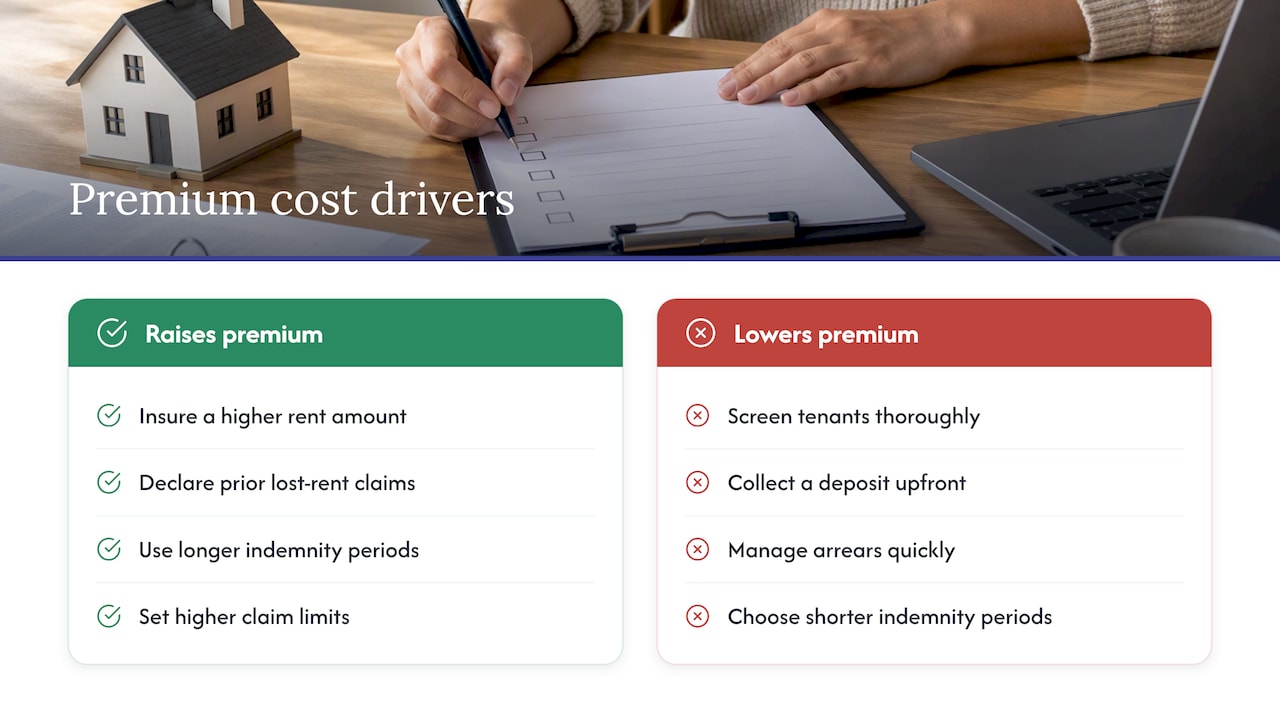
Insurers often reward landlords who screen tenants properly, collect a deposit upfront and manage arrears quickly once they appear, since these steps reduce the likelihood a claim is ever needed.
6. How to choose a policy and what to ask before buying
Start with a simple question: does this product match the events you actually worry about, non-payment, early termination or absconding, and does the indemnity period give you enough runway if an eviction drags on?
- Ask whether tribunal or court delays are covered within the standard indemnity period or only as an extension.
- Ask what evidence is required for an absconding claim specifically, since standards vary between insurers.
- Ask which supporting documents must be submitted and in what format.
- Ask for a realistic claim turnaround time once documents are submitted.
Pro Tip: Get these answers in writing from your broker before you commit, not after a tenant has already stopped paying.
If the answers satisfy your main concerns and the policy wording is clear, that’s usually enough to proceed. If tribunal delay cover or abandonment evidence standards feel vague, it’s worth getting a broker or legal opinion before signing.
Why rental indemnity is a safety net, not your first defence
Tenant screening and a properly collected deposit remain your strongest tools against default. Rental income insurance exists for the scenarios screening can’t fully prevent: a reliable tenant who loses their job, a lease that ends abruptly, or a tenant who vanishes mid-dispute while the eviction process grinds through a tribunal. Industry commentary from landlord associations frames insurance as a final layer of protection, not a substitute for vetting. We’d put it the same way: get the fundamentals right first, then let a policy catch what good practice can’t.
— Coert
How we help if a tenant stops paying or disappears
We offer cover designed around lost rent from non-payment, early termination and absconding, plus legal support to get through the eviction process without footing attorney and sheriff fees alone.

- Residential Rental Insurance for standard tenancy risk
- Commercial Rental Insurance for business tenants and longer lease terms
- Eviction Insurance focused specifically on legal costs during the eviction process
- Group Rental Insurance for landlords managing multiple units or a portfolio
- Tenant Insurance as a complementary layer alongside your existing cover
Our Rental Income Insurance plans are priced as detailed on our website, with no waiting period on eligible cover. If you’d like a figure specific to your property, request a quote and we’ll talk you through what applies, or start at our Rental Income Insurance homepage for the full picture.
FAQ
What does rental income insurance actually pay for?
It pays lost rent when a tenant stops paying, ends a lease early without proper notice, or absconds, plus legal and eviction costs tied to recovering the property. The exact scope depends on your policy’s limits and waiting periods.
Is property damage covered under this type of policy?
No, property damage caused by a tenant is generally excluded unless you’ve added malicious damage cover. Our page on property damage liability explains how that risk is usually handled separately.
How long does a claim take once a tenant stops paying?
Timelines depend on the waiting period in your policy and how long the eviction process takes through the courts or a tribunal, which can run to around three months in some provinces according to tribunal guidance. Insurers generally pay once lawful process is confirmed through submitted documents.
Does this cover apply if the tenant leaves without notice?
Yes, absconding is typically covered, but insurers usually want evidence such as a site visit report or proof of attempted contact before approving the claim. Standards for what counts as sufficient evidence vary between providers.
How is this different from public liability insurance?
Rental income insurance covers lost rent and eviction costs, while public liability insurance covers injury or damage claims from third parties on your property. They address entirely different risks and neither substitutes for the other.
Sources
- Prevention of Illegal Eviction from and Unlawful Occupation of Land Act 19 of 1998
- Practice guidelines: eviction in terms of the Prevention of Illegal Eviction From and Unlawful Occupation of Land Act 19 of 1998
- Gauteng Rental Housing Tribunal: Who can lodge a complaint
- South African property investors face serious risks — Landlords Association (LASA)