
TL;DR:
- Gross rental income is the total rent collected before expenses are deducted.
- Net rental income is what remains after allowable costs like bond interest, rates, and maintenance are subtracted.
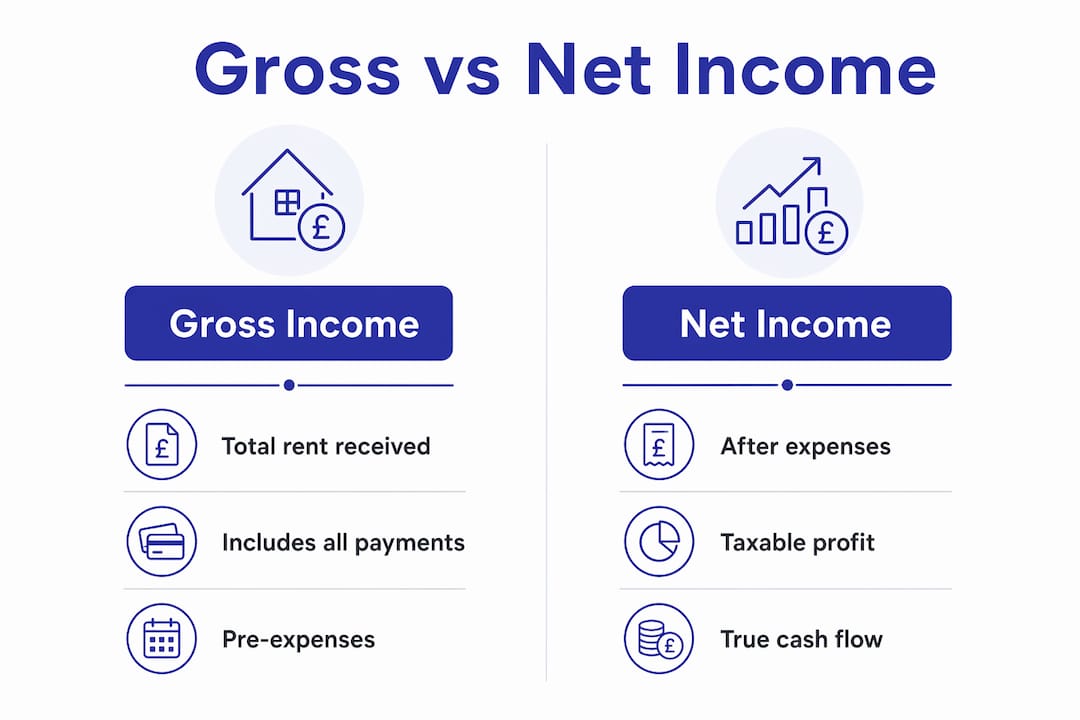
Gross rental income is the total rent you collect before any expenses are deducted. Net rental income is what remains after allowable costs such as municipal rates, bond interest, insurance, and maintenance have been subtracted. The difference between gross and net rental income is not merely academic. It determines your actual taxable profit, shapes your investment decisions, and directly affects how much you owe SARS at the end of the tax year. Every landlord and property investor needs to understand both figures clearly.
What is the difference between gross and net rental income?
Gross rental income is your starting point. It represents every rand collected from a tenancy before a single expense is considered. Net rental income is the figure that actually matters for profitability and tax purposes. The gap between the two can be substantial, and confusing one for the other leads to poor investment decisions and tax errors.

Think of it this way. If your property earns £18,000 per year in rent but costs £6,000 to run, your gross income is £18,000 and your net income is £12,000. The net figure is what SARS taxes, and it is the number that tells you whether your property is genuinely profitable.
Both figures serve different purposes. Gross income is useful for comparing properties at a surface level. Net income reveals the real return on your investment after the costs of ownership are accounted for.
What counts as gross rental income?
Gross rental income includes monthly rent, non-refundable deposits, and lease premiums, and must be declared fully on your ITR12 return under “Local Rental Income.” SARS requires you to report the full amount before any deductions. There is no option to report only what you consider your “profit.”
The following items form part of gross rental income:
- Monthly rental payments from tenants
- Non-refundable deposits retained at the end of a lease
- Lease premiums paid upfront by tenants
- Any other regular payments received in exchange for occupation
Pro Tip: Keep a separate bank account for rental income. This makes it far easier to reconcile your gross rental income figure at tax time and reduces the risk of missing a declaration.
Landlords sometimes assume that only the rent itself counts. In practice, any payment tied to the right to occupy the property forms part of gross income. Declaring less than the full amount is a compliance risk that can attract SARS penalties.
How is net rental income calculated?
Net rental income equals gross rental income minus all allowable deductions. SARS taxes net rental income at your marginal rate, which ranges from 18% to 45% depending on your combined annual income. This means your rental profit is added to your salary or other earnings, and the combined total determines which tax bracket applies.
Allowable deductions include:
- Municipal rates and taxes
- Body corporate levies
- Bond interest (not the capital repayment portion)
- Building insurance and landlord liability cover
- Maintenance and repairs
- Property management fees
- Advertising costs for finding tenants
Rental income is added to your other income for taxation, which can push you into a higher marginal tax bracket. A landlord earning a salary of R400,000 and net rental income of R80,000 is taxed on R480,000 in total. That distinction catches many first-time investors off guard.
Pro Tip: Calculate your net rental income monthly, not just at year end. Tracking it monthly lets you spot rising costs early and adjust your rent review strategy before your margins shrink.
One critical point: only the interest portion of your bond repayment is tax-deductible. The capital repayment reduces your debt but does not reduce your taxable income. Many landlords claim the full bond instalment by mistake, which is an error SARS will correct on audit.
How do gross and net rental yields differ?
Gross yield and net yield are the two standard measures of property investment performance. Gross yield is calculated as annual rent divided by purchase price, multiplied by 100. Net yield subtracts operating costs from annual rent before dividing by purchase price. The national average gross rental yield in South Africa sits at approximately 10.93%, with net yields typically 2–3 percentage points lower due to operating costs.
That gap matters enormously. A property marketed at a 10% gross yield may deliver only 7% or 8% in net yield once real costs are factored in. Gross yield is often promoted by sellers and agents because it shows a higher number. Net yield is the figure that reflects whether your cash flow is sustainable month to month.
The table below illustrates how common expenses reduce gross yield to net yield:
| Expense category | Typical annual impact |
|---|---|
| Body corporate levies | 1.0%–1.5% of property value |
| Municipal rates and taxes | 0.5%–1.0% of property value |
| Maintenance and repairs | 0.5%–1.0% of annual rent |
| Property management fees | 8%–12% of monthly rent |
| Vacancy allowance | 8%–10% of annual rent |
Vacancy rates typically cost landlords 8% to 10% of annual rent on long-term lets. That single cost alone can reduce a seemingly attractive gross yield to a mediocre net return. Body corporate levies, municipal rates, and management fees reduce net rental yield by about 2–3 percentage points compared to gross yield in the Cape Town area, and similar patterns apply across Johannesburg and Pretoria.
Vacancy and management fees must be modelled carefully in cash flow forecasts. Omitting them produces overly optimistic yields and can lead to genuine cash shortages when costs arrive.
Common tax pitfalls when calculating net rental income
The most expensive mistake landlords make is confusing capital expenses with revenue expenses. Repairs restore a property to its original condition and are immediately tax-deductible. Improvements extend the property’s useful life or add value, and are not immediately deductible. Instead, improvements are added to the cost base and factored into the capital gains tax calculation when you eventually sell.
Common pitfalls include:
- Claiming the full bond repayment instead of only the interest portion
- Treating a kitchen renovation as a repair rather than an improvement
- Failing to register as a provisional taxpayer when required
- Missing the R30,000 annual threshold for provisional taxpayer registration
Landlords must register as provisional taxpayers if their rental income exceeds R30,000 annually. This requirement surprises many first-time investors who assume rental income is handled through their standard annual return alone.
Pro Tip: Create two columns in your expense spreadsheet: one for revenue expenses (immediately deductible) and one for capital expenses (not immediately deductible). This simple habit prevents filing errors and protects you during a SARS audit.
Detailed, updated spreadsheets that distinguish between capital and revenue expenses are the single most effective tool for avoiding tax compliance problems. Accurate records also make it possible to claim every legitimate deduction without fear.
Using gross and net income knowledge to manage your property better
Net rental income is the only reliable basis for cash flow projections. Gross income tells you what tenants pay. Net income tells you what you actually keep. Building your investment model on gross figures alone produces budgets that fall apart the moment a geyser bursts or a tenant vacates.
Practical steps for better financial management include:
- Review your expense categories every six months to identify rising costs
- Benchmark your net yield against comparable properties in your area
- Factor a vacancy allowance of at least 8% into every cash flow forecast
- Separate capital and revenue expenses from the first month of ownership
- Consider rental income insurance as a fixed cost within your net income calculation
Tenant non-payment is one of the most damaging threats to net rental income. A single month of missed rent can wipe out two or three months of net profit after fixed costs are paid. Rental income protection covers this gap, ensuring your cash flow remains intact even when a tenant defaults or vacates early.
Insurance premiums paid to protect rental income are an allowable deduction. That means the cost of cover reduces your taxable net rental income, making it one of the few expenses that simultaneously protects your cash flow and reduces your tax bill.
Watch this short overview to see how rental income insurance works in practice:
Key takeaways
Net rental income, not gross rental income, is the figure that determines your taxable profit, reflects true cash flow, and should drive every property investment decision you make.
| Point | Details |
|---|---|
| Gross income is pre-expense | Gross rental income includes all rent and lease payments before any costs are subtracted. |
| Net income is taxable profit | Net rental income equals gross income minus allowable deductions, taxed at your marginal rate. |
| Yield gap is 2–3 points | Net yield typically falls 2–3 percentage points below gross yield once operating costs are included. |
| Bond interest only | Only the interest portion of bond repayments is deductible; the capital portion is not. |
| Repairs vs improvements | Repairs are immediately deductible; improvements are capitalised and affect capital gains tax on sale. |
Why I think most landlords are flying blind on net income
Most landlords I speak to know their monthly rent figure off the top of their heads. Ask them their net rental income and the room goes quiet. That gap in awareness is where financial problems begin.
Gross income is the number agents quote when selling you a property. Net income is the number that pays your bond, covers your rates, and determines whether you owe SARS money in february. The two are not interchangeable, and treating them as such is a costly habit.
The landlords who manage their properties well are the ones who build a monthly net income statement from day one. They know their vacancy allowance, their management fee, and their insurance premium as precisely as they know their rent. They also understand that a negative net rental income is not always a disaster. SARS allows rental losses to offset other income in certain circumstances, which can reduce your overall tax bill if managed correctly.
My strongest advice is this: never make a purchase decision based on gross yield alone. Calculate the net yield using realistic vacancy and cost assumptions before you commit. And once you own the property, protect that net income with a policy that covers tenant non-payment and early lease termination. The cost of cover is deductible. The cost of an uninsured vacancy is not.
— Coert
Protect the income you have worked hard to build
Knowing your gross and net rental income figures is the foundation of sound property management. The next step is making sure that net income is protected when a tenant stops paying or leaves without notice.

Rentalincomeinsurance covers landlords against tenant non-payment, early lease termination, and absconding. The premium is an allowable deduction, so it reduces your taxable net rental income while keeping your cash flow intact. Whether you own one property or a growing portfolio, the risk of a missed rental payment is real and the financial impact can be severe. Request a quote today and find out how affordable it is to protect your rental income from the unexpected.
FAQ
What is the difference between gross and net rental income?
Gross rental income is the total rent collected before any expenses are deducted. Net rental income is what remains after allowable costs such as bond interest, municipal rates, insurance, and maintenance have been subtracted.
What expenses reduce gross rental income to net rental income?
Allowable deductions include municipal rates, body corporate levies, bond interest, building insurance, repairs, property management fees, and advertising costs. Only the interest portion of bond repayments qualifies, not the capital repayment.
Is net rental income taxed in South Africa?
Net rental income is added to your other income and taxed at your marginal tax rate, which ranges from 18% to 45% depending on your total annual earnings.
What is the difference between gross and net rental yield?
Gross yield divides annual rent by purchase price. Net yield subtracts operating costs from annual rent before dividing by purchase price. Net yields typically run 2–3 percentage points below gross yields once vacancy, levies, and management fees are included.
When must a landlord register as a provisional taxpayer?
A landlord must register as a provisional taxpayer when rental income exceeds R30,000 annually. Failing to register is a compliance risk that can result in SARS penalties.