
For landlords renting out a townhouse, “homeowners insurance for townhouse” means rental income insurance that protects you against tenant non-payment, early lease termination, and absconding. Core protection includes loss of rent, tenant-default cover, and legal or eviction costs. A specialist provider such as Rental Income Insurance offers tailored policies built specifically for South African landlords rather than generic homeowner cover.
TL;DR:
- Rental income insurance covers tenant default, early lease termination, and absconding, with legal support included in the policy.
- Policies typically cap loss-of-rent payouts at three to six months, so landlords in slow eviction areas should ensure adequate coverage duration.
- Proper tenant screening, documented notices, and avoiding self-help eviction are crucial to prevent claim denials and ensure smooth processing.
- The legal eviction process under South African law usually takes several weeks to months, emphasizing the importance of legal-fees coverage and realistic payout periods.
- Coverage details, including triggers, payout caps, and legal costs, vary significantly between policies; landlords must review these before committing.
Table of Contents
- What rental income insurance for a townhouse actually covers
- Core policy features landlords should expect
- How to choose the right policy for a rented townhouse
- How eviction law shapes your insurance claim
- Filing a claim after tenant default or property damage
- Basic coverage components behind a townhouse policy
- Townhouses versus single-family homes: what changes
- Exclusions and optional extras specific to townhouses
- How HOA and body corporate rules affect your own policy
- How premiums get calculated and what pushes cost up
- Filing a standard homeowners claim as a townhouse owner
- Why specialist rental cover beats a generic homeowner policy
- Getting a tailored quote for your townhouse rental
- Sources
- FAQ
What rental income insurance for a townhouse actually covers
Rental income insurance protects the money you rely on from your townhouse, not the bricks and mortar. There are two related but distinct products landlords confuse constantly: loss-of-rent cover, which pays out when a property becomes uninhabitable due to damage, and tenant-default (rent guarantee) cover, which pays out when a tenant simply stops paying. Rental income insurance can cover both scenarios, but the triggers and proof requirements differ sharply.
Typical triggers include:
- A tenant who stops paying rent and refuses to leave
- Early termination that leaves the unit vacant before a replacement tenant is found
- Absconding, where a tenant disappears without notice or a forwarding address
- Legal and court costs incurred while pursuing a lawful eviction
Exclusions usually apply to pre-existing arrears, tenants who were never properly screened, and losses arising from a landlord’s own failure to follow legal notice procedures.
Core policy features landlords should expect
Not every policy called “rental protection” covers the same ground, so read the wording before you sign anything.
Loss of rent clauses pay out either the contracted monthly rent or the actual net loss you can prove, and that distinction matters at claim time. Some insurers cap loss-of-rent payments at a fixed number of months regardless of how long the eviction process actually takes.
Tenant-default or rent-guarantee features usually come with underwriting conditions attached upfront: proof of tenant screening, a credit check on record, and sometimes a minimum lease term. Insurers want evidence you did due diligence before the tenant moved in, not just after they stopped paying.
Legal-fees cover is where many policies earn their premium. Eviction proceedings in South Africa can run for months and the legal bill adds up quickly, so cover that includes attorney fees and court costs for a lawful eviction is worth prioritising over a policy that only pays lost rent.
Common features to compare across quotes:
- Maximum months of loss-of-rent payout
- Whether legal fees are included or a separate add-on
- Excess or waiting period before cover activates
- Whether public liability is bundled or sold separately
Pro Tip: Ask for the insurer’s exact definition of “default” and “uninhabitable” in writing before you buy. Two policies with near-identical names can pay out on completely different triggers.
How to choose the right policy for a rented townhouse
Comparing quotes on price alone is the fastest way to end up under-covered. Work through this checklist before you commit:
- Confirm the trigger events covered. Does the policy pay for non-payment, early termination, and absconding, or only one of the three? A cheap policy that only covers property damage will not help you when a tenant simply stops paying.
- Check the maximum months of cover. Some policies cap loss-of-rent payments at three or six months. If eviction typically takes longer in your province, that gap comes out of your own pocket.
- Ask about waiting periods and excesses. A new policy often carries a waiting period before a default claim is valid, which matters if you are switching insurers mid-tenancy.
- Establish proof requirements upfront. Insurers typically want a signed lease, an arrears schedule, and evidence of formal notice before they pay a default claim.
- Ask whether civil recovery must be attempted first. Some policies require you to pursue the tenant for the debt before the insurer pays out, which can delay your claim by weeks.
- Confirm eviction-legal-support limits. Does the policy pay a set amount toward attorney fees, or does it cover the full cost of a lawful eviction through to sheriff enforcement?
- Disclose your screening process honestly. Underwriters ask about tenant credit checks and prior loss history for a reason. Misrepresenting this at application stage is the single most common cause of a declined claim later.
Red flags worth walking away from: vague definitions of “default,” no stated maximum on legal-fees cover, and any insurer that cannot explain its own claims process clearly over the phone. A specialist landlord product tends to answer these questions faster than a generalist broker selling homeowner cover as an afterthought.
How eviction law shapes your insurance claim
Insurers do not pay claims in a legal vacuum. The Prevention of Illegal Eviction and Unlawful Occupation of Land Act (PIE) requires at least 14 days’ written notice before an eviction hearing, and courts must weigh the occupier’s vulnerability before granting an order. Skip these steps and you risk losing both the eviction application and the insurance claim tied to it.
Insurers generally expect you to have followed the same paper trail a court would want to see. That means proper notice, a documented arrears schedule, and proof the tenant received it.
Why self-help evictions are a dealbreaker: changing locks, cutting off electricity, or removing a tenant’s belongings without a court order is unlawful in South Africa, and it can void your insurance claim outright because the insurer will treat the loss as self-inflicted rather than tenant-caused.
Documents insurers typically ask for include:
- The signed lease agreement
- A dated arrears schedule showing exactly when payments stopped
- Copies of breach notices and proof of delivery (registered post or signed acknowledgement)
- Inspection photos showing the property’s condition
- Court papers, including the eviction order once granted
Courts apply what is often called a “just and equitable” test under PIE, weighing factors like how long the occupier has been in the home and whether alternative accommodation exists. That test can add weeks to a straightforward-looking case, which is exactly why legal-fees cover in your policy earns its premium.
Filing a claim after tenant default or property damage
Speed and documentation decide most claims. Follow these steps as soon as a tenant misses a payment or damage occurs:
- Gather evidence immediately. Photograph any damage, save every text and email exchange with the tenant, and note the exact date rent became overdue.
- Issue a formal breach notice in writing. State the amount owed, the date it fell due, and a clear deadline to remedy the breach, then send it by a method you can prove was delivered.
- Notify your insurer early, not after the eviction concludes. Most policies expect notification within a set window of the first missed payment, not months later.
- Keep a running claims timeline. Log every notice sent, every court date, and every payment received or missed, with dates attached to each entry.
- Submit documentation as it becomes available rather than waiting to bundle everything at the end. Insurers process partial submissions faster than a single large file dropped on them at the last minute.
Claims commonly get declined because a landlord skipped formal notice, disclosed screening inaccurately at application, or attempted a self-help eviction before involving the courts.
Pro Tip: Keep time-stamped copies of everything, including proof of registered post. A single missing delivery receipt has sunk otherwise straightforward claims.
Basic coverage components behind a townhouse policy
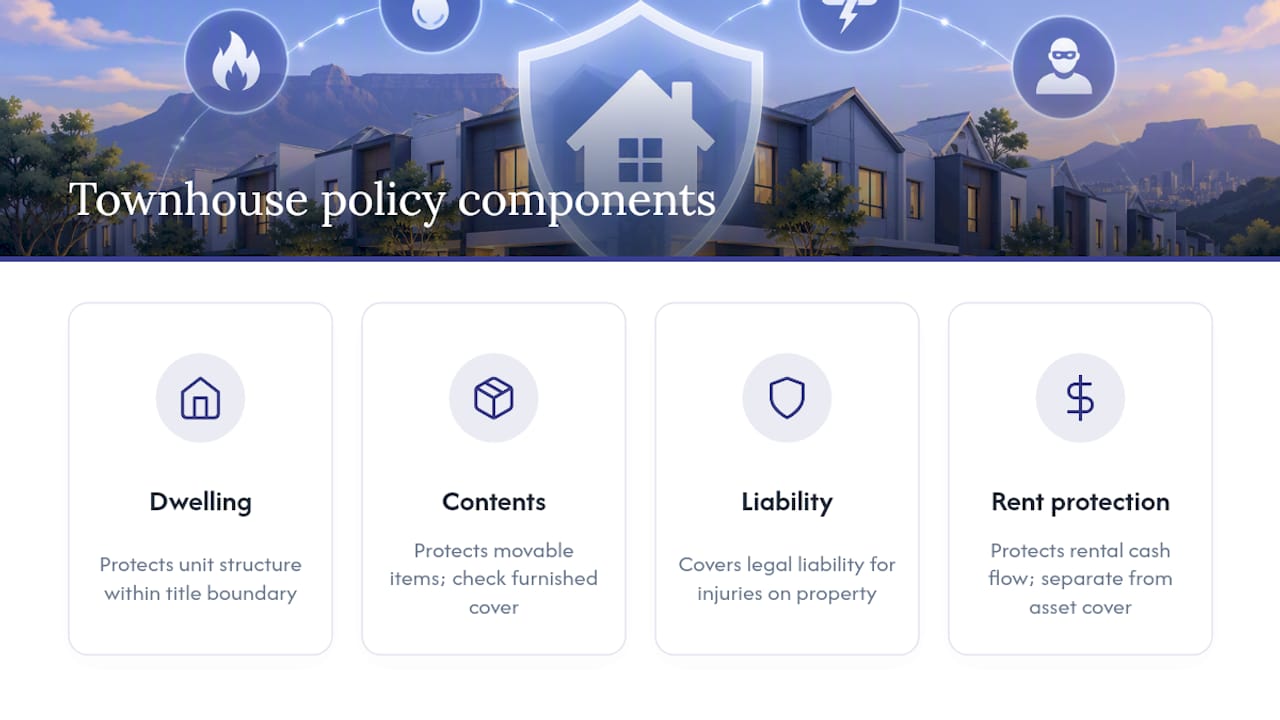
Even though this guide focuses on protecting rental income, it helps to understand the coverage categories that sit underneath most landlord policies, because rent-protection cover is usually bought alongside them rather than instead of them.
Dwelling coverage protects the physical structure of the townhouse unit itself, the walls, roof, and fixtures within your title boundary. For a townhouse, this is often narrower than a free-standing house because shared structural elements may fall under a body corporate or homeowners association policy instead.
Personal property or contents cover protects movable items inside the unit, whether that is your own furnishings in a furnished rental or fixtures you own separately from the building shell. Landlords renting out a furnished townhouse should confirm whether contents cover extends to items provided for tenant use, since a standard policy sometimes assumes owner-occupation.
Liability cover protects you if someone is injured on the property and holds you responsible, which matters more for landlords than owner-occupiers because tenants and their visitors are constantly moving through communal walkways, stairwells, and parking areas you do not fully control. A public liability add-on is worth discussing separately from rent-protection cover, since the two address entirely different risks.
None of these three components replace rental income insurance. They protect the asset and your legal exposure; rent-protection cover protects the cash flow that asset is supposed to generate.
Townhouses versus single-family homes: what changes
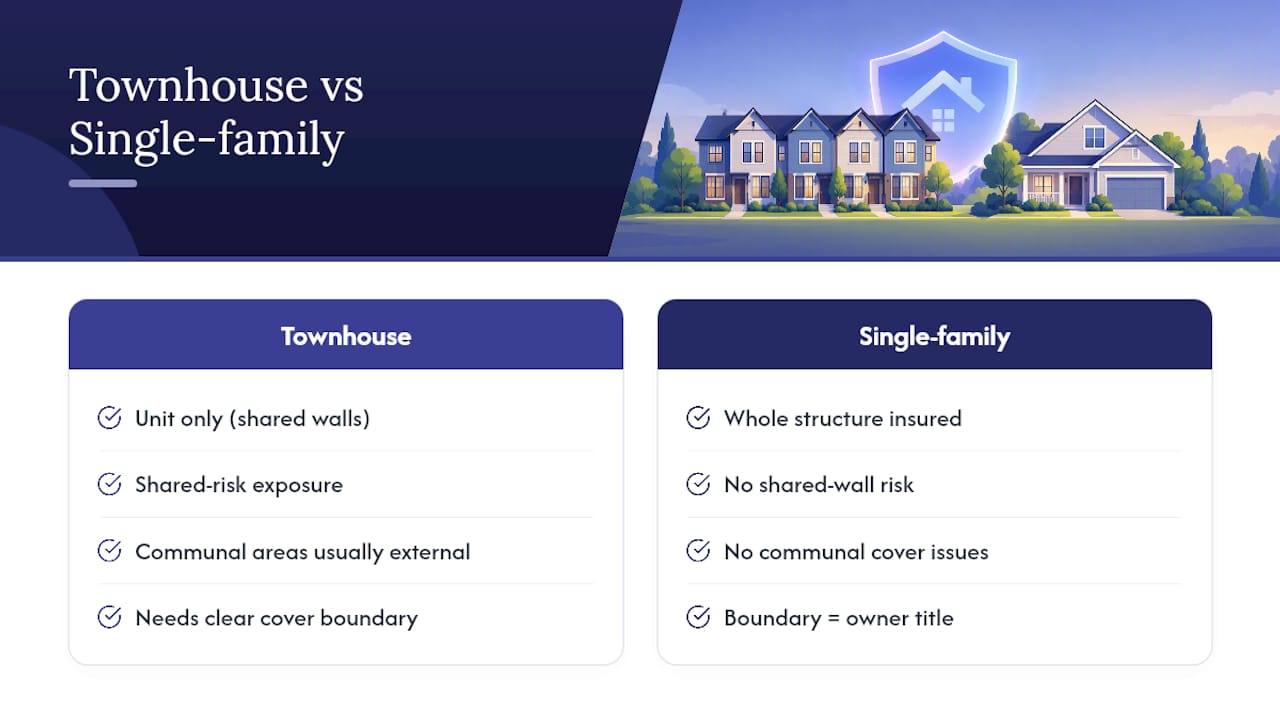
A single-family home owner insures the whole structure, boundary to boundary, because there is nothing shared. A townhouse owner insures a unit that shares at least one wall, and often a roofline, with a neighbour, and that changes both the risk profile and who is responsible for what.
Shared walls mean a fire, burst pipe, or structural issue next door can affect your unit even though the fault sits outside your title boundary. Single-family homeowners never face this cross-liability question in the same way. Townhouse policies typically need clearer boundaries around where your cover starts and the body corporate’s cover ends.
Communal areas add another layer entirely. Driveways, walkways, and shared parking are usually covered under the homeowners association or body corporate policy rather than your individual one, but landlords renting out a townhouse should confirm this rather than assume it, because a tenant’s visitor injured in a shared car park could trigger a liability question that falls into a gap between two policies.
For a landlord, the practical difference that matters most is that rent-protection cover works identically whether the underlying property is a townhouse or a detached house. What differs is the property-level dwelling and liability cover sitting alongside it, which is why confirming your body corporate’s policy scope before buying your own top-up cover saves confusion later.
Exclusions and optional extras specific to townhouses
Shared walls create a specific exclusion pattern that single-family homeowners rarely encounter. Damage originating in a neighbouring unit, such as a leak that seeps through a party wall, is often excluded from your own policy and instead falls to the neighbour’s cover or the body corporate’s building policy, depending on how the sectional title scheme is structured.
HOA or body corporate coverage typically handles the building’s exterior structure, roof, and communal areas, while your individual policy handles the interior and your own liability. That split means duplicate cover is a real risk. Paying for structural cover your body corporate already provides wastes premium money without adding protection.
Optional extras worth considering for a rented townhouse include:
- Malicious damage cover for damage a tenant causes deliberately, which sits outside normal wear-and-tear exclusions
- Alternative accommodation cover if the unit becomes temporarily uninhabitable and you need to relocate a tenant
- Accidental damage cover for events that fall outside standard perils lists
Landlords renting a townhouse specifically should confirm whether their landlord insurance responds to shared-wall damage or whether that claim needs to go through the body corporate first, since getting this wrong at claim time causes real delays.
How HOA and body corporate rules affect your own policy
Body corporates typically hold master insurance covering the building’s structure, common property, and shared amenities, funded through levies every unit owner pays. That master policy shapes what you actually need to buy individually, and getting the split wrong means either paying for cover you do not need or discovering a gap when something goes wrong.
Most sectional title schemes require unit owners to insure their own interior finishes, fixtures they have installed themselves, and contents, since the master policy typically stops at the unit’s original structural shell. Some HOA rules go further and mandate a minimum level of personal liability cover for every owner, particularly where communal facilities like pools or gyms create shared injury risk.
Landlords should request a copy of the body corporate’s insurance schedule before finalising their own policy, because it tells you exactly where the master cover ends. Ask specifically whether the master policy includes loss-of-rent for common-area damage that makes a unit unrentable, since some schemes cover this and others leave it entirely to the individual owner. Skipping this check is one of the more common reasons townhouse landlords discover a coverage gap only after a claim has already been declined.
How premiums get calculated and what pushes cost up
Insurers price rental income cover against the risk that a specific tenant, in a specific property, in a specific area, defaults or causes a loss. Several factors move the number up or down.
Monthly rent value is the starting point, since loss-of-rent and default cover are priced as a proportion of what you stand to lose each month. Rental Income Insurance, for context, prices its core cover at 3.5% to 5% per month of the insured rental value, which gives landlords a direct link between the rent they charge and what protecting it costs.
Tenant screening quality affects underwriting decisions directly. A tenant with a documented credit check and verified employment history is a lower risk than one accepted without screening, and insurers price accordingly.
Claims history matters both for the property and for you as a landlord. A unit with a prior default claim, or a landlord with multiple recent claims across a portfolio, typically faces a higher premium or tighter conditions.
Location and area risk feed into pricing too, since default and vacancy rates vary by region and insurers track this.
Cover scope is the final lever. A policy that bundles legal-fees cover, a higher months-of-cover cap, and liability add-ons costs more than a bare-bones loss-of-rent policy, but it also closes more of the gaps that cause declined claims later.
Filing a standard homeowners claim as a townhouse owner
If you are claiming on the property-damage side of your cover rather than the rent-protection side, the process runs differently, and it applies whether you occupy the townhouse yourself or rent it out.
Report the damage promptly. Most policies set a notification window, often within days of discovering the loss, and missing it can jeopardise the claim regardless of how legitimate the damage is.
Document everything before repairs begin. Photograph the damage from multiple angles, note the date it was discovered, and avoid starting repairs until the insurer has either inspected the property or explicitly authorised you to proceed.
Gather supporting paperwork. This includes the original policy schedule, any relevant maintenance records, and, where the damage may have originated from a shared wall or communal area, correspondence with the body corporate about responsibility.
Get repair quotes from at least two contractors. Insurers often require this for anything beyond minor damage, and having quotes ready speeds up the assessment.
Follow up in writing. Keep a dated record of every call and email with the insurer’s claims team, since a standard property claim can take several weeks to assess, and a paper trail protects you if there is a dispute over timelines or coverage decisions.
Why specialist rental cover beats a generic homeowner policy
Ordinary homeowner cover was never designed to protect income you earn from a paying tenant, and treating it as if it does is where most landlords get caught out. Rental income insurance exists specifically because a business-like rental relationship carries risks a standard policy simply was not built to price. Rental Income Insurance structures its cover around tenant non-payment, early termination, and absconding, with legal support built into the eviction process rather than bolted on as an afterthought, and its claim under immediate coverage with no waiting period is a real point of difference for landlords who need protection to start the moment a policy is active, not weeks later.
— Coert
Getting a tailored quote for your townhouse rental
Once you know what your policy needs to cover, getting an actual quote is a short conversation, not a lengthy application. Have your property details, monthly rent figure, current lease term, and any tenant screening or claims history ready before you reach out, since these are the details underwriters use to price your cover accurately.

Some insurance products are designed specifically for landlords needing rental cash flow protection rather than relying on generic homeowner policies that do not address tenant risks directly. Such specialized rental income insurance often structures cover around triggers landlords face — non-payment, early termination, and absconding — with legal support for the eviction process integrated rather than offered separately.
For a closer look at how the cover works, this short video walks through the basics:
.
Request a tailored quote directly and a broker will match you with cover suited to your specific townhouse rental, whether you are protecting a single unit or a small portfolio.
Sources
The PIE Act text sets the legal notice and hearing requirements every eviction must follow. Landlord rights guidance from SD Law covers practical notice and documentation steps. The Property24 eviction steps guide sets out the exact procedural sequence for non-payment cases.
- Prevention of Illegal Eviction and Unlawful Occupation of Land Act (PIE) — Republic of South Africa
- Landlord rights South Africa | Leases, arrears & evictions — SD Law
- What is Rental Income Insurance? – GeoAfrika
FAQ
What does rental income insurance actually cover?
It covers loss of rent when a tenant defaults, an early lease termination leaves a unit vacant, or a tenant absconds. Many policies, including Rental Income Insurance’s offering, also include legal-cost support for the eviction process.
How much does townhouse rental insurance cost?
Rental Income Insurance prices its core cover at 3.5% to 5% per month of the insured rental value, with the exact rate depending on the property, tenant screening, and claims history. Other providers publish quotes on request rather than a fixed rate.
Can I claim if I changed the locks myself?
No. Self-help evictions, including changing locks or removing a tenant’s belongings without a court order, are unlawful and can void your insurance claim entirely.
Does the body corporate’s insurance cover my rental income?
Usually not. Body corporate or HOA master policies typically cover the building structure and common property, while loss of rent and tenant default sit under your own individual landlord policy.
How long does an eviction usually take before insurance pays out?
Timelines vary by case, but the PIE Act’s notice and court requirements mean the process rarely resolves in days. Practical guides note that eviction proceedings can run for months once legal costs and court scheduling are factored in, which is why legal-fees cover and a realistic months-of-cover cap both matter when comparing policies.