
For landlords, this phrase points to rental income protection: insurance that covers tenant non-payment, early lease termination and eviction or legal costs. Providers such as Rental Income Insurance build policies around exactly this risk. The sections below explain what these policies typically cover, what they cost, where the exclusions sit and how to choose one with confidence.
TL;DR:
- Rental income protection policies generally cover missed rent payments, early tenant departure, and legal costs, but exclusions include pre-existing arrears and normal wear and tear.
- Claims require detailed evidence such as the lease, payment history, and eviction notices, with some insurers offering automatic payout models and others requiring legal process completion.
- Policy premiums range from 3.5% to 5% of monthly rent, with higher limits and additional services increasing costs, and coverage duration typically matches the lease term.
- Valid claims depend heavily on a clear, written lease and demonstrating that tenant obligations were fulfilled, as vague lease terms or insufficient vetting can void coverage.
- Regional legal differences influence coverage limits and claim processes, so landlords in multiple jurisdictions must verify insurer policies align with local laws.
Table of Contents
- What these policies usually cover
- How the claims process actually works
- Exclusions, limits and red flags in the policy wording
- What drives the cost of a policy
- Choosing the right policy: a short checklist
- Legal tenancy terms versus insurance product terms
- Tenant rights and obligations that affect your cover
- How long these tenancy arrangements usually run
- Why the rules differ depending on where you let
- When rental income protection makes sense
- How Rental Income Insurance can help you next
- Sources
- FAQ
What these policies usually cover
Rental income protection is built to keep money flowing when a tenant stops paying or leaves before the lease ends. Most policies bundle a few core benefits, though the exact mix varies by insurer and plan.
Rental non-payment cover is the foundation. Some policies pay a monthly rental guarantee that mirrors your usual rent income each month a tenant defaults, while others work as a lump-sum indemnity paid once a claim is finalised. The difference matters for cashflow: a monthly guarantee keeps your budget steady, while a lump sum arrives later but can be larger.
Early termination and absconding cover step in when a tenant breaks the lease without notice or simply disappears. This protects you from the gap between one tenant leaving and a replacement moving in, which is often where landlords feel the most financial strain.
Legal and eviction cost cover addresses the fees tied to recovering possession of your property, including attorney costs and court-related expenses. This is not automatic on every policy, so check whether it is included or sold as an add-on.
- Rental non-payment cover replaces missed rent, paid monthly or as a lump sum.
- Early termination and absconding cover bridges the income gap when a tenant leaves unexpectedly.
- Legal and eviction cost cover pays for the process of recovering your property, where included.
How the claims process actually works
Buying a policy is only the start. Knowing what happens when a tenant defaults is what turns cover into peace of mind rather than paperwork.
- You purchase the policy and confirm the tenant meets any vetting requirements the insurer sets.
- A tenant misses rent or breaches the lease, and you notify your insurer within the timeframe stated in the policy.
- You submit evidence: the signed lease, a payment history showing the default, any arrears notices sent to the tenant and, where eviction proceedings have started, the relevant court documents.
- The insurer assesses the claim against the policy wording and confirms whether it is accepted.
- Payment follows, either as a scheduled monthly amount or a lump sum once the claim is settled.
Evidence is central to a smooth claim, and industry commentary notes that insurers commonly expect proof of reasonable tenant vetting before they accept a claim, alongside a properly drafted lease. Some market products operate on a debit-order basis that pays out automatically and quickly once a payment is missed, while others are claims-assessed and require the legal process to progress first. The trade-off is speed against certainty: automatic models suit landlords who need fast cashflow, while claims-assessed models often extend cover further into the eviction process.
Pro Tip: Keep a dated folder of every rent reminder, arrears notice and payment record from day one, not just once a tenant starts missing payments.
Exclusions, limits and red flags in the policy wording
No policy covers everything, and the exclusions are usually where landlords get caught out. Arrears that existed before the policy started are almost always excluded, so cover only applies to defaults that happen after the start date. Claims can also be declined if the landlord breached the lease first, or if tenant vetting was inadequate at the outset. Wear and tear is treated differently from deliberate damage: general ageing of carpets or paintwork is not covered, while intentional destruction usually is.
- Pre-existing arrears at the start of the policy are typically excluded from any claim.
- Landlord breaches of the lease, or weak tenant vetting, can void a claim entirely.
- Normal wear and tear is excluded, while deliberate damage is usually covered.
- Waiting periods before cover activates, and caps on legal fees or total payout months, can significantly reduce the practical value of a policy.
Red flags worth chasing before you sign include vague wording around what counts as “default,” a cap on legal fees that would not stretch to a real eviction case, and any clause that makes payout conditional on the eviction being fully completed. Ask for the full policy document, not a summary, and read the exclusions section before the benefits section.
What drives the cost of a policy
Premiums are usually priced in one of two ways: as a percentage of monthly rent, or as a one-off premium covering the length of the lease. Market commentary has reported premiums priced as a small percentage of rental income, with cover often capped at a finite number of months and legal fees capped at a set amount.
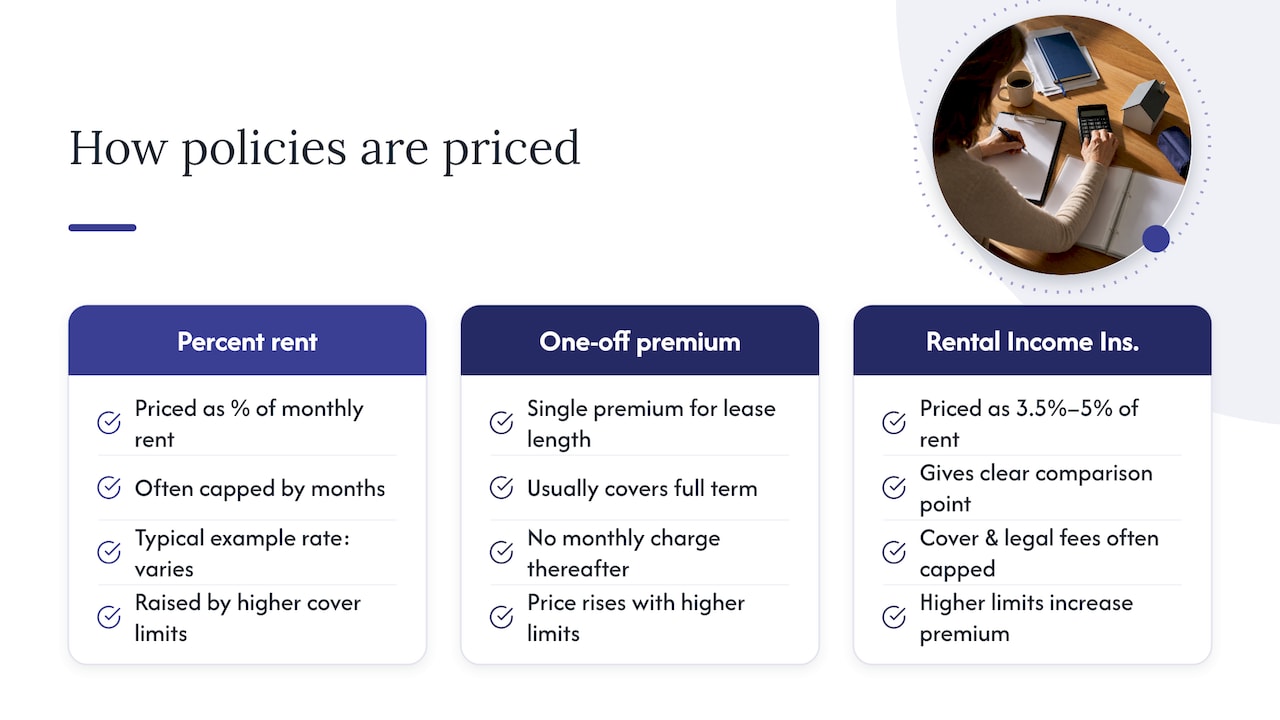
Rental Income Insurance prices its cover at 3.5% to 5% of monthly rent, which gives landlords a clear reference point when comparing quotes.
Higher cover limits, a history of prior claims and add-ons such as managed eviction services all push the premium up. A landlord with a clean claims record and a well-vetted tenant will typically see a lower quote than one insuring a higher-risk letting. Tax treatment can also affect the real cost of cover: whether premiums are deductible against rental income depends on your circumstances, so confirm this with an accountant or tax advisor before assuming the net cost.
Choosing the right policy: a short checklist
Comparing policies side by side is the only way to see past the marketing and into the actual terms. Work through this before you commit to an insurer.
- Confirm exactly what triggers a payout: missed rent, formal default, or only after eviction proceedings begin.
- Check payout timing: monthly instalments during the default, or a lump sum once the claim closes.
- Look at the legal fee limit and compare it to realistic eviction costs in your area.
- Ask what tenant vetting the insurer requires before it will accept a claim.
- Get the full evidence list in writing, covering the lease, payment records, notices and court paperwork.
- Ask whether eviction must be finalised before any payment is released.
Request sample policy wording rather than a marketing brochure, and ask the insurer directly about typical claims handling times, not just theoretical ones. Once you have that, request a quote, compare the cover limits against your actual cashflow needs, and check whether the policy suits a single unit or a portfolio.
Pro Tip: Ask for two things in writing: a sample claims form and an example timeline from missed rent to first payout.
Legal tenancy terms versus insurance product terms
It is worth being clear about what this phrase is doing in this article. In everyday use, the term describes a type of residential lease agreement, a legal arrangement between landlord and tenant. In this context, though, the phrase is used by insurers and landlords as shorthand for the protection product itself, the policy that sits alongside the lease and pays out if the tenant defaults.
The two things are related but distinct. The lease sets out the rent, the term and the obligations of each party. The insurance policy is a separate contract between the landlord and the insurer, and it relies on the lease as supporting evidence rather than replacing it. A written lease clarifies rent, increases and termination terms, and that clarity is exactly what an insurer will want to see when assessing a claim.
Landlords sometimes assume that having insurance removes the need for a properly drafted lease, but the opposite is true. A vague or informal lease weakens both your legal position and your insurance claim, since insurers assess claims against the lease terms and the payment history tied to them. Treat the two as a pair: a solid lease first, then cover built around it.
Tenant rights and obligations that affect your cover
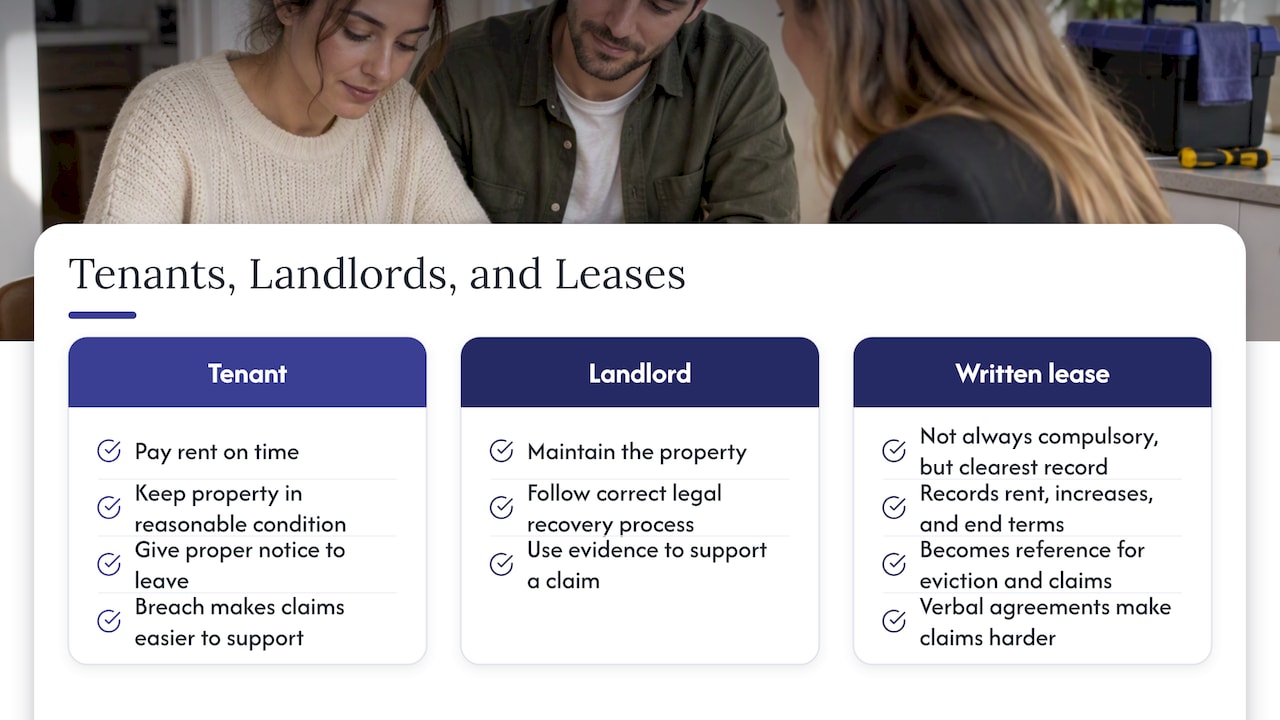
Every insurance claim tied to a tenant default sits on top of the underlying tenancy relationship, so understanding tenant obligations matters even before a claim arises. Tenants are generally expected to pay rent on time, keep the property in reasonable condition and give proper notice if they intend to leave. Landlords, in turn, are expected to maintain the property and follow the correct legal process if they need to recover it.
A written lease is not always compulsory, but it is the clearest way to record what both sides agreed to, including rent amount, increase terms and how the tenancy can end. When a dispute or default happens, this document becomes the reference point for both eviction proceedings and any insurance claim.
Insurers lean on this relationship directly. A claim is far easier to support when the tenant’s obligations were written down clearly and the landlord can show the tenant fell short of them, whether that is missed rent, unauthorised occupants or property damage beyond normal use. Where obligations were only ever discussed verbally, both the legal process and the claims process become harder to evidence. This is one reason tenant vetting and a professionally drafted lease are treated as complementary to insurance rather than optional extras.
How long these tenancy arrangements usually run
Residential leases of this kind are typically fixed for a set period, most often twelve months, though shorter and longer terms exist depending on what landlord and tenant agree. Once the fixed term ends, the arrangement either renews for another fixed period, rolls onto a periodic basis until either party gives notice, or ends outright if neither side wants to continue.
This duration matters for insurance because cover is usually tied to the lease term itself. A policy bought to cover a twelve-month lease will typically run alongside it, and renewing the lease often means renewing or adjusting the policy too. If a tenancy rolls onto a periodic arrangement without a new fixed lease, check with your insurer whether cover continues automatically or needs to be reconfirmed.
Landlords who let the same property to a string of short lets, rather than one longer lease, should pay particular attention here. Each new lease may need its own policy or an amendment to an existing one, and gaps between tenancies are rarely covered. Matching your policy renewal date to your lease renewal date is a simple way to avoid an unintentional lapse in cover.
Why the rules differ depending on where you let
Tenancy law and the insurance products built around it are not identical everywhere. Notice periods, the formal eviction process and even what counts as a valid lease vary from one jurisdiction to the next, and a policy designed around one legal system will not necessarily transfer cleanly to another.
This matters practically because eviction and legal cost cover is only useful if it matches the actual legal process a landlord has to follow locally. A policy that caps legal fees at a level appropriate for one jurisdiction’s court process may fall well short in another, where proceedings take longer or cost more. Always check that the insurer’s legal cost cap and process assumptions match the rules that actually apply where your property sits.
It also affects how insurers assess claims. Evidence requirements, such as which notices must be served before eviction can begin, are set by local law, and an insurer operating across multiple regions will usually tailor its claims checklist accordingly. If you own property in more than one region or jurisdiction, ask your insurer directly whether the same policy terms and legal cost limits apply in each, rather than assuming they do.
When rental income protection makes sense
Every landlord weighs the same trade-off at some point: the certainty of a monthly premium against the uncertainty of a tenant default. Rental income protection tends to make the most sense for landlords whose finances depend heavily on that rent arriving on time, month after month, rather than those with a large cash buffer to absorb a bad tenancy.
The value of a policy is only as good as the questions asked before buying it. Rental Income Insurance focuses specifically on this category of risk for South African landlords, which is a narrower and more useful specialism than a general property insurer bolting on a rental clause. That focus shows up in how clearly the claims process and evidence requirements are explained upfront, rather than buried in wording.
Cover is not a substitute for good tenant vetting or a solid lease. It is a backstop for when those precautions still are not enough.
— Coert
How Rental Income Insurance can help you next
Rental Income Insurance covers tenant non-payment, early lease termination, eviction and legal costs, and property damage, giving you one policy that addresses the risks this article has walked through rather than several partial ones. Premiums are priced at 3.5% to 5% of monthly rent, so the cost scales with the income you are protecting.

If you want to see exactly what a policy includes before committing, the what is rental income insurance page sets out the product in plain terms.
- Request a formal quote through the request a quote page to see pricing against your specific rental income.
- Ask for sample policy wording so you can check triggers, limits and evidence requirements before you buy.
- Confirm claims turnaround times directly with the insurer so you know what to expect if a tenant defaults.
Start with a quote request and compare it against the checklist earlier in this article: it is the fastest way to see whether the cover matches your cashflow needs.
Sources
For legal context on landlord and tenant obligations, see the Western Cape Government’s tenant guidance and Property24’s piece on protecting yourself from evictions. For leasing terminology, see our guide to residential leasing terms.
- Evictions in South Africa: How landlords can protect themselves
- Frequently asked questions for tenants | Western Cape Government
FAQ
What does an assured shorthold tenancy mean in an insurance context?
In this context, the phrase refers to rental income protection insurance, cover that pays out when a tenant stops paying rent, ends a lease early or abandons the property. It sits alongside your lease agreement rather than replacing it, and typically also covers eviction and legal costs.
What is an AST policy meant to protect against?
It is meant to protect a landlord’s rental income against tenant non-payment, early lease termination, absconding and the legal costs of recovering the property. Rental Income Insurance structures its cover around exactly these risks for landlords.
How does rental income protection actually work?
You buy a policy tied to your lease, and if the tenant defaults, you submit evidence such as the lease, payment history and any arrears notices. The insurer then pays out either monthly or as a lump sum, depending on whether the policy is debit-order based or claims-assessed.
What usually is not covered by these policies?
Arrears that existed before the policy started, damage from normal wear and tear, and claims linked to inadequate tenant vetting are commonly excluded. Waiting periods and caps on legal fees or the number of months covered can also limit a payout.
How much does rental income insurance typically cost?
Rental Income Insurance prices cover at 3.5% to 5% of monthly rent, with the exact rate depending on the property, tenant vetting and cover limits chosen. Getting a formal quote is the most reliable way to see the cost for your specific letting.
For more on how landlords manage tenant risk day to day, watch this short video: