
Most rental income insurance policies typically cost a small percentage of monthly rent, varying based on factors like property and tenant profile. We recommend insuring a reasonable number of months’ rent to cover a realistic default-and-eviction timeline. Get a tailored quote before you fix a figure in your budget, since premiums depend on the specifics of each lease and property.
TL;DR:
- Rental income insurance premiums typically range from 2% to 5% of monthly rent, scaling with property location, tenant profile, and optional add-ons.
- Insuring four to six months’ rent offers a realistic buffer for eviction delays, especially in areas with slower court processes.
- Better tenant screening and higher excess choices can decrease premiums, but excluding legal-cost coverage risks higher costs during claims.
- Costs are higher for houses than flats due to larger rent amounts, and premiums are affected by regional eviction timelines and property type.
- Claim processes require timely notification and proper documentation, with most payouts completed within weeks if paperwork is complete.
Table of Contents
- How much should renters insurance cost for a landlord?
- What does rental income insurance actually cost in rand?
- How do you choose the right level of cover?
- What happens when you actually claim?
- Comparing costs across providers and cover levels
- Discounts that can bring your premium down
- Do costs vary by region, and what regulatory factors matter?
- A landlord’s lesson on budgeting for the unexpected
- Get a tailored quote from Rentalincomeinsurance
- Sources
- FAQ
How much should renters insurance cost for a landlord?
Insurers price rental income cover as a percentage of the rent you’re protecting, not as a flat fee. That’s why two landlords with identical rent rolls can get quotes that differ by hundreds of rands, once you factor in location, tenant screening standards and the extras bolted onto the policy.
The percentage-of-rent model exists because it scales risk sensibly. A landlord renting a flat for R8,000 a month carries a different loss potential than one renting a house for R25,000. Pricing as a share of rent keeps the premium proportional to what’s actually at stake if a tenant stops paying.
Several factors move that percentage up or down:
- Location and property type: areas with higher tenant turnover or slower eviction processes through the courts tend to attract higher premiums.
- Tenant screening quality: landlords who run credit checks, verify employment and take deposits equal to a full month’s rent are usually rewarded with better rates.
- Lease terms and tenant profile: month-to-month leases and first-time tenants carry more uncertainty than a tenant on a two-year fixed lease with a clean rental history.
- Claims history: a landlord with a prior claim for non-payment or abandonment will typically see a higher quote on renewal.
- Excess selection: choosing a higher excess (the amount you pay before the policy pays out) usually pulls the premium down.
- Optional add-ons: legal-cost cover for eviction proceedings and early-termination cover both add to the base premium, since they widen what the policy pays for.
Pro Tip: Screening tenants properly before signing a lease is one of the few levers you control directly. Insurers notice, and it often shows up as a lower renewal quote the following year.
What does rental income insurance actually cost in rand?
Converting a percentage into rand terms makes budgeting far more concrete than a bare percentage range does. Premiums for rental income insurance in South Africa commonly sit between 2% and 5% of monthly rental income, and that band holds across most residential lets once you strip out unusual risk factors.
Premiums will vary depending on the monthly rent amount and the exact percentage applied, scaling with the rent to determine the monthly and annual premium costs.
A landlord charging a moderate rent who insures for several months’ cover at a small percentage premium pays a modest monthly and annual amount, which can protect against a significant amount of potential lost rent and legal fees. That’s a fairly small outlay set against a tenant default that could otherwise run for months while an eviction works through the courts.
Add-ons shift these figures in predictable directions. Legal-cost cover for eviction typically adds a modest loading to the base premium, and early-termination cover does the same, since both widen the scope of what the insurer will pay. A higher excess pulls the number back down, while a lower excess raises it.
The quick formula worth keeping on hand: monthly rent × chosen percentage = estimated monthly premium, then multiply by twelve for an annual figure. It won’t replace an actual quote, but it gets you close enough to plan a budget line before you go through the full cost breakdown for landlord insurance.
How do you choose the right level of cover?
Start with how many months of rent you want insured, since this single decision drives both your protection and your premium more than any other choice.
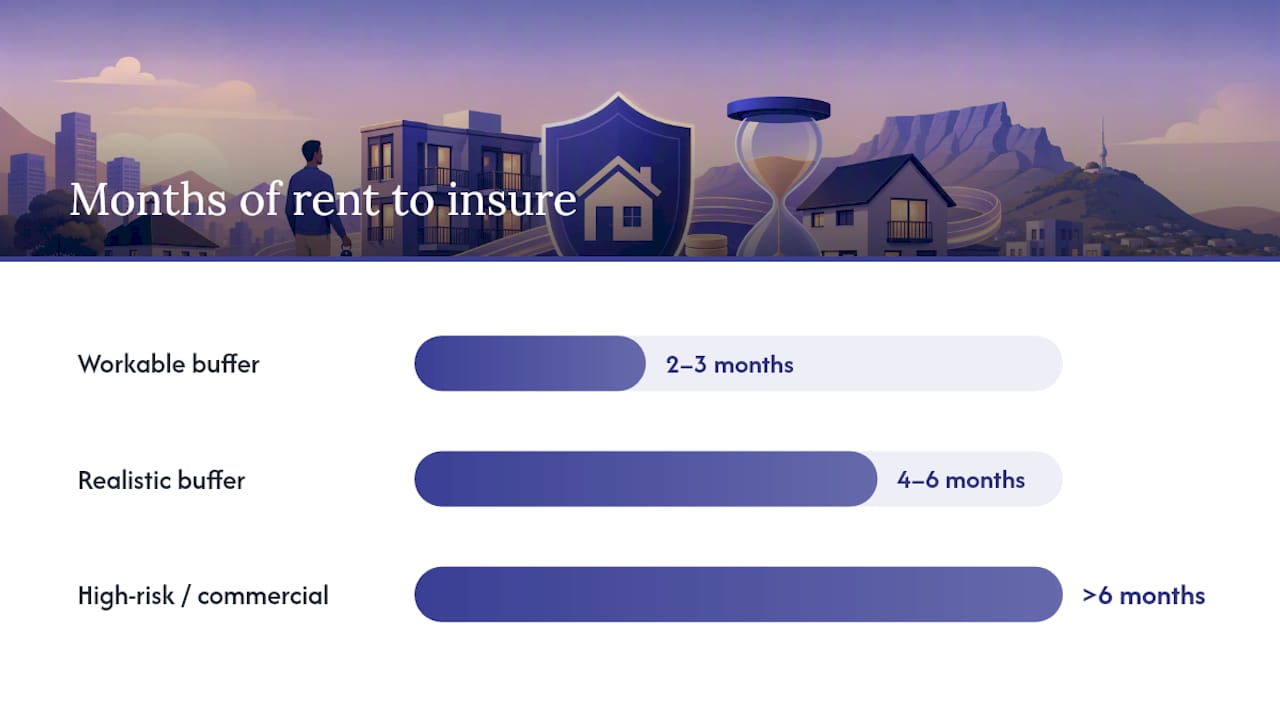
- Two to three months: workable for landlords with strong tenant screening and a healthy cash reserve to absorb a short gap.
- Four to six months: a more realistic buffer once you account for how long eviction proceedings can actually run in South African courts.
- More than six months: worth considering for commercial leases or properties where a vacancy would be financially painful to carry.
Waiting periods and excesses work as a pair. A shorter waiting period gets you paid sooner after a default but usually costs more; a higher excess lowers your premium but means you carry more of the loss yourself before cover kicks in. Match this to your own cash flow, not to the cheapest headline number.
Essential covers to include before you sign anything: unpaid rent, eviction legal costs, absconding, and early lease termination. Leaving any one of these out to save a few rand a month tends to be the gap that costs the most when a claim actually happens.
When comparing quotes, ask the insurer about exclusions, payout caps, rent escalations, required claim documentation, and typical assessment times.
Pro Tip: Furnished units and short-stay lets, including Airbnb-style properties, often need adjusted cover because vacancy risk and tenant turnover run higher. Check how your policy treats furnished versus unfurnished properties before assuming a standard residential quote applies.
What happens when you actually claim?
A claim after tenant default usually follows a fairly predictable sequence, and having the right paperwork ready from day one makes the difference between a quick payout and a drawn-out dispute.
- Notify the insurer as soon as the tenant misses a payment deadline or breaches the lease, rather than waiting to see if they catch up.
- Submit your documentation: a rent ledger showing the payment history, the signed lease, any breach notices, and eviction court papers once proceedings start.
- Insurer assessment: the insurer calculates the unpaid-rent payout against your policy cap and the cover level you selected, factoring in the excess.
- Legal-cost settlement: where eviction legal costs are covered, insurers typically reimburse invoiced legal fees up to the policy limit, often once the eviction is finalised or costs are incurred.
- Payout: once documentation checks out, most straightforward non-payment claims are settled within a matter of weeks rather than months.
Common reasons for repudiation include missing or incomplete rent ledgers, a lease that wasn’t properly signed, or a landlord who delayed notifying the insurer well after the default began. Keeping rental contract essentials such as dated breach notices and a clean rent ledger on file materially speeds up assessment and reduces the risk of a dispute.
Comparing costs across providers and cover levels
Premiums for equivalent cover can still vary meaningfully between insurers, even when two policies both sit within the 2% to 5% band. The spread usually comes down to how each insurer weighs risk, not just the raw percentage they quote.
A basic policy covering only unpaid rent will cost less, while adding eviction legal-cost cover, early-termination protection and absconding cover increases premiums, reflecting broader protection against significant landlord losses. It’s worth comparing quotes on total scope, not headline price alone, since a cheaper policy that excludes legal costs can end up far more expensive if you actually need to evict someone.
Cover level matters just as much as provider. A policy insuring fewer months’ rent will cost less than one insuring more months, due to the difference in maximum payout amount. When you’re weighing quotes side by side, normalise them: ask what percentage of rent each insurer charges for the same number of months’ cover and the same optional extras, rather than comparing raw rand amounts on policies that aren’t actually equivalent. Reviewing the difference between landlord insurance with and without rental income cover is a useful way to see exactly what you gain for the extra premium.
Discounts that can bring your premium down
Several practical steps can shift your quote toward the lower end of the typical range. Bundling rental income cover with a broader landlord insurance policy, such as buildings or liability cover, often earns a better combined rate than buying each separately.
Security features on the property itself, alarm systems, electric fencing, or a managed estate with access control, can also lower the risk profile an insurer assigns to your property. Tenant screening discounts are less commonly advertised but worth asking about directly. If you run credit checks and verify income before signing a lease, some insurers will factor that into pricing.
A clean claims history is the discount that compounds over time. Landlords who go several years without a claim typically see their renewal premiums soften, which rewards good tenant selection as much as good luck. Choosing a higher excess remains the most direct lever available, since it shifts a portion of small losses back to you in exchange for a lower monthly cost. None of these discounts are guaranteed on every policy, so it’s worth asking your insurer or broker which ones actually apply before you assume a saving.
Do costs vary by region, and what regulatory factors matter?
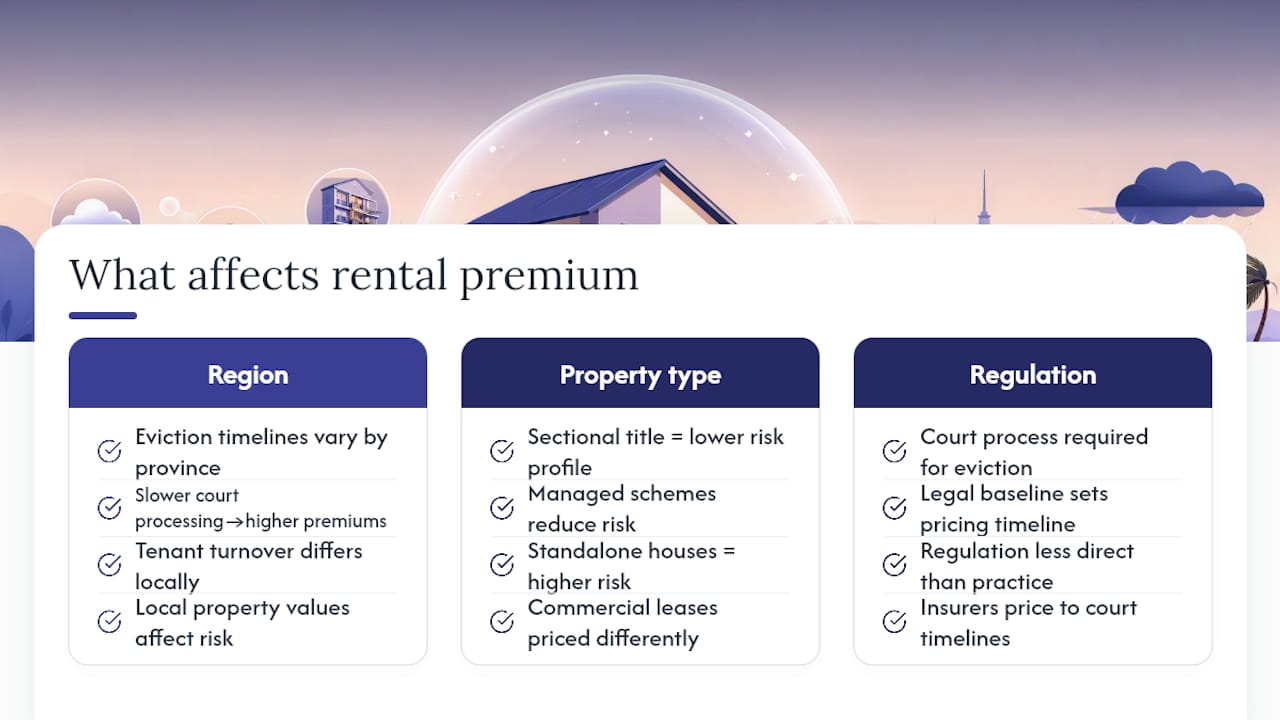
Rental income insurance pricing varies by region within South Africa, largely because eviction timelines, tenant turnover and local property values differ from one province to another. Areas where courts process eviction applications more slowly tend to see higher premiums, since the insurer is effectively underwriting a longer period of potential unpaid rent.
Property type plays a similar role. Sectional title units in managed schemes with body corporate oversight often present a lower risk profile than standalone houses let directly by an individual landlord, which can be reflected in the quote. Commercial leases carry their own pricing logic entirely, generally priced against longer notice periods and larger rent amounts rather than the residential norms used for flats and houses.
Regulatory factors matter less directly than the practical realities of the eviction process itself. South African law requires a formal court process before a tenant can be lawfully evicted, setting the baseline timeline insurers price against. This is precisely why the recommended cover of four to six months’ rent tends to hold up as sound advice across most parts of the country, even though local specifics shift the exact premium a landlord ends up paying.
A landlord’s lesson on budgeting for the unexpected
A landlord we spoke with once described a tenant who seemed reliable for eighteen months, then simply stopped paying and vanished within weeks. The eviction process ran for over three months. The premium they’d paid all year came to less than a single month’s rent, and it covered nearly all of what they lost.
The practical lesson: fold your premium into your annual rental budget as a fixed cost, the same way you’d budget for maintenance or rates. Landlords who treat rental income protection as part of the cost of doing business tend to weather a bad tenant far better than those who see it as an optional extra. Some financial guides make a similar point about small recurring outlays against larger one-off losses, and rental income cover is a clean example of that trade-off in practice.
— Coert
Get a tailored quote from Rentalincomeinsurance
The insurance cover described is built around specific rental risks, including unpaid rent, eviction legal costs, early lease termination, and tenant absconding, with pricing based on the rent roll rather than a one-size-fits-all rate.

Before requesting a quote, have your monthly rent figure, current lease terms, and any tenant screening or payment history on hand. Read the complete guide to rental income protection for a fuller breakdown of what’s included, then request a quote to see what cover would actually cost for your property.
Sources
For more on payout scope, see how much rental income cover pays out, the landlord association’s cost analysis, and this video:
.
This article is general information, not a substitute for advice from a qualified financial advisor. Consult a qualified financial professional about your own circumstances before acting on anything here.
- Is rental insurance worth it in South Africa?
FAQ
How much should renters insurance cost for a rental property?
Expect a small percentage of your monthly rent as premium, depending on location, tenant screening and the optional covers you select.
How much is contents insurance for renters different from rental income cover?
They’re separate products entirely; rental income cover protects a landlord’s rent and legal costs, while contents cover for tenants protects a tenant’s own belongings.
How much is rental income insurance for a house versus a flat?
Houses generally carry higher rand premiums than flats because the insured rent amount is usually higher, even though the percentage rate often stays similar.
How many months of rent should landlords insure?
Most landlords insure between four and six months’ rent, though two to three months can suffice with strong tenant screening and a solid cash reserve.
Does rental income insurance cover eviction legal costs?
Yes, most policies offer legal-cost cover as a core or optional feature, reimbursing invoiced legal fees for the eviction process up to the policy limit.