
TL;DR:
- Effective tenant screening combines financial verification, background checks, and legal compliance to reduce rental risks. Landlords should use layered approaches like TPN credit checks, income proof, and rental history while adhering to POPIA requirements. Consistent application of screening criteria and proper documentation protect landlords and promote fair, responsible renting.
Tenant reliability assessment is a structured screening process that evaluates a prospective tenant’s ability to pay rent and their likelihood of complying with lease obligations. For South African landlords, getting this wrong is costly. A single problematic tenancy can mean months of lost income, legal fees, and property damage. The good news is that a layered screening workflow combining credit checks, rental payment history, employment verification, and background screening gives you a defensible, evidence-based picture of every applicant before you hand over the keys.
How to assess tenant reliability: financial verification first
The most direct measure of tenant reliability is financial capacity. A tenant who cannot consistently afford the rent will eventually default, regardless of their intentions. Verifying income and credit standing before signing any lease is the foundation of sound tenant screening.

Start with income verification. Request three months of payslips, a letter of employment on company letterhead, and the most recent three bank statements. The standard benchmark is that a tenant’s gross monthly income should be at least three times the monthly rent. For self-employed applicants, request six months of bank statements and a letter from their accountant. This extra step matters because self-employed income is more variable and harder to verify at a glance.
South African landlords have a significant advantage through the Tenant Profile Network, known as TPN. Unlike a generic credit bureau report, a TPN credit check includes rental payment behaviour specifically, showing whether an applicant has paid previous landlords on time. A TPN check costs approximately R250 per applicant. That is a small price compared to the cost of pursuing a defaulting tenant through the Rental Housing Tribunal.
The table below compares the main financial verification methods available to South African landlords:
| Verification method | What it reveals | Strength |
|---|---|---|
| TPN credit check | Rental payment history and credit standing | Rental-specific behaviour data |
| Payslips and employment letter | Current income and employment stability | Confirms ability to pay now |
| Bank statements (3 months) | Actual spending patterns and cash flow | Reveals real financial behaviour |
| Payroll database verification | Employment confirmation without document fraud | Reduces falsified payslip risk |
Pro Tip: Request bank statements directly from the applicant’s banking app rather than printed copies. Digital statements are harder to falsify and show real-time balances.
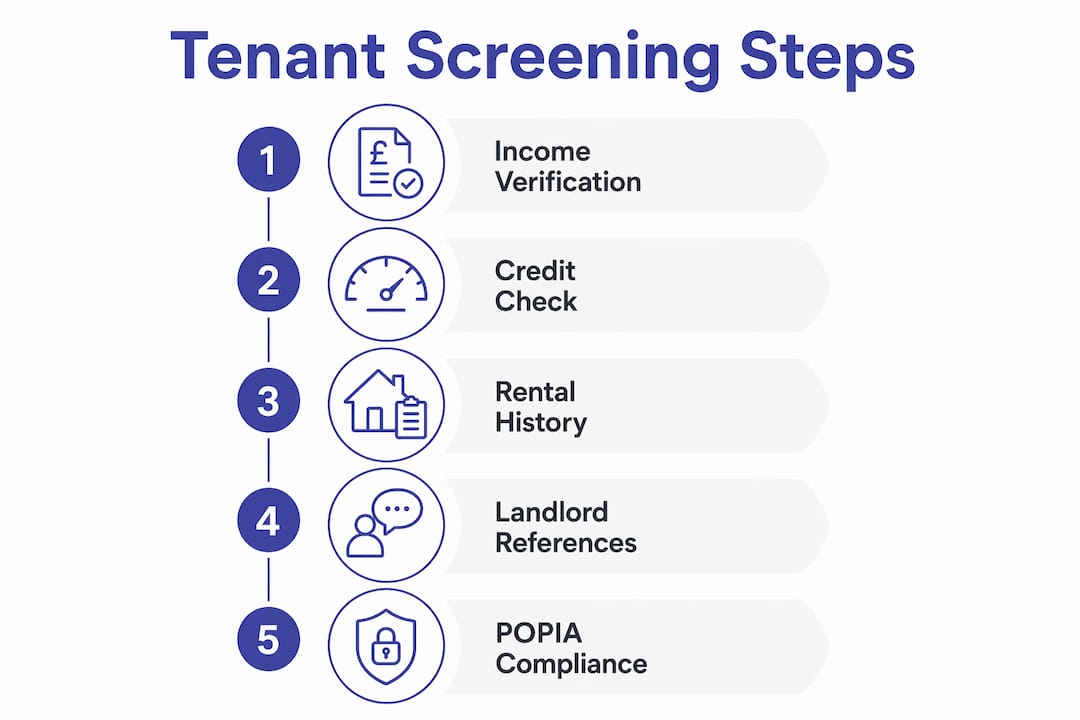
Verifying both income proof and rental payment history together provides stronger risk assessment than relying on either alone. An applicant with a clean credit score but a history of late rental payments is a higher risk than their credit score suggests.
What does rental and background history reveal about a tenant?
Financial data tells you whether a tenant can pay. Background and rental history tells you whether they will behave responsibly as an occupant. These are distinct questions, and both matter when evaluating tenant trustworthiness.
Contact previous landlords directly. Do not rely solely on the references the applicant provides. Ask specifically about rent punctuality, property condition at vacating, compliance with lease terms, and whether the landlord would rent to this person again. A landlord who hesitates before answering that last question is telling you something important.
Rental history over the past two to three years and eviction records over roughly seven years are the critical windows for assessing tenancy risk. An eviction on record is a serious red flag, but context matters. A tenant evicted during a period of documented unemployment is a different risk profile from one with a pattern of evictions across multiple properties.
Criminal background checks are a legitimate part of the screening process in South Africa, provided you obtain written consent under the Protection of Personal Information Act (POPIA). The relevance of a criminal record to tenancy depends on the nature of the offence. A conviction for property-related crime or fraud is directly relevant. Minor or dated offences require more careful consideration to avoid unfair discrimination.
Watch for these red flags during background and reference checks:
- Reluctance to provide previous landlord contact details
- Gaps in rental history with no clear explanation
- References who confirm only basic facts and volunteer nothing positive
- Eviction records within the past three years
- Inconsistencies between the application form and the information references provide
- Previous landlords who cannot be independently verified
Discrepancies in screening reports should be examined with the applicant rather than treated as automatic disqualifiers. An incorrect address on a credit report or a mismatched employment date may be a data error. Give the applicant an opportunity to explain before making a final decision.
Pro Tip: When calling previous landlords, ask open-ended questions such as “Can you tell me about your experience renting to this person?” rather than yes/no questions. Open questions reveal far more.
Is your screening process POPIA compliant?
POPIA governs tenant screening in South Africa, and non-compliance exposes landlords to significant legal liability. The Act requires that you obtain written, informed consent before running any credit or background check. It also requires that you use the data only for the stated purpose and that you store it securely.
The principle of purpose limitation means you cannot collect more information than you need to assess tenancy suitability. Asking for a copy of an applicant’s ID is necessary. Asking for their full medical history is not. Data minimisation is not just good practice. It is a legal obligation.
Retention of screening records is equally important. Good documentation of applications, consent forms, report outputs, and decision notes demonstrates lawful compliance and protects you if an unsuccessful applicant disputes your decision. Keep records for a minimum of three years after the screening date.
The table below outlines a POPIA compliance checklist for tenant screening:
| Compliance requirement | What you must do |
|---|---|
| Written consent | Obtain signed consent before any credit or background check |
| Purpose statement | Inform applicants exactly what data will be collected and why |
| Data minimisation | Collect only information directly relevant to tenancy assessment |
| Secure storage | Store screening records in a password-protected or locked system |
| Retention policy | Define how long records are kept and when they are destroyed |
| Data subject rights | Inform applicants of their right to access and correct their data |
Pro Tip: Use a standardised consent form for every applicant. A consistent form reduces the risk of missing a required disclosure and demonstrates procedural fairness if your process is ever challenged.
Screening data should also be fresh at the time of decision. Income and credit reports older than 30 to 60 days may no longer reflect the applicant’s current situation. Criminal background checks should be no older than 60 to 90 days. If the move-in date is delayed significantly after screening, run updated checks with fresh consent.
How to conduct tenant interviews and finalise your selection
The interview is where you confirm what the paperwork suggests and identify anything the documents cannot capture. A structured interview, with the same questions asked of every applicant, protects you legally and improves the consistency of your decisions.
Focus your questions on practical tenancy matters:
- Ask about the applicant’s reason for leaving their current or previous property.
- Ask how many people will be living in the property and whether any pets are involved.
- Ask about their preferred lease start date and whether they foresee any changes to their employment in the near future.
- Ask whether they have read the lease terms and whether they have any questions about the property rules.
- Ask for their preferred method of communication and how they typically handle maintenance issues.
Avoid questions about race, religion, marital status, pregnancy, or disability. These are protected characteristics under South African law, and basing a tenancy decision on any of them exposes you to a discrimination claim.
After the interview, document your reasoning. A written screening policy that sets out your criteria for reliable tenants before you begin advertising gives you a consistent standard to apply. It also makes it far easier to explain a rejection if an applicant queries your decision.
Common screening mistakes to avoid include accepting verbal references without written confirmation, skipping the interview for applicants who look good on paper, and failing to apply the same criteria to every applicant. Inconsistent application of screening criteria is one of the most common reasons landlords face discrimination complaints.
Pro Tip: Send every unsuccessful applicant a brief written notice confirming that their application was unsuccessful. You are not required to give detailed reasons, but a written record protects you if the decision is later disputed.
Key takeaways
Reliable tenant selection requires a structured, evidence-based process that combines financial verification, background checks, legal compliance, and a consistent interview framework applied equally to every applicant.
| Point | Details |
|---|---|
| Financial verification is foundational | Use TPN credit checks and income proof together for a complete picture of payment ability. |
| Background history reveals behaviour | Check rental history over two to three years and eviction records over seven years. |
| POPIA compliance is non-negotiable | Obtain written consent, limit data collection, and retain records for at least three years. |
| Fresh data improves accuracy | Income and credit reports should be no older than 30 to 60 days at the time of decision. |
| Consistent criteria prevent disputes | Apply the same written screening policy to every applicant to reduce discrimination risk. |
What I have learned from years of tenant screening in South Africa
The landlords who struggle most with problem tenancies are rarely those who skipped a credit check. They are the ones who applied their criteria inconsistently. They made exceptions for applicants who seemed charming, or who offered to pay several months upfront, or who had a compelling story about why their credit history looked the way it did. Upfront cash is not a substitute for a clean screening record. It is sometimes a sign that an applicant knows they will not pass a proper check.
The other pattern I have seen repeatedly is landlords who treat POPIA as a bureaucratic inconvenience rather than a genuine framework for fair dealing. The consent and documentation requirements are not just about avoiding fines. They force you to be deliberate and transparent, which actually improves the quality of your decisions. When you have to write down your criteria and explain your process, you catch your own biases before they become costly mistakes.
TPN has changed the game for South African landlords in a way that generic credit checks never could. Knowing that an applicant paid their previous landlord on time for three years is more predictive of future behaviour than a credit score alone. If you are not using rental-specific payment data as part of your tenant screening process, you are making decisions with incomplete information.
The final thing worth saying is this: even the most thorough screening process does not eliminate risk entirely. Circumstances change. Tenants lose jobs, face health crises, or go through relationship breakdowns. The screening process reduces the probability of a problem. It does not eliminate it. That is why screening and rental income insurance work best as a pair, not as alternatives.
— Coert
Protect your rental income beyond the screening process

Even the most thorough tenant screening cannot guarantee that every tenancy will run smoothly. Rentalincomeinsurance exists for exactly those moments when a carefully selected tenant stops paying, terminates their lease early, or absconds. Our rental income protection covers you against non-payment, early lease termination, and property abandonment, giving you a financial safety net that works alongside your screening process. Screening reduces your risk. Insurance protects you when risk becomes reality. Request a quote today and find out how affordable that peace of mind can be.
Watch this short overview to understand how rental income insurance works alongside your tenant vetting process:
FAQ
What is the most reliable way to vet tenants in South Africa?
A layered screening approach combining a TPN credit check, income verification, rental payment history, and a reference call to the previous landlord is the most reliable method. No single check provides a complete picture on its own.
How much does a TPN credit check cost?
A TPN credit check costs approximately R250 per applicant and provides rental-specific payment behaviour data that generic credit bureau reports do not include. This makes it the preferred tool for South African landlords assessing rental applicant backgrounds.
What does POPIA require for tenant screening?
POPIA requires written informed consent before any credit or background check, clear communication of the purpose for collecting data, and secure storage of all screening records. Landlords must also respect applicants’ rights to access and correct their personal information.
How far back should I check a tenant’s rental history?
Check rental payment history over the past two to three years and eviction records over approximately seven years. These windows provide a meaningful pattern of behaviour without relying on information that is too dated to be relevant.
Can I reject a tenant based on a criminal record?
You can consider a criminal record as part of your assessment, but only with the applicant’s written consent under POPIA. The relevance of the offence to tenancy risk must be considered. Automatic rejection based on any criminal record, regardless of its nature or age, may constitute unfair discrimination under South African law.
Recommended
- Tenant screening in South Africa: A landlord’s guide – Rental Income Insurance
- SA tenant screening guide: Secure reliable rental income – Rental Income Insurance
- Tenant screening benefits: reliable rentals for SA landlords – Rental Income Insurance
- Tenant screening: protect your rental income in South Africa – Rental Income Insurance