
TL;DR:
- Rent protection safeguards landlords against tenant non-payment, legal eviction costs, and property damage.
- The South African rental market’s legal delays and economic volatility increase financial risks for landlords.
- Proper policy assessment, documentation, and annual review are essential to ensure effective rental income protection.
Most landlords assume tenant problems are rare until the month a payment simply does not arrive. A single missed rental can cascade into mortgage shortfalls, unpaid levies, and mounting legal costs before you have even filed a formal complaint. South Africa’s rental market carries unique pressures: a sluggish eviction process, economic instability, and tenants who know the system well enough to delay proceedings for months. Rent protection is not a luxury for large property portfolios. It is a practical financial tool that any landlord with one property should seriously consider. This guide explains what rent protection covers, why it matters, and how to secure the right policy for your circumstances.
Table of Contents
- Why rental income is at risk in South Africa
- What is rent protection? Understanding the fundamentals
- Core benefits of rent protection for landlords
- How to secure rent protection and maximise your coverage
- The uncomfortable truth most landlords overlook
- Get protected: Your next steps with rent protection
- Frequently asked questions
Key Takeaways
| Point | Details |
|---|---|
| Covers major rental risks | Rent protection shields your income from tenant non-payment and costly damages. |
| Reduces legal and eviction stress | Policies can cover legal fees and eviction costs, easing landlord burdens. |
| Streamlines financial planning | Assured income makes budget planning easier and boosts long-term investment security. |
| Policy details matter | Understanding exclusions and choosing the right provider ensures full benefits. |
Why rental income is at risk in South Africa
Owning a rental property feels like a solid investment until reality intervenes. The truth is that tenant non-payment risks make non-payment of rent one of the leading causes of landlord financial loss. Yet most landlords only discover this after they have experienced it firsthand.
The risks are broader than many realise. Here are the most common threats to your rental income:
- Tenant non-payment or chronic late payment, which disrupts your cash flow immediately
- Early lease termination, leaving your property vacant with no income while you search for a replacement tenant
- Deliberate or accidental property damage, which can cost far more than a standard deposit covers
- Tenant absconding, where a tenant disappears without notice or forwarding details
South Africa adds layers of complexity that landlords in other countries do not face. The Rental Housing Act and the Prevention of Illegal Eviction Act (PIE Act) mean that removing a non-paying tenant legally can take anywhere from three to twelve months, sometimes longer. During that period, you receive no rent but still carry all the costs of ownership.
“The eviction process in South Africa is one of the most tenant-protective in the world, which is not a bad thing socially, but it does place enormous financial strain on private landlords who have no income buffer.”
Economic volatility compounds the problem. Rising unemployment, interest rate fluctuations, and the cost-of-living crisis mean that tenants who were perfectly reliable last year may genuinely struggle this year. Explore tenant risk examples to understand just how varied these situations can be.
Many landlords rely on the deposit to cover losses. In practice, deposits are capped at two months’ rent, rarely cover legal costs, and are often disputed at the end of a tenancy. A complete protection guide will show you why deposits alone are not a sufficient safety net. The financial exposure for an unprotected landlord is simply too large to ignore.
What is rent protection? Understanding the fundamentals
Rent protection, sometimes called rental income insurance or rental income protection, is a specific type of policy designed to replace lost rental income when a tenant fails to pay, breaches the lease, or causes significant damage to your property. It is not the same as standard home insurance, which covers the building structure, or contents insurance, which covers moveable items.
As rental income insurance explained on the subject confirms, rental income insurance specifically covers non-payment and breach of lease by tenants. That distinction matters enormously when you are trying to claim.
Here is a clear comparison to help you understand the differences:
| Cover type | Non-payment covered | Property damage | Legal eviction costs | Lease breach |
|---|---|---|---|---|
| Tenant deposit | Partial | Partial | No | No |
| Standard landlord insurance | No | Yes (structural) | No | No |
| Rent protection policy | Yes | Yes (tenant-caused) | Yes | Yes |
The claim process for rent protection is generally straightforward. You notify your insurer once a tenant misses a payment or breaches the lease, submit the required documentation (lease agreement, payment history, correspondence), and the insurer processes the claim. Payouts typically cover a set number of months of rental income, giving you breathing room while legal proceedings or re-letting efforts take place.
Understanding the insurance jargon guide before signing any policy is worthwhile. Terms like “excess,” “indemnity period,” and “exclusion clause” carry specific meanings that affect what you can actually claim.
Pro Tip: Always check whether your policy covers the full rental amount or only a percentage. Some policies cap payouts at 80% of monthly rent, which may leave a shortfall if your bond repayment is tight.
Core benefits of rent protection for landlords
The most immediate benefit is obvious: you keep receiving income even when your tenant stops paying. But the advantages of rent protection run deeper than that single feature.

Landlords using rent protection report fewer instances of unrecoverable losses, which means the policy does more than replace income. It changes how you manage risk as a landlord.
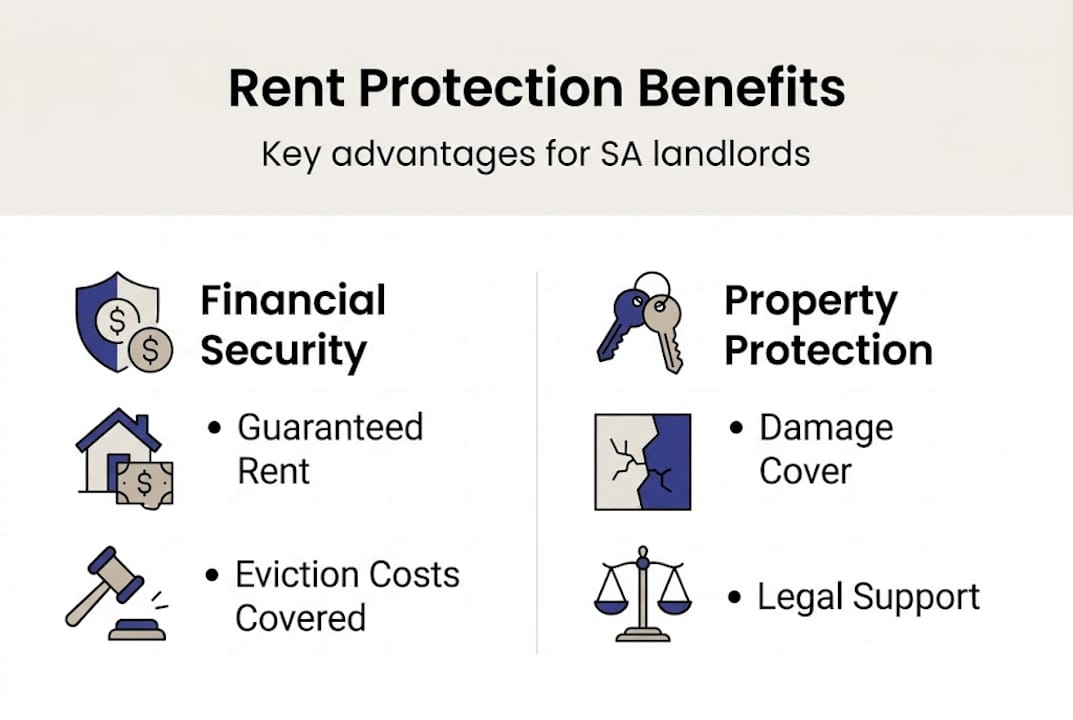
Here are the core benefits worth understanding:
- Consistent monthly cash flow regardless of tenant behaviour, protecting your bond repayments and maintenance budget
- Legal cost coverage for formal eviction proceedings, which can run to tens of thousands of rands in attorney fees and court costs
- Property damage claims for tenant-caused destruction beyond what the deposit covers
- Early lease termination protection so a sudden vacancy does not leave you exposed for months
- Peace of mind that allows you to plan your finances with confidence rather than anxiety
The financial planning benefit is underrated. When you know your rental income is guaranteed for a defined period, you can budget accurately, service your bond without stress, and even plan future property investments. Without that certainty, every month is a gamble.
| Benefit | What it protects | Typical cover period |
|---|---|---|
| Non-payment cover | Monthly rental income | 6 to 12 months |
| Legal eviction costs | Attorney and court fees | Duration of proceedings |
| Property damage | Repair costs above deposit | Per incident |
| Vacancy after breach | Lost income during re-letting | 1 to 3 months |
Exploring property income protections in detail reveals that many landlords are unaware of how much cover is actually available. The income loss coverage benefits go well beyond a simple income replacement cheque.
How to secure rent protection and maximise your coverage
Getting the right policy requires more than a quick online search. Follow these steps to make sure your cover actually works when you need it.
- Assess your risk profile. Consider your property type, location, tenant demographic, and how dependent you are on the rental income. A landlord whose bond repayment equals 90% of the rent is far more exposed than one with significant equity.
- Research specialist providers. Look for insurers who focus specifically on residential rental properties in South Africa. General insurers often lack the expertise or product depth that specialist providers offer.
- Compare policy terms carefully. Do not compare only the premium. Compare the indemnity period, the excess, what triggers a valid claim, and how quickly payouts are processed.
- Use the rental protection checklist to verify that every key risk area is covered before you sign.
- Prepare your documentation. A valid lease agreement, tenant credit check records, and a clear payment history are typically required to activate a policy and to support any future claim.
- Review exclusions line by line. As coverage exclusions explained clearly states, landlords should review coverage exclusions carefully to avoid surprises when claiming. Common exclusions include pre-existing arrears, properties without a signed lease, and damage caused by the landlord’s own negligence.
Understanding insurance in property management as a whole will help you see rent protection as one layer in a broader risk management strategy rather than a standalone fix.
Pro Tip: Renew and review your policy annually. Your rental value, tenant profile, and property condition all change over time, and your cover should reflect those changes accurately.
The uncomfortable truth most landlords overlook
Here is something the property investment community rarely discusses openly: thorough tenant screening does not make you safe. It makes you less vulnerable, but the gap between “less vulnerable” and “protected” is where most landlords lose money.
We have seen landlords with impeccable screening processes, watertight lease agreements, and years of trouble-free experience suddenly face a tenant who loses their job, refuses to leave, and contests every step of the eviction. The legal process grinds on. The income stops. The costs mount.
Many landlords tell themselves they will self-insure, meaning they will absorb losses from savings or other income. That works until it does not. A six-month eviction with legal costs can easily exceed R80,000. That is not a manageable loss for most private landlords.
The deeper issue is that rental property is a business, not a passive income stream. Businesses carry insurance because risk is inherent, not because the owners are careless. As property investors who need insurance understand, protecting your investment is a professional obligation, not an optional extra. Rent protection is the tool that bridges the gap between what you hope will happen and what actually can.
Get protected: Your next steps with rent protection
You now understand the risks, the product, and the practical steps to secure cover. The question is simply whether you act on that knowledge before or after a problem arises.

At Rental Income Insurance, we specialise in helping South African landlords protect their rental income against non-payment, early lease termination, property damage, and tenant absconding. Our solutions are designed specifically for the South African rental market, with clear terms and a straightforward claims process. Visit our rental income insurance options to explore what is available, or go directly to request a rent protection quote and get a tailored recommendation for your property. Do not wait for a missed payment to discover the value of being covered.
Frequently asked questions
What risks does rent protection typically cover?
Rent protection most commonly covers tenant non-payment, property damage, and the costs related to legal eviction processes. As rental income insurance confirms, it specifically addresses non-payment and breach of lease by tenants.
Can I still claim if a tenant damages my property but pays rent?
Yes, many rent protection policies offer coverage for significant property damage even if rent payments are up to date, but details depend on the policy terms. Always review exclusions carefully before assuming damage is automatically covered.
Is rent protection worth it for short-term rental properties?
Rent protection can be valuable for short-term rental properties, especially in high-risk areas or during volatile economic periods. Landlords with protection consistently report fewer unrecoverable losses regardless of tenancy length.
How do I choose the right rent protection provider?
Look for providers specialising in residential properties, check what is covered and excluded, and read reviews from other South African landlords. Reviewing exclusions carefully is the single most important step before committing to any policy.
Does rent protection insurance replace tenant screening?
No, tenant screening remains important and should always be your first line of defence. Rental income insurance adds another layer of security for when things go wrong despite your best efforts.
Recommended
- Rent protection eligibility in South Africa 2026 – Rental Income Insurance
- Benefits of Rental Protection: Complete South African Guide – Rental Income Insurance
- How to Minimise Rental Risks for South African Landlords – Rental Income Insurance
- Benefits of Rental Income Insurance for South Africans – Rental Income Insurance