
TL;DR:
- South Africa’s property market requires careful risk analysis beyond high gross yields, including vacancy, legal, and operational risks.
- Effective mitigation involves tenant screening, conservative cash flow modeling, legal compliance, and rental income insurance, especially due to high arrears.
- Proper understanding and management of these risks are essential to building sustainable property investment wealth in South Africa.
South Africa’s property market attracts investors with promises of strong rental yields, but property investment risk explained properly reveals a far more complicated picture. The common assumption that a high gross yield means a low-risk investment is one of the most costly misconceptions in the local market. In formal risk management circles, this discipline is known as real estate risk analysis, and it covers everything from vacancy rates and financing exposure to legal compliance and tenant affordability. Whether you are buying your first rental property or expanding an existing portfolio, understanding these risks before you commit is what separates sustainable returns from expensive mistakes.
Table of Contents
- Key takeaways
- Property investment risk explained: the core categories
- SA rental yields and the financial risk picture
- Legal risk and the eviction process
- Practical risk mitigation for SA property investors
- My take on what investors consistently get wrong
- Protect your rental income before a problem starts
- FAQ
Key takeaways
| Point | Details |
|---|---|
| Gross yield misleads investors | Net rental yield, after costs, reflects your true cash flow and should guide every purchase decision. |
| Six core risk categories matter | Vacancy, market, financing, operational, concentration, and legal risks each require separate assessment before buying. |
| Legal compliance is non-negotiable | Illegal eviction in South Africa carries criminal penalties, including up to two years’ imprisonment. |
| Tenant arrears affect cash flow | Around 17% of South African tenants are in arrears nationally, making tenant screening a critical risk tool. |
| Insurance fills the gap | Rental income insurance protects against tenant default and early lease termination when other measures fail. |
Property investment risk explained: the core categories
Structured real estate risk analysis groups investment risk into six categories: vacancy, market, financing, operational, concentration, and regulatory. Each one can erode your returns independently, and in a market like South Africa’s, several can hit simultaneously.
Vacancy risk is the most immediate threat to your rental income. Even a modest vacancy rate eats into your cash flow quickly, especially when your bond repayments continue regardless of whether a tenant is paying. Typical vacancy benchmarks run at 3 to 5% for single-family properties and 5 to 8% for multi-unit buildings. If your investment model assumes 100% occupancy, you are not modelling reality.
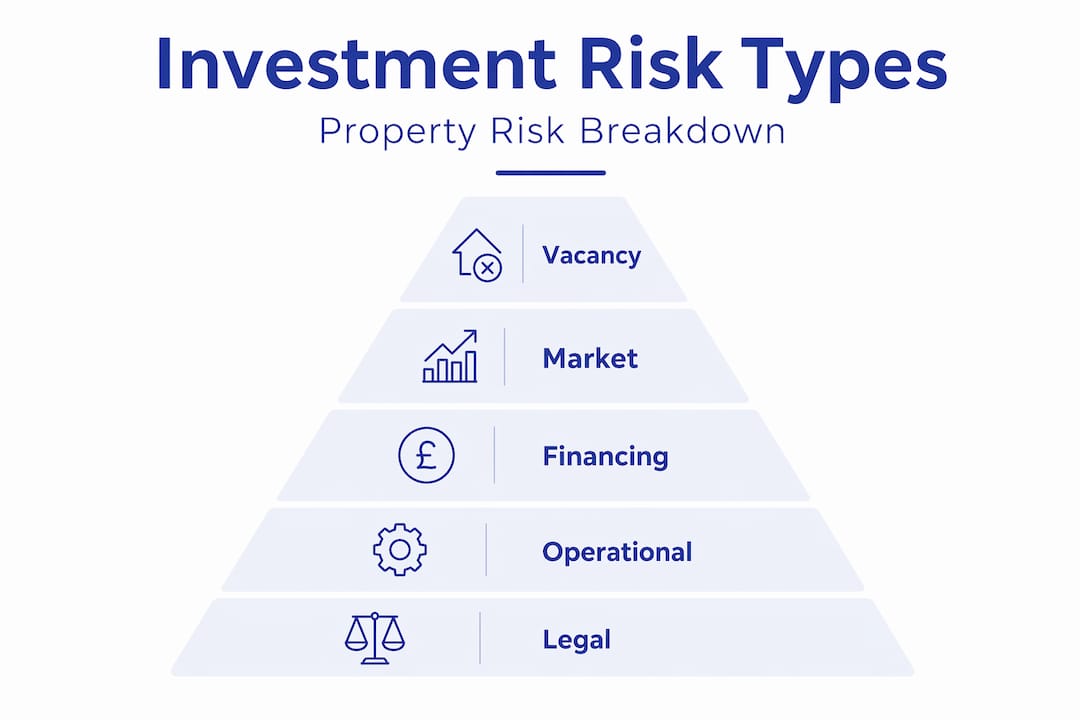
Market risk covers the movement of property values and rental rates over time. South African property prices have remained relatively flat in real terms for several years, and rental growth has cooled in many metros. Buying at the top of a local cycle without accounting for downside scenarios is a classic property investment pitfall.
Financing risk is especially relevant right now. Interest rate cycles have a direct impact on bond repayments, and a rate increase that looks manageable on paper can turn a cash-flow-positive property into a monthly liability. Stress-testing your deal at rates two percentage points above your current rate is a non-negotiable step in any responsible risk assessment.
- Operational risk: Unexpected maintenance costs, contractor disputes, and property management failures are among the risks that affect cash flow before rental income even enters the equation. A building inspection before purchase is not optional. It is the difference between knowing what you own and hoping for the best.
- Concentration risk: Owning multiple properties in one suburb or relying on a single tenant type concentrates your exposure. If that area loses economic activity or that tenant demographic comes under financial pressure, your entire portfolio suffers at once.
- Legal and regulatory risk: South Africa has specific tenant protection legislation that can make removing a non-paying tenant a slow and costly process. This legal exposure is one of the most underestimated real estate investment risk types in the local market, and it deserves its own section below.
SA rental yields and the financial risk picture
South Africa offers some attractive headline numbers. Gross rental yields average 10.93% nationally, with Johannesburg sitting at approximately 13.69% and Cape Town considerably lower at around 8.98%. Those figures look compelling until you subtract the actual costs of ownership.
| Cost category | Typical impact on yield |
|---|---|
| Municipal rates and levies | 1.5% to 2.5% of property value annually |
| Property management fees | 8% to 12% of monthly rental |
| Maintenance and repairs | 1% to 2% of property value annually |
| Vacancy allowance | 5% to 8% of annual rental income |
| Bond interest | Depends on loan-to-value ratio |
After deducting these real costs, that 10.93% gross yield can shrink to under 5% net in many cases. Net rental yield, not the gross figure, is what actually reflects your cash position.

On top of these deductions, tenant arrears are a persistent feature of the South African rental market. Around 17% of tenants are in arrears nationally. The Western Cape performs better at 13.4%, but no province is immune. When a tenant stops paying, the rental income line on your spreadsheet disappears, but the costs do not.
Pro Tip: Build your investment model using a gross-to-net yield calculator and always include a minimum 5% vacancy allowance and a 1% annual maintenance reserve before assessing whether a deal makes sense.
Monitoring evolving arrears and vacancy trends is not a once-off task. Markets shift, and your stress-test assumptions need to shift with them. Reviewing your cash flow model annually is basic real estate risk management, not overkill.
Legal risk and the eviction process
South Africa’s Prevention of Illegal Eviction from and Unlawful Occupation of Land Act, known as the PIE Act, fundamentally changes the risk profile of rental property compared to many other countries. Understanding your legal obligations as a landlord is not just good practice. It is financial self-preservation.
The lawful eviction process in South Africa follows a specific sequence:
- Cancel the lease agreement formally in writing, citing the breach of contract.
- Serve the tenant with a written notice to vacate, giving the required notice period.
- Apply to the Magistrate’s Court or High Court for an eviction order if the tenant refuses to leave.
- Serve the eviction notice on the tenant and any relevant municipality at least 14 days before the court hearing.
- Attend the court hearing and obtain a court order before any physical eviction takes place.
Eviction requires a court order at every stage. There are no shortcuts. Changing the locks, removing the tenant’s belongings, or cutting off utilities without a court order constitutes an illegal eviction.
“Illegal eviction is a criminal offence under the PIE Act, punishable by up to two years’ imprisonment and fines.” — Jonker Vorster Attorneys
The financial consequences of getting this wrong are severe. A landlord who evicts illegally faces not only criminal prosecution but also potential civil claims from the tenant. Meanwhile, the non-paying tenant may remain in occupation for months longer while the legal dispute is resolved. Legal compliance in eviction is not bureaucratic box-ticking. It is risk mitigation with real financial consequences attached.
Practical risk mitigation for SA property investors
Understanding the risks of real estate investment is the first half of the equation. Actively managing them is the other. Here is what actually works in the South African context.
- Thorough tenant screening: Verify income, employment, and credit history before signing a lease. A tenant paying consistently at a slightly lower rental is worth more than a higher-paying tenant who defaults in month three.
- Conservative cash flow modelling: Focus on downside scenarios rather than optimistic returns. Model what happens if your rental drops 10%, your rate rises 2%, and you have a two-month vacancy. If the deal still works, it is a sound investment.
- Pre-purchase building inspections: Separating property condition risk from rental income calculations before buying prevents operational surprises from eroding your returns after transfer.
- Proper lease management: Use legally sound lease agreements that clearly state rental escalation clauses, maintenance responsibilities, and breach procedures. A vague lease creates disputes.
- Portfolio diversification: Spread your exposure across property types and locations rather than concentrating everything in one suburb or tenant profile. A guide on how to mitigate rental risks can help you build a structured approach.
- Rental income insurance: When screening, documentation, and compliance all fail to prevent tenant default, rental income insurance provides a financial buffer. Cover against non-payment, early lease termination, and tenant absconding protects your cash flow when legal processes are grinding slowly through the courts.
Pro Tip: Request a risk assessment from your insurer before purchasing a new rental property. Some insurers flag high-risk property types or locations that your own due diligence might miss.
You can also explore how risk assessment and insurance work together to build a more resilient property investment strategy.
My take on what investors consistently get wrong
I have watched investors, including experienced ones, consistently underestimate two things: the time it takes to resolve a non-paying tenant situation legally, and the real cost of owning a property once you go beyond the gross yield headline.
In my experience, first-time buyers in particular fixate on the income side of the equation and treat costs as minor footnotes. They are not. Municipal rates, levy increases, and unexpected plumbing bills are not exceptional events. They are the ordinary reality of property ownership, and ignoring them in your models means you are planning to be surprised.
The legal risk dimension is the one that worries me most for newer investors. The instinct to act quickly when a tenant stops paying is understandable. But taking unilateral action without a court order in South Africa does not speed things up. It creates a second legal problem on top of the first one. I have seen landlords end up paying compensation to a non-paying tenant because the landlord skipped a procedural step in the eviction process.
What separates the investors who build lasting wealth from those who burn out after one or two properties is not market timing or finding a high-yield suburb. It is disciplined risk management, realistic cash flow expectations, and knowing when to use the legal and financial tools available to protect your position. Property investment in South Africa is genuinely viable. But it rewards preparation far more than optimism.
— Coert
Protect your rental income before a problem starts

Understanding property investment risk is one thing. Having a financial product that steps in when things go wrong is another. Rentalincomeinsurance offers rental income protection designed specifically for South African landlords, covering tenant non-payment, early lease termination, and tenant absconding. When a legal eviction is working its way through the courts and your mortgage is still due, that cover is not a luxury. It is the difference between absorbing a setback and facing a genuine financial crisis.
If you are an investor reviewing your current exposure or a first-time buyer assessing a new purchase, the right time to arrange cover is before the tenant moves in, not after the problem begins. Request a personalised quote from Rentalincomeinsurance today, or learn more about rental income insurance and how it complements the risk management steps covered in this article.
Watch this short explainer to see how rental income insurance works in practice:
https://youtu.be/ej04S_af4qM
FAQ
What are the main property investment risk types in South Africa?
The main risk categories are vacancy, market value fluctuation, financing (interest rate exposure), operational costs, concentration, and legal or regulatory risk. Each category requires separate assessment before purchasing a rental property.
What is the difference between gross and net rental yield?
Gross rental yield is the annual rental income divided by the property purchase price. Net yield deducts all ownership costs, including rates, levies, management fees, and vacancy allowances, and is the figure that reflects your actual cash position.
Can a landlord evict a tenant without a court order in South Africa?
No. The PIE Act requires a valid court order before any eviction can take place. Proceeding without one is a criminal offence punishable by up to two years’ imprisonment and civil liability.
How do I stress-test a property investment for financial risk?
Model your cash flow assuming a 10% rent reduction, a 2% interest rate increase, and a two-month vacancy simultaneously. If the deal remains viable under those conditions, the financial risk is within a manageable range.
Does rental income insurance cover all types of tenant default?
Rentalincomeinsurance covers tenant non-payment, early lease termination, and absconding. It does not replace legal compliance but provides cash flow protection while eviction proceedings are ongoing.
Recommended
- Rental property risk assessment guide for SA landlords – Rental Income Insurance
- Rental Property Risk Management Steps for SA Landlords – Rental Income Insurance
- Why Rental Income Fluctuates – Risks for South African Landlords – Rental Income Insurance
- Property indemnity explained: protect your rental income – Rental Income Insurance