
Tenants cannot be removed without a court order; the law gives you rights to privacy, a habitable dwelling, receipts, and protection from unlawful eviction. These protections come from the Rental Housing Act, the PIE Act, and Section 26 of the Constitution. If a landlord tries to lock you out or cut your utilities, that’s a criminal act, and you can seek urgent legal relief the same day.
TL;DR:
- Landlords cannot remove tenants without a court order, and lockouts or utility disconnections are criminal offenses punishable under the PIE Act.
- All tenant payments, including deposits, must be documented with receipts, and deposits plus interest must be refunded within the legal timeframe after deductions.
- Tenants should document any damage, notify landlords in writing, and keep records of repairs to prove the property’s habitability requirements are unmet.
- In case of illegal eviction attempts, tenants must avoid voluntary departure, contact police, and seek urgent court interdicts with proper evidence.
- Disputes like rent increases, lease renewals, subletting, or utility disconnections should be managed through proper documentation and, if needed, complaints to Rental Housing Tribunals or courts.
Table of Contents
- Core statutory rights every tenant should know
- How eviction works in practice (PIE Act and court process)
- Deposits, receipts, and how refunds must be handled
- Repairs, maintenance, and the tenant’s right to a habitable home
- What to do immediately if a landlord tries an illegal eviction
- Using Rental Housing Tribunals, complaints and remedies
- Rights regarding lease renewal and termination conditions
- Tenant’s rights to challenge rent increases
- Rights related to subletting and guests
- Access to utilities and municipal services as a tenant
- Rights of a tenant in South Africa: what to do if your landlord threatens eviction
- Sources
Core statutory rights every tenant should know
The Rental Housing Act sets the baseline for what landlords owe tenants, and it’s more detailed than most renters realise. It covers privacy, habitability, paperwork, and how you’re treated compared with other tenants.
- Privacy and notice for inspections: your landlord cannot enter the property whenever they like. Reasonable notice is required before any inspection or visit.
- A habitable dwelling: the property must be kept in a reasonable state of repair, fit for the purpose it was let for.
- Receipts for every payment: rent, deposits, and any other charge must be receipted in writing under the Rental Housing Act 50 of 1999.
- Proof of interest on your deposit: you can request evidence of what interest has accrued while your deposit sits with the landlord.
- Protection from discrimination: landlords cannot apply different rules to tenants based on race, gender, or other protected characteristics.
- Your own obligations: paying rent on time, keeping the property reasonably clean, and giving proper notice when you intend to leave.
None of this is optional guidance. It’s written into statute, which means a landlord who ignores it is exposed to a complaint at a Rental Housing Tribunal or a civil claim, not just an awkward conversation.
How eviction works in practice (PIE Act and court process)
No landlord, however frustrated, can legally remove you without a court order. That principle sits at the heart of the Prevention of Illegal Eviction from and Unlawful Occupation of Land Act (PIE Act) 19 of 1998, and it’s backed directly by Section 26 of the Constitution, which protects access to adequate housing. Changing locks, removing doors, or cutting off water and electricity to force you out are all criminal acts under the PIE Act, regardless of how much rent is owed.
Section 4(2) of the PIE Act requires a court to weigh “all relevant circumstances” before granting an eviction order, including how vulnerable the occupants are, how long they’ve lived there, and whether alternative accommodation is available, as set out in the PIE Act’s full text. Courts take this enquiry seriously, and in practice often grant conditional orders or postpone execution to give tenants time to find somewhere else to live, particularly where the tenant’s affidavit demonstrates genuine hardship.
The formal process usually runs in this order:
- Notice: the landlord issues a written notice of intention to seek eviction.
- Court application: the landlord applies to the Magistrate’s Court (or High Court, depending on the matter) under the PIE Act.
- Hearing: both sides present evidence; the court considers the section 4(2) factors.
- Order: if granted, the court sets a date by which the property must be vacated.
- Warrant and sheriff execution: only the sheriff of the court may carry out a lawful eviction, never the landlord or a private agent.
Urgent eviction applications under section 5 are tightly restricted. Legal commentary on this process notes that courts routinely reject claims of urgency where a landlord created their own delay by dragging out the case before rushing to court, as detailed in this analysis of urgent evictions. A landlord cannot manufacture a crisis and then demand the court treat it as one.
Deposits, receipts, and how refunds must be handled
Your deposit isn’t the landlord’s to hold indefinitely or spend as they please. The Rental Housing Act treats it as your money, held in trust, and sets clear rules for how it must be managed.
- Every payment you make, including the deposit itself, must be accompanied by a written receipt.
- You’re entitled to ask for proof of the interest earned on your deposit while it’s held by the landlord.
- Before you move out, both parties should conduct a joint inspection of the property to agree on its condition.
- Any deduction from your deposit must be justified with receipts for the actual cost of repairs.
- The Rental Housing Act’s provisions on tenant rights set out that deposits plus accrued interest must be refunded within the statutory timeframe once deductions are settled.
If a landlord withholds your deposit without justification, that’s exactly the kind of dispute a Rental Housing Tribunal was built to resolve. For a deeper look at how deposit disputes typically unfold, see this guide to mastering rental security deposits.
Repairs, maintenance, and the tenant’s right to a habitable home
A landlord who lets you a property that’s falling apart isn’t meeting their legal obligations. The Rental Housing Act requires the dwelling to be kept in a reasonable state of repair throughout the tenancy, not just on move-in day.
Notify your landlord in writing as soon as a problem appears, and keep a paper trail: dated messages, photos of the damage, and any follow-up you send if nothing happens. This record becomes essential if the dispute ever reaches a Tribunal or court.
For genuine emergencies, such as a burst pipe or an electrical fault that makes the property unsafe, you may need to arrange repairs yourself and seek reimbursement afterwards. Keep every invoice. Without them, recovering the cost later becomes far harder. Landlords carry parallel duties here too, which are set out in more detail in this guide to landlord obligations.
What to do immediately if a landlord tries an illegal eviction
The moment a landlord changes the locks, removes your belongings, or cuts your electricity, you’re dealing with a criminal offence, not a grey area. Speed and documentation matter more than anything else in the first few hours.
- Do not leave voluntarily. Moving out under pressure, even briefly, can be used to argue you abandoned the property and weaken your position.
- Call the police immediately. Illegal lockouts and utility disconnections are crimes under the PIE Act; ask for a case number and the attending officer’s details.
- Apply for an urgent interdict at the magistrate’s court. Bring photographs, witness statements, your lease, and proof of payment history. Courts frequently grant same-day relief where a landlord has clearly acted unlawfully, as outlined in this practical guide to PIE Act relief.
- Contact Legal Aid South Africa or a university law clinic if you cannot afford a private attorney. Keep every receipt, text message, and email exchanged with the landlord.
Pro Tip: Photograph the locked door, the disconnected meter, or the empty room the moment you discover it, with a timestamp visible if your phone allows it. That single image is often the strongest piece of evidence you’ll have in front of a magistrate.
Using Rental Housing Tribunals, complaints and remedies
Not every dispute needs a courtroom. Rental Housing Tribunals exist specifically to resolve unfair practices, including illegal lockouts, unreturned deposits, and a landlord’s failure to maintain the property, according to Rental Housing Tribunal guidance from the Department of Human Settlements. What Tribunals cannot do is issue an eviction order. That power sits with the courts alone.
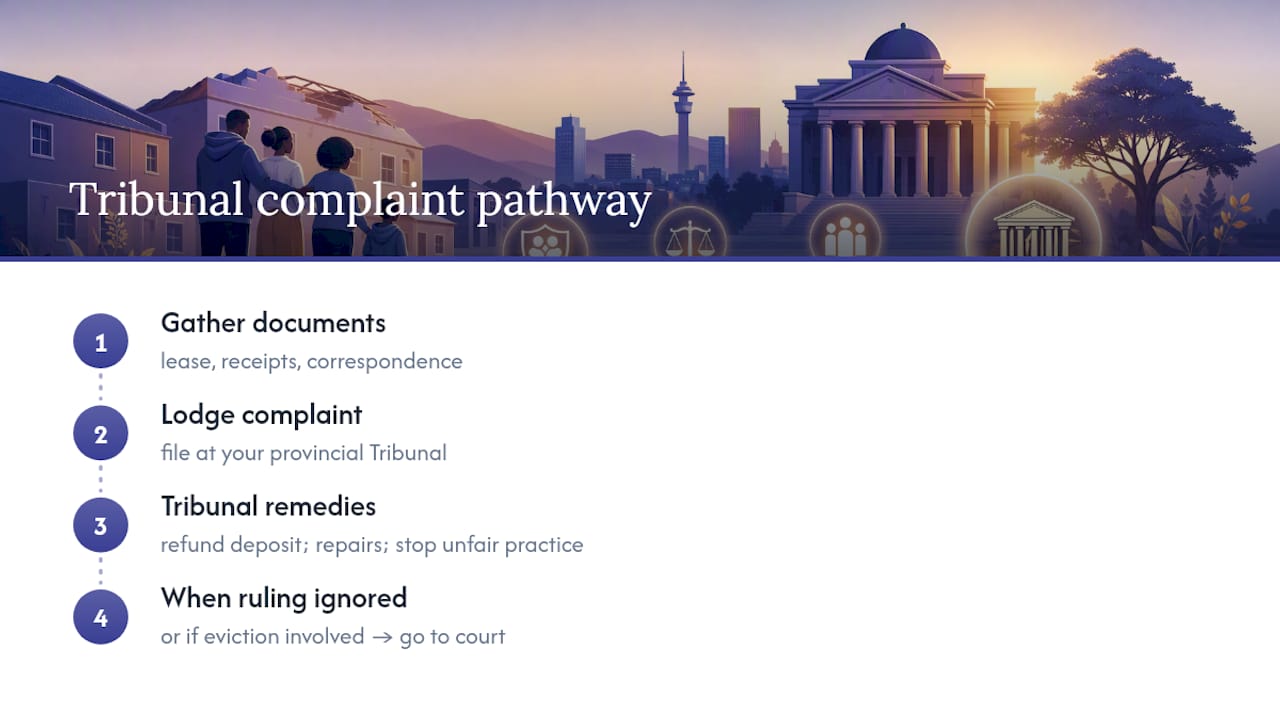
To file a complaint, gather your lease, payment receipts, and any correspondence showing the dispute, then lodge it with your provincial Tribunal. Remedies typically include orders to refund a deposit, carry out repairs, or stop an unfair practice. If a Tribunal ruling is ignored, or if the matter involves eviction itself, escalation to court becomes the only route forward.
Rights regarding lease renewal and termination conditions
A fixed-term lease doesn’t roll over automatically unless your agreement says so. Most leases either specify a renewal process or state that the tenancy becomes month-to-month once the fixed term ends, and it’s worth checking this clause before you assume anything about your position.
Termination notice periods depend on what’s written into your lease, but the Rental Housing Act requires that any notice be reasonable and in writing. A landlord cannot simply tell you to leave without following the notice period your lease specifies, and even then, they still need a court order if you refuse to go. If your lease is silent on renewal terms, or the wording is ambiguous, that’s a red flag worth raising before you sign in the first place. It’s also worth reviewing a lease agreement checklist to see what a fair renewal or termination clause should actually contain.
One point that catches tenants out: verbal agreements to renew or extend a lease carry the same legal weight as anything else agreed between the parties, but proving what was actually said becomes far harder without something in writing. Confirm any renewal discussion by email, even informally, so there’s a record if a disagreement arises later.
Tenant’s rights to challenge rent increases
Rent increases aren’t capped by a single statutory percentage in South Africa, but that doesn’t mean landlords have unlimited licence to raise rent however they choose. Any increase must follow what’s agreed in the lease, and a landlord cannot impose a mid-term hike unless the lease specifically allows for it.
If your lease is silent on rent increases, or an increase seems disproportionate to market conditions, you have grounds to raise the matter with your landlord directly, and if that fails, to lodge a complaint with your provincial Rental Housing Tribunal as an unfair practice. Tribunals have dealt with disputes over unreasonable increases before, particularly where the increase appears designed to force a tenant out rather than reflect genuine cost pressures.
Keep a full record of your rental history, including every increase notice you’ve received and when. This matters both for challenging a specific increase and for demonstrating a pattern if a landlord is using repeated hikes as a backdoor eviction tactic. A tenant who has paid consistently and on time, with clear receipts to prove it, is in a far stronger position to contest an increase than one relying on memory alone.
Rights related to subletting and guests
Whether you can sublet or host long-term guests comes down almost entirely to what your lease says. Most standard leases either prohibit subletting outright or require the landlord’s written consent before you bring in another occupant on a formal basis.
Short stays from friends or family are generally treated differently from subletting, since subletting implies a commercial or semi-permanent arrangement where the guest pays you rent or contributes to costs. If your lease is unclear on this distinction, it’s worth clarifying with your landlord in writing before a guest’s stay stretches into something that could be interpreted as unauthorised subletting.
Breaching a no-subletting clause without consent can give a landlord grounds to argue you’ve broken the lease, which could open the door to termination proceedings, though eviction would still require a court order regardless of what the lease says. If you’re planning to sublet legitimately, get the landlord’s consent in writing rather than relying on a verbal nod, since that document becomes your protection if a dispute ever arises later.
Access to utilities and municipal services as a tenant
Water, electricity, and refuse collection aren’t privileges a landlord can dangle over you. Cutting off utilities to pressure a tenant into leaving is one of the clearest examples of an illegal self-help eviction under the PIE Act, treated with the same seriousness as changing the locks.
In most rental arrangements, either the landlord pays the municipality directly and recovers the cost through rent, or the tenant holds the utility account in their own name. Your lease should specify which applies, and if utilities are meant to be included in your rent, non-payment by the landlord to the municipality is the landlord’s problem, not grounds to disconnect your supply.
If services are cut off without a court order, the same emergency steps apply as for a physical lockout: call the police, document the disconnection with photographs and timestamps, and consider an urgent interdict if the landlord refuses to restore services promptly. Municipal accounts held in your own name also give you a direct relationship with the council, which can be useful leverage if a landlord tries to interfere with your service connection as a pressure tactic.
Before you look at the practical checklist below, it’s worth watching this short explainer on tenant protections:
.
Rights of a tenant in South Africa: what to do if your landlord threatens eviction
The conventional advice tenants get, “just talk to your landlord” or “wait for the court date”, underestimates how much power sits with the tenant in the first 24 hours of a dispute. The law doesn’t reward passivity. It rewards documentation and speed. A tenant who photographs a locked door, calls the police, and gets to a magistrate’s court the same day is in a dramatically stronger position than one who waits politely for a letter that may never come.
What’s overrated is the idea that a lease clause can override statute. It can’t. No lease term permits a self-help eviction, however the wording is dressed up, and landlords who rely on such clauses are relying on tenants not knowing better. What’s underrated is the value of a paper trail built before trouble starts: receipts, dated messages, photos of the property’s condition. That evidence is what turns a shouting match into a winnable Tribunal complaint or court application.
If you take one thing from this, prioritise the record-keeping now, before you need it.
— Coert
Landlords face real financial exposure through this same legal framework, since a drawn-out eviction or a tenant who stops paying can leave months of rent unrecovered while the court process runs its course. There is insurance coverage available that can help landlords with issues such as tenant non-payment, early lease termination, absconding, and legal costs associated with lawful evictions. If you’re a landlord reading this to understand what tenants can and can’t do, it’s worth requesting a quote to see how that protection fits your own rental income.
This article is general information, not a substitute for advice from a qualified lawyer. Consult a qualified legal professional about your own circumstances before acting on anything here.