
TL;DR:
- Thorough tenant background checks in South Africa involve collecting complete data, obtaining written consent, and reviewing employment, credit, criminal, and eviction reports. Combining automated screening tools like TPN with direct landlord references reduces legal and financial risks for landlords. Consistent documentation, adherence to POPIA, and integrating income protection safeguards enhance effective risk management.
Tenant background checks are a structured verification process that confirms an applicant’s identity, financial reliability, and rental history before you hand over the keys. In South Africa, this process is formally known as tenant screening or tenant verification, and it sits at the heart of responsible property management. A well-executed, step by step tenant background check reduces your exposure to non-payment, property damage, and costly eviction proceedings. Tools like TPN credit bureau reports, POPIA-compliant consent forms, and Know Your Tenant (KYT) identity verification give South African landlords a practical framework for making informed decisions on every application.
What information do you need before starting tenant screening?
Before you run a single check, you need a complete and accurate data set from the applicant. Incomplete applications produce unreliable results, and gaps in information can expose you to legal risk under the Protection of Personal Information Act (POPIA).
Collect the following from every prospective tenant:
- Full legal name and South African ID number (or passport number for foreign nationals)
- Current and previous residential addresses (at least two years of history)
- Employer name, contact details, and proof of income (three months of payslips or bank statements)
- Names and contact details of at least two previous landlords
- Next-of-kin contact details
Pro Tip: Use a standardised rental application form for every applicant. Consistency protects you legally and makes comparisons between applicants far simpler.
POPIA requires that you obtain written consent before processing any personal information. A one-page consent form that clearly states what data you are collecting, why you are collecting it, and who will have access to it is sufficient. POPIA documentation requirements mean landlords benefit operationally by standardising these forms, since well-maintained records of data processing activities reduce your legal exposure significantly.
| Required document | Purpose |
|---|---|
| Signed consent form | Authorises credit, criminal, and reference checks under POPIA |
| South African ID copy | Confirms identity for TPN and KYT verification |
| Proof of income | Validates affordability against rental amount |
| Previous landlord contacts | Enables reference verification calls |
| Bank statements (3 months) | Corroborates employment and spending patterns |
How to conduct each core tenant background check step by step
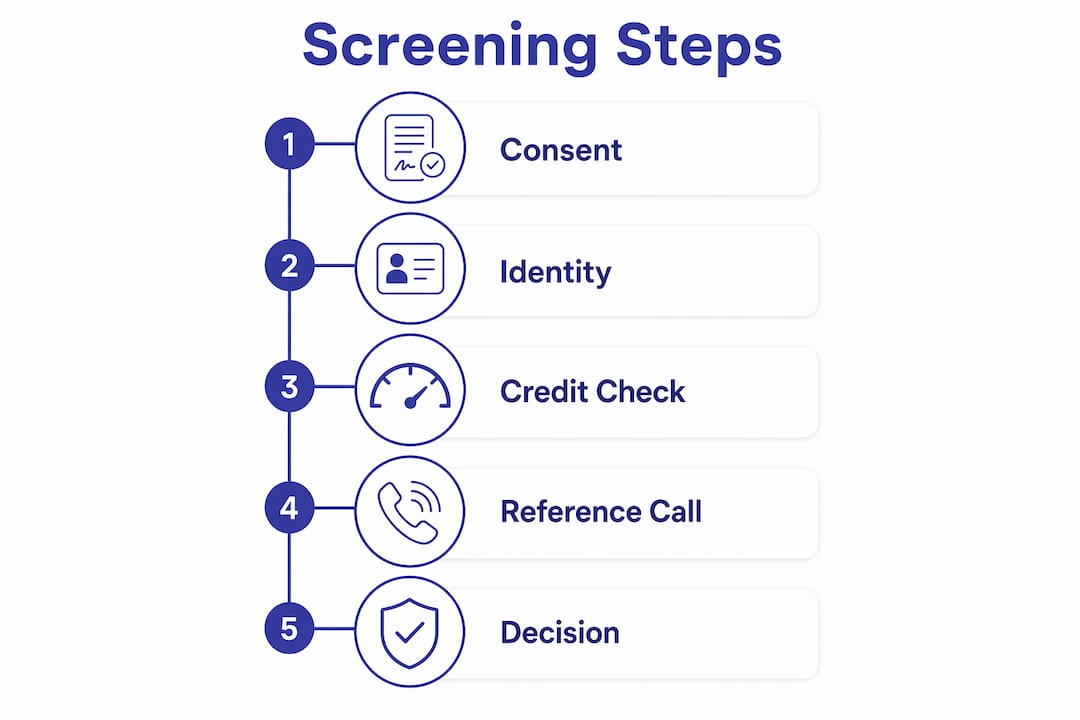
The standard screening workflow includes collecting personal information, obtaining written consent, reviewing screening reports, and then making a consistent approval decision. Here is how that translates into practice for South African landlords.
- Collect the completed application. Receive the signed application form with all supporting documents. Reject incomplete submissions immediately.
- Obtain written consent. Before running any check, confirm the signed consent form is in hand. No consent means no screening, full stop.
- Select your screening services. TPN (Tenant Profile Network) is the most widely used credit bureau for South African rental properties. TPN reports include name, ID, address, employment status, payment history, and a proprietary Credex® Score, generated within minutes of submission.
- Request all relevant reports. A thorough tenant screening checklist covers four report types: credit history, criminal record, eviction history, and employment verification. Do not skip the eviction check. A tenant with a clean credit score can still have a prior eviction on record.
- Verify identity using KYT tools. Modern Know Your Tenant approaches use real-time, bank-verified payroll and identity data to prevent document fraud and misrepresentation. This goes beyond accepting a static ID copy and is increasingly standard practice in 2026.
- Contact previous landlords directly. Verifying rental references by calling previous landlords is a step many property managers skip, yet it is one of the most reliable indicators of future behaviour. Ask specifically about payment punctuality, property condition at vacating, and whether they would rent to the applicant again.
- Review all findings against your criteria and decide. Apply your pre-set criteria consistently across all applicants. Document your reasoning, whether you approve or decline.
Pro Tip: Combine TPN credit reports with at least one direct landlord reference call. Automated reports tell you what happened financially; a previous landlord tells you what the tenancy actually felt like.
The numbered steps above form the backbone of any landlord background check process. Skipping even one step creates a gap that problematic tenants can exploit.

What are the legal and privacy challenges in South African tenant screening?
South African landlords operate under POPIA, which governs how personal information is collected, stored, and used. Non-compliance carries financial penalties and reputational damage, so understanding the boundaries of your screening process is not optional.
The principle of data minimisation applies directly to tenant screening. You may only collect personal information that is necessary for the specific purpose of evaluating the tenancy application. Collecting additional data, such as medical history or social media profiles, without a clear, documented reason is a POPIA violation.
“Landlords cannot deny applicants solely on report results without disclosure, consent, and notice processes.” This principle, drawn from FCRA-compliant screening guidance, mirrors South African best practice and underscores why your process must be documented from start to finish.
Separating data collection from decision-making reduces bias and legal risk by improving process transparency and fairness. In practical terms, this means the person who collects and stores application data should not be the sole person making the approval decision, particularly in larger property management firms.
Common mistakes landlords make during screening include:
- Storing tenant ID copies and bank statements on personal email accounts rather than encrypted, access-controlled systems
- Failing to destroy or delete applicant data after a decision is made and the retention period has lapsed
- Using screening results to discriminate on grounds prohibited by the Rental Housing Act, such as race, gender, or family status
- Running checks without written consent and assuming verbal agreement is sufficient
For a broader view of your legal compliance obligations as a South African landlord, the requirements extend well beyond screening and touch every stage of the tenancy.
How do you use screening results to manage landlord risk effectively?
A TPN report gives you a Credex® Score that indicates payment reliability based on credit accounts, loan status, and payment defaults. This snapshot helps you assess financial responsibility at a glance, but the score alone should never be the only factor in your decision.
Interpret screening results by weighing the following:
- Credit score and payment history. A low Credex® Score with multiple defaults is a clear warning. A moderate score with a single historical default and strong recent payment behaviour warrants a conversation rather than an automatic decline.
- Employment verification. Confirm that the employer named on the application actually employs the applicant. A quick phone call to the HR department takes three minutes and catches fraudulent payslips.
- Reference quality. A previous landlord who hesitates, gives vague answers, or declines to recommend the applicant is telling you something. Treat that signal seriously.
- Eviction history. A prior eviction is the single strongest predictor of future tenancy problems. Weight it accordingly.
Pro Tip: Set your affordability threshold before you receive any applications. The standard South African guideline is that gross monthly rent should not exceed 30% of the applicant’s gross monthly income. Applying this consistently removes subjectivity from the process.
When you decline an application based on screening results, communicate the decision in writing. State that a report was obtained and that the applicant has the right to request a copy of that report. This mirrors the adverse action notice process recommended in FCRA-compliant screening and protects you from claims of arbitrary or discriminatory rejection.
Screening is one layer of risk management, not the whole structure. Even a thoroughly vetted tenant can experience job loss, illness, or financial hardship after signing the lease. That is where rental income insurance becomes relevant as a complementary protection. Understanding tenant non-payment risks helps you see why screening and insurance work together rather than as substitutes for each other.
Key takeaways
Thorough tenant screening requires written consent, TPN credit reports, direct reference calls, and documented decision criteria applied consistently to every applicant.
| Point | Details |
|---|---|
| Consent before checks | Obtain a signed POPIA-compliant consent form before running any screening report. |
| TPN Credex® Score | Use TPN credit reports for instant payment history and a proprietary reliability score. |
| KYT identity verification | Apply Know Your Tenant tools to detect document fraud beyond static ID copies. |
| Reference calls matter | Contact previous landlords directly; their hesitation is as informative as their praise. |
| Screening plus insurance | Combine thorough vetting with rental income insurance to cover risks that screening cannot predict. |
Why I think most landlords underestimate the reference call
After working closely with South African landlords and property managers, the pattern I see most often is this: landlords invest in TPN reports and then treat the process as complete. The report arrives, the score looks acceptable, and the application gets approved. The reference call never happens.
That is a significant gap. Combining automated verification with human vetting produces a more trustworthy screening outcome than either approach alone. A credit bureau tells you about financial behaviour in the past. A previous landlord tells you about the person. Those are two different things, and both matter.
I have seen applicants with strong Credex® Scores who left properties in poor condition, paid on time but caused persistent neighbour disputes, or vacated without notice. None of that shows up on a credit report. It shows up in a five-minute phone call with the previous landlord.
The other underestimated step is documentation. South African landlords often treat POPIA as a compliance burden rather than a process discipline. But the landlords who document every step, from the consent form to the decision rationale, are also the landlords who resolve disputes faster and face fewer legal challenges. The paperwork is not the point. The habit of structured, consistent process is the point.
My practical advice: build a one-page tenant screening checklist that mirrors the seven steps above, attach it to every new application file, and tick each step off before making a decision. It takes ten minutes and it will save you far more than that in avoided disputes.
— Coert
Protect your rental income beyond the screening process

Diligent tenant screening reduces your risk, but it cannot eliminate it entirely. Rentalincomeinsurance offers rental income protection designed specifically for South African landlords, covering tenant non-payment, early lease termination, and absconding. After you have done the work of screening your tenants thoroughly, the next step is making sure your income is protected if circumstances change. Request a quote today and find out how Rentalincomeinsurance can safeguard your rental income against the risks that even the best screening process cannot foresee.
Watch this short overview to understand how rental income protection works in practice:
https://youtu.be/TLineBkLtuc
FAQ
What does a step by step tenant background check include?
A complete tenant background check covers identity verification, TPN credit history, criminal record, eviction history, employment confirmation, and at least one previous landlord reference call. Each step should be documented and completed before a decision is made.
Is written consent required before screening a tenant in South Africa?
Yes. POPIA requires written consent before you collect or process any personal information. A signed consent form stating the purpose and scope of the screening is mandatory for every applicant.
What is a TPN Credex® Score and how do I use it?
The TPN Credex® Score is a proprietary rating generated from a tenant’s credit accounts, payment history, and defaults. Use it as one input in your decision, not the sole criterion. Combine it with reference calls and employment verification for a complete picture.
How long should I retain tenant application data?
Retain application data only for as long as necessary to fulfil the purpose for which it was collected, in line with POPIA’s data minimisation principle. Once a decision is made and any dispute period has lapsed, securely destroy or delete the data of unsuccessful applicants.
Can I decline a tenant based solely on a credit report?
You can use a credit report as part of your decision, but you must disclose that a report was obtained, apply your criteria consistently, and communicate the decision in writing. Declining an applicant without disclosure or on discriminatory grounds violates both POPIA and the Rental Housing Act.
Recommended
- How to assess tenant reliability in South Africa – Rental Income Insurance
- SA tenant screening guide: Secure reliable rental income – Rental Income Insurance
- Tenant screening in South Africa: A landlord’s guide – Rental Income Insurance
- How background checks protect South African rentals – Rental Income Insurance