
TL;DR:
- Choosing between stepped and level premiums depends on your investment horizon and budget, with level premiums offering predictable long-term costs. Stepped premiums start lower but increase sharply after age 50, potentially becoming unaffordable, while level premiums remain stable but are higher initially. For long-term rental protection, selecting a level policy at the outset is generally more cost-effective and easier to plan for financially.
Stepped and level insurance premiums are two distinct pricing structures that determine how much you pay for cover over the life of your policy. Stepped premiums start lower and increase each year as you age, while level premiums are set at a higher fixed rate from day one and remain broadly stable throughout the policy term. For South African landlords, this choice directly affects the long-term affordability of rental income protection. Getting stepped vs level insurance explained clearly is not a luxury. It is a financial decision that can cost or save you tens of thousands of rands over a 20-year investment horizon.
How do stepped insurance premiums work?
Stepped premiums are effectively annual cover priced at your current age each year. Each policy anniversary, your insurer recalculates your premium based on your new age and the corresponding increase in risk. That means you are never truly locked in at a favourable rate. Each year’s recalculation reflects your higher risk profile, making stepped premiums progressively more expensive over time.
The initial affordability is the main draw. A landlord in their early 30s will pay noticeably less with a stepped structure than with a level policy. That difference can feel significant when you are managing bond repayments, maintenance costs, and vacancy periods simultaneously.
The problem arrives in midlife. Annual stepped premium increases range from 5% to 15% depending on age, and the acceleration past 50 is where most landlords get caught off guard. What felt manageable at 35 can become a serious budget strain at 52.
Stepped premiums: key characteristics
- Low entry cost, making cover accessible for landlords with tighter cash flow
- Annual recalculation tied to your age at each policy anniversary
- Increases accelerate sharply in your 40s and 50s
- No long-term rate lock, meaning you carry full exposure to age-related cost escalation
- Suitable for short-term cover needs or as a temporary strategy while building financial capacity
Pro Tip: If you start with a stepped policy, set a calendar reminder to review your premium every two years. The increases are gradual at first, which makes it easy to miss the point at which your policy is becoming unaffordable.
Financial planners warn that landlords often underestimate how sharply stepped premiums escalate after midlife. A policy that costs R800 per month at age 38 could cost R2,400 or more by age 55 under a stepped structure. That is a budget shock most rental income projections do not account for.
What makes level premiums better for long-term rental protection?
Level premiums are set at the rate corresponding to your age when you first take out the policy. That rate is then locked in for the duration of the cover. You pay more upfront compared to a stepped policy, but your exposure to age-related cost escalation is removed.

For landlords with a long investment horizon, this structure offers something stepped premiums cannot: predictability. You can model your insurance costs 10 or 15 years into the future with reasonable accuracy. That matters when you are calculating whether a buy-to-let property will remain profitable over time.
Level premiums eliminate the risk of insurance becoming unaffordable at older ages, which is precisely when your claim likelihood is statistically highest. A landlord who develops a health condition at 55 and is still on a stepped policy faces a double problem: rising premiums and no ability to switch without new underwriting.
Level premiums: key characteristics
- Higher starting cost than stepped, but stable over the long term
- Rate locked in at your entry age, removing age-related escalation risk
- More cost-effective if the policy is held for 15 years or longer
- Supports accurate long-term financial planning for rental property portfolios
- Preferred by landlords who intend to hold properties well into retirement
Pro Tip: Ask your insurer or broker whether your level policy includes an indexation clause. Some level policies adjust premiums annually for inflation, commonly around 5% or CPI-linked. “Level” does not always mean absolutely fixed.
Legal & General and similar insurers note that inflation indexation on level policies is standard practice in many markets. Your premium may still rise slightly each year, but the increase is tied to inflation rather than your age. That is a fundamentally different and far more manageable risk.
When do stepped premiums become more expensive than level?
The crossover point is the age or policy duration at which cumulative stepped premium payments exceed what you would have paid under a level structure. Understanding this point is the single most useful calculation a landlord can make before choosing a premium type.
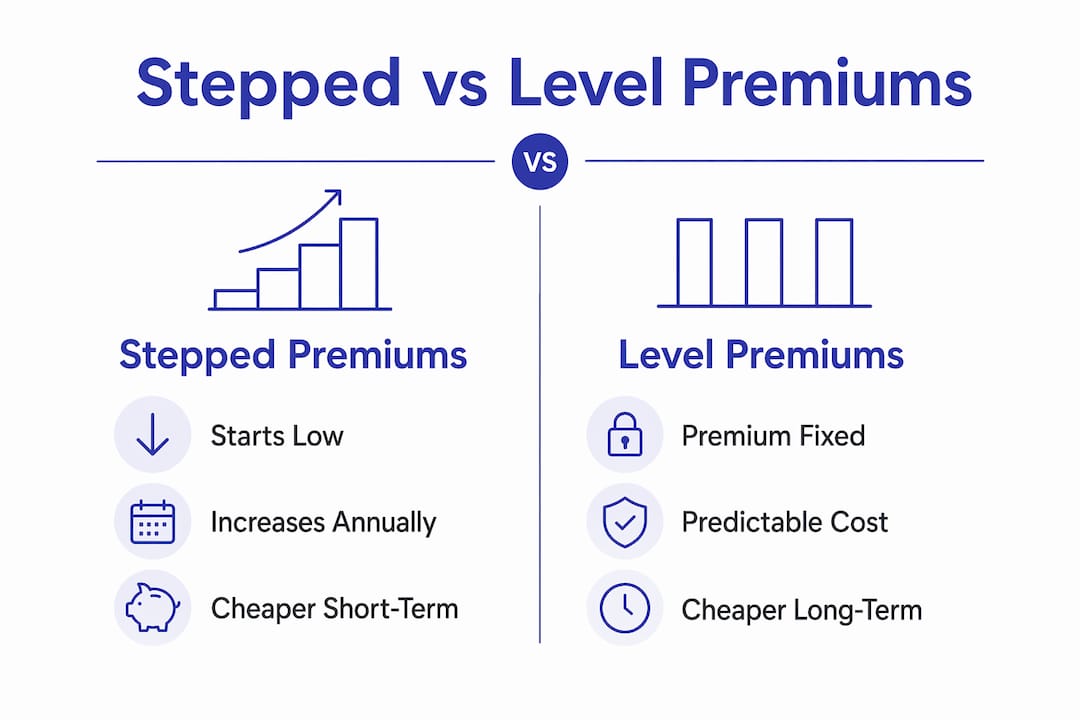
The crossover typically occurs after 15–20 years of holding a policy. Before that point, stepped premiums are cheaper in total. After it, level premiums deliver cumulative savings that grow larger with every passing year.
| Policy Duration | Stepped Premiums | Level Premiums | Likely Better Value |
|---|---|---|---|
| 0–7 years | Lower total cost | Higher total cost | Stepped |
| 8–14 years | Approaching parity | Approaching parity | Depends on age at entry |
| 15–20 years | Exceeds level total | Lower total cost | Level |
| 20+ years | Significantly higher | Stable and lower | Level, clearly |
The table above is a general model. Your actual crossover point depends on your age when you took out the policy, the specific insurer’s rate tables, and whether your level policy includes indexation. A landlord who starts a policy at 28 will reach the crossover at a different point than one who starts at 45.
Switching from stepped to level mid-policy is not straightforward. Late switching often requires new medical underwriting, which can result in higher premiums or outright denial if your health has changed. This is the trap that catches landlords who delay the decision. The right time to choose level premiums is at policy inception, not after a decade of stepped increases.
How should south african landlords choose between the two?
The right premium structure depends on four practical factors: your intended policy duration, your current budget, your age at entry, and your health trajectory. Here is a structured way to think through the decision.
-
Assess your investment horizon. If you plan to hold a rental property for 20 years or more, level premiums are almost certainly the better financial choice. The crossover point calculation confirms that policies held beyond 15 years favour level structures on cumulative cost.
-
Be honest about your budget. If level premiums are genuinely unaffordable right now, a stepped policy is better than no cover at all. Experts confirm that some coverage is better than none, but they stress the need for a clear plan to convert to level when your finances allow.
-
Review your policy every year. Stepped premiums can creep up without triggering alarm because each individual increase feels small. Set a fixed annual review date and compare your current premium against what a new level policy would cost at your current age.
-
Plan your switch before your health changes. The window to convert from stepped to level without new underwriting complications is open now. Once a health event occurs, that window may close permanently.
-
Check for indexation clauses on any level policy. Before signing, confirm whether your level premium is truly fixed or subject to annual CPI adjustments. This affects your long-term cost modelling and should be factored into your rental income projections.
-
Consult a specialist broker. A broker who works with South African landlords regularly will have access to rental property insurance comparisons and can model both structures against your specific portfolio and age profile.
How does your premium choice affect rental income protection?
Your choice of premium structure does not exist in isolation. It sits within a broader insurance framework that determines whether your rental income remains protected through every phase of your investment.
The core risk for any landlord is income interruption. Tenant non-payment, early lease termination, and property damage can each stop rental income flowing at any point. The insurance premium choice impacts affordability and therefore the continuity of that protection. A stepped policy that becomes unaffordable at 54 is not just an insurance problem. It is a gap in your income security at the exact age when you may be most reliant on rental revenue.
| Premium Type | Short-Term Cost | Long-Term Cost | Income Protection Continuity |
|---|---|---|---|
| Stepped | Lower | Higher (accelerates with age) | At risk if premiums become unaffordable |
| Level | Higher | Lower (stable or CPI-linked) | Maintained predictably over full term |
Rental income insurance products from Rentalincomeinsurance are designed to complement whichever premium structure you choose. Cover against tenant non-payment risks and early lease termination works alongside your life or income protection policy to create a layered defence for your rental revenue. The premium structure you choose for your life cover affects your budget. That budget directly determines whether you can afford to maintain all layers of that defence simultaneously.
For landlords managing multiple properties, the compounding effect of stepped premiums across several policies can become a serious cash flow problem by the time you reach your 50s. Level premiums, while more expensive initially, allow you to plan insurance costs across your entire portfolio with far greater accuracy.
Key takeaways
Choosing between stepped and level premiums is a long-term financial decision, not a short-term cost comparison. Level premiums become the more cost-effective structure for any policy held beyond 15 years.
| Point | Details |
|---|---|
| Stepped premiums increase annually | Each year’s rate reflects your current age, with sharp acceleration past 50. |
| Level premiums lock in your entry age rate | Costs stay broadly stable, making long-term budgeting far more reliable. |
| Crossover occurs at 15–20 years | Policies held beyond this point cost less cumulatively under a level structure. |
| Switching mid-policy carries risk | New medical underwriting may increase costs or deny cover if health has changed. |
| Level policies may still include indexation | Confirm whether your “level” premium is truly fixed or CPI-adjusted before signing. |
Why most landlords get this decision wrong
I have spoken with enough South African property owners to recognise a pattern. The decision between stepped and level premiums almost always comes down to the monthly premium quote, and the stepped option wins because it is cheaper today. That is the wrong frame entirely.
The question is not “what can I afford this month?” The question is “what will I be paying at 55, and will I still be able to afford it alongside my bond, levies, and maintenance costs?” Most landlords never model that scenario. They find out the hard way when a renewal notice arrives with a 12% increase and they are already stretched.
What I have found genuinely useful is treating the premium structure decision the same way you would treat a fixed versus variable rate bond. You would not choose a variable rate bond without modelling what happens if rates rise sharply. The same logic applies here. Run the numbers over 20 years before you sign anything.
The other mistake I see regularly is landlords assuming they can always switch to level later. Switching mid-policy is complicated by new underwriting requirements, and a single health event can make that switch impossible or prohibitively expensive. The time to make the right decision is at inception, not after a decade of stepped increases have already eroded your margin.
If you are under 40 and planning to hold rental property into retirement, a level premium is almost certainly the right structure. If you are genuinely cash-constrained right now, start with stepped but build a specific financial target that triggers your switch to level. Do not leave it open-ended.
— Coert
Protect your rental income regardless of which premium you choose
Whichever premium structure you select, your rental income still needs protection against the risks that no life policy covers: tenant non-payment, absconding, and early lease termination. Rentalincomeinsurance specialises in exactly this layer of cover for South African landlords. Whether you are on a stepped policy managing costs carefully or a level policy built for the long term, gaps in your rental income protection can undermine your entire investment strategy. Request a tailored quote from Rentalincomeinsurance today and find out how rental income protection fits alongside your existing cover. You can also watch a quick overview of how it works here:
https://youtu.be/TLineBkLtuc
FAQ
What is stepped insurance in simple terms?
Stepped insurance is a premium structure where your cost increases each year based on your age. Stepped premiums start lower than level premiums but accelerate significantly in your 40s and 50s.
What does level premium explained mean for landlords?
A level premium is a fixed rate set at your entry age and held broadly stable for the life of the policy. It costs more initially but protects you from age-related cost escalation, which matters most when your rental income is your primary retirement asset.
How long before level premiums become cheaper than stepped?
The crossover point occurs typically after 15–20 years of holding a policy. Beyond that point, cumulative level premium payments are lower than what you would have paid under a stepped structure.
Can i switch from stepped to level premiums later?
You can, but it is not straightforward. Switching mid-policy usually requires new medical underwriting, which may result in higher costs or denial of cover if your health has changed since the original policy was issued.
Are level premiums truly fixed or do they still increase?
Many level policies include indexation clauses that adjust premiums annually for inflation or a fixed percentage. Industry advice stresses checking for these clauses before signing, as “level” does not always mean absolutely fixed.