
TL;DR:
- Insurance endorsements legally amend policies to tailor coverage specific to a landlord’s lease requirements and risk profile. They must be obtained and properly documented before a loss to ensure enforceability, especially for waivers of subrogation and third-party protections. Landlords should proactively review lease clauses, request written endorsements, and consult their insurer for full policy details to prevent coverage gaps during claims.
An insurance endorsement is a legally binding written amendment that modifies your existing policy by adding, removing, or changing coverage terms, limits, or exclusions. For South African landlords, the role of insurance endorsements goes well beyond administrative paperwork. These modifications, also called riders or amendments, are the mechanism through which a standard property insurance policy becomes genuinely suited to your rental portfolio. Whether you need to add a tenant as an additional insured, waive your insurer’s subrogation rights under a commercial lease, or extend your coverage limits after a renovation, endorsements make it possible. Understanding how they work protects your investment and prevents costly surprises at claim time.
How do insurance endorsements modify and enhance landlord insurance policies?
An endorsement modifies coverage by becoming a legally binding part of your insurance contract, capable of overriding original policy terms where the two conflict. This is the mechanism that gives endorsements their power. They are not suggestions or addenda. They carry the same legal weight as the base policy itself.
In practical terms, endorsements can work in several directions:
- Adding coverage: A landlord insuring a block of flats in Cape Town might add equipment breakdown cover for the building’s lift or backup generator. Without an endorsement, that equipment is typically excluded from a standard property policy.
- Increasing limits: If you renovate and the rebuild value of your property rises significantly, an endorsement can raise your sum insured without requiring a full policy rewrite.
- Modifying exclusions: Some standard policies exclude damage caused by tenants. An endorsement can narrow or remove that exclusion, which is particularly relevant in South Africa’s high-turnover rental market.
- Changing definitions: An endorsement can redefine what counts as a “covered peril” or alter the definition of “insured premises” to include a newly acquired property.
Endorsements can also reflect changes in how you use a property. If a residential property shifts to short-term letting, the risk profile changes entirely, and an endorsement formalises that change with your insurer.
Pro Tip: Never assume your base policy automatically covers a new use or new tenant arrangement. Notify your insurer in writing and request a formal endorsement to document the change. Verbal agreements carry no weight at claim time.

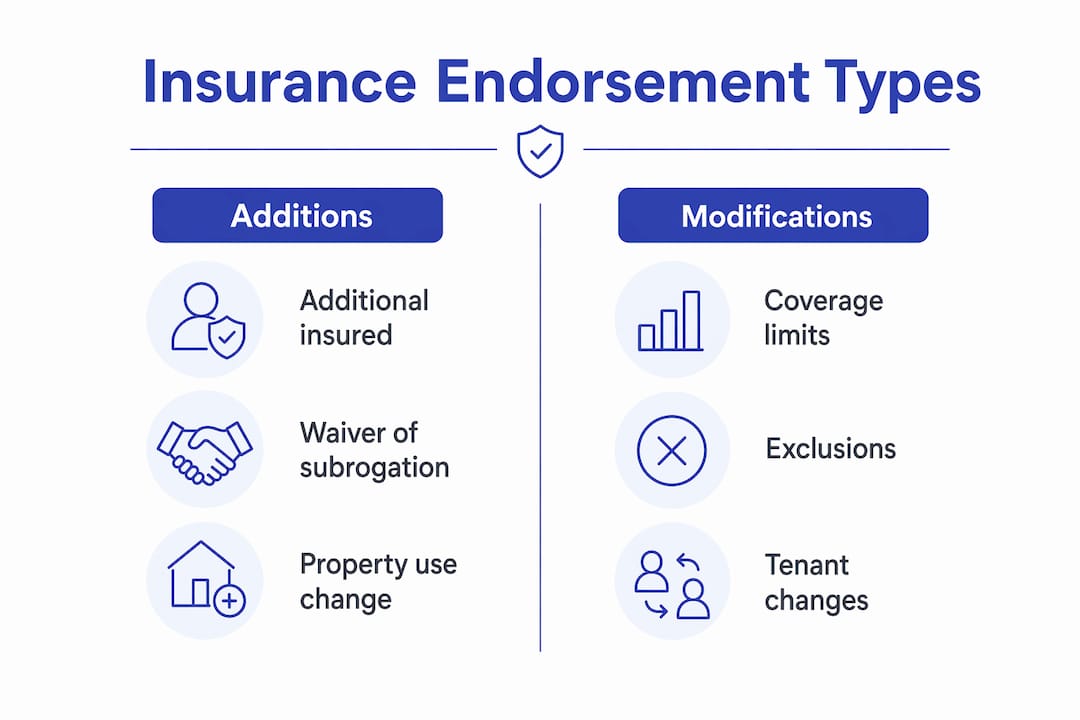
Two endorsements that South African landlords encounter most frequently in commercial lease negotiations are the additional insured endorsement and the waiver of subrogation endorsement. The additional insured endorsement extends your policy’s protection to a third party, such as a property managing agent or a commercial tenant, covering them if they face a claim arising from your property. These are standard requirements in many South African commercial lease agreements and are worth understanding before you sign.
What are the common types of insurance endorsements for SA landlords?
South African landlords encounter a range of endorsement types, each serving a distinct purpose. The table below outlines the most relevant ones, their function, and when you are likely to need them.
| Endorsement type | Function | Typical scenario |
|---|---|---|
| Additional insured | Extends coverage to a named third party | Commercial tenant or managing agent requires it in the lease |
| Waiver of subrogation | Prevents insurer from suing a specified third party | Lease or contractor agreement prohibits recovery actions |
| Coverage limit increase | Raises the sum insured or sub-limits | Post-renovation rebuild value increases |
| Exclusion modification | Removes or narrows a standard exclusion | Tenant damage exclusion removed for furnished rentals |
| Extended reporting period | Allows claims to be reported after policy expiry | End of a claims-made policy period |
| Prior acts coverage | Covers incidents that occurred before policy inception | Switching insurers mid-tenancy |
The waiver of subrogation endorsement deserves particular attention. It prevents your insurer from pursuing a third party, such as a tenant or contractor, for reimbursement after paying your claim. This is common in commercial leases and construction contracts where the parties want to avoid litigation between themselves. The financial loss shifts entirely to the insurer, which is why some insurers charge an additional premium for this endorsement.
A few further distinctions are worth noting:
- Voluntary endorsements are requested by the policyholder to broaden or adjust coverage, such as adding accidental damage cover.
- Mandatory endorsements are required by law, regulation, or a contractual counterparty, such as a commercial tenant insisting on additional insured status.
- Restrictive endorsements narrow coverage, often in exchange for a lower premium. A landlord with a low-risk property might accept an endorsement excluding flood damage to reduce costs.
Pro Tip: When reviewing a new lease agreement, check every clause that references insurance. Any clause requiring you to “maintain insurance naming the tenant as additional insured” or “provide a waiver of subrogation” is a direct instruction to obtain a specific endorsement before the lease commences.
Understanding common rental insurance exclusions alongside your endorsements is equally important. An endorsement that adds coverage in one area does not automatically remove exclusions elsewhere in the policy.
How do endorsements affect claim handling and risk management?
The impact of endorsements on claims is where many South African landlords are caught off guard. Courts interpret endorsements in the context of the whole insurance policy, not as standalone documents. An endorsement that appears to extend coverage may still be constrained by an exclusion elsewhere in the base policy. This is not a technicality. It is the legal reality of how insurance contracts operate.
For landlords, this has direct consequences:
- An endorsement adding tenant damage cover does not override a separate exclusion for wilful destruction unless the endorsement explicitly says so.
- A waiver of subrogation endorsement must be in place before a loss occurs. Obtaining endorsements after a loss can invalidate coverage, because most policies prohibit the insured from surrendering the insurer’s recovery rights without prior consent.
- In South Africa, insurers can institute legal proceedings in their own name or in the insured’s name when exercising subrogation rights. If your lease requires a waiver of subrogation but you have not obtained the endorsement, your insurer may pursue your tenant after a claim, damaging the tenancy relationship and potentially exposing you to a breach of contract claim.
“Endorsements are integral to maintaining relevant and legally compliant insurance coverage for evolving business operations, especially in property management.” — Business.com
After any endorsement is issued, request the full current policy wording from your insurer. This consolidated document shows all amendments, remaining exclusions, and unchanged conditions in one place. Reading only the endorsement schedule without the base policy is one of the most common and costly mistakes landlords make. For a detailed walkthrough of how these dynamics play out at claim time, the insurance claims guide for South African landlords covers the process step by step.
How can landlords effectively use insurance endorsements?
Using endorsements strategically requires timing, documentation, and a clear understanding of your contractual obligations. The following steps give you a practical framework.
-
Audit your lease agreements before signing. Every commercial or residential lease in South Africa that references insurance is a potential trigger for an endorsement requirement. Identify those clauses before you commit to the lease, not after.
-
Contact your insurer in writing. Once you have identified the endorsement you need, submit a written request to your insurer specifying the exact change required, the effective date, and the reason. Verbal requests are not binding.
-
Confirm the effective date. Endorsements must be in force before the event they are meant to cover. A waiver of subrogation requested after a pipe burst has already caused damage is worthless. Timing is not a formality. It is a coverage condition.
-
Review the endorsement document carefully. Check that the named parties, property addresses, and coverage terms match exactly what was agreed. Errors in an endorsement document are surprisingly common and can create disputes at claim time.
-
Reassess at every renewal. Your property portfolio changes. Tenants change. Lease terms change. At each annual renewal, review whether your existing endorsements still reflect your current risk profile and contractual obligations.
-
Weigh cost against coverage benefit. Some endorsements carry additional premiums. A waiver of subrogation endorsement, for instance, may cost more because it removes the insurer’s recovery option. Compare that cost against the contractual risk of not having it in place.
Pro Tip: If you manage multiple properties, keep a simple spreadsheet tracking each property, its active endorsements, the effective dates, and the lease clauses that triggered them. This takes thirty minutes to set up and can save you thousands in a coverage dispute.
Understanding the role of insurance for landlords more broadly will help you see where endorsements fit within your overall risk management strategy, rather than treating them as isolated policy add-ons.
Key takeaways
Insurance endorsements are legally binding policy amendments that every South African landlord must obtain, review, and manage proactively to avoid coverage gaps and contractual breaches.
| Point | Details |
|---|---|
| Endorsements are binding contract changes | They carry the same legal weight as the base policy and can override original terms. |
| Timing is a coverage condition | Endorsements must be in place before a loss event, not requested after the fact. |
| Read the full policy, not just the endorsement | Courts interpret endorsements alongside base policy exclusions and conditions. |
| Waiver of subrogation protects relationships | It prevents your insurer from suing your tenant or contractor after a claim is paid. |
| Audit leases before signing | Lease clauses requiring endorsements must be actioned before the lease commences. |
Why endorsements deserve more attention than most landlords give them
I have spoken with many South African landlords who treat endorsements as something their broker handles quietly in the background. That attitude is understandable. Insurance documentation is dense, and most landlords are focused on tenants, maintenance, and cash flow. But the endorsement is often the difference between a claim that pays out and one that does not.
The most common mistake I see is the waiver of subrogation gap. A landlord signs a commercial lease requiring a waiver of subrogation, assumes the broker has sorted it, and never verifies the endorsement document. Then a tenant causes significant water damage. The insurer pays the claim and then pursues the tenant for recovery, in direct breach of the lease agreement. The landlord faces a contractual dispute with their own tenant, potential legal costs, and a damaged business relationship. All of it preventable with one document check.
South Africa’s rental market adds another layer of complexity. Tenant turnover is high, lease terms vary widely, and the line between residential and commercial use is often blurred in mixed-use properties. Each of these transitions is a potential endorsement trigger that landlords miss because they are not looking for it.
My honest advice: treat every new lease, every renovation, and every change in property use as a prompt to call your insurer and ask one question. “Does my current policy cover this, and do I need an endorsement?” That question, asked consistently, costs nothing and protects everything.
— Coert
Protect your rental income with the right coverage in place
At Rentalincomeinsurance, we work specifically with South African landlords who need insurance that reflects the real complexity of managing rental properties. Endorsements are a core part of that. Whether your lease requires an additional insured endorsement, a waiver of subrogation, or a coverage limit adjustment after a property upgrade, our team helps you identify what you need and get it in place before it matters. Protecting your rental income starts with a policy that is actually built for your situation. Request a quote today and let us review your current coverage against your lease obligations.
FAQ
What is the role of insurance endorsements for landlords?
An insurance endorsement is a legally binding amendment to your base policy that adds, removes, or modifies coverage terms, limits, or exclusions. For landlords, endorsements customise standard property insurance to reflect specific lease obligations, tenant arrangements, and risk exposures.
When must a waiver of subrogation endorsement be in place?
The endorsement must be in force before any loss event occurs. Requesting a waiver of subrogation after a claim has been made can invalidate coverage, as most policies prohibit the insured from surrendering the insurer’s recovery rights without prior written consent.
Do endorsements replace the base insurance policy?
No. Endorsements modify but do not replace the base policy. Courts interpret endorsements alongside all other policy terms, exclusions, and conditions, meaning a coverage extension in an endorsement can still be limited by an exclusion in the original policy wording.
What is an additional insured endorsement?
An additional insured endorsement extends your policy’s protection to a named third party, such as a managing agent or commercial tenant, covering them against claims arising from your property. It is a standard requirement in many South African commercial lease agreements.
How does South African law treat insurer subrogation rights?
Under South African insurance law, insurers may institute proceedings in their own name or in the insured’s name to recover losses from a responsible third party. A waiver of subrogation endorsement is the only contractually reliable way to prevent this, making it a critical tool for landlords whose leases prohibit such recovery actions.
Recommended
- Best rental property insurance for SA landlords – Rental Income Insurance
- Insurance Premiums – How They Impact Landlords’ Security – Rental Income Insurance
- Understanding insurance deductibles: smart guidance for SA landlords – Rental Income Insurance
- Role Of Insurance Brokers For Landlords: Complete Guide SA – Rental Income Insurance