
TL;DR:
- Rental income protection covers unpaid rent, lease-break losses, and eviction costs for landlords. Key policy details include the waiting period and indemnity period, which determine payout scope during tenant default. Legal-budget allowances and clear activation triggers are essential for effective coverage in South Africa’s tenant-favorable environment.
In the context of rental income protection, accidental buildings insurance covers three core risks: unpaid rent replacement, legal and eviction costs, and income lost when a tenant breaks a lease early or absconds. The industry term for this product is rental income protection or rent guarantee insurance, and it is distinct from structural accidental damage cover for walls, roofs, and fixtures. Before you buy, check two clauses above everything else: the waiting period (how long before cover activates) and the indemnity period (how many months the policy will pay).
Table of Contents
- What does accidental buildings insurance cover in practice?
- What exclusions and limits should you watch for?
- How do claims work in South Africa?
- What affects your premium and how much cover do you need?
- How do you choose the right policy?
- Step-by-step: how to file a rental income claim
- Key takeaways
- Why rental income protection matters more than most landlords realise
- Protect your rental income with Rentalincomeinsurance
- Useful sources
What does accidental buildings insurance cover in practice?
Rental income protection policies in South Africa typically cover unpaid rent, eviction costs, and tenant-caused damage that exceeds the deposit. Here is how each element works in practice.
Unpaid rent replacement
When a tenant stops paying, the insurer replaces the lost monthly rent up to the agreed sum insured. Most policies calculate the payout as monthly rent multiplied by the number of months in arrears, subject to the indemnity period cap. A landlord receiving R12,000 per month whose tenant defaults for three months would receive up to R36,000, provided the policy’s indemnity period covers three months and the waiting period has elapsed.
Early lease termination and lease-break cover
Early lease termination cover typically pays two to three months’ rent when a tenant exits before the lease end date without adequate notice. The trigger is usually a formal written lease-break notice combined with proof that the property is vacant. Caps vary by insurer, so check the exact number of months stated in the schedule.
Tenant absconding
Absconding differs from non-payment because the tenant has left without notice, often leaving the property in an unknown state. Cover triggers typically require a police report confirming abandonment and evidence that the landlord has attempted contact. Once those conditions are met, the policy pays lost rent for the covered period.
Tenant-caused damage and loss of rent while uninhabitable
Some policies cover loss of rental income while a property is uninhabitable due to tenant-caused damage, and may extend to alternative accommodation costs. This is separate from structural buildings insurance; the rental income element pays the rent you cannot collect while repairs are under way.
Legal and eviction costs
A legal-budget allowance covers attorney fees, court costs, and sheriff charges during the eviction process. This is one of the most valuable components for South African landlords, given how lengthy formal evictions can be.

Sample indemnity calculation:
Illustrative only. Actual payouts depend on policy terms, waiting period, and indemnity period.
Pro Tip: Find the indemnity period in the policy schedule, not the marketing summary. It is the single figure that determines your maximum payout, and it is often buried in the definitions section.
What exclusions and limits should you watch for?
Common exclusions deny cover for wilful or intentional damage by tenants, pre-existing arrears at the policy start date, and failure to disclose letting activity to the insurer. Understanding these limits before you sign protects you from a denied claim when you need it most.
Typical exclusions:
- Wilful or intentional damage caused by tenants
- Arrears that existed before the policy inception date
- Letting the property without notifying your insurer (which can also void your standard buildings cover)
- Normal vacancy periods between tenancies
- Routine maintenance losses or wear and tear
- Short-term or holiday lets, and subletting arrangements not disclosed to the insurer
Common payout limits to check:
- Maximum indemnity period (often three months per claim)
- Aggregate annual limit across all claims
- Per-claim cap expressed as a percentage of the monthly rent
- Excess or deductible applied before the insurer pays
Watch this clause carefully: Many standard homeowners’ buildings policies are voided the moment you let the property to a paying tenant. If you have not taken out specialised landlord cover, you may have no buildings protection at all — not just no rental income cover.
Run a mortgage-stress scenario before you buy: calculate your bond repayment and fixed costs for a realistic eviction timeline of three to six months, then compare that total against the policy’s indemnity limit and legal-fees allowance. If the numbers do not align, you need a higher indemnity period or a larger legal budget. More detail on rental income protection exclusions is worth reviewing before finalising any policy.
How do claims work in South Africa?
Claims require evidence of arrears, a formal demand letter, and proof that eviction or recovery steps have begun. South Africa’s Rental Housing Act and Consumer Protection Act give tenants significant procedural protections, which means evictions are often lengthy and costly, making the legal-budget component of your policy critical.
Typical eviction sequence:
- Tenant misses payment; landlord issues a written demand notice.
- Tenant fails to remedy; landlord instructs an attorney and issues a letter of demand.
- Application to the Rental Housing Tribunal or Magistrate’s Court.
- Court hearing and judgment.
- Warrant of eviction issued; sheriff executes eviction.
- Property handed back; landlord assesses damage and submits final claim documents.
Indemnity payments usually begin after the waiting period has elapsed and the formal legal process has started — not from the first missed payment. Knowing this timeline helps you budget for the gap between arrears and your first payout.
Watch for policies that require a tenant to have occupied the property for three months before any claim is valid, or that only pay after two or more missed payments. These activation triggers materially affect when you receive money.
Documents insurers typically require:
- Signed tenancy agreement
- Rent ledger or bank statements showing arrears
- Written demand letters and proof of delivery
- Police report (for absconding claims)
- Repair invoices and photographs (for uninhabitable property claims)
- Court documents once legal proceedings are under way
Pro Tip: Keep a time-stamped communication log from day one of arrears. A single folder, digital and physical, containing every message, letter, and photograph will speed up insurer assessment and reduce the risk of a disputed claim.
What affects your premium and how much cover do you need?
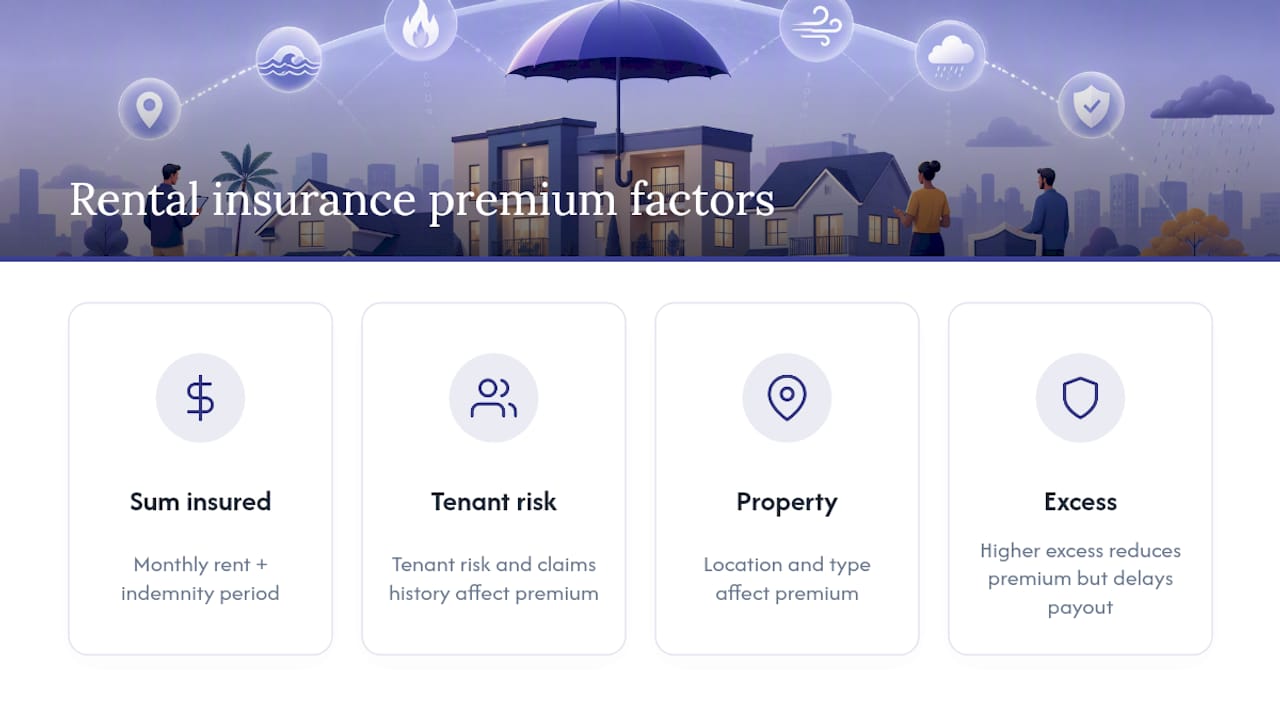
Premium levels depend on the sum insured (monthly rent and indemnity period), tenant risk profile, property location and type, claims history, and the excess you choose. Premiums in South Africa are commonly quoted in the 2–5% range of monthly rent.
Illustrative annual premium table (for guidance only):
Illustrative only. Actual premiums vary by insurer, property, and cover selected.
As a rule of thumb, size your cover to meet at least your monthly bond repayment plus a legal-fees buffer for the full indemnity period. Increasing the waiting period or raising the excess will reduce your premium, but both delay or reduce your payout during early arrears. That trade-off is worth modelling before you commit.
Integrating rental cover into a broader property investment strategy is worth considering, particularly if you hold multiple properties with different risk profiles.
How do you choose the right policy?
Clear policy wording about activation triggers is the most important factor to compare across quotes. Whether the insurer pays after two missed payments or only after a court order makes a substantial difference to your cash flow.
Essential questions to ask every insurer:
- Does the policy cover tenant non-payment, lease-break, absconding, and legal eviction fees?
- What is the precise definition of “tenant default” in the policy wording?
- What triggers a payout, and how many missed payments are required?
- What is the exact indemnity period and the per-claim cap?
- What is the waiting period, and does a three-month occupation requirement apply?
- What excess applies, and how is it calculated on rent-replacement claims?
- Which tenant types or letting arrangements are excluded?
Red flags to spot:
- Vague indemnity wording with no stated cap in months
- Activation triggers tied to a court order only (delays payout by months)
- Clauses voiding cover if the property was let without insurer notification
- No explicit legal-fees or eviction-budget allowance
Quick scoring framework:
| Feature | Must-have | Nice-to-have | Deal-breaker if absent |
|---|---|---|---|
| Unpaid rent replacement | ✓ | ||
| Legal/eviction budget | ✓ | ||
| Lease-break cover | ✓ | ||
| Absconding cover | ✓ | ||
| Short waiting period | ✓ | ||
| No occupation requirement | ✓ | ||
| Vague activation trigger | ✓ |
Step-by-step: how to file a rental income claim
Follow this sequence from the moment you notice arrears to the point of receiving your indemnity payment. The claims process for landlords follows a consistent pattern across most South African insurers.
- Identify arrears. Confirm the missed payment in writing and update your rent ledger immediately.
- Issue a formal demand notice. Send a written demand to the tenant by registered post or email with read receipt.
- Notify your insurer promptly. Most policies require notification within a set number of days of the first missed payment. Late notification is a common reason for claim denial.
- Instruct an attorney. Begin the formal eviction or recovery process. Keep all attorney correspondence.
- Collect and organise documents. Gather your tenancy agreement, rent ledger, demand letters, proof of communication, and any photographs or repair invoices.
- Submit the claim file. Send the complete file to your insurer with a covering letter summarising the timeline.
- Follow up on indemnity payments. Confirm when the waiting period ends and when the first payment is due.
Document checklist:
- Tenancy agreement (signed by both parties)
- Rent ledger or bank statements showing arrears
- Demand letters with proof of delivery
- Attorney correspondence and court documents
- Police report (absconding claims)
- Photographs and repair invoices (uninhabitable property claims)
For a detailed walkthrough of handling unpaid rent step by step, Rentalincomeinsurance provides a dedicated landlord guide covering each stage of the process.
Key takeaways
Rental income protection covers unpaid rent, legal eviction costs, and lease-break losses, but the indemnity period and waiting period clauses determine whether the payout actually covers your mortgage during a South African eviction.
| Point | Details |
|---|---|
| Core cover | Policies typically pay unpaid rent, legal/eviction costs, and lease-break or absconding losses. |
| Critical clauses | Check the waiting period and indemnity period first; these two figures determine your actual payout. |
| Common exclusions | Wilful damage, pre-existing arrears, and undisclosed letting arrangements are the most frequent claim denials. |
| Legal-fees budget | South African evictions are lengthy under the Rental Housing Act; a legal-fees allowance is not optional. |
| Rentalincomeinsurance | Offers rental income protection tailored to South African landlords, covering non-payment, lease-break, and absconding risks. |
Why rental income protection matters more than most landlords realise
South African landlords face a legal environment that is genuinely tenant-favouring. The Rental Housing Act and the Consumer Protection Act together mean that even a straightforward eviction can take months and cost tens of thousands of rands in legal fees before you recover possession. Many landlords discover this only after the fact, when their bond repayments are already overdue and their savings are depleted.
The conventional wisdom is that a deposit covers you. It rarely does. A deposit typically covers one to two months’ rent, while a contested eviction can run three to six months or longer. The gap between what the deposit covers and what the eviction costs is precisely where rental income protection earns its premium.
What we see consistently is that landlords who treat their policy as a legal-budget fund, not just a rent-replacement cheque, are far better positioned. They engage attorneys earlier, they follow the correct procedural steps, and they do not make the costly mistake of accepting a partial payment arrangement that resets the eviction clock. A policy with a clear legal-fees allowance and a short activation trigger is not a luxury. For a landlord with a bond to service, it is the difference between a manageable problem and a financial crisis.
Protect your rental income with Rentalincomeinsurance
Losing rental income to a defaulting tenant while your bond repayments continue is one of the most stressful situations a South African landlord faces. Rentalincomeinsurance offers rental income protection designed specifically for this reality, covering tenant non-payment, early lease termination, and absconding, with a legal-fees budget built in for South African eviction proceedings.

Our policies include clear indemnity period wording, defined activation triggers, and a straightforward claims process so you know exactly where you stand from day one. Sample policy wording is available on request. Whether you manage one property or a portfolio, we can tailor cover to your sum insured, waiting period, and excess preferences.
Request a quote today and find out how much cover costs for your property. You can also visit Rentalincomeinsurance for a full overview of our product suite and to review our rental income protection guide.
Watch our short explainer to see how the cover works in practice:
Useful sources
- Is Rental Insurance Worth It In South Africa? — South African Landlords Association
- Landlord insurance: Protect your rental investment — Private Property
- What is Rental Income Insurance? — GeoAfrika
- Rental income insurance: protecting your assets and liabilities — bbrief
- Rental Income Protection Exclusions Explained — Rentalincomeinsurance
- Early Lease Termination Insurance — Rentalincomeinsurance
- Claim Rental Insurance Process Guide — Rentalincomeinsurance
Recommended
- Accidental Landlord Insurance – Protecting South Africans – Rental Income Insurance
- Commercial building insurance essentials for SA landlords – Rental Income Insurance
- Building insurance in South Africa: protects 40% of landlords – Rental Income Insurance
- Property damage liability for South African landlords – Rental Income Insurance