
In this article, “assured tenancy” means rental income protection that can cover unpaid rent, early lease termination and eviction legal costs, but the actual scope of that cover depends on the policy schedule, the underwriting behind it and whether procedural steps were followed correctly. It typically includes rent replacement and legal fee assistance, with a checklist below to help you verify what you are actually buying.
TL;DR:
- Rental income protection policies exclude pre-existing arrears, landlord negligence, and poor tenancy administration, which can invalidate claims or limit coverage.
- Payment structures vary from monthly indemnities to lump sums, and claims are contingent on strict procedural compliance like formal notices and inspections.
- Legal fee coverage only applies if eviction follows proper court procedures, with distinctions between Magistrate’s Court and Small Claims Court rulings.
- Confirm the insurer’s authorization, coverage scope, caps, excess, and documentation requirements before purchasing or renewing to avoid surprises.
- Maintaining comprehensive documentation of leases, inspections, and communications enhances the likelihood of a successful claim.
Table of Contents
- 1. What this cover means in practice
- 2. What policies commonly cover and how payments work
- 3. Common exclusions and limits to watch for
- 4. Checklist for verifying cover before you buy
- 5. How to prepare and lodge a claim
- 6. Why eviction procedure and court jurisdiction matter to cover
- Our take on assured tenancy cover
- How Rental Income Insurance can help protect your rent
- Sources
- FAQ
1. What this cover means in practice
When people talk about assured tenancy in this context, they mean an insurance product designed to protect a landlord’s rental income rather than a tenant’s legal status. It suits landlords who want a financial buffer if a tenant stops paying, breaks a lease early, or disappears without notice. We understand the anxiety that comes with an empty bank transfer where rent should be, and this type of cover exists precisely to soften that blow.
You will see this product marketed under several names, and the wording matters more than most landlords realise:
- Rental income protection: the most literal description of what the policy does.
- Eviction cover: often bundled in, but sometimes sold as a separate add-on.
- Rental guarantee: a term used loosely by some sellers, so always confirm whether it is genuine insurance or an informal promise.
Benefits usually take one of three shapes: a monthly indemnity that replaces lost rent, a lump sum for extended vacancy, or reimbursement of legal costs tied to recovering the property. Knowing which shape your policy uses changes how you budget for a claim.
2. What policies commonly cover and how payments work
Most policies bundle several categories of protection rather than a single benefit, and understanding how each is structured helps you read a policy schedule properly.
- Unpaid rent, usually paid monthly for a defined period once arrears are confirmed.
- Early lease termination, covering the shortfall between what was contracted and what the tenant actually paid.
- Eviction and legal costs, including attorney fees and, in some policies, sheriff or tracing fees.
- Tracing fees, used when a tenant absconds and the landlord needs to locate them for legal service.
- Limited property damage recovery, often capped well below full repair costs.
Payment structures vary. Some insurers pay a monthly indemnity that mirrors the rent you would have received, others settle with a lump sum once a claim is finalised. Nearly all apply a waiting period before a claim becomes active, and most set a cap on the total payout per claim or per year.
Procedural conditions often decide whether a valid claim actually gets paid. Missing a notification deadline, failing to issue a formal demand, or skipping a required inspection can delay or void a payout even when the underlying loss is genuine.
Pro Tip: Read the “conditions precedent to liability” section of your policy schedule before you sign anything: it usually lists the exact steps you must follow to keep a claim valid.
3. Common exclusions and limits to watch for
Policies read generously in the marketing brochure and far more narrowly in the schedule. A handful of restrictions come up again and again:
- Pre-existing arrears at the time the policy started are almost always excluded.
- Losses linked to landlord negligence, such as failing to screen a tenant, are typically not covered.
- Poor tenancy administration, including missing lease documents or unrecorded inspections, can invalidate a claim regardless of the actual loss.
- Per-claim caps and aggregate annual limits mean a serious loss may only be partially covered.
- High excesses and short waiting periods reduce the practical value of cover for shorter vacancies.
Some sellers market guarantee-style products that are not underwritten as genuine insurance at all. The FSCA has taken enforcement action against firms offering unauthorised guarantee arrangements without proper short-term insurer authorisation, which is exactly why confirming the underwriter matters more than the marketing copy.
4. Checklist for verifying cover before you buy
Before you sign or renew a policy, a short conversation with the insurer or intermediary can save you a painful surprise later. Ask these questions directly and get the answers in writing.
- Who is the underwriting insurer, and is the intermediary selling it authorised by the FSCA?
- Which specific risks are named: non-payment, early termination, absconding, damage, or all four?
- What are the waiting period, the per-claim cap, the aggregate limit and the excess?
- What evidence does the insurer require to open and settle a claim?
- Where do you escalate a dispute: the insurer’s own complaints process, or the insurance ombud for contractual disagreements?
Keep your own file alongside these answers: the signed lease, rent ledger, inspection reports, photographs and any correspondence with the tenant. This documentation is what turns a plausible claim into a paid one.
Pro Tip: Ask for the policy wording, not just the quote summary. The wording is the document that governs a claim, and it is often more restrictive than the sales page suggests.
5. How to prepare and lodge a claim
When a tenant stops paying or vacates without notice, the sequence you follow affects both your legal position and your claim outcome.
- Record the arrears as soon as they appear, dated and itemised against the lease terms.
- Send a formal demand for payment, keeping proof of delivery.
- Document a property inspection with dated photographs, ideally with a witness present.
- Begin the relevant court or tribunal process if the tenant does not respond, since most legal fee cover is conditional on following the correct procedure.
- Notify your insurer promptly, ideally before serving formal court papers, since many policies require notification before legal costs are incurred.
The essential paper trail includes the lease, the arrears ledger, demand letters, inspection reports, photographs and any invoices already paid. Our guide to the rental insurance claim process sets out the documents insurers typically ask for in more detail. Early notification matters because a delay can be read as a failure to mitigate loss, which some insurers use to reduce a payout.
6. Why eviction procedure and court jurisdiction matter to cover
Legal fee cover only pays out when the underlying eviction follows the correct procedure, so it helps to understand how that procedure works. Residential evictions must proceed under the Prevention of Illegal Eviction Act, heard in the Magistrate’s Court or, in some cases, the High Court. This route involves formal notices, court applications and, ultimately, a sheriff to execute an eviction order, as practice notes on evictions in the Magistrate’s Court set out.

The Small Claims Court cannot be used to eject a residential occupier, regardless of how small the arrears might be, and its financial jurisdiction is limited to non-residential matters in any case. This distinction matters because some landlords assume a cheaper court route exists for residential cases, and it does not.
The practical implication for your cover: check whether the policy funds sheriff fees, counsel, tracing costs and appeals, or only the initial attorney letter. A policy that stops paying once the matter reaches court leaves you carrying the most expensive part of the process yourself.
Our take on assured tenancy cover
Most landlords underestimate how much a claim depends on paperwork rather than the loss itself. The policy schedule decides what gets paid, but your own tenancy administration decides whether you can prove the claim at all. Landlords who keep a disciplined file of leases, inspections, demand letters and photographs tend to have far smoother claims than those relying on memory and a folder of unread emails.
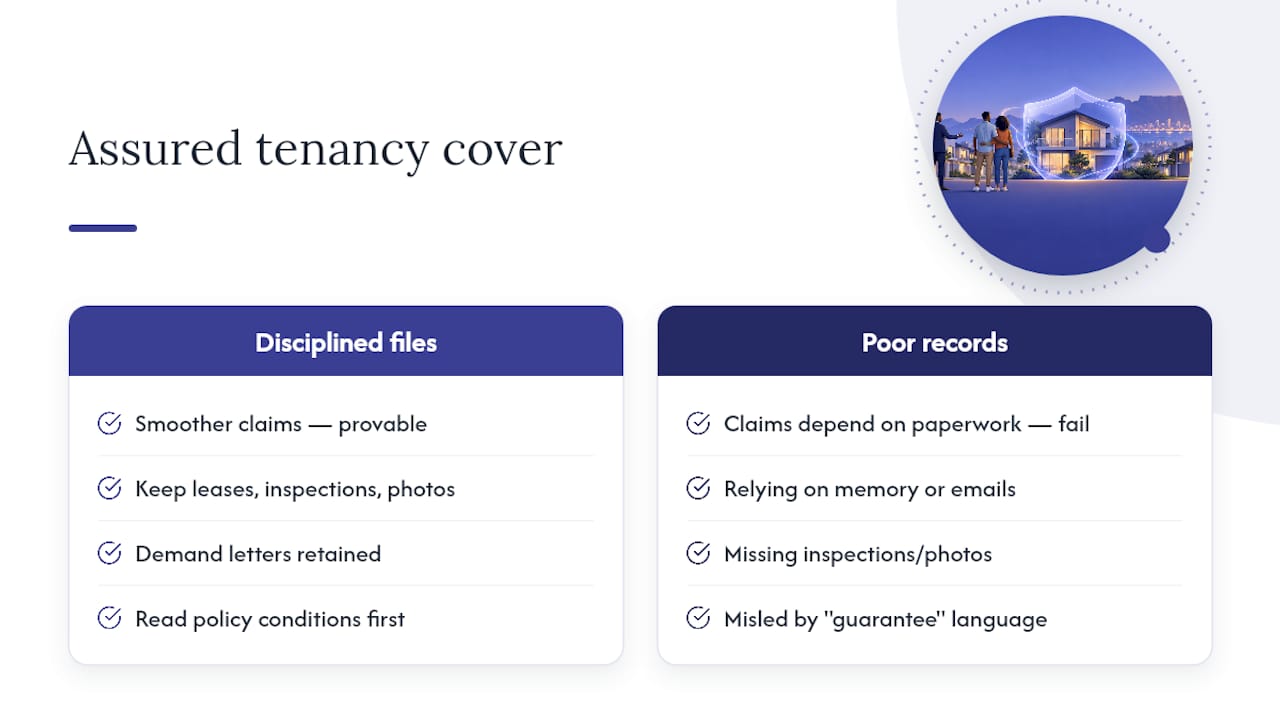
We also think the industry does landlords a disservice by using “guarantee” language loosely. A guarantee implies certainty, and insurance never offers that. It offers a structured process with conditions, and the landlords who read those conditions before a crisis are the ones who actually get paid.
Rental Income Insurance focuses specifically on protecting landlords against tenant non-payment and early lease termination, and we publish practical guides because we would rather you understand the policy you are buying than discover its limits during a dispute. Use the checklist above on your next call with an insurer or intermediary.
— Coert
How Rental Income Insurance can help protect your rent
Tenant non-payment, early lease termination and absconding are exactly the outcomes our cover is built around, alongside the legal fees that come with recovering a property once things go wrong.

We offer a range of tailored products so you can match cover to your situation rather than accepting a one-size policy:
- Rental Income Insurance, our core product covering lost rent from non-payment or early termination.
- Eviction Insurance, focused on legal costs tied to recovering a property.
- Residential Rental Insurance and Commercial Rental Insurance, structured for the different risks each property type carries.
- Group Rental Insurance and Tenant Insurance, for landlords managing multiple units or wanting broader tenant-related cover.
Whichever plan you consider, compare the policy schedule closely: check the underwriter, the caps, the excess and the exclusions before committing, whether that is with us or anyone else. If you would like a quote based on your own property and lease terms, request a quote and we will match cover to what you actually need.
Sources
This article draws on FSCA regulatory guidance on authorised sellers and underwriting, SARS guidance on rental income for tax treatment, eviction practice notes on court procedure, and the Rental Housing Act on landlord administration duties.
- Spotlight on evictions and the magistrates’ court in South Africa — practice notes
- FSCA — consumer and regulatory information
FAQ
What does assured tenancy mean for a landlord?
In this context, it means rental income protection: insurance that can pay out for unpaid rent, early lease termination or absconding, subject to the policy’s waiting period, caps and conditions. It is not a legal status but a financial safeguard you buy as cover.
What is typically excluded from rental income protection?
Pre-existing arrears at the start of the policy, losses linked to landlord negligence, and claims undermined by poor tenancy administration are common exclusions. Per-claim caps, aggregate limits and short waiting periods also restrict what a policy actually pays.
How does eviction procedure affect legal fee cover?
Legal fee cover generally only helps when the eviction follows the correct process under the Magistrate’s Court framework, since the Small Claims Court cannot eject a residential occupier. Check whether your policy funds sheriff fees, counsel and appeals, or only the initial legal letter.
Can I deduct rental insurance premiums from my tax?
Qualifying insurance can be a deductible expense against rental income in specified circumstances, according to SARS guidance on rental income, though landlords should get advice on their own ownership structure. Our guide to deductible items for landlords covers this in more detail.
What plans does Rental Income Insurance offer?
Rental Income Insurance offers Rental Income Insurance, Eviction Insurance, Residential Rental Insurance, Commercial Rental Insurance, Group Rental Insurance and Tenant Insurance. Pricing for the core Rental Income Insurance product is competitively priced per month, while other plans are quoted individually on request.