
TL;DR:
- Investment property insurance is essential to protect landlords from damages, liability claims, and rental income loss. Standard homeowner policies do not cover rental activities and may result in claim denial, making landlord-specific policies necessary. Proper coverage, aligned with lender requirements and reviewed annually, ensures financial protection and investment security.
Investment property insurance is a specialised category of cover that protects landlords against property damage, liability claims, loss of rental income, and vacancy risks. Standard homeowners insurance does not cover rental activities and using it for a rental property can result in complete claim denial. South African landlords need policies built specifically for rental use, aligned with both their financial exposure and their lender’s requirements. Rentalincomeinsurance offers cover tailored to exactly these risks, including tenant non-payment, early lease termination, and property damage.
What insurance do I need for an investment property?
The four core types of cover every landlord needs are dwelling insurance, liability insurance, loss of rental income insurance, and vacant property cover. Each addresses a distinct risk that a standard homeowners policy ignores or excludes.

Dwelling (property) insurance
Dwelling insurance covers physical damage to the building and its permanent fixtures from fire, storm, flooding, and malicious damage. The policy should cover the full replacement cost of the structure, not just its market value. Replacement cost and market value often differ significantly, particularly in older properties where rebuilding costs have risen faster than sale prices.
Liability insurance
Liability cover protects you if a tenant or visitor is injured on your property and holds you responsible. Liability coverage is recommended to start at R1,000,000 per occurrence to meet rising legal and settlement costs. Landlords with multiple properties or significant personal assets should also consider an umbrella policy, which provides layered protection of R1,000,000 to R5,000,000 or more across their entire portfolio.
Loss of rental income insurance
Loss of rental income cover replaces lost rental payments during repairs or tenant vacancies, typically for 6–12 months. This cover is non-negotiable if your rental income funds the mortgage. Without it, a single prolonged vacancy or major repair can push you into arrears on your bond repayments.
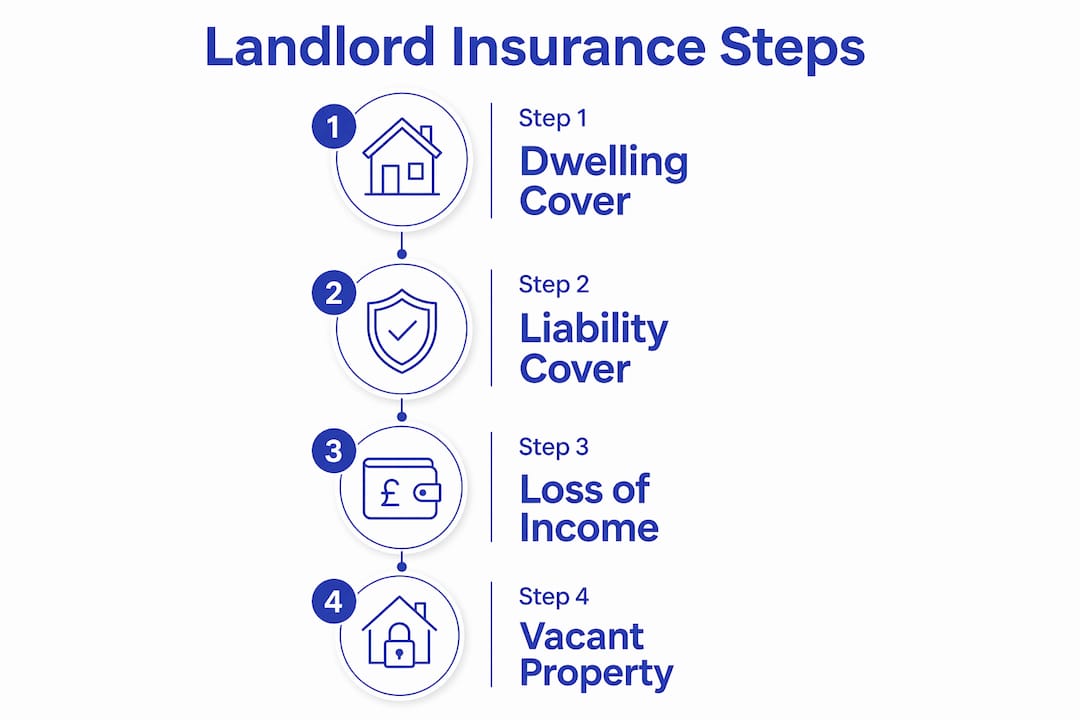
Vacant property cover
Most standard policies reduce or void coverage if a property sits empty beyond 30–60 days without a specific endorsement. Vacant property premiums run 30–80% higher than standard rates, reflecting the increased risk of vandalism, burst pipes, and undetected damage. If you are renovating between tenants or struggling to fill a unit, this endorsement is not optional.
Other endorsements worth considering include short-term rental cover (if you list on platforms like Airbnb), equipment breakdown cover for geysers and electrical systems, and ordinance or law cover for properties that may require upgrades to comply with building regulations after a claim.
Pro Tip: Bundle your dwelling, liability, and loss of rental income cover under a single landlord policy rather than stacking separate homeowners endorsements. A dedicated landlord policy is structured for rental use and will not be voided by tenant activity.
How much does investment property insurance cost?
Investment property premiums in South Africa run 15–25% higher than homeowners insurance due to the higher claim frequency associated with rental properties. That gap reflects real risk. Tenants do not maintain properties with the same care as owners, and insurers price accordingly.
The table below outlines typical annual premium ranges as a percentage of property value:
| Risk zone | Annual premium (% of property value) | Key cost drivers |
|---|---|---|
| Low-risk area | 1–1.5% | Stable tenants, low crime, newer construction |
| Medium-risk area | 1.5–2% | Mixed tenant profile, moderate crime, older stock |
| High-risk area | 2–3% | High vacancy, crime exposure, older buildings |
Several factors push premiums up or down beyond location. Property age and construction type matter: a 1970s brick flat block costs more to insure than a 2015 sectional title unit. Vacancy periods increase risk and therefore cost. Higher liability limits add to the premium but reduce your personal exposure in a claim. The excess you choose also affects the monthly or annual cost.
Pro Tip: Raise your excess to reduce your annual premium, but only to an amount you can genuinely afford to pay out of pocket after a claim. A low premium with an unaffordable excess is not a saving.
Budgeting 1–1.5% of property value annually is realistic for low-risk South African markets. In high-risk zones, budget up to 3%. Factor this into your yield calculations before you buy, not after.
How do lender requirements shape your insurance obligations?
Lenders treat insurance as a risk validation tool, not a formality. Failing to satisfy lender insurance mandates can delay or kill a property deal at closing. South African banks and bond originators typically require the following before registration:
- Dwelling cover at full replacement cost. The insured value must reflect what it would cost to rebuild the property today, not its purchase price or municipal valuation.
- A mortgagee or loss payee clause. This clause names the lender as a co-beneficiary on the policy, so any claim payout goes to settle the bond before you receive any balance.
- Continuous coverage evidence. Lenders require proof that cover is active and will not lapse. A gap in cover can trigger a technical breach of your loan agreement.
- Vacancy endorsements where applicable. If the property is empty at the time of registration, the lender will want confirmation that vacancy cover is in place.
- Builder’s risk cover during renovations. Standard policies exclude properties under active construction. If you are buying to renovate, you need a builder’s risk policy from day one.
Getting lender requirements in writing early prevents underwriting delays and last-minute deal disruptions. Ask your bond originator for the full insurance schedule before you approach an insurer. Lenders scrutinise replacement cost accuracy and coverage consistency more than ever, and a policy that does not match their checklist will be rejected regardless of how comprehensive it looks on paper.
A homeowners policy will not satisfy most lender requirements for a rental property. Lenders recognise the difference between owner-occupied and rental-use policies, and they will ask for a landlord-specific product. The role of insurance in property investment has shifted from background cost to a gating factor that determines whether a deal proceeds at all.
What steps should South African landlords follow to choose the right cover?
Selecting the right insurance for an investment property is a process, not a single decision. Follow these steps to get it right.
- Assess your property-specific risks first. A sectional title flat in a gated estate carries different risks than a freestanding house in a high-crime suburb. Your cover should reflect the actual risk profile, not a generic template.
- Match the policy to your ownership structure. Policy title must match your ownership entity, whether that is an individual, a company, or a trust. A mismatch between the named insured and the legal owner of the property is grounds for claim denial.
- Compare coverage limits and exclusions, not just premiums. The cheapest policy is rarely the best. Read the exclusions carefully, particularly around tenant damage, subsidence, and electrical faults.
- Review your cover annually. Property values and rebuilding costs change. A policy that was adequate three years ago may now be underinsured. Update your insured value every year, ideally after a professional replacement cost assessment.
- Never rely on a standard homeowners policy for a rental property. A homeowners policy used for rental purposes exposes you to complete claim denial. Landlord-specific policies address rental liability and income loss in ways that homeowners products do not.
- Manage vacancy cover proactively. Notify your insurer as soon as a property becomes vacant. Do not wait until a claim arises to discover that your cover lapsed 30 days into the vacancy period.
You can find a detailed breakdown of property owner insurance types relevant to South African landlords to help you compare your options before committing to a policy.
Understanding the international dimension of property investment insurance is also useful. Landlords who hold assets across borders, or who want to understand how insurance frameworks compare, can review how property investment insurance works in other markets to benchmark their own cover decisions.
Key takeaways
Investment property insurance requires a landlord-specific policy covering dwelling damage, liability, loss of rental income, and vacancy risks. A standard homeowners policy will not suffice and will expose you to claim denial.
| Point | Details |
|---|---|
| Use a landlord-specific policy | Homeowners insurance is voided by rental activity and rejected by most lenders. |
| Budget 1–3% of property value annually | Premium range depends on location, property age, and vacancy risk in South Africa. |
| Name the correct insured entity | Policy title must match your ownership structure or claims will be denied. |
| Satisfy lender requirements early | Get the lender’s insurance schedule before approaching an insurer to avoid deal delays. |
| Review cover every year | Rebuilding costs rise faster than market values, so annual updates prevent underinsurance. |
Why I think most landlords underestimate insurance until it is too late
I have spoken with enough South African landlords to know that insurance is almost always treated as an afterthought. The property gets bought, the bond gets registered, and then someone scrambles to find the cheapest policy that satisfies the bank. That approach works right up until the moment it does not.
The claim I hear most often after a denial is: “I didn’t know my homeowners policy wouldn’t cover a tenant.” That is not a gap in the fine print. It is a fundamental mismatch between the product and the use case. Insurance has become a gating factor for real estate investment viability, not just a line item on a spreadsheet.
The landlords who manage this well treat their insurance portfolio the way they treat their property portfolio: actively. They review cover annually, they notify their insurer when a tenant leaves, and they check that their policy title matches their ownership structure. These are not complicated tasks. They are habits that separate landlords who recover from setbacks from those who do not.
The uncomfortable truth is that inadequate cover does not feel like a problem until you file a claim. By then, the financial damage is already done. Proactive insurance management is the only version of this that actually protects your investment.
— Coert
How Rentalincomeinsurance protects South African landlords
South African landlords need cover that goes beyond bricks and mortar. Rentalincomeinsurance is built specifically for the risks that rental property owners face every day, including tenant non-payment, early lease termination, and absconding tenants.

Whether you own a single flat or a portfolio of residential properties, Rentalincomeinsurance provides cover that keeps your income flowing even when tenants do not. Their team understands the South African rental market and can help you structure a policy that satisfies both your lender’s requirements and your own financial exposure. Getting started is straightforward. Request a quote today and find out exactly what cover your investment property needs.
You can also watch this short overview to understand how rental income protection works in practice:
FAQ
What type of insurance do landlords need for a rental property?
Landlords need a dedicated landlord policy covering dwelling damage, liability, and loss of rental income. A standard homeowners policy does not cover rental activities and will result in claim denial.
Does my lender require specific insurance clauses?
Yes. Most South African lenders require a mortgagee clause, dwelling cover at full replacement cost, and continuous coverage evidence before bond registration. Failing to meet these requirements can delay or cancel a property deal.
How long does loss of rental income cover last?
Loss of rental income cover typically pays out for 6–12 months, replacing income lost during repairs or extended vacancies. This cover is critical when rental income services the bond.
What happens if my property is vacant for more than 30 days?
Most standard policies reduce or void cover after 30–60 days of vacancy without a specific endorsement. You must notify your insurer and arrange vacant property cover to maintain protection during empty periods.
Can I use one policy for multiple investment properties?
A single landlord policy can sometimes cover multiple properties, but each property’s risks, ownership structure, and lender requirements must be individually assessed. An umbrella liability policy can provide additional cover across your entire portfolio.