
A car insurance premium is the price you pay to transfer specified vehicle risks, such as accident damage, theft or third-party liability, to an insurer for a defined period. Most South African insurers bill it monthly by debit order or annually upfront, and the amount is set individually for each driver based on risk. The size of that price depends on far more than the car itself, which is what the rest of this guide unpacks.
TL;DR:
- A car insurance premium covers specific risks like accident damage, theft, and third-party liability, with add-ons increasing both coverage and cost.
- Premium amounts depend on driver risk factors, vehicle profile, location and use, policy choices, and market trends, causing significant variation even for identical cars.
- Insurance costs can rise despite an older vehicle due to repair cost inflation, theft pattern shifts, or risk recalculations at each renewal.
- Adjustments such as increasing voluntary excess, declaring security devices, or lowering annual mileage can reduce premiums, but proper comparison requires detailed policy review.
- Premium payments may be monthly, six-monthly, or annually, with each option affecting cost, coverage renewal timing, and the risk of lapsing if payments are missed.
Table of Contents
- What is a car insurance premium meant to cover?
- How insurers calculate car insurance premiums
- Why your premium might rise even as your car gets older
- Practical ways to reduce your premium
- Monthly, annual or six-month: how premium payments actually work
- Two drivers, same car, very different premiums
- How to think about premiums when you renew or switch
- Protecting income that has nothing to do with your car
- Sources
- FAQ
What is a car insurance premium meant to cover?
A premium buys protection against a defined list of insured events, not blanket cover for anything that happens to your car. Comprehensive policies typically include accident damage, theft, hijacking, fire, vandalism and third-party liability, while third-party only cover deals purely with damage you cause to someone else’s vehicle or property.
Add-ons push the price up but also widen the safety net:
- Car hire cover while your vehicle is being repaired
- Credit shortfall cover, useful if you still owe more than the car is worth
- Windscreen and glass cover, often excluded from the main sum insured
Statistic callout: Industry figures put the average monthly car insurance premium in South Africa at around R1,322, though your own quote could sit well above or below that depending on your risk profile.
How insurers calculate car insurance premiums
Every insurer runs its own proprietary model, but they all price the same broad categories of risk. Understanding factors affecting car premiums helps you see which levers are actually within your control.
- Driver profile. Your age, how long you’ve held a licence, your claims history and increasingly your credit or ICS risk signals all feed into the calculation.
- Vehicle profile. Make, model, current market value, and how expensive the car is to repair or how attractive it is to thieve all matter more than its age alone.
- Location and use. Where you park overnight, your daily commute, whether you use the car for business, and your annual mileage all shift the risk picture.
- Policy choices. Your chosen cover level, voluntary excess and any optional benefits you add all move the premium directly.
- Market factors. Insurers update their models regularly, and general claims inflation, theft trends and rising parts costs affect pricing across the board.
An insurer effectively answers two questions when calculating auto insurance premiums: how likely you are to claim, and how expensive that claim would be if it happened, according to risk analysis reported by the Daily Maverick. That combined estimate explains why two neighbours with identical cars can pay very different amounts, since the driver and the context are priced just as heavily as the vehicle, according to reporting in IOL.
Pro Tip: No online calculator will give you an exact figure, because each insurer’s rating model is confidential. A calculator tool can show you which factors move your price, but only a formal quote gives you the real number.
Why your premium might rise even as your car gets older
You’d expect an older car to cost less to insure every year, and that’s not always how it works. A vehicle’s market value drops with age, but the cost of repairing it doesn’t fall at the same rate, and sometimes moves in the opposite direction.
- Imported parts and labour costs can rise faster than the car depreciates, especially when exchange rates weaken
- Theft and recovery patterns shift model by model, so a car that was low risk two years ago can become a target this year
- Insurers recalculate premiums at every renewal, and general claims inflation across their entire book can push your rate up even if you’ve never claimed, according to this premium glossary explainer
- If your sum insured hasn’t kept pace with replacement costs, you risk under-insurance, which can trigger the Principle of Average on a partial claim and reduce your payout proportionally
None of this means you’re being penalised personally. It means the pool of risk you belong to has become more expensive to cover.
Practical ways to reduce your premium
You have more control over your premium than most people realise. A few deliberate changes at renewal can shift the number meaningfully.
- Raise your voluntary excess. Agreeing to pay more out of pocket if you claim typically lowers your monthly premium, but weigh that against what you could actually afford if something happened tomorrow.
- Install approved security devices and make sure they’re formally declared on your policy, not just fitted.
- Check your declared annual mileage. If you drive less than the figure on file, correcting it can bring the price down, and a simple driving log supports the claim if the insurer asks.
- Protect your no-claims discount. Absorbing a small, low-value repair yourself sometimes costs less over time than losing years of no-claims history.
- Compare quotes properly at renewal. The gap between the cheapest and most expensive insurer for the exact same risk profile can run to 30% to 50%, so loyalty alone rarely earns you the best price.
Pro Tip: Raising your excess from R2,000 to R7,500 might shave a meaningful amount off your monthly instalment, but run the maths on what you’d need to find in cash the day you claim before you commit to it.
Monthly, annual or six-month: how premium payments actually work
Most insurers offer a monthly debit order, which spreads the cost but sometimes carries a small instalment fee or interest charge that adds up over a year. Paying annually upfront usually avoids that extra cost entirely, if you have the lump sum available.
A “six-month premium” generally refers to a policy period reviewed and repriced every six months rather than annually, which lets the insurer adjust for claims inflation or risk changes more frequently. A few practical points to keep in mind:
- Cancelling mid-term can affect your no-claims bonus depending on the insurer’s rules
- Missed monthly debit orders can lapse cover entirely, not just delay it
- Six-monthly reviews mean your rate can change twice a year rather than once
Two drivers, same car, very different premiums
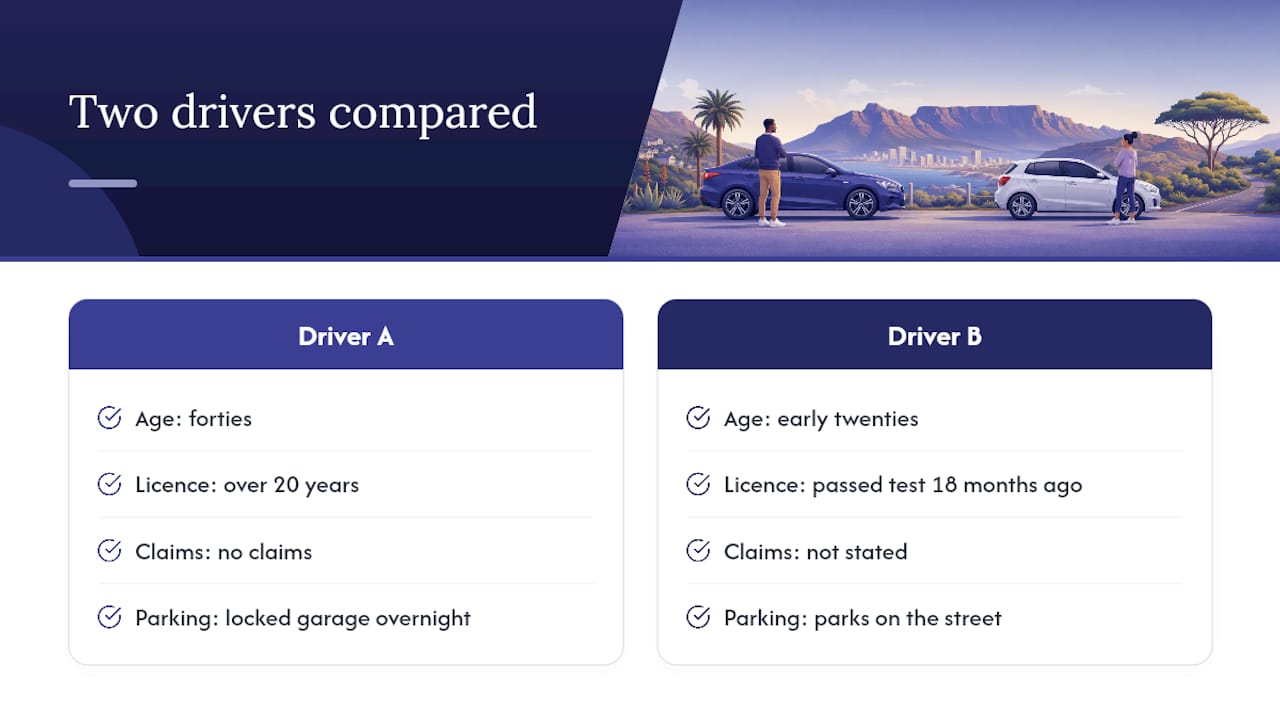
Picture two drivers insuring an identical mid-range hatchback. Driver A is in her forties, has held a licence for over 20 years, has no claims and parks in a locked garage overnight. Her quote might land close to the average of around R1,322 a month, or below it.
Driver B is in his early twenties, passed his test 18 months ago, and parks on the street.
How to think about premiums when you renew or switch
Compare cover like for like, not just the debit order amount. Read the policy schedule for excess levels and exclusions, because the cheapest quote often hides the highest out-of-pocket exposure. Once your car is sorted, remember your rental income deserves the same scrutiny.
— Coert
Protecting income that has nothing to do with your car
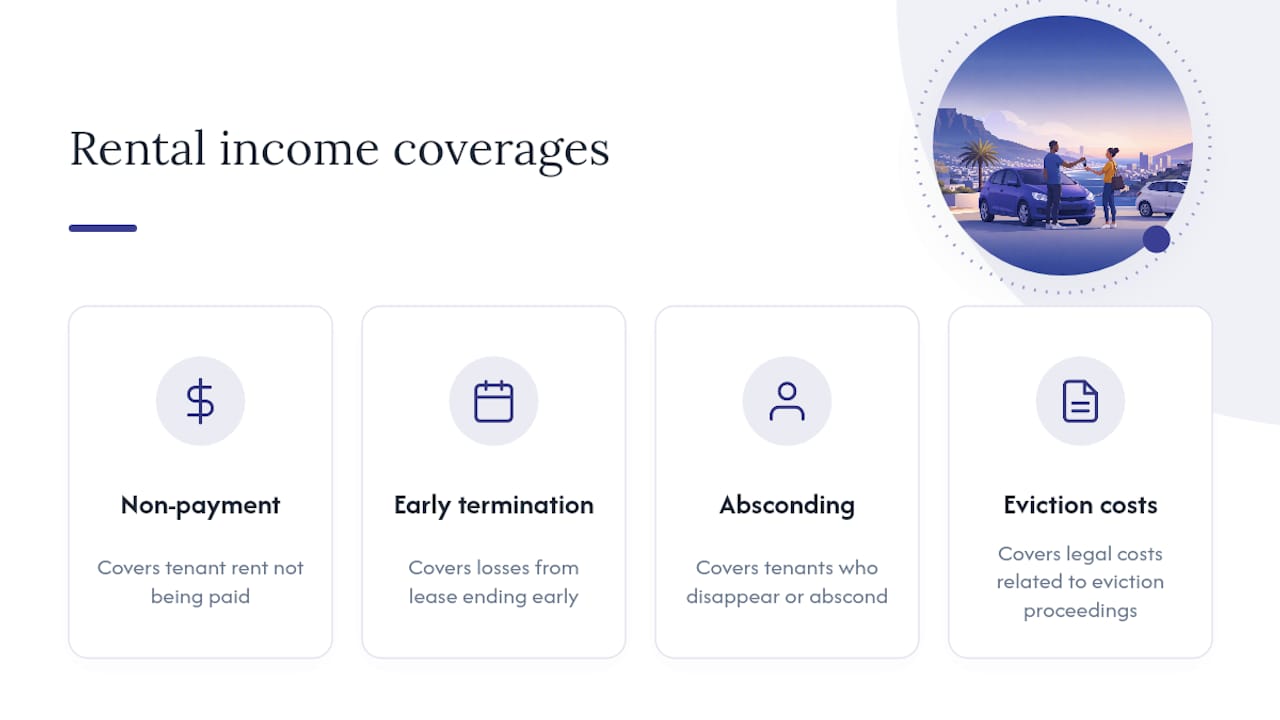
Car insurance protects your vehicle. It does nothing for the income you rely on if a tenant stops paying, disappears, or has to be evicted, and that’s a completely different category of risk that Rentalincomeinsurance was built to cover. Rental Income Insurance is designed specifically to help landlords manage risks such as tenant non-payment, early lease termination, absconding, and legal costs related to eviction proceedings.

Watch a quick overview of how landlord protection works in practice:
Whether you hold one residential unit or manage a commercial portfolio, you can get a sense of what monthly cover involves through this landlord insurance cost guide and see what renters insurance actually covers for property owners specifically. If you’re ready to see what protection would cost for your own property, request a quote directly from Rentalincomeinsurance today.
This article is general information, not a substitute for advice from a qualified financial advisor. Consult a qualified financial professional about your own circumstances before acting on anything here.
Sources
- What is a car insurance premium? (Prime)
- How car insurance premiums are calculated (King Price blog)
- Why your car insurance premium differs from your neighbour’s (IOL)
- Why vehicle insurance premiums differ from one person to the next (Daily Maverick)
FAQ
What does premium mean on car insurance?
A premium is the price you pay your insurer for agreeing to cover specific risks on your vehicle, such as accident damage or theft, for a set period. It’s calculated from your individual risk profile rather than a flat rate applied to everyone.
Is a car insurance premium monthly or yearly?
It can be either, depending on how you set up your policy. Most South African drivers pay monthly by debit order, though annual upfront payment is usually available and can avoid instalment fees.
Do you pay a premium every month?
Only if you’ve chosen a monthly payment structure rather than an annual one. Missing a monthly debit order can lapse your cover, so it’s worth confirming exactly how your insurer handles a missed payment before you rely on it.
What does a six-month premium mean?
It typically refers to a policy that’s priced and reviewed every six months instead of annually, letting the insurer adjust for claims inflation or changing risk more frequently. Your rate can move twice a year under this structure rather than once.
Does Rentalincomeinsurance cover car insurance?
No. Rentalincomeinsurance covers a landlord’s rental income against tenant non-payment, early lease termination, absconding and eviction legal costs, which is a separate class of insurance entirely from vehicle cover. Pricing for Rental Income Insurance runs at 3.5% to 5% per month of insured rental income.