
A sublease agreement is a secondary lease where an existing tenant rents out all or part of their premises to a third party, while remaining bound to the original landlord under the head lease. Two contracts run side by side: the head lease and the sublease. The subtenant has no direct legal relationship with the head landlord, and the entire arrangement depends on the head lease staying in force, with the landlord’s consent.
TL;DR:
- Sublessors remain fully liable to the landlord for the head lease, regardless of the subtenant’s payment status or conduct.
- A sublease cannot legally extend beyond the duration of the head lease and ends automatically if the head lease terminates.
- Landlord consent is legally required before subletting, and it must be in writing to avoid breach or eviction risks.
- Subletting often involves separate agreements for the head lease and sublease, with no direct legal link between subtenant and landlord.
- Rental income insurance mitigates risks of non-payment, early lease termination, and legal costs associated with subletting complications.
Table of Contents
- How does a sublease work in practice?
- What to include in a sublease agreement
- Do you need the landlord’s consent to sublet?
- Sublease vs assignment: which one actually applies?
- What can go wrong, and how do you limit it?
- How to sublet safely: a step-by-step process
- Why landlords who allow subletting should think about insurance
- How rental income insurance covers the risks of subletting
- Sources
- FAQ
How does a sublease work in practice?
A sublease creates two separate contracts that run in parallel. The first is the head lease, between the landlord and the original tenant (now called the sublessor). The second is the sublease itself, between the sublessor and the subtenant. These two agreements never merge into one, and that separation shapes everything about who owes what to whom.
The subtenant has no direct legal tie to the head landlord. This is what lawyers call a lack of privity: if the subtenant stops paying rent, the head landlord cannot chase them directly. Their claim runs against the sublessor, who remains fully responsible for the head rent regardless of what the subtenant pays or fails to pay.
That dependency cuts both ways:
- The sublessor still owes the head landlord, whatever happens between them and the subtenant.
- A sublease can never legally run longer than the head lease itself.
- If the head lease ends, whether by expiry, cancellation, or breach, the sublease terminates automatically, even if the sublessor and subtenant still want it to continue.
That last point catches people out constantly. A subtenant can do everything right and still lose their tenancy through no fault of their own, simply because the head lease collapsed.
What to include in a sublease agreement
A sublease that skips the basics is far harder to enforce if something goes wrong. Treat this as your working checklist, whether you are drafting one from scratch or reviewing one someone else prepared.
- Parties and premises. Full names, identity numbers, and a precise description of what is being sublet (a room, a floor, the whole unit).
- Term and rent. Start and end dates, monthly rent, payment method, and escalation if the sublease runs longer than a year.
- Deposit and utilities. Amount held, where it’s banked, and who pays electricity, water, and levies.
- Maintenance and permitted use. What the subtenant may and may not do with the space, and who fixes what.
- Access and inventories. A signed inventory of fixtures and contents at move-in, referenced again at move-out.
- Reference to the head lease. A clause confirming the sublease is subject to the head lease, ideally with a copy attached as an annexure.
- Landlord’s written consent. Attached or referenced directly, not just mentioned in passing.
- Termination and reinstatement. What happens to the deposit, the inventory check, and notice periods when the sublease ends.
- Signatures and witnesses. Some commercial leases require notarial execution; check the head lease for this before finalising anything.
Our rental agreement checklist covers the equivalent clauses for a standard lease, and it’s worth cross-checking against it.
Pro Tip: Attach a short extract of the head lease and the landlord’s signed consent as annexures to the sublease itself. It makes the limits of the arrangement obvious to everyone, and it saves an argument later about what was actually agreed.
Do you need the landlord’s consent to sublet?
Yes. Under South Africa’s Rental Housing Act, a tenant may not sublet a dwelling without the landlord’s consent, and that consent may not be unreasonably withheld. Subletting without it can amount to an unfair practice, and many head leases go further, banning subletting outright or requiring written approval before any subtenant moves in.
Legal practitioners consistently point to the same mistake: tenants assume they have an automatic right to sublet, when in reality most modern leases contain restrictive clauses that override that assumption.
Get consent wrong, or skip it entirely, and the consequences escalate quickly:
- The landlord may treat the sublease as a breach of the head lease.
- That breach can trigger termination of the head lease itself, which drags the sublease down with it.
- The sublessor may face eviction proceedings, with the subtenant caught in the middle.
Consent should always be in writing, signed and dated, with any conditions spelled out. Where the arrangement is more complex (a long commercial sublease, for instance), a tripartite agreement involving the landlord, sublessor, and subtenant directly is often the safer route, since it puts everyone’s obligations in one document rather than two overlapping ones.
Sublease vs assignment: which one actually applies?
People use “subletting” and “assigning” as if they mean the same thing. They don’t, and the difference determines who stays liable.
A sublease keeps the original tenant fully in the picture. The sublessor still owes the landlord, still signs the head lease, and still carries the risk if the subtenant defaults. Assignment or cession works differently: it transfers the tenant’s rights (cession), obligations (delegation), or both, and where the landlord agrees, it can release the original tenant from the lease entirely.
- Sublease: original tenant stays liable; subtenant has no direct link to the landlord.
- Assignment: usually needs a tripartite agreement; can release the original tenant if all parties agree.
- Cession alone: can sometimes pass a right without full consent, unless the lease specifically forbids it.
If you want out of the lease completely, assignment is the mechanism to ask about. If you just want to bring in someone else to occupy part of the space while you stay on the hook, a sublease is what you’re actually looking for.
What can go wrong, and how do you limit it?
The sublessor carries most of the risk in this arrangement, and it’s worth being blunt about that before signing anything.
- You remain liable for the full head rent even if your subtenant stops paying.
- A dispute or breach on your side can put the subtenant’s occupation at risk too, since their sublease dies with the head lease.
- Deposits, utility accounts, and damage claims get messy fast when three parties are involved instead of two.
Subtenants face their own exposure. Their right to stay is only ever as strong as someone else’s lease, a lease they usually never see in full and have no say over.
Pro Tip: Ask your subtenant to pay rent directly into an account you control, insist on a signed inventory at move-in, and require a written indemnity covering damage. It won’t stop every dispute, but it gives you something concrete to point to when one happens.

How to sublet safely: a step-by-step process
Subletting properly takes a bit of admin, but skipping steps is how landlords end up in eviction court.
- Read your head lease first. Check for a “no subletting” clause or a consent requirement before you do anything else.
- Speak to your landlord early. A phone call before you advertise the space saves everyone time.
- Get consent in writing. Verbal approval isn’t worth much if a dispute arises later.
- Screen the subtenant properly. Our tenant screening guide covers background and affordability checks worth running before anyone signs.
- Draft and sign the sublease. Use the clause checklist above, and attach the landlord’s consent.
- Conduct a move-in inspection. Photograph the space and sign an inventory together.
Expect written consent to take anywhere from a few days to a couple of weeks, depending on how responsive your landlord is. Keep every document, consent letter, and inspection photo on file; if a dispute ever reaches a tribunal, paper trails matter more than memory.
Why landlords who allow subletting should think about insurance
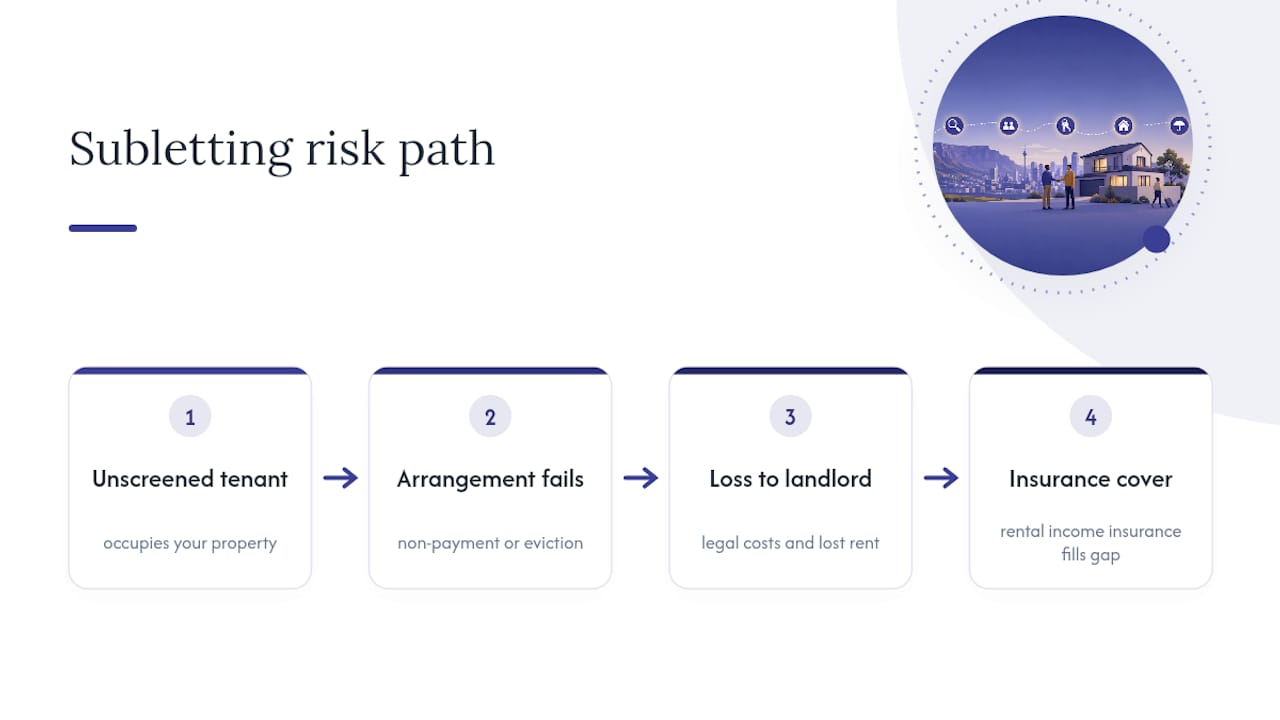
Subletting adds a layer most landlords don’t plan for: a tenant they didn’t screen, occupying a property they still own. If that arrangement breaks down, through non-payment, an early termination, or an eviction that drags on for months, the legal costs and lost rent land squarely on you.
That’s the gap rental income insurance is built to cover. At Rentalincomeinsurance, we focus on exactly this kind of exposure for South African landlords, residential and commercial alike.
— Coert
How rental income insurance covers the risks of subletting
Allowing a sublease doesn’t have to mean carrying all the risk yourself. Rental Income Insurance is built around the specific gaps subletting creates: tenant non-payment, early lease termination, absconding, and the legal costs that come with an eviction process. Cover for property damage sits alongside these, so a dispute between your sublessor and subtenant doesn’t leave you paying for both.

If you’re weighing up whether to approve a sublease request, it’s worth understanding what rental income insurance actually covers before you say yes. Premiums run at a percentage of your rental income, with no waiting period before cover begins. For a tailored view of your situation, whether it’s a residential unit or a commercial property, request a quote and get a policy matched to how you actually let your property.
Sources
- Sublease Agreement in South Africa
- Rental Housing Act 1999 (consolidated)
- Subletting your property — Snymans legal advice
This article is general information, not a substitute for advice from a qualified lawyer. Consult a qualified legal professional about your own circumstances before acting on anything here.
FAQ
What is the difference between a sublease and a lease?
A lease (the head lease) is the original contract between landlord and tenant. A sublease is a second, separate contract the tenant enters into with a third party, and it can never outlast or override the terms of that head lease.
What are the legal restrictions on subletting in South Africa?
The Rental Housing Act requires landlord consent before subletting, and that consent cannot be unreasonably withheld. Many leases also contain their own restrictive clauses, so check the head lease itself before assuming subletting is allowed.
How does subleasing usually work?
The original tenant rents out all or part of the property to a subtenant while staying fully liable to the landlord under the head lease. The subtenant pays the sublessor, not the landlord directly, and has no direct contractual relationship with the landlord at all.
Does a sublease need to be in writing?
It isn’t always a strict legal requirement, but a written sublease is the only practical way to prove what was agreed if a dispute arises. Include landlord consent, rent terms, and an inventory as a minimum.
Can rental income insurance help if my subtenant stops paying?
Rental Income Insurance is designed to cover risks like tenant non-payment, early termination, and eviction costs, which become more relevant once a sublet is in place. Details and quotes are available through Rentalincomeinsurance.