
“AGI renters condo insurance” is a phrase that turns up in search results, but for South African landlords the concept that matters is rental income insurance: cover that protects a property owner’s cashflow when a tenant stops paying, breaks the lease early, or absconds. The policy replaces lost rent and helps fund the legal costs of eviction, so the landlord isn’t left carrying a mortgage on an empty promise.
TL;DR:
- Rental income insurance typically covers tenant non-payment after a set period, often starting from the second missed month, and lasts for a defined indemnity period.
- The policy also pays legal and eviction costs, usually between R10,000 and R40,000, and may include cover for rent loss due to property damage or early lease termination.
- Claims require clear documentation from the outset, including a signed lease, demand letter, arrears ledger, and bank statements, with claims often accepted from the second consecutive missed payment.
- Exclusions commonly include pre-existing arrears, damages caused by the landlord’s wilful acts, and claims where lease documentation is incomplete or non-compliant.
- Premiums start around 5% of monthly rent, increasing with longer indemnity periods or higher caps, and landlords should compare policy specifics, not just premiums, before choosing coverage.
Table of Contents
- What does rental income insurance typically cover?
- How does a rental income insurance claim actually work?
- What do the exclusions and small print usually say?
- How much does rental income insurance cost?
- How do you choose a policy and request a quote?
- What does the phrase “AGI renters condo insurance” actually refer to for landlords?
- What does landlord‑focused cover actually include?
- How does this cover interact with a body corporate’s master policy?
- How do you know if this type of cover suits your situation?
- What are the common exclusions in a condo or sectional title rental context?
- What should you expect from claims handling and service?
- Where does insurance fit in a landlord’s broader risk plan?
- Get a personalised rental income insurance quote
- Sources
- FAQ
What does rental income insurance typically cover?
Rental income insurance is built around one job: keeping rent flowing when a tenant doesn’t. Most South African policies bundle several protections rather than offering a single benefit, and knowing what’s standard helps you judge whether a quote is actually competitive.
- Tenant non‑payment: cover usually activates after a tenant misses a set number of consecutive payments, often the second month of arrears, and continues for a defined indemnity period.
- Early termination and absconding: if a tenant vacates before the lease ends or disappears owing rent, the policy typically pays out for the remaining cover period rather than the full lease term.
- Eviction and legal fees: insurers commonly cover eviction costs between roughly R10,000 and R40,000, which is often the gap that catches landlords off guard when they price cover on rent alone.
- Loss of rent from property damage: if the unit becomes uninhabitable through an insured event and the tenant can’t occupy it, lost rent for that period is frequently included.
- Add‑on services: some providers bundle tenant vetting or rent collection support into the policy, reducing the admin load on top of the financial protection.
None of these benefits are automatic across every insurer. Always confirm which triggers apply to your specific policy before treating any of the above as guaranteed, as terms vary between insurers and product tiers. You can read a fuller breakdown of what’s included on our rental income insurance page.
How does a rental income insurance claim actually work?
Insurers pay claims against evidence, not against your word that a tenant stopped paying. The documentation you gather from day one of the tenancy determines whether a claim sails through or stalls.
- Keep a signed, dated lease on file from the outset. A properly drafted agreement setting out payment terms and obligations is the foundation of any arrears claim.
- Issue a formal letter of demand the moment a payment is missed. This is not optional paperwork; insurers use it as proof you acted within the required timeframe.
- Maintain an arrears ledger showing exactly when payments were due and what was received, cross‑referenced against bank statements.
- Submit the claim once the trigger is met. Many insurers accept claims from the second consecutive missed payment, so waiting three or four months before notifying your insurer can weaken your position.
- Track the eviction timeline against your indemnity period. If the legal process runs longer than your policy’s payout window, you need to know that gap exists before it costs you.
If you recover rent after a payout, most policies require you to repay the insurer that portion, and full disclosure of any recovery is a condition of the cover, not a courtesy.
Pro Tip: Open a dedicated file (physical or digital) for each tenancy on day one, containing the signed lease, ID copies, and a payment tracker. Retrofitting this evidence after a tenant stops paying is far harder than building it as you go.
What do the exclusions and small print usually say?
The exclusions are where a seemingly generous policy quietly narrows. Reading them before you buy, not after a claim is declined, saves genuine frustration.
- Waiting periods: many insurers impose a period before cover becomes active on a new policy, so cover taken out mid‑dispute rarely helps.
- Indemnity periods and monthly maximums: cover is capped both in duration (commonly up to three months) and in the maximum monthly payout, usually tied to your declared rent.
- Excess or deductible: a portion of each claim is typically for your account, reducing the net payout below the headline cover figure.
- Common exclusions: pre‑existing arrears at the time you took out the policy, a lease that doesn’t meet the insurer’s minimum requirements, and losses caused by the landlord’s own wilful acts are almost universally excluded.
- Subrogation: insurers reserve the right to pursue the defaulting tenant for recovery, and if you receive money from the tenant after a claim, you’ll likely need to reimburse the insurer.
Our page on coverage limits and the separate guide to common exclusions are worth reading before you sign anything, since these clauses are exactly where disputes tend to originate.
How much does rental income insurance cost?
Premiums are driven mainly by your monthly rent, the property type, and how rigorously you screen tenants before signing a lease. A landlord who skips credit and affordability checks is a higher underwriting risk, and premiums reflect that.
One market example shows premiums starting from around 5% of monthly rent, with cover extending up to three months of rent and eviction cost cover layered on top. That figure is an illustrative market rate rather than a fixed industry price, and your own quote will depend on the specifics of your property and tenant.
Premiums are usually structured either as a percentage of monthly rent or as a fixed banded fee, and a longer indemnity period or higher monthly cap generally pushes the premium up. For lower‑value tenancies, the maths can tip against buying cover at all, in which case stricter tenant vetting, a larger deposit, or more active rent collection may do more for your risk than a policy would.
How do you choose a policy and request a quote?
Comparing rental income insurance properly means asking the same questions of every insurer, not just comparing headline premiums.
- Check the indemnity period. Three months of cover is common, but confirm the exact figure before assuming it matches your mortgage or bond exposure.
- Confirm the monthly limit and excess. These two figures together determine your real payout, not the premium.
- Ask specifically about legal‑fee cover. Some policies bundle eviction costs; others sell it as an add‑on.
- List the exclusions in writing. Ask the insurer or broker to confirm, in writing, what triggers a claim and what voids one.
- Gather your documents before you request quotes: a signed lease, rent roll, payment history, and any tenant vetting reports. Insurers price risk more accurately, and often more favourably, when you can show a well‑managed tenancy.
Pro Tip: Request quotes from more than one provider using identical figures for rent, indemnity period, and excess. Insurers price risk differently, and a like‑for‑like comparison is the only way to see which quote is genuinely cheaper rather than just differently structured.
What does the phrase “AGI renters condo insurance” actually refer to for landlords?
Search results for this phrase often point toward consumer renters insurance products sold under names like AGI or Assurant, aimed at tenants insuring their own belongings inside a rented unit. That is a different product for a different buyer. If you’re a landlord searching for protection against a tenant who stops paying rent, breaks a lease early, or leaves owing money, the product you actually need is rental income insurance, sometimes called rental income protection.
The distinction matters because the two products protect entirely different financial interests. A tenant’s renters policy covers their sofa, laptop, and clothing if there’s a fire or burglary, plus their personal liability if someone is injured in the unit. It does nothing for the landlord’s cashflow if that same tenant stops paying rent tomorrow. Rental income insurance, by contrast, is bought by the property owner and pays out against the owner’s loss of rent, not the tenant’s possessions.
If your search brought you here because you’re trying to protect rental income rather than personal contents, rental income insurance is the correct category to compare, not a tenant‑facing renters policy. Landlords sourcing quotes should specify this clearly to any broker or insurer to avoid being sold the wrong type of cover entirely.
What does landlord‑focused cover actually include?
Once you’re clear that rental income insurance is the right category, the specific inclusions look different from tenant contents cover. Rather than insuring furniture or personal liability inside a unit, landlord policies focus squarely on the income stream and the legal costs of protecting it.
Core protection typically centres on three pillars: replacement of lost rent during a defined indemnity period, cover for the legal costs of pursuing an eviction, and, in some policies, cover for physical damage that prevents the unit being occupied. Personal property and public liability, the features associated with tenant‑facing renters policies, sit outside this scope entirely, because the landlord’s own building and contents insurance (or a body corporate’s master policy in a sectional title scheme) is the correct place for those risks.
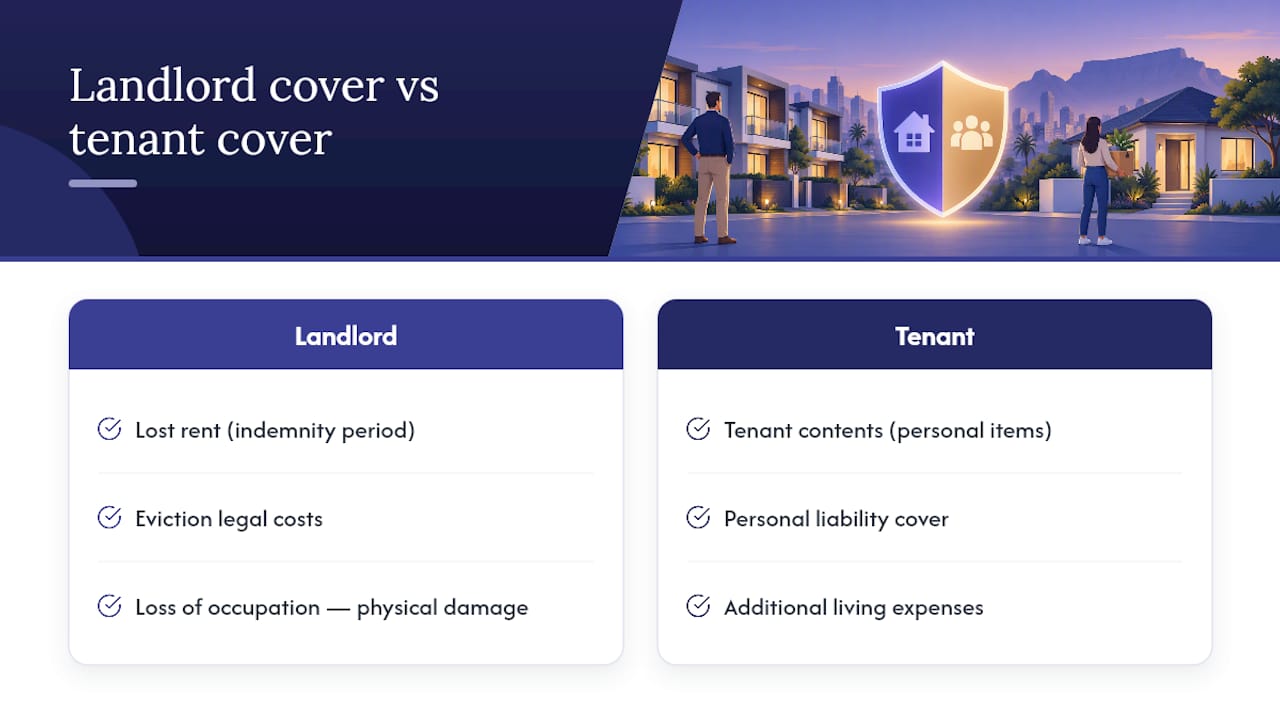
Additional living expenses, another feature associated with tenant policies, also fall outside a landlord’s rental income cover. A landlord isn’t displaced by a tenant’s non‑payment. Their financial exposure is the missing rent cheque and the legal bill to get the unit back, and that is precisely what this category of insurance is built to address.
How does this cover interact with a body corporate’s master policy?
For landlords letting units in sectional title schemes, a body corporate typically holds a master insurance policy covering the building structure, common areas, and shared infrastructure. That master policy does not, and was never intended to, cover the individual landlord’s rental income if a tenant defaults.
This is a common point of confusion. A body corporate’s master policy protects the physical asset collectively, while rental income insurance protects one owner’s specific cashflow individually. If a burst pipe in a common wall damages your unit and makes it uninhabitable, the body corporate’s cover and your own landlord buildings cover may respond to the physical damage. But if your tenant simply stops paying rent while living in a perfectly habitable unit, no master policy, however comprehensive, will replace that lost income.
The gap rental income insurance fills sits entirely outside the scope of any communal scheme cover. It’s a personal financial safeguard tied to your lease and your tenant, not a shared asset tied to the building. Sectional title landlords sometimes assume their levy contributions to a body corporate’s insurance somehow extend to tenant default risk. It doesn’t, and confirming that gap exists is worth doing before you ever need to rely on it.
How do you know if this type of cover suits your situation?
Not every landlord needs the same shape of policy, and the right evaluation starts with your actual exposure rather than a generic checklist. A landlord with one bond‑dependent unit has a very different risk profile from a portfolio owner managing ten tenancies through a property manager.
Start by asking how much of your monthly obligations depend on that specific rent cheque arriving on time. If missing two months of rent would seriously strain your finances, cover that pays out from an early trigger point matters more than a cheap premium with a long waiting period. If you manage several units, a group rental insurance arrangement can sometimes be more efficient than insuring each lease separately.
Typical coverage limits worth checking against your own numbers include the monthly rent cap, the total indemnity period (commonly up to three months), and any separate cap on eviction legal costs. Optional add‑ons some providers offer include tenant vetting services or rent collection support, both of which reduce the chance you’ll ever need to claim in the first place. Weigh those add‑ons against your own capacity to screen tenants independently before paying extra for something you may already do well.
What are the common exclusions in a condo or sectional title rental context?
Sectional title and condo‑style rentals carry a few exclusion patterns that catch owners out more often than freestanding rentals do. The shared nature of the building introduces ambiguity that insurers resolve firmly in their own favour.
Pre‑existing arrears at the point you take out a policy are excluded almost universally, which matters in sectional title schemes where a change of managing agent sometimes obscures how far behind a tenant already is. Damage or access disputes tied to body corporate rules, such as a tenant being locked out of common areas over unpaid levies, typically fall outside rental income cover because the dispute involves the scheme rather than the lease itself.
Wilful acts by the landlord, including retaliatory behaviour like withholding services or attempting to remove a tenant’s possessions without a court order, void cover entirely and can expose the landlord to separate legal liability, since the Rental Housing Act and Consumer Protection Act both prohibit self‑help eviction tactics. A lease that doesn’t meet an insurer’s minimum documentation standard, missing signatures, absent payment terms, or no clear notice period, is also a frequent reason claims fail before they’re even assessed on the merits.
What should you expect from claims handling and service?
Claims handling quality varies significantly between insurers, and it’s rarely visible until you actually need to make a claim. The two things worth probing before you buy are turnaround time and how much documentation the insurer expects at the point of submission versus after.
Insurers who ask for everything upfront, lease, demand letters, ledger, bank statements, tend to move faster once a claim is open, because there’s no back‑and forth chasing missing paperwork. Insurers who accept a lighter initial submission sometimes take longer overall, because gaps surface during assessment rather than before. Neither approach is inherently better, but knowing which one you’re dealing with sets realistic expectations.
Ask any insurer or broker directly how long a typical claim takes from submission to first payout, and ask for that answer in writing rather than a verbal estimate. Reviews and word‑of‑mouth feedback among landlord networks are genuinely useful here, more useful than marketing copy, because claims experience is where policies are actually tested. A policy that looks identical on paper to a competitor’s can feel very different once you’re the one waiting on a payout with rent already unpaid for two months.
Where does insurance fit in a landlord’s broader risk plan?
Rental income insurance is a backstop, not a substitute for good tenant screening. The landlords who claim successfully are almost always the ones who vetted tenants properly and acted fast on the first missed payment, not the ones who bought a policy and stopped paying attention.
Cover matters most if your cashflow genuinely depends on that rent, or if your portfolio is older and repair‑prone enough that vacancy risk compounds default risk. Either way, the discipline is the same: keep your lease, demand letters, and payment records current from move‑in, because that file is what turns a claim into a payout.
Get a personalised rental income insurance quote
There’s a real cost to discovering, mid‑eviction, that your policy’s small print doesn’t cover the situation you’re actually in. Rentalincomeinsurance builds cover specifically around South African landlord risk: tenant non‑payment, early lease termination, absconding, and the legal fees that come with eviction, rather than generic contents or liability products aimed at tenants.

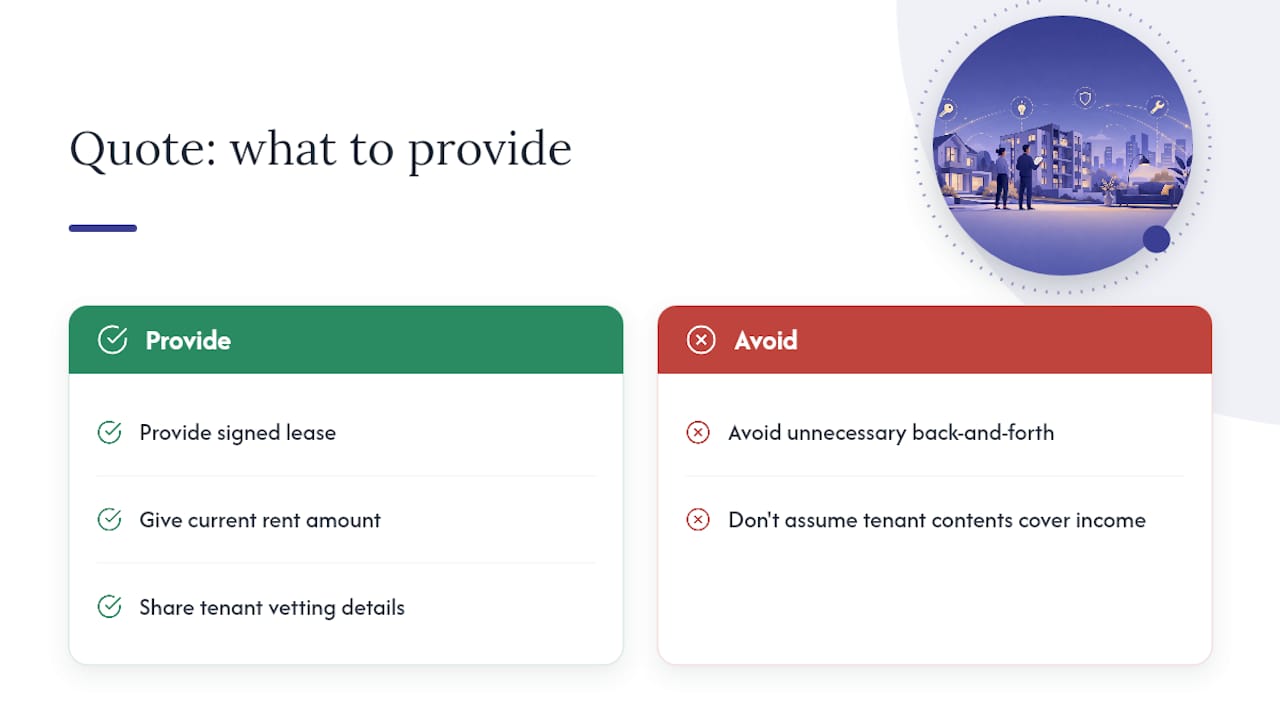
Our plans start from 3.5–5% of monthly rent, with tailored options across Residential Rental Insurance, Commercial Rental Insurance, and Group Rental Insurance for landlords managing multiple units. To request a quote, you’ll typically need your signed lease, current rent amount, and details of your tenant vetting process. That’s enough for our brokers to match you with cover suited to your specific exposure, without the immediate coverage being held up by unnecessary back and forth.
If you manage rental property in Gauteng, the Western Cape, or anywhere else across South Africa, visit our rental income insurance page to see the full range of cover, or go straight to request a quote and speak to an adviser about your specific tenancy today.
For a broader look at how rental income protection fits into everyday property management, this video walks through the practical side:
Sources
- Property rental insurance: insuring rental income against risk of tenant default | Insurance Biz
- Rental arrears: Here’s what landlords and tenants need to know – Finance, Advice
FAQ
Is “AGI renters condo insurance” the same as landlord rental income insurance?
No. AGI‑branded renters or condo insurance is typically a tenant‑facing product covering personal belongings and liability inside a rented unit. Landlords looking to protect rent against tenant default need rental income insurance instead, which pays the property owner, not the tenant.
What documents do I need to make a rental income insurance claim?
You generally need a signed lease, a formal letter of demand sent to the tenant, an arrears ledger, and bank statements showing the missed payments. Insurers commonly accept claims from the second consecutive missed payment, so gathering this evidence early speeds up assessment.
How much does rental income insurance cost in South Africa?
Rental income insurance is generally priced as a percentage of monthly rent, with some products requiring a personalized quote for specific pricing based on property and tenant factors.
Does rental income insurance cover the cost of eviction?
Many policies include legal‑fee cover for eviction alongside lost rent, with market examples showing eviction cost cover between roughly R10,000 and R40,000. Always confirm the exact cap and any excess with your specific insurer before assuming a figure applies to your policy.
Is rental income insurance worth it for a single rental unit?
It depends on how exposed your finances are if that one tenant stops paying. If you rely heavily on the rent to cover a bond or other costs, cover with a fast claim trigger is usually worth the premium, while owners with strong reserves may manage the risk through stricter vetting instead.