
TL;DR:
- Alternative accommodation coverage pays for temporary housing when a rental property becomes uninhabitable due to insured, sudden damage such as fire or flood. Landlords must understand their policy’s specific definitions, triggers, and limits to avoid rejected claims, especially distinguishing it from wear and tear or maintenance issues. Using appropriate landlord insurance ensures coverage for both property damage and income protection, while homeowner policies are generally insufficient.
Alternative accommodation coverage is an insurance benefit that pays for temporary housing costs when a rental property becomes uninhabitable due to sudden, insured damage such as fire, flood, or storm. The industry also refers to this as “loss of alternative accommodation” cover, and it typically forms part of a broader landlord or building insurance policy. For South African landlords, understanding exactly when this benefit applies and what it excludes is the difference between a paid claim and an unexpected bill. Rentalincomeinsurance works with property owners who face precisely these situations, and the gaps in knowledge are consistent and costly.
What is alternative accommodation coverage and when does it apply?
Alternative accommodation coverage is defined as insurance that pays for temporary housing when an insured peril causes physical damage that renders a rental property untenantable. The key word is “insured.” The damage must result from a sudden, unforeseen event that your policy explicitly lists as a covered peril.
The most common triggers include:
- Fire or explosion causing structural damage that makes the property unsafe to occupy
- Storm or hail damage that destroys the roof or walls beyond immediate repair
- Flooding from burst pipes or external water ingress classified as an insured event
- Lightning strikes causing significant structural or electrical damage
The property must be genuinely untenantable. That means a tenant cannot reasonably live there while repairs are carried out. A broken window or a damaged gutter does not meet this threshold. A collapsed roof or a fire-damaged interior does.
Coverage does not trigger for repairs arising from maintenance failures, ageing, or wear and tear. If a roof leaks because it is old and has not been maintained, the insurer will not pay for alternative accommodation. The damage must be sudden and unexpected, not the result of gradual deterioration.
Pro Tip: Read your policy’s definition of “untenantable” before you need to make a claim. Some policies require a formal assessment confirming the property cannot be occupied. Having this documented from the outset speeds up the claims process considerably.
Landlords frequently assume that any repair requiring a tenant to vacate qualifies for this benefit. That assumption leads to rejected claims. The trigger is always the insured peril causing physical damage, not the inconvenience of repair work.
How does alternative accommodation coverage fit within landlord insurance?
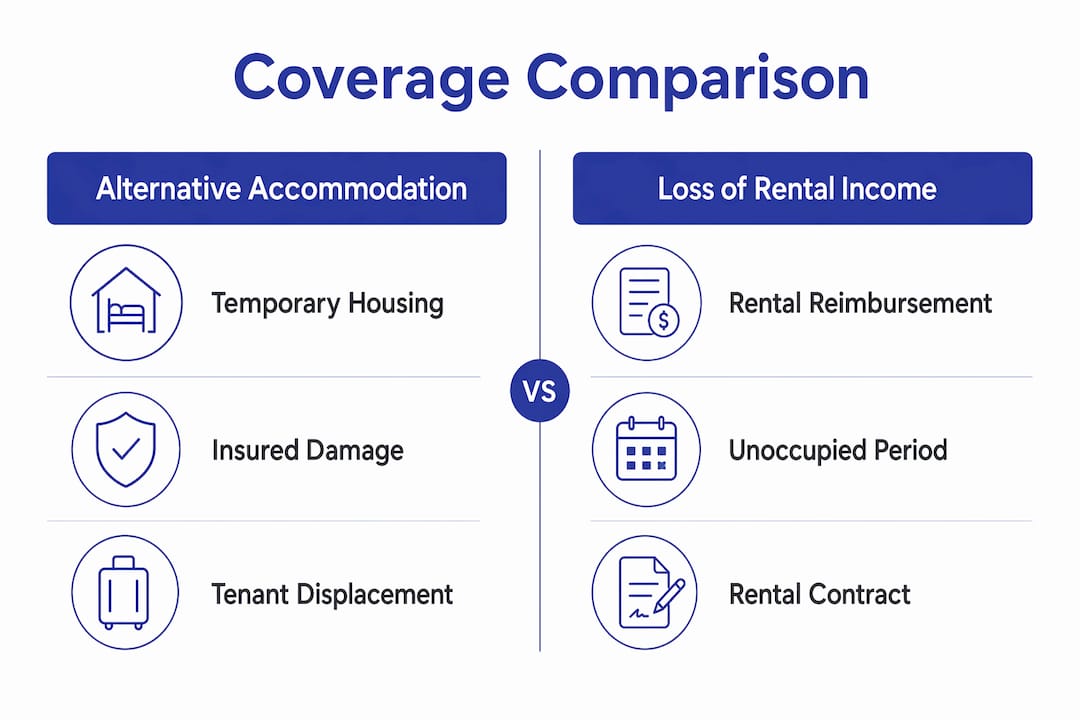
Alternative accommodation cover and loss of rental income cover are related but distinct. Understanding the difference protects you from assuming one replaces the other.

| Coverage type | What it pays for | When it triggers |
|---|---|---|
| Alternative accommodation | Temporary housing costs for displaced tenants | Insured peril renders property untenantable |
| Loss of rental income | Rent you cannot collect during repairs | Insured peril causes property to be untenantable |
| Tenant default cover | Unpaid rent due to tenant non-payment | Tenant stops paying rent regardless of property condition |
| Legal cost cover | Eviction and litigation expenses | Tenant dispute or eviction proceedings |
Both alternative accommodation and loss of rental income benefits require insured physical damage and untenantability before they activate. Neither applies when a tenant simply stops paying rent or vacates early.
Landlord insurance is specialised to cover risks that general home insurance does not address. A standard homeowner’s policy is designed for owner-occupied properties. It does not account for tenant liability, rental income loss, or the commercial nature of a letting arrangement. Using a homeowner’s policy on a rental property is a common and expensive mistake. Insurers can and do reject claims on the basis that the property was used for commercial rental activity without appropriate cover.
Policies designed for commercial rental activities also typically include legal cost cover for eviction proceedings, cover for tenant-caused damage beyond the deposit, and public liability protection. These are landlord-specific risks that a building-only policy will not cover.
Pro Tip: Ask your insurer directly: “Does this policy cover alternative accommodation costs if my tenant is displaced by an insured event?” If the answer is not a clear yes with a defined limit, the policy may not be fit for purpose.
Understanding the difference between rental and landlord insurance types is the first practical step toward selecting cover that actually protects your income.
Common misconceptions about temporary housing coverage
Landlords consistently misread their policies in predictable ways. Knowing these pitfalls in advance prevents rejected claims and financial surprises.
Misconception 1: Any repair that displaces a tenant triggers the benefit.
This is incorrect. The repair must result from an insured peril. Voluntary upgrades, scheduled maintenance, or repairs to ageing infrastructure do not qualify, regardless of how disruptive they are.
Misconception 2: Wear and tear damage is covered if it becomes severe enough.
Insurers draw a clear line between sudden damage and gradual deterioration. A roof that has been failing for years and finally collapses is not a sudden, unforeseen event. The insurer will investigate the maintenance history of the property.
Misconception 3: The policy covers the full cost of alternative accommodation indefinitely.
Most policies set a time limit and a monetary cap on alternative accommodation benefits. These limits vary significantly between insurers. Landlords who do not check these figures before a claim often find the benefit runs out before repairs are complete.
Misconception 4: Eviction costs are covered under alternative accommodation benefits.
Eviction proceedings are lengthy and costly, and they require separate legal cost cover within a landlord policy. Alternative accommodation cover addresses physical displacement due to property damage. It has no bearing on tenant disputes or eviction scenarios.
Documentation is non-negotiable when making a claim. Landlords should retain:
- Photographs of the damage taken immediately after the event
- A written assessment from a qualified contractor confirming the property is untenantable
- Correspondence with the tenant confirming displacement
- All invoices and receipts for alternative accommodation costs incurred
Gaps in documentation give insurers grounds to reduce or reject a claim. Treat every insured event as a potential claim from the moment it occurs.
Practical advice for selecting and managing short-term accommodation insurance
Choosing the right policy requires more than comparing premium costs. The definitions within the policy wording determine whether a claim succeeds or fails.
Checking policy definitions before you sign
The terms “untenantable,” “insured peril,” and “sudden and unforeseen” carry specific meanings in insurance contracts. These definitions vary between insurers. A property that one insurer considers untenantable may not meet another insurer’s threshold. Read these definitions before purchasing, not after a loss.
Policy wording nuances directly affect claim outcomes. Landlords who understand their policy’s exact language are far better positioned to make successful claims and to manage tenant expectations during a crisis.
Managing the claim process effectively
Notify your insurer immediately when an insured event occurs. Delayed notification can give an insurer grounds to question the claim. Document everything from day one, and keep a clear record of all costs related to the displacement.
The rental insurance claim process in South Africa follows a structured sequence. Knowing this sequence in advance reduces stress and speeds up resolution.
Dos and don’ts for landlords managing temporary accommodation claims
| Action | Guidance |
|---|---|
| Do notify your insurer immediately | Delayed notification weakens your claim position |
| Do document all damage with photographs | Visual evidence supports the untenantability assessment |
| Do obtain a written contractor assessment | Confirms the property cannot be occupied during repairs |
| Do keep all accommodation receipts | Insurers require proof of costs incurred |
| Don’t begin repairs before the insurer inspects | Premature repairs can invalidate the claim |
| Don’t assume maintenance damage is covered | Wear and tear exclusions apply consistently |
| Don’t use a homeowner’s policy for rental property | Commercial rental policies are required for valid cover |
Mortgage lenders frequently require landlord insurance on bonded rental properties as a loan condition. This is separate from any legal obligation. Even where no lender requires it, the financial exposure of an uninsured rental property is substantial.
Ongoing property maintenance also protects your coverage. A well-maintained property is less likely to suffer damage that an insurer classifies as gradual deterioration. Maintenance records can support your claim if an insurer questions whether damage was sudden or pre-existing.
Key takeaways
Alternative accommodation coverage only pays out when a sudden, insured peril causes physical damage that makes a rental property genuinely untenantable. Wear and tear, maintenance failures, and voluntary works never trigger this benefit.
| Point | Details |
|---|---|
| Coverage trigger is specific | Only sudden, insured peril damage causing untenantability activates the benefit. |
| Wear and tear is always excluded | Gradual deterioration and maintenance issues never qualify for alternative accommodation payouts. |
| Landlord policies differ from home policies | Commercial rental activity requires specialised landlord insurance, not a standard homeowner’s policy. |
| Documentation determines claim success | Photographs, contractor assessments, and receipts are required to support any temporary accommodation claim. |
| Loss of rent and alternative accommodation are separate | Each benefit has its own trigger conditions and monetary limits within a policy. |
What I have learned from watching landlords get this wrong
The most consistent mistake I see is landlords treating their insurance policy as a safety net for everything that goes wrong with a property. It is not. It is a contract with precise conditions, and those conditions exist for a reason.
The landlords who fare worst are those who buy the cheapest policy available, never read the definitions section, and then discover the gap when they are standing in a fire-damaged property trying to rehouse a tenant. At that point, the policy wording is fixed. There is nothing to negotiate.
What actually protects landlords is specificity. Knowing exactly what “untenantable” means in your policy. Knowing the monetary cap on alternative accommodation benefits. Knowing whether your insurer requires a formal assessment before they will authorise temporary housing costs. These are not complicated questions, but most landlords never ask them.
The second mistake is using a homeowner’s policy on a rental property. Policies designed for commercial rental activity cover a fundamentally different risk profile. An insurer who discovers a property was rented out under a homeowner’s policy has legitimate grounds to reject the claim entirely. This happens more often than landlords expect.
My practical advice is simple. Before you renew or purchase any landlord policy, ask your insurer three questions: What exactly triggers alternative accommodation cover? What is the monetary and time limit on that benefit? And does this policy cover commercial rental activity? If the answers are not clear and in writing, keep looking.
— Coert
Rentalincomeinsurance: cover built for South African landlords
Landlords who understand alternative accommodation coverage also understand that property damage is only one of many risks they face. Tenant non-payment, early lease termination, and absconding tenants create income gaps that no building policy addresses.
Rentalincomeinsurance specialises in landlord insurance built specifically for South African rental property owners. Policies cover tenant non-payment, early lease termination, and property damage, giving landlords a single, coherent layer of financial protection. If you want to know exactly what cover is available for your rental portfolio, request a personalised quote and speak to a specialist who understands the South African rental market. You can also watch this short overview to see how rental income protection works in practice:
FAQ
What is alternative accommodation coverage in simple terms?
Alternative accommodation coverage is an insurance benefit that pays for temporary housing when an insured event such as fire or flood makes a rental property uninhabitable. It forms part of a landlord or building insurance policy and only activates when the damage results from a listed insured peril.
Does alternative accommodation cover apply to wear and tear damage?
No. Insurers exclude payouts for temporary accommodation when damage results from maintenance failures, ageing, or gradual deterioration. The damage must be sudden and unforeseen to trigger the benefit.
Is landlord insurance legally required in South Africa?
Landlord insurance is not legally required, but mortgage lenders often mandate it on bonded rental properties as a loan condition. Operating without it exposes landlords to significant uninsured financial risk.
What is the difference between alternative accommodation cover and loss of rental income cover?
Alternative accommodation cover pays for a displaced tenant’s temporary housing costs. Loss of rental income cover reimburses the landlord for rent that cannot be collected while the property is untenantable. Both benefits require the same trigger: insured peril damage making the property uninhabitable.
Can I use a standard homeowner’s policy to cover a rental property?
A standard homeowner’s policy is not designed for commercial rental activity and can result in rejected claims. Landlord-specific insurance covers the additional risks that come with tenanting a property, including rental income loss, tenant damage, and legal costs.