
TL;DR:
- An insured peril is a specific cause of loss listed or included in an insurance policy, triggering insurer payments when that event causes damage. For South African landlords, understanding the distinction between named and open peril policies is crucial for successful claims and adequate property protection. Climate change is increasing the frequency and severity of weather-related perils, urging landlords to review their coverage regularly and address hazards proactively.
An insured peril is a specific cause of loss explicitly listed or included in an insurance policy, meaning your insurer will pay out only when that named event causes the damage. For South African landlords and property owners, understanding this distinction is not a technicality. It is the difference between a successful claim and a costly rejection. Common insured perils include fire, theft, windstorm, hail, and burst pipes. Knowing exactly which perils your policy covers, and which it excludes, determines how well your property investment is protected when things go wrong.
What is an insured peril and how does it work?
An insured peril is the specific event that triggers your insurance policy to pay. If your rental property burns down and fire is listed as a covered peril, your insurer is obligated to settle the claim. If the cause of damage is not listed, or is actively excluded, no payment is due regardless of the severity of the loss.
Insurance policies categorise perils in two broad ways. Named peril policies list every covered event explicitly. Open peril policies, sometimes called all-risk or all-perils coverage, cover every cause of loss except those specifically excluded. The practical difference is significant: under a named peril policy, you must prove the damage was caused by a listed event, while under an open peril policy, the insurer must prove the cause falls within an exclusion to deny your claim.
For South African landlords, most standard building and contents policies operate on a named peril basis. This means reading the schedule of perils carefully is not optional. A policy that lists “storm damage” but excludes “flood” may leave you unprotected if heavy rains cause water ingress through your roof rather than rising groundwater, and the insurer disputes which peril applies.
Pro Tip: Ask your broker to confirm in writing whether your policy is a named peril or open peril policy. This single question shapes your entire claims experience.
What types of perils are typically covered in property insurance?
Standard property insurance policies in South Africa generally cover a core set of named perils. These typically include fire and smoke damage, lightning strikes, explosion, theft and attempted theft, windstorm and hail, burst or leaking pipes, and impact damage from vehicles or falling objects. Each of these represents a discrete event that the insurer has priced and agreed to cover.
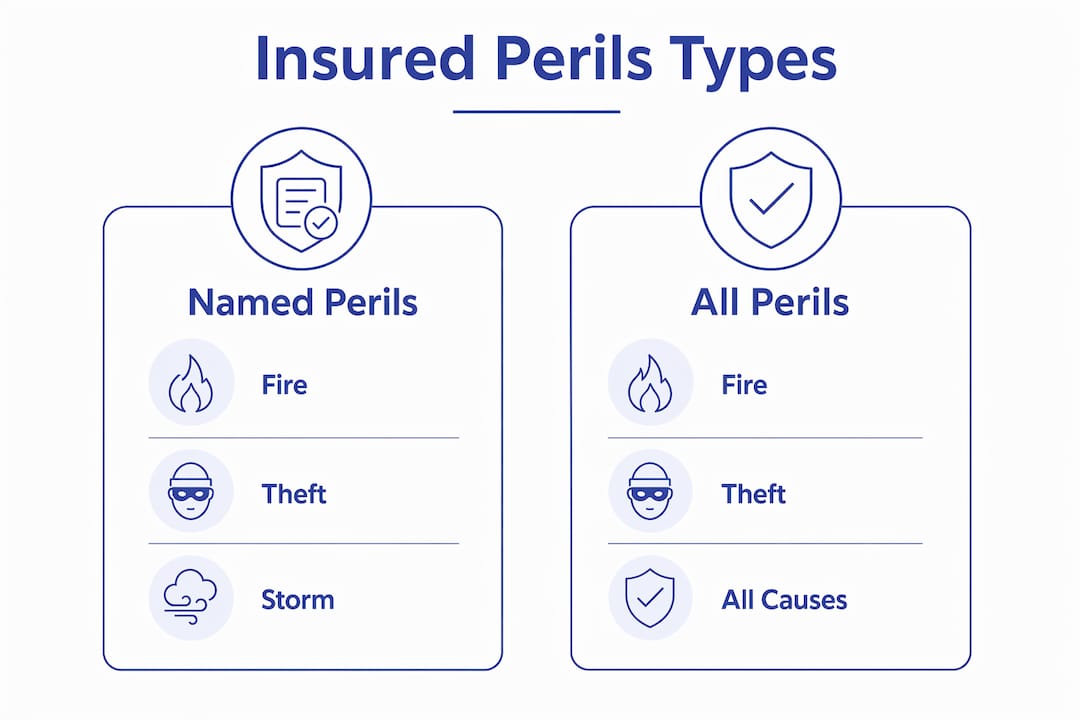
The distinction between named perils and all-perils coverage matters enormously in practice. Named peril policies are usually cheaper but leave gaps. All perils home insurance coverage is broader and better suited to landlords with high-value properties or properties in areas prone to unusual weather events. The table below illustrates how common perils compare across policy types:
| Peril | Named peril policy | All perils policy |
|---|---|---|
| Fire | Covered | Covered |
| Theft | Covered | Covered |
| Flood | Often excluded | Covered unless excluded |
| Hail | Usually covered | Covered unless excluded |
| Subsidence | Rarely covered | Sometimes covered |
| Accidental damage | Not covered | Covered unless excluded |
Secondary perils, those that were once considered minor or infrequent, are now reshaping the insurance market. Hail has risen to account for over 20% of Australian insured property losses and was reclassified as a primary peril in 2026. South Africa faces comparable hail exposure, particularly in Gauteng and the Free State, where severe hailstorms can strip roofs and shatter windows across entire suburbs in minutes.
Convective storms, wildfires, and flash flooding are also increasing in frequency. Landlords who purchased policies five years ago and have not reviewed their peril schedule since may find their coverage no longer reflects the actual risk profile of their property.
Pro Tip: Review your policy’s peril schedule every year at renewal, not just when you buy a new property. Insurers quietly adjust exclusions and sub-limits between policy periods.
How do perils differ from hazards and risks?
These three terms are used interchangeably in everyday conversation but carry precise, distinct meanings in insurance. Getting them confused leads to real financial consequences.
A peril is the cause of loss itself. Fire, theft, and hail are perils. A hazard is a condition that increases the likelihood or severity of a peril occurring. Faulty wiring is a hazard; the fire it causes is the peril. Risk, in insurance terms, refers to the overall uncertainty of loss, encompassing both the probability of a peril occurring and the potential financial impact.
Here is how the three concepts interact in a real landlord scenario:
- Risk: You own a rental property in a high-crime area. The overall probability of financial loss is elevated.
- Hazard: Your property has a weak perimeter fence and poor exterior lighting. These conditions increase the chance of theft.
- Peril: A burglar breaks in and steals appliances. Theft is the peril that triggers the insurance claim.
Understanding this hierarchy helps landlords in two ways. First, it clarifies what your policy actually covers. Second, it shows where proactive action reduces both your exposure and potentially your premium. Insurers assess hazards when pricing policies. A property with a monitored alarm system, security gates, and good lighting presents fewer hazards and typically attracts lower premiums, even though the underlying peril of theft remains the same.
| Term | Definition | Example |
|---|---|---|
| Peril | The cause of loss | Fire, theft, storm |
| Hazard | Condition increasing peril likelihood | Faulty wiring, poor security |
| Risk | Overall uncertainty of financial loss | High-crime area, flood-prone suburb |
Pro Tip: Differentiating hazards from perils helps you reduce claim denials by addressing the conditions that make perils more likely, before they occur.
What challenges do landlords face when claiming for insured perils?
Claim disputes over insured perils are more common than most landlords expect. The two most frequent sources of conflict are the burden of proof and the application of the Efficient Proximate Cause rule.
On burden of proof: named peril policies require the insured to demonstrate that the damage was caused by a listed peril. Open peril policies reverse this burden, requiring the insurer to prove the cause falls within an exclusion. This difference is not academic. A landlord with a named peril policy who suffers water damage must prove it was caused by a burst pipe rather than gradual seepage, which is often excluded. Without documentation, the claim fails.
The Efficient Proximate Cause rule adds another layer of complexity. When a chain of events leads to a loss, this rule identifies the dominant cause and determines whether the claim is payable based on that single cause. If a storm (covered peril) weakens a wall and the wall subsequently collapses (potentially excluded as structural failure), the insurer will argue about which event was the proximate cause. If the initial cause is excluded, the entire claim may be denied.
A third common dispute involves the split between structure and contents coverage. Dwelling structures are often covered on an open peril basis while personal property or contents are covered on a named peril basis within the same policy. Landlords who assume their entire policy works the same way across all sections frequently discover gaps at claim stage.
Follow these steps to protect your claim from the outset:
- Document the property with photographs and video before and after any tenancy begins.
- Keep receipts and valuations for all fixtures, fittings, and appliances.
- Report damage to your insurer within the timeframe specified in your policy schedule.
- Obtain an independent assessment if the insurer’s loss adjuster disputes the cause of damage.
- Request a written explanation citing the specific policy clause if a claim is denied.
“Most insurance claim disputes over insured perils arise from confusion about named versus open peril coverage burdens of proof.” — Legal Clarity
Pro Tip: Read your policy’s key insurance terms section before you need to make a claim. Knowing the definitions your insurer uses for each peril prevents disputes about whether your loss qualifies.
How is climate change reshaping insured perils for South African property owners?
The list of perils that matter to property owners is no longer static. Climate change has structurally increased insured losses, and Swiss Re models peak-loss scenarios exceeding $320 billion by 2026. What was once a rare weather event is now a recurring annual risk in many parts of South Africa.
In 2025, global insured natural disaster losses reached $108 billion, with secondary perils accounting for $98 billion of that total. Weather-related disasters accounted for 97% of all insured losses that year. This means the perils that insurers once priced as low-frequency events, severe hailstorms, flash floods, and wildfires, are now driving the majority of claims globally. South African landlords in KwaZulu-Natal, the Western Cape, and Gauteng are directly exposed to this trend.
The practical consequence for landlords is twofold. Premiums for weather-related perils are rising as insurers reprice their risk models. At the same time, some insurers are narrowing coverage by adding sub-limits or new exclusions for specific perils like flood or hail. A policy that covered hail damage without restriction three years ago may now carry a separate excess or a cap on the maximum payout.
Landlords should also be aware that climate-driven shifts in peril severity demand proactive policy reassessment. Waiting for renewal to review your coverage is no longer sufficient when the risk environment is changing mid-term. Properties in low-lying areas, near rivers, or in historically hail-prone regions need specific attention. The 2025 landlord insurance trends for South African owners show a clear shift toward broader peril coverage as weather events become less predictable.
Pro Tip: Request a flood and hail endorsement review from your broker if your property is in a high-risk area. Standard policies increasingly treat these as sub-limited perils rather than fully covered ones.
Key takeaways
Understanding what is an insured peril, and how it differs from a hazard or risk, is the foundation of every successful property insurance claim a landlord will ever make.
| Point | Details |
|---|---|
| Insured peril defined | A covered peril is the specific event listed in your policy that triggers a valid insurance claim. |
| Named vs all perils | All perils coverage shifts the burden of proof to the insurer; named peril policies place it on you. |
| Hazards vs perils | Hazards increase the chance of a peril occurring; addressing them can reduce premiums and claim disputes. |
| Efficient Proximate Cause | The dominant cause in a chain of events determines whether a claim is paid or denied. |
| Climate risk is rising | Weather perils now drive 97% of global insured losses, making regular policy reviews non-negotiable. |
Why landlords cannot afford to guess about perils
I have spoken with dozens of landlords over the years who discovered what their policy actually covered only after a claim was rejected. That is the worst possible time to learn the difference between a named peril and an open peril policy.
The most common misunderstanding I encounter is the assumption that “comprehensive” means “everything.” It does not. Comprehensive is a marketing word. What matters is the schedule of perils in your specific policy document, the definitions your insurer applies to each one, and the exclusions buried in the fine print. A landlord in Johannesburg who assumes hail is covered without checking the sub-limits is taking a financial risk that has nothing to do with the weather.
My honest view is that most landlords underinvest in understanding their insurance until something goes wrong. The Efficient Proximate Cause rule alone has cost property owners significant sums because they did not understand how a chain of events gets evaluated. A storm loosens a roof tile, rain enters, the ceiling collapses, and suddenly the insurer is arguing about whether the dominant cause was storm or gradual deterioration. Knowing this rule exists before you file a claim changes how you document and present the loss.
The climate data makes this even more pressing. When 97% of global insured losses in 2025 came from weather events, and secondary perils drove $98 billion of that total, the idea that your 2019 policy is still fit for purpose deserves serious scrutiny. Review your insurance in property management approach as a business decision, not an annual admin task.
— Coert
Protect your rental income against the perils that matter

Understanding insured perils is the first step. Making sure your coverage actually reflects those perils is the next one. At Rentalincomeinsurance, we work specifically with South African landlords to close the gaps that standard property policies leave open. Whether your concern is tenant non-payment, property damage from a covered peril, or early lease termination, our policies are built around the real risks landlords face. Do not wait for a rejected claim to find out what your current policy does not cover. Request a tailored quote today and get clarity on exactly what you are protected against. You can also visit the Rentalincomeinsurance main page to explore the full range of cover options available to South African property owners.
Watch this short overview to understand how rental income protection works in practice:
https://youtu.be/TLineBkLtuc
FAQ
What does “perils insured against” mean in a policy?
“Perils insured against” refers to the specific events listed in your policy that the insurer agrees to cover. If a cause of loss is not named or falls within an exclusion, the insurer is not obligated to pay.
What is the difference between named perils and all perils coverage?
Named peril policies cover only the events explicitly listed; all perils coverage covers every cause of loss except those specifically excluded. All perils policies place the burden of proof on the insurer to justify a denial.
Is flood an insured peril under standard South African property policies?
Flood is frequently excluded from standard named peril policies or subject to a sub-limit. Landlords in flood-prone areas should request a specific flood endorsement and confirm the terms in writing with their broker.
How does the Efficient Proximate Cause rule affect my claim?
The Efficient Proximate Cause rule identifies the dominant event in a chain of causes. If that dominant cause is excluded under your policy, the entire claim can be denied even if a covered peril also contributed to the loss.
Can I reduce my premium by addressing hazards on my property?
Addressing hazards such as faulty wiring, poor security, or ageing roofing reduces the likelihood of perils occurring. Insurers factor these conditions into their pricing, so proactive maintenance and security upgrades can lower your premium at renewal.