
TL;DR:
- Bailiff cover is insurance that reimburses landlords for sheriff enforcement fees during eviction proceedings. It helps protect rental income from unexpected enforcement costs, which can reach several thousand rand. Landlords should obtain bailiff cover before disputes start to avoid coverage restrictions and ensure financial protection.
Bailiff cover is defined as an insurance product or financial safeguard that helps landlords manage costs arising when a sheriff of the court enforces eviction orders or debt recovery actions against tenants. In South Africa, the term “bailiff” refers to the Sheriff of the Court, a government-appointed officer who holds statutory authority under the Sheriffs Act 90 of 1986. Understanding what bailiff cover includes, how it works alongside the Prevention of Illegal Eviction Act (PIE Act), and whether you need it is one of the most practical steps you can take to protect your rental income. Rentalincomeinsurance offers cover that addresses exactly these enforcement-related costs, helping landlords avoid unexpected financial gaps during tenant disputes.
What is bailiff cover and why does it matter for landlords?
Bailiff cover is a landlord insurance product, either standalone or packaged within a broader rental income policy, that pays for costs incurred when the Sheriff of the Court enforces a court order on your behalf. These costs include sheriff service fees, travel allowances, warrant of execution charges, and related legal enforcement expenses. Without this cover, landlords absorb every rand of those costs out of pocket, often during a period when rental income has already stopped.

The term “bailiff” is widely used in British and international property circles, but in South Africa the correct legal title is Sheriff of the Court. Both terms describe the same function: a court-appointed officer who physically executes eviction orders and attachment of assets. Knowing this distinction matters because bailiff cover insurance is often marketed under the eviction cover or legal expenses cover umbrella in South African products.
Landlords who skip this protection frequently discover the financial reality only when they receive a sheriff’s invoice. Sheriff fees are regulated by Government Gazette, but they are not trivial. A warrant of execution on movable assets costs between R550 and R900, with a sales commission of 6–8% on proceeds. That is money you pay regardless of whether you recover your lost rent.
What legal role do sheriffs play in South Africa’s eviction process?
Sheriffs of the Court are independent officers operating under the Sheriffs Act 90 of 1986 and are overseen by the South African Board for Sheriffs. They do not represent landlords or tenants. They represent the court, executing judgements impartially and without bias. This independence is precisely why only a sheriff can lawfully enforce an eviction order.
Many landlords confuse sheriffs with debt collectors or private process servers. The distinction is legally significant. Legal couriers can deliver pre-litigation notices, breach notices, and certain CCMA documents, but they cannot substitute for a sheriff once formal court proceedings begin. Attempting to use a private courier or personal action to execute an eviction is not just ineffective. It is a criminal offence under South African law.
What sheriffs are authorised to do
Sheriffs hold authority across several enforcement actions relevant to landlords:
- Serve summonses and eviction notices on tenants after a court order is granted
- Execute warrants of attachment on movable assets belonging to a defaulting tenant
- Conduct sales in execution to recover outstanding debt, earning a regulated commission
- Physically remove tenants from a property following a court-granted eviction order under the PIE Act
- Serve section 4(2) notices required before a court will hear an eviction application
Sheriff fee schedule at a glance
| Service | Regulated fee |
|---|---|
| Serving a summons (within 8 km of court) | Approximately R195 |
| Serving a summons (further distances) | Approximately R295 |
| Travel allowance | R7.50 per km |
| Warrant of execution on movables | R550–R900 |
| Sales in execution commission | 6–8% of proceeds |
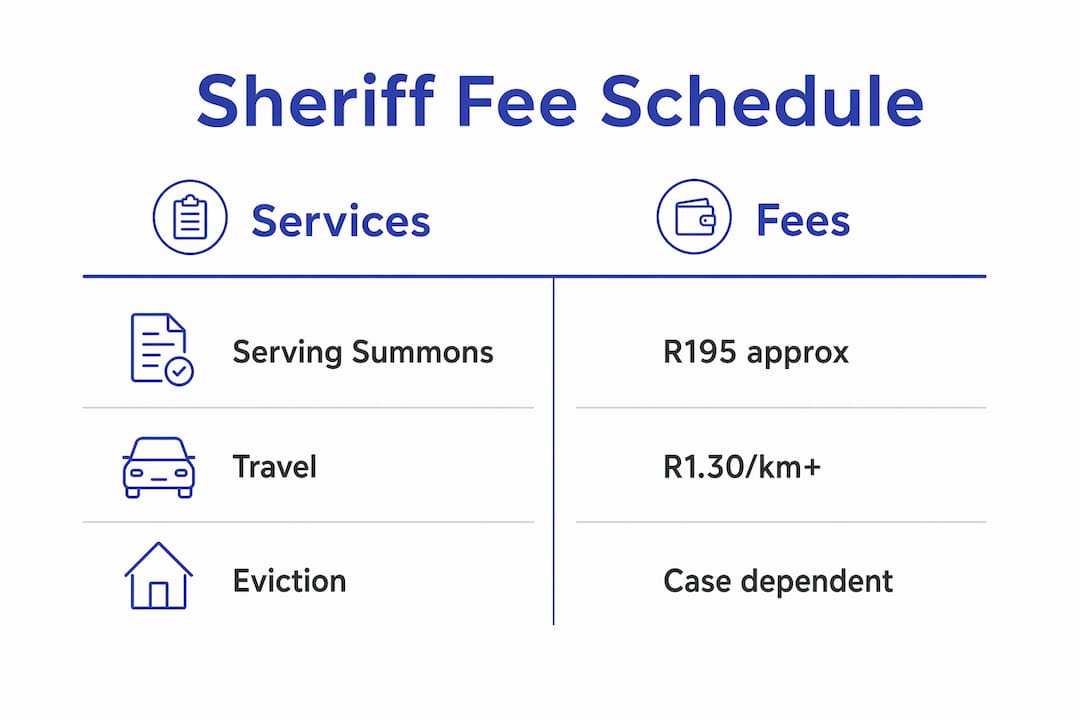
Fees are set by Government Gazette, and disputes must be lodged within 90 days of billing. Missing that window means you lose the right to challenge the charge.
Pro Tip: Keep every sheriff invoice and note the billing date immediately. The 90-day dispute window closes faster than most landlords expect, especially during a drawn-out eviction.
How does bailiff cover insurance support landlords in tenant disputes?
Bailiff cover insurance helps landlords manage costs associated with eviction enforcement and court-mandated sheriff fees, protecting rental income from loss during tenant disputes. It is often packaged within rental income insurance or legal expenses cover specific to landlords. The core purpose is straightforward: when a tenant stops paying rent and you must pursue a court order and sheriff enforcement, the costs mount quickly, and bailiff cover absorbs them.
What bailiff cover typically includes
- Sheriff service fees for serving eviction notices and summonses
- Travel allowances charged by the sheriff per kilometre
- Warrant of execution costs when attaching tenant assets
- Legal enforcement expenses directly tied to the eviction process
- Court application costs in some packaged products
What bailiff cover does not replace
Bailiff cover is not the same as legal expenses insurance, though the two products complement each other well. Legal expenses cover pays for attorney fees and court costs, while bailiff cover focuses on the enforcement-related fees that arise after a court order is already granted. You may need both, depending on how contested your eviction becomes.
A common misconception is that bailiff cover pays the sheriff to act faster or prioritise your case. Sheriffs operate independently of landlord preferences. Cover simply reimburses you for the regulated fees the sheriff charges. It does not grant you any procedural advantage.
Pro Tip: When reviewing a rental income insurance policy, ask specifically whether sheriff fees and travel allowances are included. Some policies cover legal costs but exclude enforcement fees, leaving a gap precisely when you need protection most.
How does the eviction process work in South Africa, and when does bailiff cover apply?
The eviction process in South Africa is governed by the PIE Act, and a court order is required before any tenant can be legally removed. Eviction without a court order is illegal, regardless of how severe the tenant’s breach is. The sheriff only enters the picture at the final stage, but costs accumulate throughout the process.
Here is how the process unfolds, and where bailiff cover becomes relevant:
-
Issue a breach notice. Send the tenant a written notice specifying the breach, typically non-payment of rent, and give them a reasonable period to remedy it. This step is a contractual requirement under most lease agreements.
-
Apply to court. If the breach is not remedied, you apply to the Magistrate’s Court or High Court for an eviction order. You must also serve a section 4(2) notice on the tenant and the local municipality, giving them an opportunity to be heard.
-
Attend the court hearing. The court considers the circumstances of all occupants, including vulnerability and the availability of alternative accommodation. Only once the court is satisfied does it grant the eviction order.
-
Instruct the sheriff. Once the order is granted, you hand it to the Sheriff of the Court for execution. The sheriff serves the order on the tenant, sets a date for physical removal, and carries out the eviction peacefully and lawfully.
-
Physical eviction takes place. The sheriff attends the property on the court-specified date and removes the tenant. You may not be present during this process unless the court permits it.
-
Recover outstanding debt. If the tenant owes arrear rent, you may pursue a separate warrant of execution to attach and sell movable assets. Sheriff fees apply at each stage of this process.
Bailiff cover applies from step four onwards, covering the fees the sheriff charges to execute the order and any subsequent enforcement actions. Without cover, steps four through six can cost several thousand rand in sheriff fees alone, on top of the legal costs already incurred.
Is bailiff cover necessary for South African landlords?
Bailiff cover is necessary for any landlord who cannot comfortably absorb several thousand rand in enforcement costs during a period of zero rental income. That describes the majority of South African landlords. The question is not whether eviction costs are significant. They are. The question is whether your financial buffer is large enough to carry them without insurance.
Factors that increase your need for cover
- Higher-value rentals. The longer an eviction takes, the more income you lose. Higher monthly rentals mean larger gaps.
- Tenants with limited assets. If a tenant has few attachable assets, you will not recover enforcement costs through a sale in execution. Insurance becomes your only recovery mechanism.
- Properties in high-demand areas. Sheriffs in busy urban jurisdictions often have longer execution timelines, increasing the period during which costs accumulate.
- First-time landlords. Without experience navigating the PIE Act, first-time landlords are more likely to make procedural errors that extend the eviction timeline and increase costs.
Bailiff cover versus self-funding enforcement
| Approach | Cost exposure | Risk level |
|---|---|---|
| Bailiff cover included in policy | Premiums spread over policy term | Low: costs reimbursed |
| Self-funding sheriff fees | R550–R900+ per enforcement action | High: full cost absorbed |
| Legal expenses cover only | Attorney and court fees covered | Medium: enforcement fees excluded |
| No cover at all | All costs out of pocket | Very high: income loss plus fees |
The most complete protection combines rental income insurance with legal expenses cover and bailiff cover. Each product addresses a different cost category in the eviction process.
Pro Tip: Do not wait until a tenant defaults to research your cover options. Insurers assess risk at the point of application, and an active dispute may affect your eligibility or premium.
Key takeaways
Bailiff cover is a landlord’s most direct financial protection against the enforcement costs that arise when a sheriff executes a court-ordered eviction, and it works best when combined with legal expenses cover and rental income insurance.
| Point | Details |
|---|---|
| Sheriffs hold exclusive authority | Only the Sheriff of the Court can lawfully execute evictions under South African law. |
| Fees are regulated but significant | Sheriff charges range from R195 for a summons to R900 for a warrant of execution, plus travel. |
| Bailiff cover reimburses enforcement costs | It covers sheriff fees and travel allowances, not attorney or court costs. |
| Legal expenses cover is complementary | Combine both products to address the full cost spectrum of a contested eviction. |
| Act before a dispute arises | Insurers may restrict cover once an active tenant dispute is already under way. |
Why landlords underestimate eviction enforcement costs
Most landlords I speak with focus on the legal battle: the attorney, the court application, the PIE Act compliance. Those costs are real, but they are also the ones landlords expect. What catches people off guard is the sheriff’s invoice that arrives after the court order is granted. You have won in court, the order is in your hand, and then you discover that executing it costs another R1,500 or more in regulated fees before the tenant has even left the property.
The second thing landlords consistently underestimate is the timeline. A sheriff does not arrive the day after you hand over the court order. Busy urban sheriffs carry heavy caseloads, and execution dates can be weeks away. During that window, you are still not receiving rent, and the costs are still accumulating. Bailiff cover does not speed up the sheriff’s schedule, but it does mean you are not paying those fees from a depleted account.
My strongest advice is this: treat bailiff cover not as an optional add-on but as a baseline component of your landlord insurance package. The landlords who skip it are usually the ones who have never been through a contested eviction. Those who have been through one never skip it again.
— Coert
How Rentalincomeinsurance protects you from bailiff costs and rental loss
Rentalincomeinsurance offers landlords in South Africa a practical way to protect their rental income from the full range of tenant-related risks, including the enforcement costs that arise when a sheriff executes a court order.

Cover options address tenant non-payment, early lease termination, absconding tenants, and the legal and enforcement costs that follow. Whether you need standalone bailiff cover, a combined legal expenses policy, or a full rental income protection package, Rentalincomeinsurance can match you with the right product for your property and risk profile. The best time to get covered is before a dispute starts. Request a personalised quote today and find out exactly what protection is available for your rental portfolio.
FAQ
What is bailiff cover in South Africa?
Bailiff cover is insurance that reimburses landlords for the fees charged by the Sheriff of the Court when enforcing eviction orders or debt recovery actions. It covers regulated sheriff charges such as service fees, travel allowances, and warrant of execution costs.
Is bailiff cover the same as legal expenses insurance?
No. Legal expenses cover pays for attorney and court costs, while bailiff cover focuses on the enforcement fees the sheriff charges after a court order is granted. The two products complement each other and are often purchased together.
Can a landlord evict a tenant without using a sheriff?
No. Only the Sheriff of the Court has statutory authority to execute eviction orders in South Africa. Attempting to remove a tenant without a sheriff and a valid court order is a criminal offence under the PIE Act.
How much do sheriff fees typically cost during an eviction?
Sheriff fees are regulated by Government Gazette. Serving a summons costs approximately R195 within 8 km of court, travel is charged at R7.50 per km, and a warrant of execution on movable assets costs between R550 and R900, plus a sales commission of 6–8%.
When should a landlord get bailiff cover?
Get bailiff cover before any tenant dispute arises. Insurers may limit cover or adjust premiums once an active dispute is already under way, so the right time to arrange protection is when you sign a new lease agreement.
Recommended
- Landlord obligations explained: South Africa guide – Rental Income Insurance
- What is eviction cover? Safeguard your rental income – Rental Income Insurance
- Legal requirements for South African landlords: Essential guide – Rental Income Insurance
- Legal Expenses Cover: Safeguarding South African Landlords – Rental Income Insurance