
For a South African landlord, “bodily injury and property damage liability” in the rental context means cover that replaces lost rent when your property becomes uninhabitable and pays for tenant-caused damage, plus legal and eviction costs where your policy includes those extensions. It protects your income and your asset, not just the bricks. Rental income insurance is one option built specifically around this need.
TL;DR:
- Loss of rent only activates after your property becomes uninhabitable due to insured events, with the indemnity period typically set around 1.5 times the expected repair duration.
- Property damage cover varies by insurer and may include malicious tenant damage as an optional extension, often with sub-limits separate from the main buildings sum insured.
- Tenant contents are not covered; landlord policies address physical damage and loss of rental income but do not respond to tenant non-payment, which requires separate rent-guarantee insurance.
- Claims are most successful when promptly documented with photos, lease agreements, repair quotes, and police reports for malicious damage, emphasizing the importance of timely notification.
- Bodily injury liability covers injury claims against the landlord due to maintenance failures but is usually bundled with property owner liability, addressing different risks in rental property management.
Table of Contents
- What does landlord rental-income and property-damage cover include?
- What isn’t covered, and where landlords get caught out
- How do you compare policy limits, waiting periods and exclusions?
- How do you make a successful claim for tenant damage or lost rent?
- How do you choose the right cover for your rental portfolio?
- What is bodily injury liability in a broader insurance context?
- What situations typically fall under this kind of liability cover?
- How does this liability concept fit into a broader landlord policy?
- How do bodily injury and property damage claims differ in practice?
- What legal responsibilities come with holding this kind of cover?
- Common landlord mistakes and quick fixes
- How to get the right cover for your rental income
- Sources
- FAQ
What does landlord rental-income and property-damage cover include?
Three components sit at the core of a well-built landlord policy: loss of rent, property damage repair, and legal or eviction support. Each works differently, and confusing them is where most landlords come unstuck.
Loss of rent kicks in once your property is genuinely uninhabitable after an insured event, such as a burst geyser or fire damage. It typically replaces rental income for a defined indemnity period, subject to a monthly limit you agree upfront. If your realistic repair timeline is four months but your policy only pays for two, you carry the shortfall yourself. A useful rule from claims specialists is to multiply expected repair duration by a safety factor of around 1.5 before choosing an indemnity period, since contractor delays and permit waits routinely blow past optimistic estimates.
Property damage cover deals with the physical harm tenants cause, whether accidental (a bath overflow that soaks the ceiling below) or malicious (deliberate destruction on move-out). Policies vary here. Some insurers treat malicious tenant damage as a standard inclusion, others as an optional extension, and sub-limits often apply separately from the main buildings sum insured. Landlord-supplied contents, think the stove, blinds, or a fitted kitchen, generally need to be scheduled separately from any furniture the tenant brings themselves.
Eviction and legal-fees cover pays for the legal process of removing a non-paying or disruptive tenant, which in South Africa can run for months given court backlogs. Some providers bundle this with rent-protection products under names like “Rent Protect”, and these add-ons carry their own waiting periods and eligibility rules that differ from the main policy.
A landlord letting out three units, for example, might face one tenant who stops paying, one whose washing machine floods a downstairs unit, and one who trashes a flat on exit. Rental-income and property-damage cover is built to respond to exactly this spread of scenarios, not just a single catastrophic loss.
What isn’t covered, and where landlords get caught out
Landlord policies have firm boundaries, and assuming otherwise is the most expensive mistake you can make.
- Tenant contents are never your policy’s problem. Your tenant’s furniture, electronics, and personal belongings need their own contents insurance, not yours.
- Loss of rent is not the same as rent-guarantee cover. Standard landlord policies replace income after insured physical damage, not when a tenant simply stops paying. Non-payment sits in rent-guarantee or tenant-default products instead.
- Wear and tear is excluded outright, as is deliberate damage you cannot back with a police case number, pre-existing defects, and often short-term or Airbnb-style lets unless specifically declared.
- Undeclared letting can void cover entirely. If your insurer still thinks the property is owner-occupied, failing to notify them of the change can invalidate an ordinary homeowners policy the moment you rent it out.
Deposits, thorough tenant vetting, and regular inspections remain your first line of defence. Insurance covers what vetting cannot prevent, not what it should have caught. Our exclusions breakdown goes further into policy wording specifics.
How do you compare policy limits, waiting periods and exclusions?
Reading two landlord policies side by side only works if you check the same details on each.
- Match the monthly limit to your actual rent, and check the indemnity period against how long repairs genuinely take, not the insurer’s optimistic estimate.
- Confirm the waiting period and claim trigger. Some policies start paying from day one of uninhabitability; others impose a short waiting window first.
- Check excesses and sub-limits for tenant damage separately from the main buildings excess, and ask whether malicious damage claims require a police docket before they’ll pay out.
- Prioritise optional extensions in this order: malicious damage, eviction/legal-fees support, rent guarantee, and alternative accommodation cover if you’re relying on the rental income to service a bond.
Pro Tip: Ask for the policy wording document, not just the brochure summary. Insurers routinely define “uninhabitable” differently, and that single clause decides whether your loss-of-rent claim gets paid.
How do you make a successful claim for tenant damage or lost rent?
Speed and documentation decide most outcomes. The moment damage is discovered, secure the property, photograph everything before touching anything, and notify your insurer the same day if possible.
- Gather the signed lease, a furnished-let inventory if applicable, recent rent statements, and at least one independent repair quote.
- For malicious damage, file a police case and keep the docket number on hand, since insurers routinely ask for it before settling.
- For eviction or legal-fee claims, keep invoices from your attorney, court filing documents, and a paper trail showing you attempted to resolve arrears before litigation.
Most declined claims come down to late notification, missing photographic evidence, or trying to claim tenant non-payment under a loss-of-rent clause that only responds to physical damage.
How do you choose the right cover for your rental portfolio?
Matching cover to your actual portfolio beats buying the cheapest policy on the shelf.
- Size the indemnity period and monthly limit to your real rent and realistic repair timelines, checking your buildings sum insured reflects true rebuild cost rather than market value.
- Weigh your tenant profile. Student lets and short-term furnished rentals carry higher damage risk and usually justify a malicious-damage extension; long-term family tenants may not.
- Decide what job each tool does. Deposits and thorough vetting handle small risks cheaply; rent-guarantee products and insurance extensions handle the larger ones you can’t absorb.
- Ask a broker precisely: what’s the monthly rent limit, what’s the indemnity period, is malicious damage included or optional, and are eviction legal fees capped per claim?
Pro Tip: Landlord insurance wording varies significantly between providers, and decisions often turn on how indemnity periods and monthly limits are structured rather than the premium alone. Never compare two quotes on price without lining up these two figures first.
What is bodily injury liability in a broader insurance context?
Bodily injury liability, in general insurance terms, is the section of a liability policy that responds when someone other than the policyholder is physically hurt and the policyholder is found responsible. It typically covers medical costs, rehabilitation, lost income for the injured party, and legal defence costs if the matter goes to court. You’ll encounter this term most often in motor insurance and general public liability policies, where it sits as a distinct cover clause from anything relating to physical property.
For a landlord, this concept surfaces in a related but separate form: property owner’s liability. If a visitor or tenant is injured on your rental property because of a maintenance failure you were responsible for, such as a broken stair rail or an unlit walkway, a liability claim could follow. Landlord-specific policies commonly bundle property owner’s liability alongside buildings cover and loss-of-rent extensions, precisely because owning a rental property creates this kind of exposure.
It’s worth being clear that bodily injury liability, as a standalone insurance term, is not the primary product landlords need to protect rental income. The cover explored throughout this article, loss of rent, tenant-caused property damage, and eviction support, addresses financial risk to your investment rather than injury claims against you. Both can matter to a landlord, but they solve different problems and usually sit in different policy sections.
What situations typically fall under this kind of liability cover?
Property owner’s liability responds to a narrower set of situations than most landlords assume. A tenant tripping on a loose paving stone in a communal courtyard, a visitor injured by a falling ceiling tile in a poorly maintained unit, or a delivery driver hurt by an unsecured gate are the kinds of claims that typically qualify, provided negligence on the landlord’s part can be shown.
Property damage liability scenarios, more relevant to the bulk of what this article covers, look different: a tenant’s overflowing bath damaging the unit below, a burst geyser ruining a neighbour’s ceiling, or accidental fire damage spreading from your unit to an adjoining property in a sectional title scheme. These scenarios are the reason property owner’s liability is usually bundled with landlord buildings cover rather than sold as a separate product.
Malicious damage by a tenant, smashed fittings, deliberately broken windows, forced-entry damage on move-out, sits closer to the property-damage side of the ledger and is generally handled under the tenant-damage section of a landlord policy rather than a liability clause. Knowing which bucket a given incident falls into matters at claim time, because the documentation an insurer expects differs sharply between a liability claim and a straightforward property-damage claim.
How does this liability concept fit into a broader landlord policy?
A comprehensive landlord insurance policy is rarely one single cover. It’s a bundle of related sections stitched together: buildings cover for the structure, property owner’s liability for injury claims against you, tenant-damage cover for what renters do to the property, and loss-of-rent cover for the income you lose while repairs happen. Typical landlord policies list building cover, public liability, accidental and intentional damage, and temporary alternative accommodation as core features, sold as one package rather than separate purchases.
Liability cover sits alongside, not instead of, the tenant-damage and rent-protection sections most landlords actually claim on. Understanding how the sections interact matters because a single incident can trigger more than one at once. A burst pipe that floods your unit and the one below, for example, might trigger your own property-damage cover for your unit and your liability cover for the damage caused to your neighbour’s property.
This is precisely why landlord-specific policies exist as distinct products from ordinary homeowners insurance. A standard homeowners policy is built around a single owner-occupier, and its liability and property sections assume that structure. The moment you rent the property out, the risk profile changes, other people living there, other people’s belongings at stake, other tenants potentially affected by shared building systems, and the policy needs to be built around that reality. Rental Income Insurance and similar landlord-focused products exist specifically to bundle these interconnected risks into one coherent policy rather than leaving gaps between mismatched covers.
How do bodily injury and property damage claims differ in practice?
The two claim types diverge in almost every practical respect: what triggers them, what evidence they need, and how they get settled.
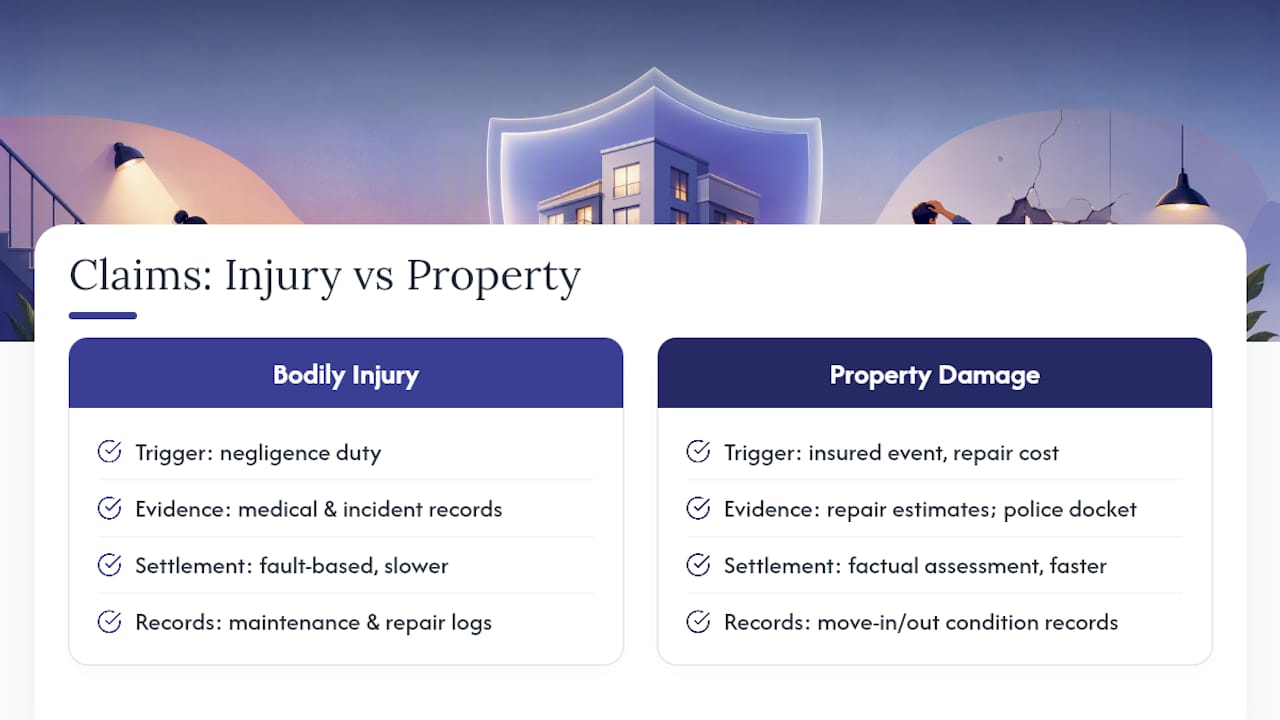
A bodily injury or liability claim requires proof of negligence, someone must show that you, as the property owner, failed in a duty of care that led to their injury. That’s a legal threshold, and it can take considerably longer to resolve because fault has to be established before any payout happens. Medical records, incident reports, and sometimes legal representation on both sides become part of the process.
A property damage claim, by contrast, is usually a more straightforward factual question: did an insured event happen, and what did it cost to fix? Malicious damage claims specifically often need a police docket as supporting evidence, but beyond that the process tends to move faster because it’s assessing cost of repair rather than apportioning blame.
For a landlord, this distinction changes what you should keep on file. Liability exposure means you should document maintenance schedules and repair history, proof you acted on hazards promptly, since that’s your defence if a negligence claim ever arises. Property damage exposure means you should document the state of the property at each tenancy start and end, since that’s your evidence when a tenant disputes a damage claim. Keeping both types of records separately, rather than assuming one folder covers everything, saves real time when a claim actually lands.
What legal responsibilities come with holding this kind of cover?
Holding landlord insurance doesn’t remove your underlying legal duties, it sits alongside them. You remain responsible for maintaining the property to a standard that doesn’t create foreseeable hazards, and for disclosing accurately to your insurer that the property is rented rather than owner-occupied.
That disclosure point deserves emphasis. Letting a property is material information an insurer needs, and failing to declare a change from owner-occupied to rented can void cover entirely at the worst possible moment, right when you try to claim. Landlords also carry an obligation to act reasonably fast once a hazard is reported. If a tenant flags a leaking roof and you sit on it for months before it causes a ceiling collapse, an insurer may query whether the damage was truly accidental or a consequence of your own delay.

On the tenant-management side, South African landlords also need to follow the correct legal eviction process rather than attempting self-help remedies like changing locks or removing a tenant’s belongings, both of which carry legal risk regardless of what your insurance covers. This is exactly why eviction cover typically pays for the legal process itself rather than allowing landlords to bypass it. Meeting these obligations properly is often what determines whether an insurer honours a claim at all.
Common landlord mistakes and quick fixes
The single biggest error I see is landlords assuming a tenant who stops paying counts as an insured loss. It doesn’t, unless you’ve specifically bought rent-guarantee cover. Underinsuring rebuild value is the second, usually because nobody revisited the sum insured after renovations. Third: skipping malicious-damage extensions on furnished student or short-term lets, precisely the tenant profile most likely to need it.
Fix all three with one habit: review your policy wording annually against your actual rent roll and tenant mix, not just at renewal by default. Our property damage liability guide and eviction cover explainer are worth ten minutes each if you’ve never read them properly.
— Coert
How to get the right cover for your rental income
If the sections above left you wondering whether your current policy actually replaces lost rent or just covers the building, that’s the gap Rental Income Insurance was built to close. Immediate coverage with no waiting period means you’re not left exposed while paperwork moves through underwriting, and tailored options for both residential and commercial property mean you’re not fitting your portfolio into a generic homeowner template.

Before requesting a quote, pull together your rent roll, copies of current leases, and any repair history from the past two years. This is exactly what a broker needs to match your indemnity period and monthly limit to reality rather than guesswork. Whether you need Eviction Insurance, cover for tenant default, or straightforward rental income protection, compare limits, indemnity periods and exclusions across quotes rather than shopping on premium alone. You can request a personalised quote directly, or start with our rental income insurance overview to see how the product lines fit together.
For a broader look at how policy limits get structured in other rental markets, this tenant insurance overview offers a useful comparison point, though South African policy structures differ in detail.
This short explainer video walks through how landlord cover works in practice:
.
Sources
- Buildings Insurance for Landlords in South Africa | Savvy Insurance
- Landlord Insurance Explained: What Property Investors Actually Need to Cover
- Landlord Insurance In South Africa – ZABENEFITS
This article is general information, not a substitute for advice from a qualified financial advisor. Consult a qualified financial professional about your own circumstances before acting on anything here.
FAQ
Does landlord insurance cover a tenant who stops paying rent?
No. Standard landlord policies replace rental income after insured physical damage, not simple non-payment. Tenant default needs a separate rent-guarantee product or a robust deposit and vetting process.
What’s the difference between loss of rent and eviction cover?
Loss of rent replaces income while your property is uninhabitable after damage, while eviction cover pays legal costs for removing a problem tenant through the courts. Both loss of rent and eviction cover are offered as distinct products, since they respond to different triggers.
Do I need a police report to claim for tenant damage?
For malicious or deliberate damage, most insurers require a police docket as supporting evidence before settling. Accidental damage claims typically don’t need one, but photographic evidence still helps significantly.
How much does Rental Income Insurance cost?
Rental Income Insurance is priced as a percentage of monthly rental income, varying depending on your property and policy specifics. You can get an exact figure by requesting a quote with your rent roll and lease details ready.
Can I insure a short-term or Airbnb-style rental the same way?
Not always. Many standard landlord policies exclude short-term letting unless it’s specifically declared and priced for, since the risk profile differs from a long-term tenancy. Always confirm your letting type with your broker before assuming standard cover applies.