
TL;DR:
- Most South African landlords misunderstand the “exemption period,” which is a temporary waiting period on claims, not a permanent exclusion.
- While premiums are paid, claims for specific events are restricted until the waiting period expires, which varies by policy and cause; adding cover resets this period.
- Understanding the difference between waiting periods and exclusions is crucial, as waiting periods are temporary and expire, whereas exclusions are permanent and eliminate coverage altogether.
Most South African landlords encounter the phrase “exemption period” when they take out a new policy and assume they are fully covered from day one. They are not. What is exemption period in insurance is one of the most misunderstood concepts in personal and property finance, and the confusion can cost you dearly if a claim arises shortly after you sign. This article cuts through the terminology, explains exactly how these periods work in South African insurance products, and shows you what it means specifically for protecting your rental income.
Table of Contents
- Key takeaways
- What is exemption period in insurance?
- Waiting periods versus exclusions
- How waiting periods apply in South African insurance products
- Practical steps for landlords managing waiting periods
- My perspective on why this really matters
- Protect your rental income from the start
- FAQ
Key takeaways
| Point | Details |
|---|---|
| Exemption period is a waiting period | The term refers to a temporary restriction on claims after a policy starts, not permanent removal of cover. |
| Premiums are still due | You pay your monthly premium throughout the waiting period even though claims are restricted. |
| Waiting periods differ from exclusions | Exclusions permanently remove cover for specific events; waiting periods expire after a set time. |
| Durations vary by product and cause | Life and funeral policies may have different waiting periods for accidental versus natural causes. |
| Policy changes reset the clock | Adding cover or reinstating a lapsed policy can trigger a fresh waiting period from that date. |
What is exemption period in insurance?
The term “exemption period” is used interchangeably with insurance waiting period in South African insurance circles, and consumers commonly confuse the two with something altogether different: a policy exclusion. Understanding the distinction is not a technicality. It is the difference between knowing when you can actually make a claim and being blindsided by a denial.
A waiting period is the time after a policy commences during which claims for certain events are not permitted, even though your premiums are being paid in full. The policy is active. The direct debit runs. You are simply not yet eligible to claim on specific covered events until the waiting period expires.
Here is why insurers build these periods into policies:
- Risk management. Without a waiting period, a person who already knows they face an imminent financial risk could take out a policy specifically to exploit the benefit, then cancel immediately after claiming.
- Adverse selection prevention. Waiting periods discourage people from signing up only when they anticipate an immediate loss, which would make policies unaffordable for everyone else.
- Portfolio stability. Insurers price premiums based on the assumption that policyholders represent a spread of risk over time. Immediate claims skew that spread significantly.
A straightforward South African example: funeral policy waiting period of six months for natural causes means that if the policyholder passes away from a natural cause within that six-month window, the insurer will not pay out the full benefit. Some policies offer a graded payout, returning premiums plus interest rather than the full sum assured, during the waiting period.
One point that trips up many landlords: waiting period timing starts on the policy commencement date, not on the date you submitted your application or made your first payment. If there is a gap between application approval and commencement, that gap does not count towards your waiting period.

Pro Tip: Ask your insurer for the exact commencement date in writing and calculate the waiting period expiry date yourself. Do not rely on verbal assurances that “cover starts immediately.”
Waiting periods versus exclusions
Understanding exemption periods requires understanding what they are not. Landlords who conflate waiting periods with exclusions end up with a distorted picture of their cover, and that distortion tends to surface at the worst possible moment.
Waiting periods are temporary time-based restrictions. They expire. Once the clock runs out, you are fully covered for that event. Exclusions are a different matter entirely. An exclusion permanently removes a specific event or cause from your cover, regardless of how long you have held the policy.
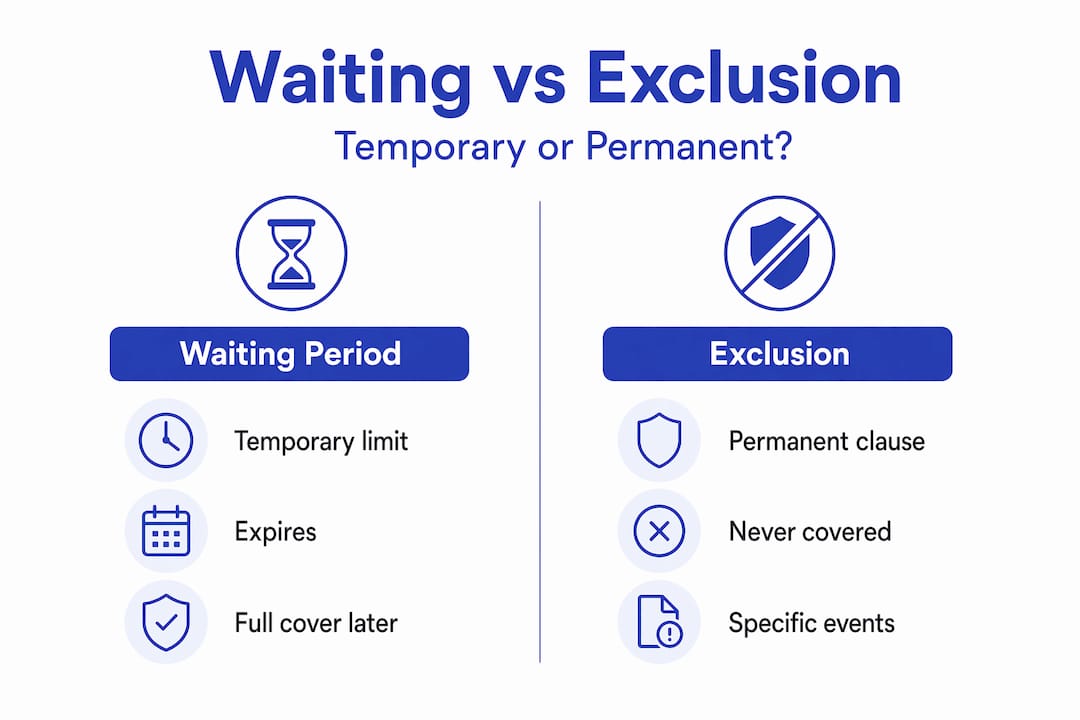
| Feature | Waiting period | Exclusion |
|---|---|---|
| Duration | Temporary, specified in days or months | Permanent for life of the policy |
| Can it expire? | Yes, automatically after the stated period | Rarely, only if insurer formally removes it |
| Effect on premiums | Premiums are paid throughout | Policy may be cheaper due to reduced risk |
| Common examples | 3 months for illness claims, 6 months for natural death | Criminal activity, self-inflicted harm, pre-existing conditions |
| Resolution | Wait it out | Negotiate with insurer or seek specialist cover |
Insurance exclusions are permanent clauses. A life or funeral policy that excludes deaths during criminal activity will never pay that claim, whether the policyholder has been insured for six months or six years. For rental income insurance specifically, common exclusions might include damage caused by deliberate tenant vandalism where the landlord knowingly retained a flagged tenant, or losses arising from illegal letting arrangements.
Reading your policy wording closely matters here. The words “exclusion,” “waiting period,” “exemption,” and “restriction” are not interchangeable, yet insurers and brokers do not always use them consistently. When you see any of these terms in a policy schedule, ask the insurer to specify whether the restriction is time-limited or permanent.
Pro Tip: Request a policy summary that lists all waiting periods with their expiry dates and all exclusions separately. If the insurer cannot produce this, treat it as a warning sign about their transparency.
How waiting periods apply in South African insurance products
Understanding exemption periods in the abstract is useful. Seeing how they play out across different South African products you might actually hold makes the concept concrete.
Life and funeral insurance. Waiting periods vary by cause of death in these products. A typical structure has a shorter waiting period for accidental death (often zero to six months) and a longer one for natural causes (commonly twelve months). This cause-specific structure means your eligibility can differ depending on how a claim arises, even under the same policy.
Rental income insurance. For landlords, the waiting period in a rental income protection product typically applies from the policy start date and may affect claims for tenant non-payment or early lease termination that arise very soon after inception. The waiting period exists to confirm that the insured tenancy was not already in distress before the policy was taken out.
Medical aids. South African medical aid waiting periods apply to new members and generally involve a three-month general waiting period and up to twelve months for specific conditions. Even during these periods, members retain access to Prescribed Minimum Benefits. The Medical Schemes Act legally mandates this structure to balance member protection with insurer risk management. This is a useful analogy for landlords: just because a waiting period restricts some claims does not mean all cover is absent.
Policy changes and reinstatements. This is where many landlords get caught out. Adding cover or reinstating a lapsed policy triggers a new waiting period from the effective date of that change, not from your original policy start date. If you add a rental income benefit to an existing homeowners policy mid-year, the waiting period for that new benefit starts from the day the addition takes effect.
- Always confirm the effective date when making policy changes
- Do not cancel and reissue a policy assuming the waiting period carries over
- Budget for a period of reduced coverage when reinstating a lapsed policy
- For claim timing planning, note the exact expiry of each waiting period in your property management records
Pro Tip: Keep a simple spreadsheet for each rental property that lists all your insurance policies, their commencement dates, waiting period durations, and expiry dates. Review it whenever you make a policy change.
Practical steps for landlords managing waiting periods
Knowing what a waiting period is will not protect you unless you apply that knowledge before something goes wrong. Here are the steps that make a genuine difference for South African property owners.
-
Read the policy schedule before you sign. Request the full policy wording, not just the marketing brochure. Look specifically for sections labelled “waiting period,” “exemption period,” or “claims restriction period.” Note the duration and start date.
-
Map your risk exposure during the waiting period. If your rental income policy has a three-month waiting period, plan for the possibility that a tenant non-payment event in that window will not be covered. Have a cash reserve or alternative arrangements in place.
-
Do not let policies lapse. A lapsed policy that you reinstate restarts the waiting period, leaving you exposed twice. Set up a direct debit and confirm it is active after any banking changes.
-
Ask specifically about cause-specific durations. Do not assume one waiting period applies across all events. Life and income protection products often have layered periods that differ by event type. Get clarity in writing.
-
Treat policy additions with the same care as new policies. Adding a new benefit mid-term is functionally identical to taking out a new policy for that benefit. The waiting period clock resets for the added benefit.
-
Seek advice when terminology is unclear. If a policy document uses “exemption clause,” ask the insurer directly whether it refers to a temporary waiting period or a permanent exclusion. Brokers and financial advisers can help you understand policy terms in plain language before you commit.
For a step-by-step overview of what to expect when setting up cover, the rental insurance process guide on the Rentalincomeinsurance website gives landlords a practical walkthrough of the key stages, including how waiting periods factor into your cover timeline.
My perspective on why this really matters
I have worked with enough South African landlords to see a pattern: the ones who get into trouble with waiting periods are almost never careless people. They read the brochure. They asked questions. But the brochure never mentioned a waiting period, and they did not know to ask the specific question.
What I have learned is that insurers have every right to include waiting periods. They are a legitimate risk management tool, not a trap. The problem is the terminology. When a policy document says “exemption period,” many landlords read it as a description of what they are exempt from having to pay. They assume it means there is no premium due initially. The exact opposite is true.
The real cost of not understanding this shows up when a tenant stops paying rent in month two of a new policy and the landlord discovers their rental income insurance has a three-month waiting period. The financial gap is real. I have seen landlords bridge that gap with credit, disrupt their mortgage payments, or accept an unfair settlement just to move on quickly.
My advice is simple: treat the waiting period as a vulnerability window, not a formality. Plan your cash flow accordingly. And when your policy renews or changes, go back to the schedule and find the new waiting period dates. It takes five minutes and can save you thousands.
— Coert
Protect your rental income from the start
Understanding your policy’s waiting period is only half the challenge. Choosing the right rental income insurance product with transparent terms is the other half.

At Rentalincomeinsurance, we work with South African landlords to provide cover against tenant non-payment, early lease termination, and absconding tenants. Our policies are designed with clear waiting period terms so you know exactly when cover kicks in and what is covered from day one. You can also explore our guidance on rental income exclusions and void period protection to build a complete picture of your cover. Ready to see what your options are? Request a personalised quote today and let our team explain exactly how waiting periods and exclusions apply to your specific rental situation.
FAQ
What is the exemption period in insurance?
The exemption period, also called a waiting period, is a defined span of time after a policy starts during which certain claims cannot be made, even though premiums are being paid. It is temporary and expires automatically once the stated period ends.
How long is an exemption period in South African insurance?
Durations vary by product and cause. Funeral policies may carry a six-month waiting period for natural causes and a shorter or zero period for accidental causes. Medical aids typically apply a three-month general waiting period and up to twelve months for specific conditions.
What is the difference between a waiting period and an exclusion?
A waiting period is temporary and expires after a set time, after which the event is covered. An exclusion is a permanent removal of cover for a specific event or cause and does not expire regardless of how long you hold the policy.
Does adding cover to an existing policy restart the waiting period?
Yes. When you add a new benefit or reinstate a lapsed policy, the waiting period for that benefit restarts from the effective date of the change. The original policy start date does not apply to the newly added cover.
Can I claim at all during a waiting period?
In most South African insurance products, no claims are permitted for the restricted events during the waiting period. Some policies offer a limited graded payout, such as returning premiums plus interest, rather than the full benefit during this time.
Recommended
- Rental Income Protection Exclusions Explained
- Rental void periods explained: maximise income protection – Rental Income Insurance
- Exclusions in Rental Income Insurance – What Landlords Need to Know – Rental Income Insurance
- Policy Waiting Periods – Impact On Landlords’ Cover – Rental Income Insurance