
Guaranteed rent, in practical terms, means rental income insurance: a policy that pays landlords when a tenant stops paying, breaks a lease early, or disappears without notice. It does not put you above the law. Insurers still expect you to follow lawful eviction steps before they settle an eviction-cost claim, and some insurance providers offer licensed options built specifically for this purpose.
TL;DR:
- Guaranteed rent only covers specific triggers such as unpaid rent, early lease termination, or tenant absconding, not general tenant disputes.
- Policies typically include rent replacement for a limited number of months and legal costs for lawful eviction procedures, with coverage limits varying between insurers.
- Landlords must follow proper eviction procedures and provide proof, such as court applications and notices, for insurer claims related to legal costs.
- Checking the insurer’s FSCA authorization and reviewing sample claims examples helps verify the policy’s legitimacy and coverage scope.
- Premiums depend on rent level, tenant screening, property type, claims history, and optional add-ons, while the claims process involves notification, evidence submission, assessment, and payment or decline.
Table of Contents
- How does guaranteed rent work in practice?
- What does a rental income insurance policy cover and exclude?
- Can insurance replace the legal eviction process?
- What should you check before buying a policy?
- What does guaranteed rent cost, and how does a claim run?
- Why verification and proof of coverage matter more than marketing claims
- Get a tailored rental income insurance quote
- Sources
- FAQ
How does guaranteed rent work in practice?
Rental income insurance responds to a defined set of triggers, not to every dispute you might have with a tenant. The most common ones are missed rent payments, a tenant breaking a fixed-term lease before it ends, and outright absconding, where a tenant vanishes and stops communicating. Once a trigger occurs, the policy typically pays out under one or more of the following benefit types:
- Rent replacement for a defined loss period while you pursue recovery or eviction.
- Legal and eviction-cost reimbursement covering court or Tribunal fees tied to removing a defaulting tenant.
- Optional add-ons for property damage, though these often sit under a separate limit.
Insurers will ask for paperwork before they pay anything. That usually means a signed lease agreement, a rent payment history showing the default, inspection reports, and any invoices tied to the claim. A realistic timeline looks like this: rent goes unpaid on the first of the month, you send a formal notice within days, and by week three or four you have enough evidence, missed payments, written notices, communication logs, to lodge a claim with your insurer.
Pro Tip: Keep a simple spreadsheet logging every rent payment date from day one of the tenancy. When a dispute happens, that record does more to speed up your claim than any single document you produce after the fact.

What does a rental income insurance policy cover and exclude?
Policy wordings vary between insurers, but most guaranteed rent products follow a similar pattern of inclusions and exclusions. Knowing where the line sits before you buy saves a lot of frustration at claim time.
- Defined rent-loss period. Cover usually runs for a set number of months, not indefinitely, so check the maximum payout period stated in your schedule.
- Eviction legal costs. Court or Tribunal fees linked to removing a non-paying tenant are typically included, provided you followed the lawful process.
- Tenant absconding. Most policies specifically name this as a covered event, separate from ordinary non-payment.
- Wear and tear exclusion. Normal deterioration of the property is never treated as an insurable loss.
- Pre-existing arrears. Rent that was already overdue before the policy started is commonly excluded.
- Unproven disputes. If you cannot demonstrate the tenant actually defaulted, rather than disputing a repair or a deposit, the claim is likely to be declined.
- Landlord breaches. A claim tied to your own failure to meet lease obligations is generally excluded.
One distinction catches landlords out repeatedly: rent replacement and property-damage compensation are often treated as separate covers with separate limits. A landlord insurance policy may pay your lost rent promptly while a damage claim runs on an entirely different track, so read the definitions of “tenant default” and “eviction costs” in your policy document rather than assuming they mean what you’d expect.
Can insurance replace the legal eviction process?
No. Rental income insurance supports a lawful eviction; it never substitutes for one. Removing a tenant in South Africa requires a Tribunal or court order, and the process follows procedural steps set out under the Prevention of Illegal Eviction from and Unlawful Occupation of Land Act, commonly known as PIE, alongside obligations in the Rental Housing Act. Self-help eviction, changing locks or removing a tenant’s belongings without a court order, is unlawful regardless of how much rent is owed.
This is why insurers ask for proof that you followed the correct sequence before they settle a claim tied to eviction costs:
- A written notice to the tenant giving reasonable time to remedy the default.
- Copies of the Tribunal or court application, if the matter proceeded that far.
- Proof of service showing the tenant received the papers.
- The Tribunal or court ruling once one is granted.
If a tenant opposes the eviction or the court process is delayed, your claim timing shifts with it. Insurers typically pay eviction-related costs against the legal process as it happens, not against your original estimate of how long removal should take, so a contested case can extend the wait for both possession of the property and settlement of the claim.
What should you check before buying a policy?
Verifying the provider matters as much as comparing premiums. The Financial Sector Conduct Authority, known as the FSCA, maintains a public register of authorised insurers, and checking it takes a few minutes. Skipping this step carries real consequences: enforcement action against unlicensed insurance activity has included fines running into millions of rand and bans on individuals selling cover without proper authorisation.
Before you commit to a premium, work through this checklist:
- Confirm the FSCA authorisation of both the insurer and the intermediary selling you the policy.
- Ask which insurer actually underwrites the risk, and request the full policy schedule in writing.
- Request sample claims scenarios showing how a real default or absconding case was handled.
- Ask about the complaints route if a claim is declined or delayed.
- Clarify the waiting period before cover activates, the maximum payout period, the excess you’ll carry, and whether eviction legal fees are capped at a fixed amount.
- Ask the intermediary for references or case studies from other landlords they’ve placed cover with.
Pro Tip: A “guarantee” label on a product does not automatically mean it’s licensed short-term insurance. Ask the seller directly which FSCA-registered insurer stands behind the policy, then verify that name yourself on the register rather than taking their word for it.
What does guaranteed rent cost, and how does a claim run?
Premiums for rental income insurance are set against several variables rather than a flat rate. The main drivers are the monthly rent you’re insuring, how thoroughly you screen tenants, the property type (residential versus commercial carries different risk profiles), your claims history, and any optional add-ons like damage cover you choose to bundle in. Excesses and payout caps then determine what you actually recover: a policy with a high excess or a short maximum payout period can leave a meaningful gap between the rent you lost and the amount you receive.
The claims process itself generally follows four steps:
- Notify your insurer as soon as the default, lease break, or absconding is confirmed.
- Submit evidence, including the lease, payment history, notices sent, and any court or Tribunal documents.
- Assessment, where the insurer reviews whether the trigger and documentation match the policy wording.
- Payment or decline, with a written explanation if the claim is rejected.
If you disagree with a decision, raise it through the insurer’s internal complaints process first. If that doesn’t resolve it, the FSCA’s Insurance Division supervises insurer conduct and can be approached as an escalation route.
Why verification and proof of coverage matter more than marketing claims
Landlords searching for guaranteed rent often focus on price and speed of payout, but the more useful question is what evidence a provider can actually show you. Rental Income Insurance describes its cover as protecting landlords against tenant non-payment, early lease termination, and absconding, with legal support built into the policy. That kind of stated scope is a reasonable starting point, but it’s only a starting point.
Before treating any provider’s claims as reliable, ask for three things: the name of the underwriting insurer standing behind the policy, worked examples of how a real claim was assessed and paid, and the credentials of the insurance advisors… A provider that can produce these without hesitation is behaving the way a regulated insurance business should.
— Coert
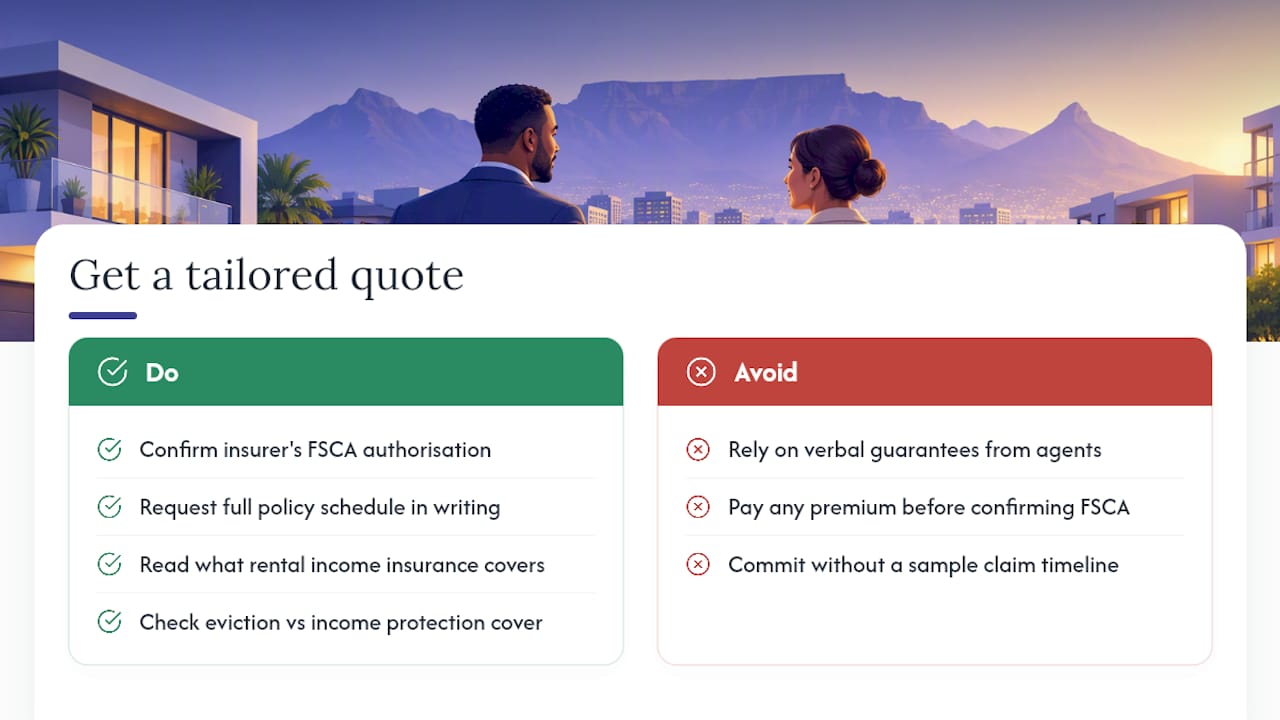
Get a tailored rental income insurance quote
Rental income insurance products are an alternative to carrying the full risk of tenant default yourself. Where a landlord relying on a verbal “guarantee” from an agent has no regulatory backing if that arrangement falls apart, some policies offer cover for tenant non-payment, early lease termination, and absconding with legal support and no waiting period before protection starts.

Before paying any premium anywhere, confirm the insurer’s FSCA authorisation and request the full policy schedule in writing, whatever provider you choose. If you want to see how this applies to your own property, read what rental income insurance actually covers, check the difference between eviction cover and standard income protection, and then request a tailored quote so we can walk you through a sample claim timeline before you commit to anything. For a broader look at how rental income fits into your finances, this explainer on whether rental income counts as passive income is worth a read too.
For a walk-through of how this cover applies day to day, watch this video:
This article is general information, not a substitute for advice from a qualified financial advisor. Consult a qualified financial professional about your own circumstances before acting on anything here.
Sources
- Practice Guidelines: Eviction in terms of the Prevention of Illegal Eviction From and Unlawful Occupation of Land Act 19 of 1998
- FSCA enforcement example cited by Moonstone (R12.6m fine) — enforcement shows risk of unauthorised insurance activity
- Rental Housing Act No. 50 of 1999
- FSCA list of registered insurers
FAQ
Is guaranteed rent the same as rental income insurance?
Yes, in this context guaranteed rent refers to rental income insurance, a policy that pays landlords when a tenant defaults, breaks a lease early, or absconds. It is not a scheme where a third party rents your property and pays you a fixed sum regardless of occupancy.
Is guaranteed rent safe to rely on?
It’s as safe as the insurer behind it. Confirming the underwriting insurer’s FSCA authorisation and reading the full policy schedule before paying a premium removes most of the risk.
Does rental income insurance cover property damage as well as lost rent?
Not automatically. Rent replacement and property-damage compensation are usually treated as separate covers under separate limits, so check your policy wording on what landlord insurance covers before assuming one claim handles both.
Can an insurer help me evict a tenant faster?
No policy speeds up the court or Tribunal process itself, since eviction requires a lawful order under PIE. What insurance does is reimburse the legal costs of that process once you’ve followed the correct steps.
How much does Rental Income Insurance cost?
Rental income insurance premium rates vary based on factors including the property and cover selected; current prices are available on the provider’s pricing page. Request a tailored quote for an exact figure based on your situation.