
Indemnity insurance, in this context, means rental income insurance: cover that indemnifies a landlord for lost rent and related eviction or legal costs when a tenant defaults, terminates early or absconds. A 2024 South African Tax Court judgment records exactly this kind of policy being used to protect rental income on a commercial property. This article covers rental income indemnity cover for landlords, not the title or planning indemnity policies used in conveyancing.
TL;DR:
- Rental income insurance is most beneficial for landlords with long eviction processes, multiple units, or tenants prone to absconding, especially if landlord reserves cover few months.
- The policy typically covers unpaid rent, early lease termination, absconding tenants, and associated legal eviction costs, with optional extensions for property damage and repairs.
- Claims require prompt notification, thorough documentation, and adherence to legal eviction procedures, which can extend claim timelines to several months.
- This insurance does not cover title or planning defects discovered during property sale transactions, which are separate conveyancing indemnity policies.
- Careful tenant screening reduces risk but does not eliminate the need for rental income protection, which provides a financial backstop during lengthy eviction or default events.
Table of Contents
- What rental income indemnity insurance covers and excludes
- How a rental income insurance claim actually works
- Deciding when rental income cover is worth it
- How to choose a policy: what to check before you sign
- Indemnity insurance in a house sale is a different product entirely
- Why this distinction matters for landlords specifically
- Where sale-related indemnity gaps actually surface
- How Rental Income Insurance approaches cover for landlords
- Get a rental income insurance quote that fits your risk
- Sources
- FAQ
What rental income indemnity insurance covers and excludes
A rental income policy exists to keep money flowing into your account when a tenancy breaks down. Most policies built for landlords centre on four core risks, though wording varies between insurers.
- Unpaid rent: cover for the monthly rent you lose once a tenant stops paying, usually up to a set indemnity period.
- Early lease termination: compensation when a tenant walks away from a fixed lease before its term ends.
- Absconding tenants: protection when a tenant vacates without notice, leaving arrears and often a vacant unit to re-let.
- Legal and eviction costs: contribution towards sheriff fees, court costs and attorney fees tied to a lawful eviction process.
Many insurers also offer optional extensions, most commonly tenant-caused property damage and loss of rent during repairs after that damage. These sit outside the core indemnity and usually carry their own sub-limit.
Exclusions matter just as much as the cover itself. Expect a waiting period before a claim becomes payable, a maximum indemnity period (often measured in months rather than years), and firm exclusions for arrears that existed before the policy started or for deliberate acts by the landlord. Insurers also decline claims tied to tenants who were never properly vetted, since prevention through screening is treated as a precondition, not an afterthought.
Picture two tenants. One stops paying rent in month three after a genuine job loss, and the landlord has full lease and payment records. The other never signed a proper lease and has been in dispute with the landlord for months before the policy began. The first scenario is a textbook claim. The second is exactly the kind of pre-existing dispute most policies exclude.
How a rental income insurance claim actually works
Claims move through a fairly predictable sequence, and knowing it in advance saves weeks of back and forth with your insurer.
- Notify the insurer promptly. Most policies require notification within days of the first missed payment or the tenant vacating, not at the end of the eviction process.
- Submit documentation. This typically includes the signed lease, a full rent statement, written proof of the breach (missed payment notices, correspondence) and any court or sheriff papers already issued.
- Insurer assessment. The insurer checks the claim against policy wording, confirms the waiting period has passed, and verifies the tenant was screened according to the policy’s requirements.
- Decision and payment. Approved claims pay out for the agreed indemnity period; declined claims usually come with a written reason tied to a specific exclusion.
Eviction timing shapes this whole process more than most landlords expect. The Prevention of Illegal Eviction from and Unlawful Occupation of Land Act requires a court order and proper notice before any eviction, and city-level guidance such as Cape Town’s eviction process treats eviction as a last resort after debt arrangements have failed. That sequence can stretch a claim out over several months, which is exactly why insurers set maximum indemnity periods rather than open-ended cover.
Pro Tip: Start a dated file the moment a tenant misses a payment. Insurers lean heavily on contemporaneous records, and a clean paper trail from day one is the single biggest factor in whether a claim gets approved without delay.
Legal costs add another layer of complexity. Some policies pay eviction legal fees from within the same indemnity limit as lost rent, which quietly shrinks the rent portion of your payout; others pay legal costs separately. Reading a claims process guide before you sign is worth the ten minutes it takes.
Deciding when rental income cover is worth it
Rental income insurance earns its premium in a fairly specific set of circumstances, and it is worth being honest about when it does not.
Start by comparing your fixed monthly liabilities, bond repayment, levies, rates and utilities, against how long a worst-case eviction might realistically run. If those costs would strain you within one or two missed rent payments, cover is doing real work. If you hold enough reserve to absorb three or four months without strain, the calculation looks different.
- Cover tends to earn its keep when eviction processes are likely to run long, when a tenant has already absconded, or when you hold several units and one bad tenancy would meaningfully dent overall cashflow.
- Cover is a weaker fit if your leases are short, your tenant vetting is already thorough, and your reserves comfortably cover a few months of vacancy.
Insurance is a backstop, not a substitute for tenant screening and lease administration.
One more thing worth flagging. The 2024 Tax Court judgment involved a trust that had taken out insurance specifically to protect rental income on a property insured for R131 million. That case shows courts recognise rental income insurance as a legitimate business tool, but it says nothing about how your own premiums or payouts should be treated for tax purposes. Speak to a tax adviser about your own reporting obligations rather than relying on someone else’s case facts.
How to choose a policy: what to check before you sign
Policy wording varies more between insurers than landlords expect, so a side-by-side comparison of a few specific terms saves real money later.
- Indemnity period and monetary limit. Confirm the maximum number of months covered and the rand cap on total payout, not just the monthly figure.
- Where legal costs sit. Ask directly whether eviction legal fees are paid from within the rent indemnity limit or as a separate, additional benefit.
- Waiting period and excess. Establish how many days or weeks must pass before a claim becomes payable, and what excess applies per claim.
- Proof requirements. Ask what documentation triggers a payout, and request a sample of a previously paid claim if the insurer or broker will share one.
- Sample wording. Request the actual policy document, not a summary, before committing.
Red flags worth walking away from include vague definitions of “eviction costs,” no clear statement of whether legal fees are inside or outside the main limit, and exclusions written around “adequate recordkeeping” without defining what that means. A comparison of landlord cover is a useful reference point before any sales call, so you walk in knowing which questions matter.
Indemnity insurance in a house sale is a different product entirely
It is worth being direct about a common point of confusion. When people search for indemnity insurance in the context of selling a house, they are usually asking about a completely different product from the rental income cover described throughout this article.
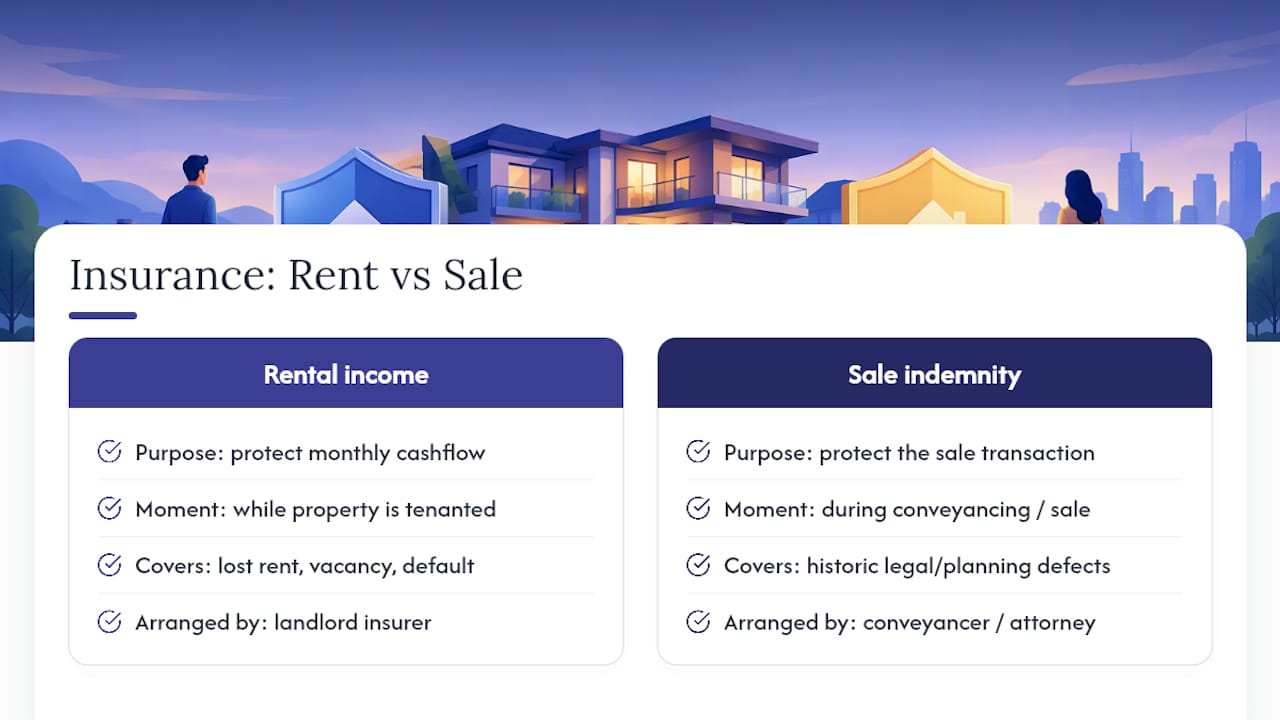
Title or planning indemnity insurance, used in conveyancing, protects a buyer or seller against legal defects in a property’s title or against unresolved planning and building consent issues discovered during a sale. That is a one-off policy tied to a single transaction, bought to satisfy a conveyancer or lender before a transfer completes.
Rental income insurance is a recurring policy tied to an ongoing landlord and tenant relationship. It has nothing to do with title defects, missing planning permissions, or historic building consent gaps. If your search brought you here because you are selling a property and a conveyancer mentioned indemnity cover, that is a legal and conveyancing matter, best handled by the attorney managing your transfer, not an insurance product a landlord buys to protect monthly rent.
The overlap in name causes genuine confusion, since both products use the word “indemnity” to describe the same basic mechanic: an insurer compensating a party for a defined loss. Beyond that shared structure, the risks, the buyers, and the moment in a property’s life when each policy applies are entirely separate.
Why this distinction matters for landlords specifically
Landlords occasionally encounter both products in the same property’s lifecycle, which is exactly why the distinction deserves a clear line drawn through it.
Say you are a landlord who eventually decides to sell a rental property. At that point, a conveyancer might flag a title indemnity or planning indemnity need if the property has an unresolved boundary dispute, an addition built without full council sign-off, or a missing occupancy certificate. That policy protects the sale transaction itself, covering the buyer or a future owner against the cost of that historic defect surfacing later.
None of that has any bearing on the rental income insurance you may have held while the property was tenanted. The two policies serve entirely different moments: one protects your monthly cashflow while you operate as a landlord, the other protects a specific one-off transaction when ownership changes hands. A landlord who has never let a room in their life can still need title indemnity cover when selling a house with an old unauthorised structure on it.
The practical takeaway is straightforward. If your concern is protecting rent while you have tenants, rental income insurance is the product built for that job. If your concern is a legal defect discovered during a sale process, that is a conveyancing matter and a different insurance product entirely, arranged through the attorney handling the transfer rather than a landlord insurer. Confusing the two, or assuming one covers the other’s risk, leaves a genuine gap in protection at exactly the moment it matters most.
Where sale-related indemnity gaps actually surface
Because these two products get conflated so often, it is worth naming precisely where a title or planning gap tends to show up during a sale, even though it sits outside rental income cover.
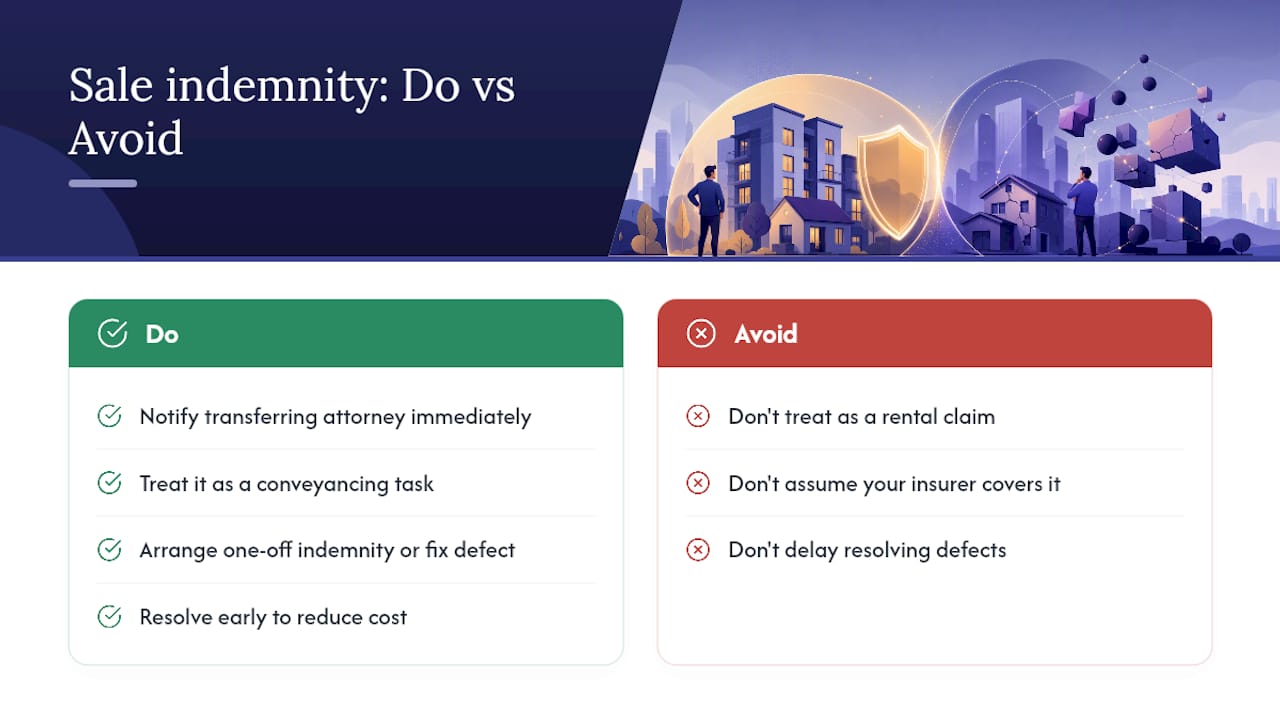
A conveyancer typically flags the need for title or planning indemnity cover after a title deeds search or a building compliance inspection turns up something unresolved. Common triggers include an extension built without full council approval, a missing occupancy certificate on an older structure, or a historic boundary encroachment that never got formally corrected.
For a landlord selling a tenanted or previously tenanted property, these issues are entirely separate from anything a rental income policy would have covered. Your rental income insurer was never assessing planning compliance or historic title defects. Those risks sit with the conveyancing side of a transaction, and a sale can stall or fall through if a buyer’s attorney insists the gap be resolved, either by fixing the underlying defect or by the seller arranging a one-off indemnity policy to satisfy the buyer’s lender.
The exclusions and terms on that kind of policy, covering a single defined defect for as long as the buyer or a future owner holds the property, bear no resemblance to the waiting periods, indemnity periods and excesses that shape a rental income claim. If you are a landlord facing this situation, treat it as a conveyancing task for your attorney, separate entirely from any rental income cover you hold or have held on the same property. The practical answer is to raise it with the transferring attorney the moment it is flagged, since resolving it early is almost always cheaper than a delayed transfer.
How Rental Income Insurance approaches cover for landlords
Rental income insurance policies are built around practical landlord challenges like missed rent, absconding tenants, and legal costs related to eviction. Some providers offer immediate coverage with no waiting period, along with legal support for eviction and default cases, aiming to minimize the time between missed payment and claim resolution.
That approach is shaped by working closely with brokers who match landlords to cover suited to residential, commercial and portfolio exposure, rather than offering one generic policy to everyone. For a landlord weighing up whether cover suits their situation, the starting point is understanding your own exposure, not accepting a one-size policy. Rental income insurance is one option among several worth considering, providing a South African-focused solution for landlords.
— Coert
Get a rental income insurance quote that fits your risk
Rental Income Insurance gives landlords immediate coverage with no waiting period, a real advantage over policies that make you sit out weeks before a claim becomes payable. Our range covers Rental Income Insurance, priced at 3.5% to 5% of monthly rent, alongside Eviction Insurance, Residential Rental Insurance, Commercial Rental Insurance, Group Rental Insurance and Tenant Insurance, each built for a different scale of exposure, from a single unit to a full portfolio.

Before you request a quote, pull together your signed lease, a full rent payment history, any written notices sent to the tenant, and copies of court or sheriff documents if an eviction is already under way. Having these ready speeds up both the quote and, later, any claim.
For a deeper look at what the cover includes before you commit, read what rental income insurance actually is, then head to our request a quote page to get tailored figures for your property. For a practical walkthrough of how landlords use this kind of cover day to day, this video is worth ten minutes:
.
Sources
- SARSTC IT 45673 (IT) 2024 ZATC PTA (17 July 2024)
- Prevention of Illegal Eviction from and Unlawful Occupation of Land Act 19 of 1998
FAQ
What is indemnity insurance when selling a house, exactly?
In a sale context, it usually refers to title or planning indemnity insurance, a one-off policy covering a specific legal or planning defect found during conveyancing. It is a different product from the rental income insurance covered throughout this article, which protects a landlord’s ongoing rent rather than a single sale transaction.
Why use indemnity insurance for rental income instead of just chasing arrears myself?
Chasing arrears takes time, legal costs and often a formal eviction, which can run for months under the Prevention of Illegal Eviction Act. Rental income insurance replaces lost rent during that process, so your cashflow does not depend entirely on how quickly the courts move.
What are the main types of indemnity insurance relevant to landlords and sellers?
For landlords, the relevant product is rental income insurance covering unpaid rent, early termination, absconding and eviction legal costs. For sellers, title indemnity and planning indemnity are the two policies conveyancers typically arrange, and neither overlaps with rental cover.
Do I need indemnity insurance if I already screen tenants carefully?
Careful screening lowers your risk but does not remove it entirely; a good tenant can still lose their income unexpectedly. Insurance and screening work together, with screening as prevention and insurance as the backstop when prevention fails.
How much does rental income insurance cost?
Rental Income Insurance prices cover at 3.5% to 5% of monthly rent, depending on the property type and level of cover chosen. Eviction Insurance and other product lines don’t carry a published price, so it’s best to request a tailored quote for an exact figure.