
TL;DR:
- Indemnity value is the cost to restore a property to its pre-loss condition, excluding land value. It differs from market and replacement cost, impacting insurance payouts and premium calculations. Properly assessing indemnity value prevents underinsurance and ensures rental income protection for landlords.
Indemnity value is defined as the financial compensation required to restore an insured property to the exact condition it was in immediately before loss or damage, excluding land value. The principle of indemnity ensures the insured is restored financially but does not profit from a claim. This is the foundational rule in South African property insurance, and misunderstanding it costs landlords money every year. Rentalincomeinsurance works within this same framework to protect rental income from the unexpected. Knowing what indemnity value means, how it is calculated, and how it differs from market value gives you a real advantage when managing your property investment.
How is indemnity value calculated?
Indemnity value is not a single figure pulled from a property listing or a bank statement. It is built from the actual costs required to rebuild your property from the ground up, after a total loss.
Insurance value components include:
- Demolition and rubble removal costs
- Construction and rebuilding costs based on current material and labour rates
- Professional fees for architects, engineers, and quantity surveyors
- VAT on all applicable costs
- Inflation escalation to account for rising building costs over the policy period
Land value is excluded entirely. The ground your property sits on cannot burn down or flood, so it has no place in an indemnity calculation. This is where many South African property owners go wrong. They look at what their property sold for, or what the municipality rates it at, and use that figure as their sum insured.
Pro Tip: Never use a bank valuation or municipal rates valuation to set your sum insured. Both figures include land and reflect market conditions, not rebuild costs. Using them leads directly to underinsurance or overinsurance.
Escalation matters more than most landlords realise. Building costs in South Africa have risen sharply over recent years. A rebuild cost calculated three years ago may be significantly lower than what a contractor would quote today. Review your indemnity sum insured annually, not just at renewal.

What is the difference between indemnity value, market value, and replacement cost?
Confusing these three terms is the single most common mistake South African property owners make when reading their insurance documents. Each term means something different, and each affects your premium and your claim settlement in a distinct way.
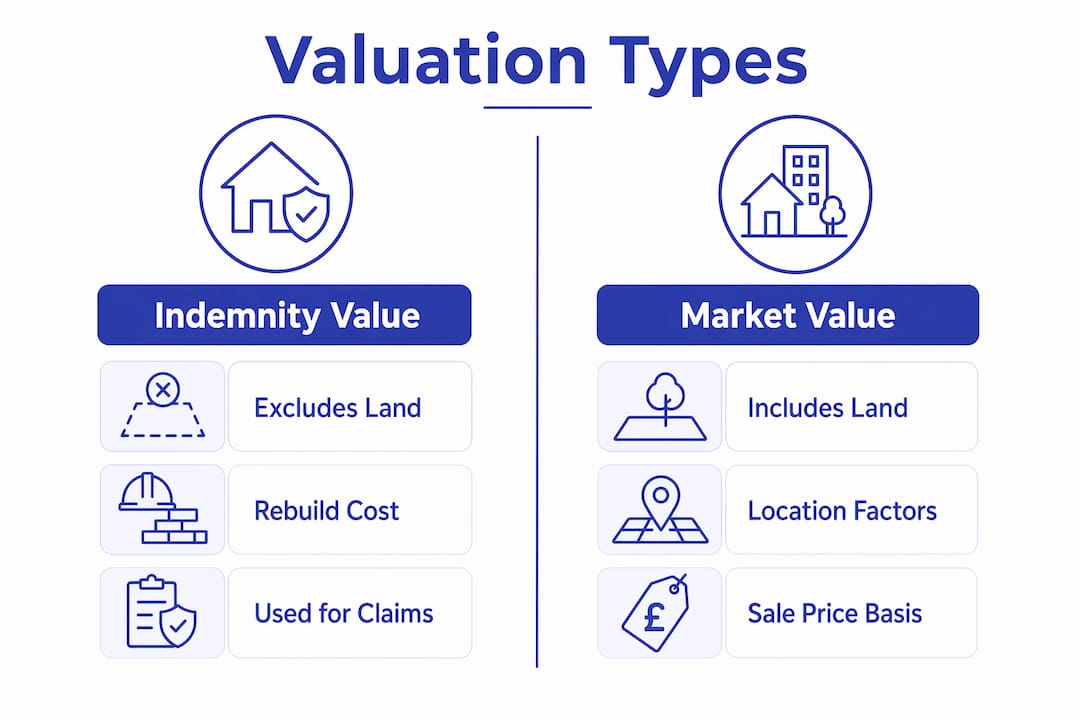
Market value differs significantly from indemnity value because it includes the land. A property with a market value of R3.5 million may carry an indemnity value of only R2.4 million. That R1.1 million gap represents the land, location premium, and buyer demand factors that have no bearing on what it costs to rebuild.
Replacement cost is often used interchangeably with indemnity value, but there is a meaningful distinction. Replacement cost refers to the full cost of rebuilding with new materials at today’s prices, without any deduction for wear and depreciation. Indemnity value, in its strictest sense, may apply a depreciation deduction to account for the age and condition of the property at the time of loss. Many modern policies offer replacement value cover, which removes that depreciation deduction, but this comes with conditions.
| Valuation type | What it includes | Used for | Key implication |
|---|---|---|---|
| Market value | Land, location, buyer demand, structures | Property sales, bond applications | Too high for insurance sums insured |
| Indemnity value | Rebuild cost minus depreciation, excluding land | Standard insurance claims | May result in lower payout on older properties |
| Replacement cost | Full rebuild cost at current prices, excluding land | Replacement value policies | Higher premium, but full reinstatement on valid claims |
The table above shows why using the wrong figure creates problems. Insuring at market value means you are paying premiums on an inflated sum that includes land your insurer will never pay out for. Insuring at an outdated indemnity figure means your payout falls short of actual rebuild costs.
What are the practical implications for South African property owners?
Understanding the meaning of indemnity value is one thing. Knowing how it plays out in a real claim is another. Several policy conditions directly affect whether you receive a full replacement payout or a reduced indemnity settlement.
Policy schedules override master policy conditions when it comes to indemnity terms and limits. Your schedule is the document that sets the actual values, excesses, and conditions that apply to your specific property. Read it carefully, not just the general policy wording.
Key practical points every landlord should know:
- Betterment clauses prevent you from profiting from a claim. If your roof was 15 years old when it was damaged, your insurer will not pay for a brand new roof without applying a depreciation deduction, unless you hold a replacement value policy.
- Reinstatement time frames are a condition of replacement value cover. Replacement value conditions require the insured to actually incur reinstatement costs within a specific period. If you delay repairs or take a cash settlement without rebuilding, your claim may revert to an ordinary indemnity basis with depreciation applied.
- Failure to reinstate within the required period means your claim settles on a depreciated basis, which can be substantially lower than the full replacement cost.
- Subrogation rights give your insurer the legal right to recover losses from third parties after settling your claim. If a contractor’s negligence caused the damage, your insurer steps into your shoes to pursue that contractor. You are obliged to transfer any recovered funds to avoid double payment.
Pro Tip: Keep a file with photographs, invoices, and contractor quotes related to any reinstatement work. This documentation protects you if your insurer questions whether reinstatement conditions were met.
Property owners who treat their policy as a set-and-forget document are the ones who face disputes at claim stage. The conditions attached to replacement value cover are not small print. They are the terms on which your full payout depends.
How does indemnity value affect rental income protection?
For South African landlords, indemnity value is not just an abstract insurance concept. It has a direct line to your rental income and your ability to keep your investment generating returns after a loss event.
Underinsurance is the most immediate risk. If your sum insured is lower than the actual rebuild cost, your insurer applies an average clause. This means your claim payout is reduced proportionally. A landlord who insures a property at R1.8 million when the true rebuild cost is R2.4 million may receive only 75% of any valid claim. That shortfall comes out of your pocket, at exactly the moment when your rental income has also stopped.
Rental income stops when a property is uninhabitable. A fire, flood, or structural failure that forces tenants out removes your monthly income while repair costs mount. Rental income protection specifically addresses this gap, covering the income you lose while your property is being restored. But that cover only works properly when your property indemnity value is set correctly in the first place.
Rentalincomeinsurance builds its cover around the realities South African landlords face, including tenant non-payment, early lease termination, and property damage events that disrupt income. Understanding how indemnity principles apply to your property is the foundation of getting that cover right.
Practical steps for landlords:
- Commission a professional rebuild cost assessment every two to three years, not a market valuation.
- Adjust your sum insured annually to account for building cost inflation.
- Confirm your policy basis with your broker. Clarify whether you hold indemnity cover or replacement value cover, and what conditions apply.
- Link your property insurance to your rental income cover so that both respond correctly when a loss event occurs.
The financial consequences of ignoring indemnity value distinctions are real. Underinsurance, disputed claims, and reduced payouts all affect your cash flow as a landlord. Getting the valuation right is not optional. It is the basis on which everything else rests.
Key takeaways
Indemnity value is the rebuild cost of your property excluding land, and setting it correctly is the single most important step in avoiding underinsurance and disputed claims.
| Point | Details |
|---|---|
| Indemnity value excludes land | Always base your sum insured on rebuild cost only, never on market or municipal value. |
| Betterment limits payouts | Depreciation applies unless you hold replacement value cover and meet reinstatement conditions. |
| Policy schedule is binding | Your schedule overrides general policy wording on indemnity terms and limits. |
| Underinsurance reduces claims | An average clause cuts your payout proportionally if your sum insured falls short of rebuild cost. |
| Rental income depends on correct valuation | Accurate indemnity sums insured protect both your property and your rental income cover. |
Why landlords get indemnity value wrong more often than they should
I have spoken with enough South African landlords to know that the indemnity value conversation almost never happens at the right time. It happens after a claim, when the shortfall is already locked in.
The most common mistake I see is using the bond value or the municipal rates valuation as the sum insured. Both figures include land. Neither reflects what a builder will charge to reconstruct your property today. The gap between those figures and a genuine rebuild cost assessment can be several hundred thousand rand, and the average clause turns that gap into a direct financial loss at claim stage.
Betterment clauses catch people off guard too. Landlords expect “new for old” and receive a depreciated settlement instead, because they did not read the reinstatement conditions or did not act within the required time frame. I have seen landlords take a cash settlement thinking it was simpler, only to find the payout was calculated on a depreciated basis because they did not actually reinstate the property.
My honest advice: treat your indemnity sum insured as a live figure, not a once-off decision. Commission a professional rebuild cost assessment, review it every two years, and have a direct conversation with your broker about whether your policy settles on an indemnity or replacement value basis. That conversation takes 20 minutes and can save you a six-figure shortfall. If you are also relying on rental income from that property, the stakes are even higher. Protecting the building and protecting the income are two sides of the same decision.
— Coert
Rentalincomeinsurance and indemnity-based cover for South African landlords
South African landlords carry real financial risk every month. A property that is damaged, uninhabitable, or occupied by a non-paying tenant stops generating income immediately.

Rentalincomeinsurance is built for exactly this situation. Its cover addresses tenant non-payment, early lease termination, and absconding, giving landlords a financial safety net when income stops. When your property indemnity value is set correctly and your rental income cover is in place, you are protected on both fronts. Getting the right cover starts with an accurate picture of your exposure. Request a quote from Rentalincomeinsurance today and find out what tailored rental income protection looks like for your property.
FAQ
What is indemnity value in simple terms?
Indemnity value is the cost to rebuild or repair your property to its pre-loss condition, excluding land value. It represents fair compensation for your actual loss, without allowing you to profit from the claim.
How does indemnity value differ from market value?
Market value includes land, location, and buyer demand, while indemnity value covers only the rebuild cost. A property worth R3.5 million on the market may have an indemnity value of R2.4 million.
What happens if my sum insured is lower than the indemnity value?
Your insurer applies an average clause, which reduces your claim payout proportionally to the shortfall. This means you bear part of the loss yourself, even on a valid claim.
What is the betterment principle in South African insurance?
The betterment principle prevents an insured from receiving a better property than they had before the loss. Depreciation is applied to older components unless the policy offers replacement value cover with reinstatement conditions met.
How often should I review my indemnity sum insured?
Review your indemnity sum insured at least once a year. Building costs change with inflation, and an outdated figure can leave you significantly underinsured at claim stage.
Want to understand more about how indemnity principles connect to your rental income cover? Watch this short explainer:
Recommended
- Property damage liability for South African landlords – Rental Income Insurance
- Property Owner Insurance Types for Landlords – Rental Income Insurance
- Property indemnity explained: protect your rental income – Rental Income Insurance
- Understand rent indemnity: protect your rental income – Rental Income Insurance