
Liability insurance for renters, in this article, means rental income insurance for landlords: a policy that protects your rental cash flow from tenant non-payment, early lease breaks, absconding, and the eviction costs that follow. If you depend on rent to cover a mortgage or service costs, this cover closes a gap that a standard buildings policy leaves wide open. Specialised providers build this type of insurance specifically for South African landlords.
TL;DR:
- Rental income insurance covers tenant non-payment, early lease breaks, absconding, and eviction costs, making it essential for landlords relying on rent for mortgage payments.
- The policy responds solely to financial defaults caused by tenants, not physical property damage or uninhabitable conditions, which are covered by loss-of-rent insurance.
- Landlords should document every step of tenancy, including lease agreements and rent histories, to support claims and avoid delays or denials from insurers.
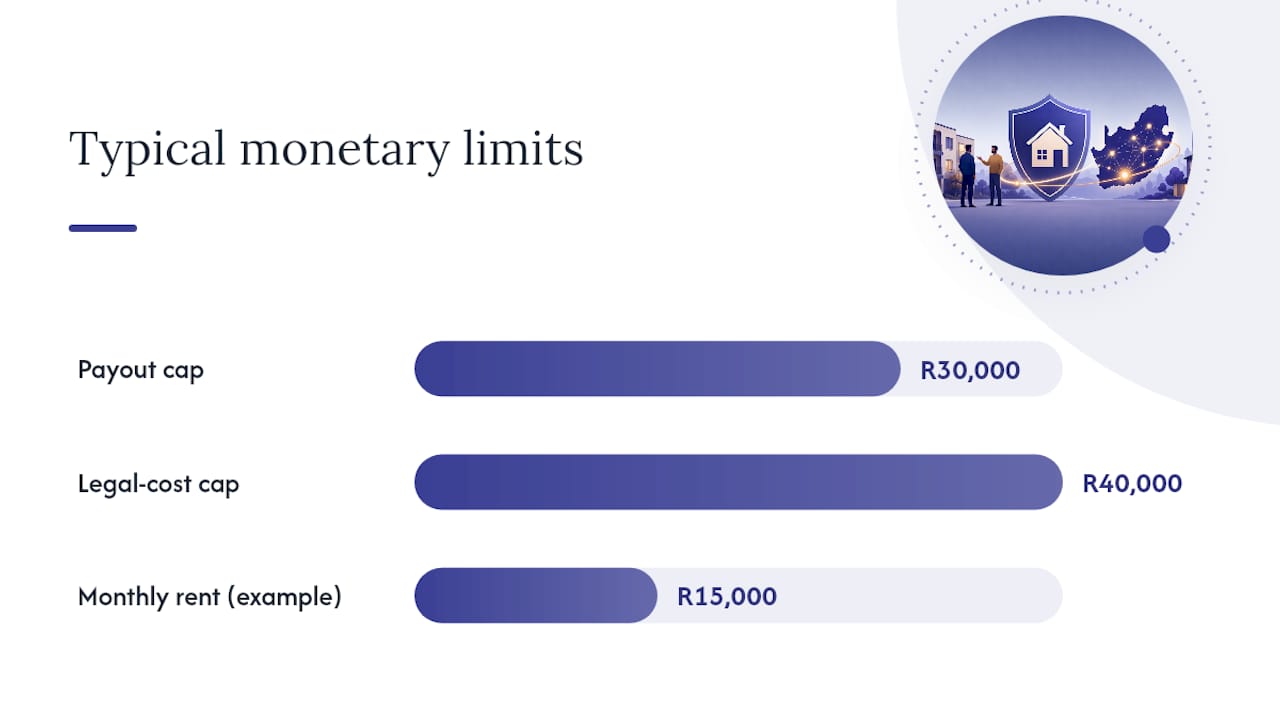
- Premium costs are generally small compared to potential losses from several months of unpaid rent, with typical payout caps up to R30,000 and eviction costs between R10,000 and R40,000.
- Renters liability insurance, often purchased separately, protects tenants from legal claims for injuries or property damage, but does not impact rental income or landlord liability.
Table of Contents
- What landlord rental income insurance covers
- How rental income insurance differs from loss-of-rent and tenant liability cover
- Who needs it and when to claim
- Typical limits, waiting periods and premium examples
- How to buy and set up cover: a checklist
- What renters liability insurance actually means
- What does renters liability cover actually pay for?
- Renters liability cover versus landlord liability cover
- Why this cover matters for renters
- How renters buy liability cover
- Treating rental income insurance as a cash-flow tool
- Get a tailored rental income insurance quote
- Sources
What landlord rental income insurance covers
Rental income insurance responds to the financial fallout of a tenant relationship going wrong, not the physical state of the property. That distinction shapes everything about how the policy pays out.
Cover typically includes:
- Tenant non-payment — missed rent once arrears reach a defined threshold, usually two consecutive months.
- Early lease termination — lost income when a tenant breaks the lease before the agreed end date.
- Absconding — where a tenant vacates without notice, leaving arrears and often damage behind.
- Eviction and legal costs — the legal fees and court costs of removing a non-paying tenant.
- Property damage tied to the same event — in some policies, damage discovered once a defaulting tenant has left.
Insurers generally require a valid, signed lease, proof of consecutive missed payments, and a formal letter of demand before a claim proceeds. Pre-existing arrears at the start of the policy, informal verbal tenancies, and certain excluded perils (such as tenants who were already in breach before cover began) are common exclusions worth reading carefully in the policy wording.
Picture a tenant who stops paying in month three of a twelve-month lease, ignores the demand letter, then disappears in month five. That sequence, non-payment followed by absconding, is precisely the scenario this cover is built to answer.
How rental income insurance differs from loss-of-rent and tenant liability cover
Landlords frequently confuse three separate products, and mixing them up means discovering the wrong policy at the exact moment you need it to pay out.
- Loss-of-rent cover responds when a physical event, fire, storm damage, burst pipes, makes the property genuinely uninhabitable. It replaces income while repairs happen. It does not respond to tenant non-payment, because the property itself remains perfectly liveable; the tenant has simply stopped paying.
- Rental income insurance (sometimes called rent guarantee cover) does the opposite. It pays when the tenant is the problem, non-payment, an early break, or an abscond, along with the legal costs of eviction, regardless of whether the building has a scratch on it.
- Tenant renters’ liability insurance sits on the other side of the lease entirely. It protects the tenant against claims for bodily injury or damage they cause to someone else. It has no bearing on a landlord’s rental income and is not covered further in this guide.
A quick test: if a burst geyser floods the flat and the tenant moves out temporarily, that’s loss-of-rent. If the tenant simply stops paying while living there quite happily, that’s rental income insurance.
Who needs it and when to claim
Rental income insurance earns its premium fastest for landlords whose finances have little slack. If a bond, levy, or rates bill depends on that rent arriving on the first of the month, one defaulting tenant can turn a manageable month into a crisis.
It’s particularly worth prioritising if you’re:
- A landlord using rental income to cover a mortgage or body corporate levies directly.
- A multi-unit owner where several simultaneous vacancies would strain cash flow.
- A property manager responsible for owners who expect consistent, predictable payouts.
- A real estate investor relying on rental yield as part of a portfolio return calculation.
Insurers generally trigger a claim from the second consecutive missed payment, once a letter of demand has been issued and, where eviction becomes necessary, once formal proceedings are under way. To support a claim, you’ll typically need the signed lease, a full rent payment history, copies of the demand letter and any follow-up correspondence, and the eviction case number if the matter has reached court.
Pro Tip: Keep a simple rent ledger from day one of every tenancy, even for tenants who’ve never missed a payment. If a claim ever becomes necessary, that ledger is the difference between a smooth payout and a drawn-out dispute over dates.
Cover is unlikely to help where the lease was never formalised, where arrears predate the policy’s start date, or where you can’t produce the paper trail insurers ask for. Rental income insurance rewards landlords who run their tenancies properly, not those hoping to insure a mess after the fact.
Typical limits, waiting periods and premium examples
**Premiums for rental income insurance in South Africa vary depending on the monthly rent and policy terms. On rent of R10,000, that works out to a modest monthly premium, a figure worth weighing against the alternative: several months of unpaid rent on the same property would cost you tens of thousands of rand, plus legal fees, before you’ve even found a new tenant.
Local policy examples tend to cluster around similar structures:
- Monthly payout caps of up to roughly R30,000, scaled to the insured rent amount.
- Time caps around three months of cover, reflecting typical eviction timelines in South Africa.
- Eviction and legal-cost cover ranging from about R10,000 to R40,000, depending on the policy and how far a matter proceeds through the courts.
Some policies also include a reimbursement mechanism: if arrears are later recovered from the tenant, through debt collection or a court order, the insurer may reclaim what it already paid you, so you’re never paid twice for the same loss.
The arithmetic worth doing before you buy: a property earning R15,000 a month could lose a significant amount over several months of non-payment, a real risk against a premium that, at a low percentage, amounts to a small fraction of monthly rent. Size your limits to your actual rent, not a rounded estimate, and check that the time cap realistically covers how long eviction takes in your province. Underinsuring the time element is the most common gap landlords discover too late.
How to buy and set up cover: a checklist
Getting this right takes less effort than most landlords expect, provided you go in with the right questions.
- Gather your paperwork first. A valid lease, tenant ID and vetting records, and a clean rent history all speed up underwriting and often improve your quoted premium.
- Ask about the excess and waiting period. Some policies impose a short waiting period before a new tenancy’s cover activates, so know exactly when protection actually starts.
- Confirm the caps in writing. Get the monthly payout limit, the total time limit, and the eviction legal-cost sub-limit spelled out, not just quoted verbally.
- Check exclusions line by line. Ask specifically about informal tenancies, pre-existing arrears, and any perils the policy carves out.
- Match the policy to your portfolio. A single-unit landlord might prioritise a lower excess; a multi-unit owner or property manager often benefits more from higher aggregate caps across several tenancies.
- Get more than one quote. Premium structures and sub-limits vary enough between insurers that comparing two or three quotes is worth the half hour it takes.
- Revisit the sum insured whenever rent changes. A policy sized to last year’s rent under-protects you the moment you raise it.
Pro Tip: Set a calendar reminder for each lease renewal to check your insured rent figure against the actual new rent. It’s a two-minute task that prevents a nasty surprise if you ever need to claim.
What renters liability insurance actually means
Renters liability insurance is a distinct product from rental income insurance, and it’s worth being precise about the difference so you buy the right one for your situation. It’s a policy tenants themselves take out, typically as part of a broader renters’ or contents policy, that protects them financially if they’re held legally responsible for injuring someone or damaging property that isn’t theirs while living in a rented home.
Think of it as the tenant’s safety net against their own accidents. If a tenant’s guest slips on a wet floor and sues, or if the tenant’s leaking washing machine floods the unit below, renters liability insurance is designed to cover the resulting legal claim and damages, up to the policy limit. It exists to protect the tenant’s personal finances, not the landlord’s rental income, and it sits entirely outside the scope of what a landlord’s rental income insurance is built to do.
For landlords, the practical relevance is limited but real: a tenant who carries this cover is generally a lower liability risk to have on your property, because a genuine accident is less likely to become a dispute over who pays. It has no bearing on whether your rent arrives on time, though, which is precisely the gap that rental income insurance is designed to close.
What does renters liability cover actually pay for?
The core of renters liability cover is bodily injury and property damage caused by the tenant, a member of their household, or sometimes their pets, within the rented property or occasionally beyond it.
Typical scenarios include a visitor injured by a hazard the tenant created, accidental damage the tenant causes to a neighbouring unit, or a dog on the property biting a guest. Cover generally extends to the legal defence costs of contesting a claim, not just the settlement itself, which matters because legal fees alone can outstrip the actual damages in a drawn-out dispute.
Policies commonly exclude intentional acts, business activities conducted from the rented home, and damage arising from the tenant’s own negligence toward the landlord’s property under a separate deposit or damage clause. The line between what the landlord’s deposit covers and what a tenant’s liability policy covers can blur, which is exactly why personal liability coverage tends to confuse both parties without a clear breakdown. Broader principles around how liability claims are assessed and defended, established in premises liability law, give useful background on how a legal claim over an accident typically unfolds, even though jurisdictions differ.
Renters liability cover versus landlord liability cover
The two policies protect two different people against two different risks, and confusing them is one of the more expensive mistakes either party can make.
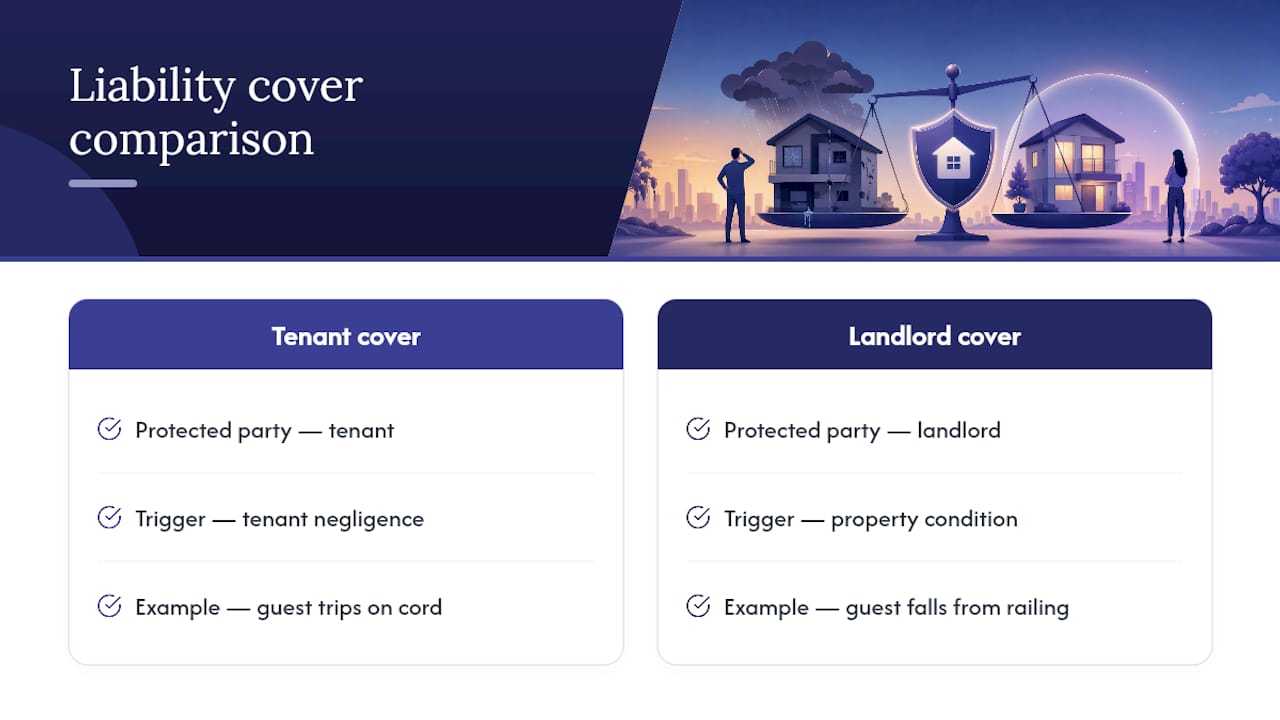
Renters liability insurance protects the tenant if they’re found responsible for injury or damage to a third party while living in the property. Landlord liability insurance, by contrast, protects the property owner if a claim arises from the physical condition of the building itself, a broken staircase, faulty wiring, or an unmarked hazard in a common area that the landlord was responsible for maintaining.
Put simply: if a guest trips over a tenant’s own extension cord, that’s typically the tenant’s liability exposure. If a guest falls because a stair railing the landlord never repaired gave way, that’s the landlord’s exposure. Both policies can run simultaneously on the same property without overlapping, because they cover different parties for different causes of harm. Landlords wanting the fuller picture on their own exposure can review landlord liability cover alongside their rental income protection, since the two are often bundled by insurers as complementary, not competing, products.
Why this cover matters for renters
For a tenant, a single liability claim without cover can be financially ruinous in a way that has nothing to do with their income level. Legal costs alone can run into the tens of thousands before a settlement is even discussed, and most tenants simply don’t have that sitting in a savings account.
There’s also a relationship dimension landlords quietly value. A tenant who carries liability cover is signalling a degree of financial seriousness that tends to correlate with lower-risk behaviour generally, fewer disputes, more reliable communication, and less friction when something does go wrong. It’s not a guarantee, but it’s a reasonable proxy landlords have long used informally when weighing one applicant against another.
For renters themselves, the appeal is straightforward: it converts an unpredictable, potentially six-figure legal exposure into a fixed, modest monthly cost. That trade, a small known amount against a large unknown one, is the entire logic behind insurance as a product, and it applies here just as it does to a landlord weighing rental income cover against months of lost rent.
How renters buy liability cover
Renters typically access liability cover in one of two ways: as a standalone policy, or bundled into a broader renters’ or contents insurance package that many insurers in South Africa offer alongside home contents cover.
Pricing depends on the coverage limit chosen, the tenant’s claims history, and sometimes the type of property they’re renting, a flat carries different risk factors to a freestanding house with a garden and a pool. Most insurers allow tenants to select their own liability limit, and higher limits cost more but close a larger gap in a worst-case claim.
The buying process itself is usually simple: get a quote from an insurer offering renters or contents cover, confirm the liability limit and any exclusions, and add it either as a standalone policy or a rider on an existing contents policy. It’s worth tenants checking whether a policy they already hold, through an employer, a vehicle insurer, or a family member’s household policy, already extends some liability protection to them before paying for a duplicate.
Treating rental income insurance as a cash-flow tool
The mistake most landlords make with rental income insurance is treating it as an afterthought rather than a budgeted line item. Once you frame the premium the same way you’d frame a maintenance reserve or a vacancy allowance, the decision becomes far less emotional and far more arithmetic.
Compare your realistic exposure, how many months of eviction delay is normal in your area, and what that costs at your actual rent, against what a year of premium payments would cost you. For most single-property landlords, that comparison tips firmly in favour of buying cover, because the downside scenario is disproportionate to the monthly outlay. Market analysis increasingly frames this as standard portfolio hygiene rather than an optional extra, and that shift in thinking is overdue. Providers like Rental Income Insurance build policies around exactly this cash-flow logic, which is worth exploring properly rather than assuming your existing buildings cover already handles it.
— Coert
Get a tailored rental income insurance quote
Certain providers give landlords a direct route to cover designed for tenant default events such as non-payment, early lease termination, absconding, and eviction legal costs, sometimes including an optional property-damage component.

Some policies offer flexible limits tailored to actual rent amounts, and legal support may be available as an add-on for landlords seeking assistance with eviction processes. If you’d like to see what that looks like against your own rent figure, you can request a tailored quote directly and get a clear answer on cost versus cover within days.
Sources
This guide draws on South African market reporting from FAnews and Insurance Biz, alongside ZABenefits on landlord cover and Vantage Point Risk on loss-of-rent distinctions. Landlords wanting more depth can review the full rental income protection guide before finalising a policy.
- Securing Your Investment: Why Rental Insurance is Essential in South Africa’s Recovering Property Market
- Property Rental Insurance: insuring rental income against risk of tenant default | Insurance Biz
- Loss of rents coverage, explained – Vantage Point Risk