
TL;DR:
- Periodic vacancy cover protects landlords from income loss during routine property vacancies between tenants. Most standard rental policies exclude this coverage, requiring landlords to request it separately and manage specific notification and documentation requirements. Proper understanding and proactive management of vacancy risks help landlords avoid costly claim rejections and unexpected financial shortfalls.
Periodic vacancy cover is insurance designed to protect a landlord’s rental income during periods when a property sits empty between tenants. Most landlords assume their standard rental income policy covers this gap. It does not. The Landlords Association of South Africa confirms that most rental income policies exclude income loss during routine tenant transitions, focusing instead on tenant defaults such as non-payment or early lease termination. Understanding periodic vacancy cover is the first step to closing that gap and protecting your investment properly.
What is periodic vacancy cover and how does it differ from standard rental income insurance?
Periodic vacancy cover is a specialised insurance product that compensates landlords for lost rental income during planned or unplanned vacancy periods between tenancies. The industry term for this type of protection is “vacancy loss endorsement,” and it sits in a distinct category from the more familiar rental income protection policies.

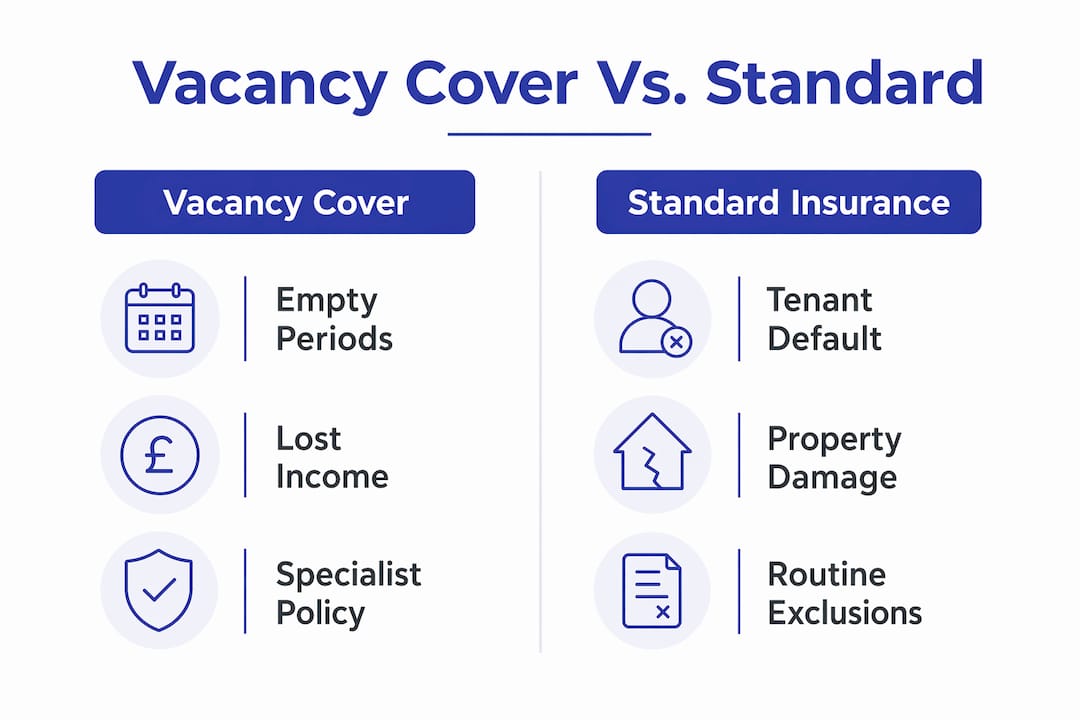
Standard rental income insurance is built around tenant behaviour. It pays out when a tenant stops paying rent, abandons the property, or terminates a lease early. What it does not cover is the income gap that occurs when one tenant leaves and the next has not yet moved in. That gap is precisely what periodic vacancy coverage addresses.
Loss of rent insurance triggered by property damage is another product landlords often confuse with vacancy cover. Loss of rent pays when a covered event, such as a fire or flood, renders the property uninhabitable. Vacancy cover pays when no damage has occurred at all. The property is simply empty. Landlords regularly mistake one for the other, which leads to denied claims and unexpected income shortfalls.
The table below shows the key differences at a glance.
| Cover type | What triggers a payout | Covers routine vacancy? |
|---|---|---|
| Tenant default insurance | Tenant non-payment or absconding | No |
| Loss of rent insurance | Property damage making unit uninhabitable | No |
| Periodic vacancy cover | Property empty between tenancies | Yes |
Vacancy loss protection is a niche insurance product that requires explicit negotiation with your insurer. It does not appear automatically on a standard landlord policy. You must request it, document it, and pay a separate premium for it.
Why is vacancy risk so significant for landlords in South Africa?
Vacant properties carry a risk profile that is fundamentally different from occupied ones. The moment a tenant leaves, the property becomes more vulnerable on multiple fronts, and your insurer knows it.
Vacant properties face increased threats of squatting, malicious stripping, and land invasion in South Africa. These are not theoretical risks. Copper piping, electrical fittings, and geysers are stripped from empty homes regularly. Squatters can establish legal rights that take months and significant legal costs to reverse.
“Landlords face a ‘Critical Danger Zone’ after 60 days of vacancy. At that point, the insurance risk profile shifts significantly, making claims harder to pursue and more expensive to settle.”
Mzansi Baze Insurance Commentary
Insurance companies treat properties vacant for longer than 60 days as higher risk, often adjusting coverage terms or requiring formal notification. This means the excess on any claim can increase sharply, and certain perils may no longer be covered at all. Claims related to vacancy can trigger an additional penalty excess of R5,000 to R10,000 on top of the standard excess. That surcharge alone can wipe out the benefit of a smaller claim entirely.
The financial logic is straightforward. A property sitting empty for two months costs you rental income. If something goes wrong during that period and your claim is rejected or heavily penalised, the loss compounds quickly. Periodic vacancy protection addresses both sides of that equation.
How to obtain periodic vacancy cover: policies, endorsements, and requirements
Securing vacancy cover requires more than a phone call to your broker. It involves understanding your existing policy, communicating proactively, and meeting specific compliance requirements.
-
Review your current policy wording. Look for clauses defining “unoccupied” and “vacant.” Insurers treat these differently. An unoccupied property still contains furniture and the owner intends to return. A vacant property is stripped of contents and in a transition or renovation period. The classification affects your cover and your obligations.
-
Notify your insurer promptly. Landlords must notify insurers about unoccupied or vacant status within specific time frames, often 30–60 days. Failure to notify can lead to claim denials or policy restrictions. Do not wait until you have a new tenant lined up. Notify as soon as the previous tenant vacates.
-
Request a vacancy endorsement explicitly. Ask your insurer or broker to add a vacancy loss endorsement to your policy. Vacancy cover endorsements require separate premium evaluations and may raise your policy cost due to increased risk exposure. Get the cost in writing and compare it against the rental income you stand to lose.
-
Maintain your tenant vetting records. Insurers require proof of screening for claims to be valid. Even with vacancy cover in place, a claim can be challenged if you cannot demonstrate that you followed a proper tenant selection process for the previous tenancy. Keep credit checks, employment verifications, and reference records on file.
-
Understand the cost-benefit calculation. Weigh the additional premium against your average vacancy period and monthly rental income. If your property typically sits empty for six to eight weeks between tenants, the maths usually favours taking the cover.
Pro Tip: Notify your insurer the day your tenant gives notice, not the day they leave. Early notification protects your coverage from the first day of vacancy and avoids any dispute about when the clock started.
For a full breakdown of how the rental insurance claim process works in South Africa, including what documentation you need to submit, Rentalincomeinsurance provides a detailed guide on its website.
What are the common pitfalls landlords make with vacancy cover?
Misunderstanding vacancy cover is expensive. The mistakes landlords make most often are predictable, and each one has a direct financial consequence.
-
Assuming standard policies cover vacancy losses. They do not. Confusing these products is a common reason for ineffective coverage. A standard landlord policy protects the building and, in some cases, tenant default. It does not compensate you for an empty property.
-
Conflating tenant default cover with vacancy protection. Tenant default insurance pays when a tenant is present but not paying. Vacancy cover pays when no tenant is present at all. These are separate products addressing separate risks.
-
Missing the notification window. Many landlords discover too late that their policy required notification within 30 days of vacancy. A claim submitted after that window is frequently rejected in full. The insurer is not being unreasonable. The policy terms were simply not followed.
-
Ignoring the unoccupied excess. Claims on vacant properties often trigger a unique “unoccupied excess” in addition to the standard excess. Landlords who do not account for this can find that a claim for R15,000 in malicious damage nets them far less than expected after both excesses are applied.
-
Overlooking the impact on other cover sections. Once a property is classified as vacant, some insurers restrict or suspend cover for theft, glass breakage, and liability. Check which sections of your policy remain active during a vacancy period.
Pro Tip: Read your policy’s definition of “vacant” before your next tenant moves out. If the definition is unclear, ask your broker to clarify it in writing. That written confirmation can be critical if a claim is ever disputed.
Understanding the full scope of rental income protection exclusions helps landlords identify gaps before they become costly surprises.
Key takeaways
Periodic vacancy cover is a distinct, specialist product that fills the income gap standard rental policies leave open during empty periods between tenancies.
| Point | Details |
|---|---|
| Definition is specific | Periodic vacancy cover compensates for lost rental income when a property is empty between tenants. |
| Standard policies exclude it | Most rental income policies cover tenant defaults, not routine vacancies between leases. |
| The 60-day threshold matters | Properties vacant beyond 60 days face higher excesses and potential coverage restrictions from insurers. |
| Notification is non-negotiable | Landlords must inform their insurer within 30–60 days of vacancy to maintain valid cover. |
| Vetting records protect claims | Insurers require proof of tenant screening; without it, claims can be challenged even with vacancy cover in place. |
Why I think landlords underestimate vacancy risk more than any other threat
I have spoken with landlords who spent years worrying about non-paying tenants, only to suffer their biggest financial loss during a six-week vacancy they thought was covered. The pattern is consistent. Landlords invest time in understanding tenant default insurance because the threat feels personal. A bad tenant is a visible problem. An empty property feels temporary and manageable.
The reality is that a vacant property is often the more dangerous situation from an insurance perspective. The risk of physical damage is higher, the income loss is immediate, and the policy gaps are wider. Most landlords I encounter have never read the vacancy clause in their policy. They find out what it says when a claim is denied.
My view is that vacancy cover should be the first endorsement a landlord adds to their policy, not an afterthought. The cost is modest relative to even one month of lost rental income. The alternative is self-insuring a risk that compounds quickly when something goes wrong during the empty period.
Combining vacancy cover with thorough tenant screening practices is the most effective approach I have seen. Good screening reduces vacancy duration. Vacancy cover protects the income while the next tenant is found. Together, they address the full cycle of risk between tenancies.
The landlords who manage this well treat vacancy as a scheduled event, not an emergency. They notify their insurer when notice is given, not when the keys are handed back. They have the endorsement already in place. They know their excess. That preparation is what separates a manageable vacancy from a costly one.
— Coert
How Rentalincomeinsurance supports landlords during vacancy periods
Rentalincomeinsurance is built specifically for South African landlords who need income protection that goes beyond standard building cover.

Whether your property is between tenants for a few weeks or a few months, Rentalincomeinsurance offers cover options tailored to the realities of the South African rental market. The team understands that vacancy periods are a normal part of property ownership, and that landlords deserve protection during those gaps, not just when tenants default. From customised vacancy endorsements to comprehensive rental income protection, the cover is designed to match your specific risk profile. Request a personalised quote today and find out exactly what your property needs to stay protected between tenancies.
FAQ
What is periodic vacancy cover in simple terms?
Periodic vacancy cover is insurance that pays a landlord for lost rental income when a property is empty between tenants. It is a specialist product separate from standard rental income or tenant default insurance.
Does standard rental insurance cover vacancy periods?
No. Most standard rental income policies in South Africa exclude routine vacancy losses and focus on tenant-related defaults such as non-payment or early lease termination.
How long can a property be vacant before insurance is affected?
Insurers typically treat properties vacant for more than 60 days as higher risk, which can trigger increased excesses, coverage restrictions, or a requirement to notify the insurer formally.
What happens if I do not notify my insurer about a vacancy?
Failure to notify your insurer within the required time frame, often 30–60 days, can result in claim denials or policy restrictions. Always notify your insurer as soon as a tenant gives notice.
Is periodic vacancy cover the same as loss of rent insurance?
No. Loss of rent insurance pays when property damage makes a unit uninhabitable. Periodic vacancy cover pays when the property is simply empty between tenants, with no damage required to trigger a claim.
Recommended
- Landlord obligations explained: South Africa guide – Rental Income Insurance
- 7 Essential Landlord Coverage Options List for South Africans
- Rental void periods explained: maximise income protection – Rental Income Insurance
- Policy Waiting Periods – Impact On Landlords’ Cover – Rental Income Insurance