
Property damage cover under a landlord policy pays for physical damage to your rental property caused by tenants, insured perils, or malicious acts, so you don’t carry those repair costs alone. For most South African landlords, this sits inside a broader rental income insurance package alongside protection for tenant non-payment, early lease termination, and absconding.
You should expect this cover to respond when a tenant causes accidental or deliberate damage, when a covered peril (like a burst pipe or fire) hits the structure, or when a tenant absconds and leaves damage behind. It typically won’t respond to gradual wear and tear, or to a tenant’s own furniture and belongings.
- Loss of rent, sometimes called loss-of-use, replaces rental income while repairs happen.
- Rental Income Insurance bundles property damage with cover for non-payment and lease breaks.
- Civil authority coverage can even pay out when your property isn’t damaged but access is blocked by an official order.
Key Takeaways
Property damage cover pays for tenant-caused or peril-related harm to a rental property, and it works best paired with loss-of-rent and legal cost protection rather than bought alone.
| Point | Details |
|---|---|
| Definition matters | Property damage cover for landlords pays for damage to the structure, not tenant belongings or normal wear. |
| Document everything early | Dated photos, a move-in inventory, and quotes within 48 hours strengthen every claim. |
| Watch the exclusions | Flood, earthquake, wear and tear, and tenant possessions typically fall outside standard cover. |
| Pair it with income protection | Loss-of-rent and legal cost add-ons close the gap that repair-only cover leaves open. |
| Choose a bundled policy | Rentalincomeinsurance combines property damage, non-payment, and lease termination cover in one policy. |
Table of Contents
- How does property damage cover differ from other landlord insurance?
- What damage scenarios does property damage cover include?
- What’s excluded from property damage cover?
- How does this connect to rental income and legal costs?
- How do you file a property damage claim?
- What should you check before choosing your cover amount?
- How can landlords reduce damage and lower premiums?
- Why do people search for “property damage liability” and mean something else?
- What typically causes landlord property damage claims?
- Are there exclusions specific to this type of cover?
- How does this cover interact with other parts of a landlord’s policy?
- What do policy limits actually mean for you as the insured?
- What does the claims process look like step by step?
- Why we built this cover around real landlord mistakes
- Get cover that protects your rental income and your property
- Frequently asked questions
- Sources
How does property damage cover differ from other landlord insurance?
Landlords often confuse property damage cover with building insurance, contents cover, and premises liability, but each does a distinct job. Building insurance pays for the physical structure and fixed features like garages, pools, and gates, and it can include lost rental income while repairs are under way. Landlord contents cover protects items you, the owner, supply (a stove, blinds, built-in cupboards), not anything the tenant brings in. Premises liability pays legal costs and settlements when someone is injured on your property. Property damage cover, as part of a rental income policy, specifically targets harm the tenant or an incident causes to your property during the tenancy.
Consider two scenarios. A geyser bursts and floods the ceiling below: that’s a building insurance claim. A tenant’s guest smashes a bathroom door during a party, and the tenant vacates before paying for it: that’s a property damage and potential loss-of-rent claim.
| Cover type | What it typically pays for |
|---|---|
| Building insurance | Structural damage, fixed features, some loss-of-rent |
| Landlord contents | Owner-supplied appliances and furnishings |
| Premises liability | Injury claims and legal defence on the property |
Check your policy wording for overlaps. Many landlords double up on building cover and rental income cover without realising the loss-of-rent triggers differ between them.
What damage scenarios does property damage cover include?
Most claims fall into a handful of recognisable patterns. Knowing them helps you spot a valid claim quickly and gather the right evidence from day one.
- Damage from a tenant party or gathering (broken doors, damaged flooring, stained carpets).
- Deliberate vandalism by a tenant or their guests before moving out.
- Accidental but severe damage, such as a bath overflow that ruins flooring and ceilings below.
- Damage discovered only after a tenant absconds, often combined with unpaid rent.
A typical case runs like this: a tenant absconds owing two months’ rent, and the inspection reveals a broken window, damaged kitchen cabinetry, and a stained carpet needing full replacement. The landlord photographs everything within 48 hours, submits quotes from two contractors, and the insurer approves the repair claim alongside a separate loss-of-rent claim for the vacant period.
Damage that forces a tenant to vacate, or that’s discovered after they’ve already gone, is one of the clearest triggers for a loss-of-rent payment. Damage found while the tenant is still paying and living there usually only triggers the repair cost, not the income replacement.
That distinction shapes how you document a claim: capture not just the damage but the occupancy status at the time.
What’s excluded from property damage cover?
Exclusions catch out more landlords than any other part of the policy, mostly because they assume “damage” means everything, and it doesn’t. Standard exclusions typically include:
- Wear and tear or gradual deterioration (worn carpets, ageing paintwork, tired appliances).
- Tenant-owned personal belongings, since those need the tenant’s own contents cover.
- Flood and earthquake damage, which usually requires a separate policy.
- Punitive or exemplary damages awarded beyond actual repair costs.
Limits and sub-limits matter just as much as exclusions. Your declared property value sets the ceiling for a total loss claim, and many policies apply sub-limits to specific perils, such as a cap on malicious damage claims separate from the main structural limit. Excess (the amount you pay before the insurer contributes) works on a sliding scale in practice: a small claim, say a broken door, might cost you more in excess than the repair is worth, while a catastrophic claim makes the excess almost irrelevant against the total payout. Understanding your coverage limits before a claim arises avoids an unpleasant surprise at settlement.
How does this connect to rental income and legal costs?
Property damage and rental income protection are two sides of the same coin. Damage that makes a unit temporarily uninhabitable is exactly when loss of rent matters most, since it replaces fair rental value while repairs happen, subject to waiting periods and payout limits set in your policy.
Legal and eviction costs sit as a related but separate line. When a tenant causes damage and refuses to pay, or has to be evicted, liability sections of landlord policies can cover legal defence and associated fees, usually capped at a set amount per claim.
A realistic timeline looks like this:
- Week 1: Damage discovered; landlord notifies insurer and begins documentation.
- Weeks 2 to 4: Eviction or lease termination process begins if the tenant hasn’t vacated.
- Weeks 4 to 8: Repairs quoted and carried out; loss-of-rent payments begin after the waiting period.
- Week 8 onwards: Insurer settles the repair claim and rental income resumes once a new tenant is in place.
- Loss-of-rent cover typically has a maximum payout period, so check that figure before assuming full protection.
- Legal fee add-ons often need to be selected upfront; they’re rarely automatic on a basic policy.
For a fuller breakdown of how eviction and lease termination timelines work, our lease termination guide walks through the process step by step.
How do you file a property damage claim?
A property damage claim moves faster when you treat the first 48 hours as the most important part of the process, not an afterthought.
- Mitigate immediately. Stop further damage (shut off water, secure broken entry points) and note the time you did so.
- Notify your insurer promptly. Delays are one of the most common reasons claims get disputed or delayed.
- Gather evidence. Photograph everything, including angles that show scale and context.
- Get repair quotes. Two independent quotes strengthen your position during assessment.
- Follow up with the adjuster. Confirm receipt of your documents and ask for a timeline.
Your evidence checklist should include:
- Dated photos and, ideally, video of the damage.
- A move-in inventory for comparison.
- Tenant correspondence, especially anything acknowledging the damage.
- Repair invoices or quotes.
- A police report for malicious damage or vandalism cases.
Avoid these common mistakes: notifying the insurer late, submitting vague or undated photos, and admitting fault or negotiating directly with the tenant before the insurer has assessed the claim. Our detailed claims process guide covers each step with printable checklists.
What should you check before choosing your cover amount?
Getting your limits right up front saves you from underinsurance at the worst possible moment. Work through this before signing anything:
- Set a realistic declared value for the structure and any owner-supplied fittings, not a guess.
- Choose a loss-of-rent period that reflects how long local repairs and re-letting realistically take.
- Consider legal expenses cover as an add-on rather than assuming it’s included.
- Check sub-limits for specific perils like malicious damage or absconding-related claims.
Ask your insurer directly: What exactly triggers loss-of-rent? Is there a waiting period? What’s the maximum payout duration? What evidence do you require for eviction-related legal costs? A landlord policy built for one to four units differs from a commercial multi-unit product, so match the policy type to your portfolio.
Pro Tip: A higher excess usually means a lower premium, but only accept it if you could comfortably cover that excess out of pocket on a bad month, not just in theory.
How can landlords reduce damage and lower premiums?
Prevention doesn’t just cut your claim frequency; insurers reward a clean claims history with better renewal terms.
- Take a thorough inventory with photos at move-in, and repeat it at move-out.
- Run proper tenant reference and affordability checks before signing a lease.
- Schedule regular property inspections, ideally quarterly, with notice given per your lease terms.
- Add clear lease clauses on reporting damage promptly and who covers minor repairs.
- Install basic physical safeguards: secure gates, working smoke detectors, and CCTV in common areas where privacy law allows.
Pro Tip: Word your lease so the deposit can be applied directly to minor damage without a dispute, and keep a signed move-in inventory. It turns a messy claim into a straightforward one.
Our prevention checklist expands on each of these with practical detail.
Why do people search for “property damage liability” and mean something else?
Search results for “property damage liability” mostly point towards motor insurance, where it describes the part of a driver’s cover that pays for damage to someone else’s vehicle or property after an accident they caused. That’s a genuinely different product, built for a different risk (driving), aimed at a different buyer (a car owner, not a property owner).
For landlords, the phrase means something else entirely: liability and cover tied to damage that happens to your rental property, not damage your vehicle causes to someone else’s. The confusion is understandable given how similar the wording sounds, but the products, the triggers, and the claims process have nothing in common beyond the name. If you’re a landlord who typed this phrase into a search engine, your actual concern is almost certainly what happens when a tenant, an incident, or an insured peril damages the property you own and rent out, and how your policy responds to that.
That’s the definition this article has covered throughout: a landlord-focused property damage cover, embedded within rental income protection, that addresses tenant-caused damage, vandalism, and peril-related loss to the structure and fittings you’re responsible for.
What typically causes landlord property damage claims?
The most frequent claims landlords file don’t come from dramatic events. They come from ordinary tenancy friction that escalates.
Common causes include tenant parties that get out of hand, appliance misuse (a washing machine overflow left unattended), pet damage to flooring and doors, and deliberate damage during a dispute or right before a tenant absconds. Fires caused by unattended cooking or faulty tenant-owned appliances also feature regularly, though the appliance itself typically isn’t covered if it belongs to the tenant.

Absconding cases deserve particular attention because they combine two problems at once: unpaid rent and undiscovered damage. A landlord often only finds the damage during the final inspection, weeks after the tenant has already gone, which is why a documented move-in inventory matters so much for proving the property’s prior condition.
Are there exclusions specific to this type of cover?
Yes, and they mirror the exclusions in broader landlord policies but with a sharper focus on tenancy-related situations. Damage caused by ongoing neglect rather than a single incident (a slow leak ignored for months) usually falls under wear and tear, not a valid claim. Cosmetic damage from normal living, scuffed walls or worn flooring after a long tenancy, is excluded for the same reason.
Damage the landlord could have prevented through basic maintenance, such as a known faulty pipe never repaired, can also be declined. Some policies limit payouts for damage tied to illegal activity conducted by the tenant on the premises, and most exclude any damage happening after a lease has formally ended and the property has been handed back, since that shifts into a different risk category entirely.
How does this cover interact with other parts of a landlord’s policy?
Property damage cover rarely works in isolation. It sits alongside building insurance, premises liability, and loss-of-rent cover, and the boundaries between them determine which one actually pays.
Building insurance and property damage cover can overlap when the damage affects both fixed structure and tenant-caused elements, which is why checking your policy wording for how claims are apportioned matters. Premises liability, by contrast, protects you when someone else is injured or their property is harmed because of your building’s condition, an entirely separate trigger from tenant-caused internal damage. Loss-of-rent cover activates once the property damage claim confirms the unit is uninhabitable, effectively picking up where the repair claim leaves off.
An umbrella policy can extend liability limits beyond your primary policy’s cap, which matters if a single incident triggers both a large property damage claim and a liability claim from an injured third party on the same premises.
What do policy limits actually mean for you as the insured?
A policy limit is the maximum amount the insurer will pay for a covered claim, and it’s set by your declared property value along with any sub-limits attached to specific perils. If your declared value is too low, you risk being underinsured; a full rebuild after serious fire or storm damage could cost more than your payout covers.
Sub-limits complicate this further. A policy might carry a high overall limit but cap malicious damage or absconding-related claims at a much lower figure within that total. Reviewing how coverage limits work before you need to claim avoids discovering a shortfall mid-crisis. Your excess also interacts with the limit: a smaller claim close to your excess amount might not be worth filing at all, while a claim well above the limit still leaves you covering the difference yourself.
What does the claims process look like step by step?
The mechanics mirror the general claims process for landlord property damage, but with a few details worth restating in this context. Notify your insurer as soon as damage is discovered, ideally within 48 hours, and avoid making repairs before the insurer has had a chance to assess unless mitigation is urgent.
Documentation carries the claim. Photograph the damage from multiple angles, retain any tenant correspondence acknowledging responsibility, and secure at least two independent repair quotes. If the damage involves vandalism or theft, a police report strengthens your position considerably.
Timelines vary by insurer and claim complexity, but most straightforward property damage claims move from notification to settlement within a few weeks once documentation is complete. Claims involving disputes with the tenant, or tied to an ongoing eviction, typically take longer because settlement may wait on the legal process resolving first. Our property damage liability page sets out localised examples of how these timelines typically play out for South African landlords.
Why we built this cover around real landlord mistakes
We see the same pattern repeatedly: landlords assume “insurance” covers everything, then discover mid-claim that tenant belongings, wear and tear, or unrecorded pre-existing damage fall outside their policy. That gap is exactly why Rentalincomeinsurance treats property damage as one part of a connected package with rental income and legal cost protection, not a standalone afterthought.
Watch a short walkthrough here:
For the full local detail, see our property damage liability page.
Get cover that protects your rental income and your property
Rentalincomeinsurance packages property damage cover together with protection against tenant non-payment, early lease termination, and absconding, so you’re not stitching together separate policies to close the gaps.

That matters because most standalone building policies leave rental income and legal costs as someone else’s problem. Our approach covers the full financial impact of a bad tenancy: the repair bill, the lost rent while you fix it, and the legal costs if eviction becomes necessary.
A typical policy covers:
- Property damage caused by tenants or insured perils.
- Loss of rental income during repairs or after a tenant absconds.
- Legal and eviction cost support, subject to policy limits.
Support is local, and our claims guidance walks you through exactly what evidence to gather before you file. If you’re ready to see what cover would cost for your property, request a quote and get a policy summary tailored to your portfolio.
Frequently asked questions
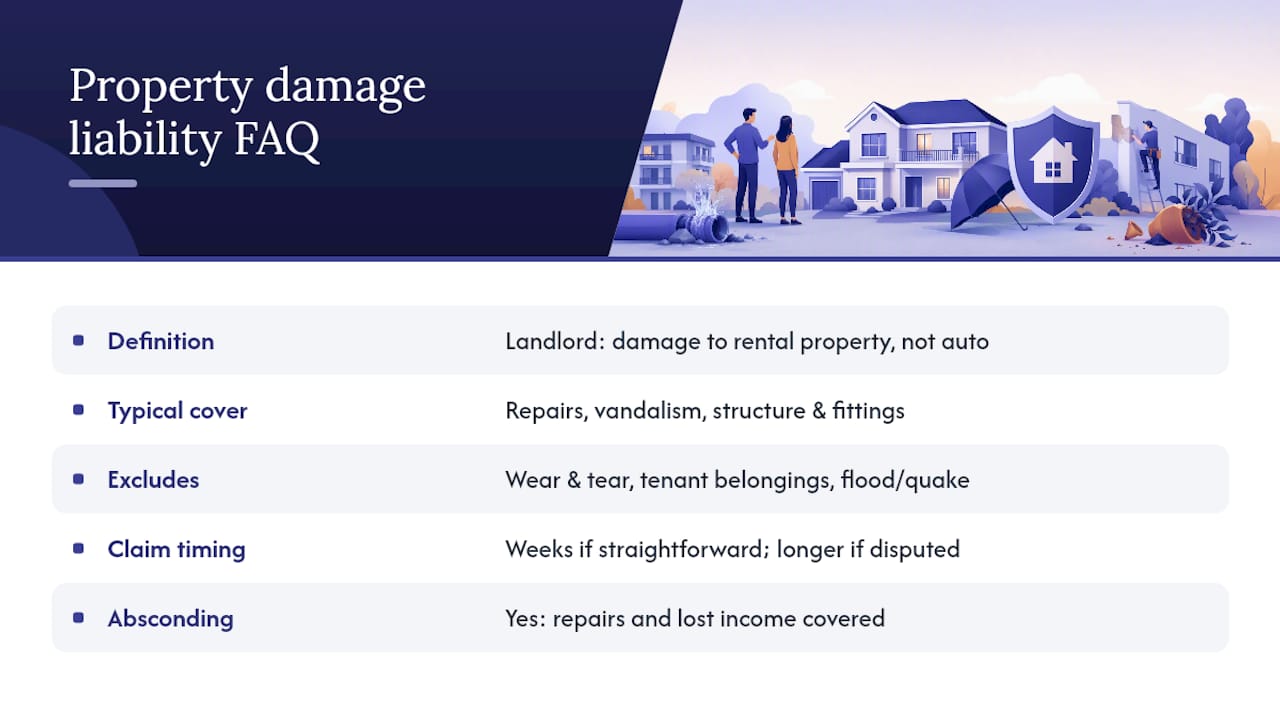
What is property damage liability in auto insurance, and does it apply to landlords?
For landlords, “property damage liability” refers to cover for damage tenants or insured perils cause to your rental property, not motor insurance. The auto insurance version of this phrase covers a driver’s liability for damage to someone else’s vehicle, which is a separate product entirely.
What does property damage cover typically include for a rental property?
It typically covers repair costs for tenant-caused damage, vandalism, and peril-related harm to the structure and owner-supplied fittings, often alongside loss-of-rent if the damage makes the unit uninhabitable.
What does property damage cover exclude?
Standard exclusions include wear and tear, tenant-owned belongings, and perils like flood or earthquake that usually need separate policies.
How long does a property damage claim take to settle?
Straightforward claims with complete documentation often settle within a few weeks; claims involving disputes or an active eviction process usually take longer.
Can property damage cover help if a tenant absconds?
Yes. Absconding often combines unpaid rent with undiscovered damage, and a bundled policy like Rentalincomeinsurance’s can address both the repair cost and the lost income together.
This article is general information, not a substitute for advice from a qualified financial advisor. Consult a qualified financial professional about your own circumstances before acting on anything here.
Sources
- Building & home contents insurance for rented property – Dialdirect
- Landlord Insurance for Rental Properties | Travelers Insurance
- Quote