
TL;DR:
- Property portfolio insurance consolidates multiple rental properties into one policy, reducing administrative burden and potentially lowering premiums. It provides comprehensive coverage, including buildings, liability, and loss of rent, with flexible optional extensions tailored to specific risks. Regular review and accurate property valuations are essential to ensure the program aligns with your evolving rental portfolio.
Property portfolio insurance is a single coordinated insurance programme that covers multiple residential, commercial, or mixed-use properties under one policy, replacing the need for separate landlord policies on each address. Rather than managing a stack of individual renewals, you consolidate your entire rental portfolio into one unified arrangement. Brokers such as Alan Boswell and insurers like Insure24 have built specific products around this need. The result is fewer administrative headaches, lower per-door premiums in many cases, and a clearer picture of your total risk exposure. For any landlord holding more than two or three properties, this structure deserves serious consideration.
What is property portfolio insurance and what does it cover?
Property portfolio insurance is defined as a master insurance programme that treats your collection of rental properties as a single insurable entity rather than a series of unrelated risks. The core of any policy starts with buildings insurance, which protects your structures against fire, flood, storms, vandalism, and accidental damage. That foundation matters because a single major weather event can affect multiple properties in your portfolio simultaneously.

Beyond the structure itself, a well-constructed programme includes property owners’ liability, which covers you if a tenant or visitor is injured on your premises and pursues a claim. Legal expenses cover is typically bundled alongside this, paying for defence costs that can otherwise run into tens of thousands of pounds. Loss of rent cover extends that protection further by maintaining your cash flow during repair periods, and some policies also cover alternative accommodation costs for displaced tenants.
The optional extensions are where portfolio insurance becomes genuinely flexible. Depending on your portfolio’s profile, you can add:
- Rent guarantee insurance covering tenant non-payment and early lease termination
- Terrorism cover for properties in higher-risk urban locations
- Directors and officers (D&O) insurance for landlords operating through a limited company
- Cyber liability cover for landlords using digital property management platforms
- Legal expenses extensions covering eviction proceedings and rent arrears disputes
Policies can cover mixed residential and commercial assets with flexible, customisable programmes, which is particularly useful if your portfolio includes a mix of buy-to-let flats, commercial units, and holiday lets. The key distinction from financial portfolio insurance is worth stating clearly: property portfolio insurance protects physical bricks-and-mortar assets, not stock market positions. Confusing the two leads landlords to misunderstand what they are actually buying.
Pro Tip: When requesting a quote, ask your broker to itemise the optional extensions separately. This lets you compare the cost of adding rent guarantee cover against buying a standalone rental income protection policy, so you choose the structure that genuinely fits your cash flow risk.
How does portfolio insurance differ from standard landlord cover?
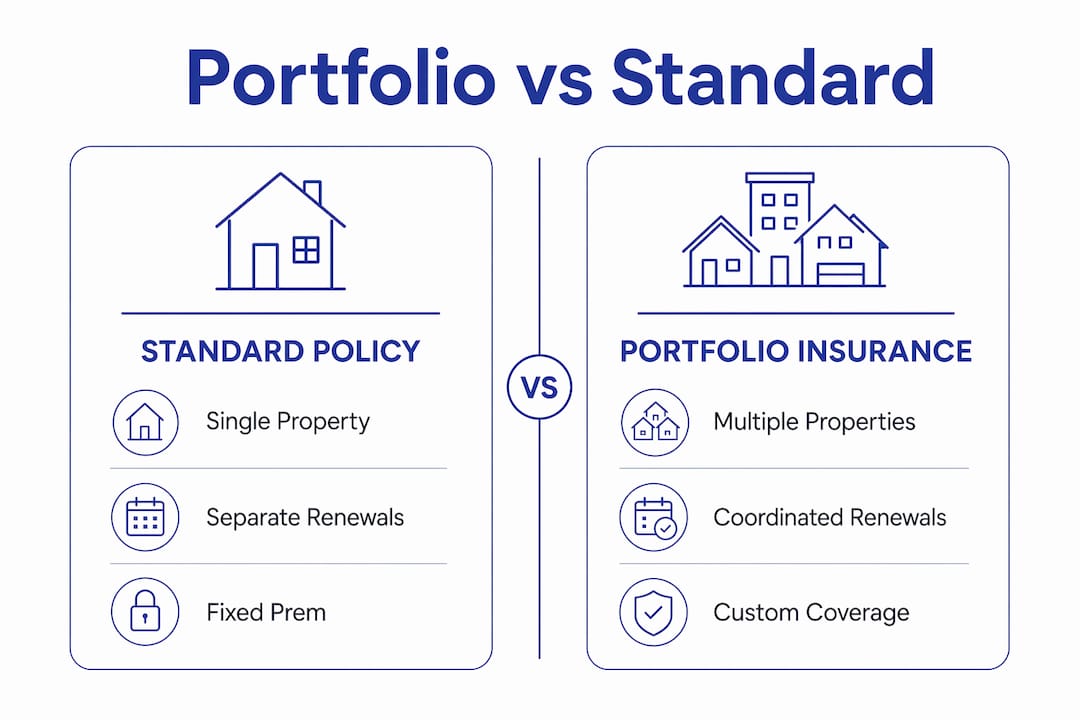
Standard landlord insurance covers one property under one policy with its own renewal date, schedule, and premium. Portfolio programmes reduce per-door premiums and simplify administration by placing every property on a single document with a single renewal date. That difference sounds administrative, but the practical impact on your time and cost is substantial.
The table below summarises the key distinctions:
| Feature | Standard landlord policy | Property portfolio programme |
|---|---|---|
| Number of properties | One per policy | Multiple under one programme |
| Renewal management | Separate dates per property | Single annual renewal |
| Premium structure | Individual risk rating | Aggregated underwriting |
| Bespoke endorsements | Limited | Available for complex portfolios |
| Claims management | Property by property | Unified across portfolio |
| Market capacity | Standard retail market | Access to layered/shared programmes |
The aggregated underwriting point deserves elaboration. When an insurer prices a single buy-to-let flat, they assess that one risk in isolation. When they price a portfolio of twenty properties across different locations and construction types, they can spread their exposure. That diversification often translates into a lower average premium per property, particularly for landlords with geographically spread assets.
Portfolio insurance allows bespoke endorsements and manuscript terms that are simply unavailable in off-the-shelf retail policies. An experienced investor can negotiate unique liability thresholds or tailored cover for a listed building sitting alongside modern new-builds in the same programme. That flexibility is not available when you are buying individual policies through a comparison website.
The limitation worth acknowledging is that portfolio programmes can be harder to exit mid-term. If you sell a property, removing it from the schedule is straightforward, but switching insurers before renewal may carry penalties. Individual policies offer more flexibility on that front.
Pro Tip: Request a full Schedule of Values (SOV) from your broker before consolidating. This document lists every property, its rebuild value, and its individual risk characteristics. Without it, you cannot accurately compare the cost of your current individual policies against a portfolio programme.
How is portfolio insurance tailored to diverse rental portfolios?
No two landlord portfolios are identical, and the best portfolio insurance programmes reflect that reality. The risk profile of a portfolio containing student lets in a city centre differs enormously from one holding rural holiday cottages and commercial retail units. Insurers account for this through a combination of location data, construction type, tenant demographics, and claims history.
The Schedule of Values is the backbone of this tailoring process. It captures the rebuild cost of every property, not the market value, and this distinction matters enormously. Underinsuring a property because you used its sale price rather than its rebuild cost leaves you exposed to a shortfall in the event of a total loss. Accurate valuations, reviewed annually, protect you from that gap.
Customisation options within a portfolio programme typically include:
- Residential and commercial mixed-use cover on a single schedule
- Holiday let extensions covering short-term tenancy gaps and higher wear rates
- Unoccupancy clauses adjusted to reflect realistic void periods between tenants
- Flood risk endorsements for properties in higher-risk postcodes
- Heritage property clauses covering listed buildings with specialist rebuild requirements
Policies adapt for mixed residential and commercial portfolios, which is critical for landlords who have diversified beyond pure residential buy-to-let. The broker’s role here is not simply to find the cheapest quote. A good broker analyses your portfolio composition, identifies concentration risks (such as five properties on the same street), and structures the programme to address those specific vulnerabilities.
Multi-carrier, layered programmes increase market capacity and reduce volatility at renewal, which is particularly valuable for large portfolios where a single insurer might not be willing to carry the full exposure. In a layered structure, multiple insurers each cover a defined layer of loss, which distributes the risk and keeps the programme competitive even in harder insurance markets.
What are the practical benefits and challenges of portfolio insurance?
The operational benefits of consolidating your portfolio under one programme are concrete and measurable. Here is how they play out in practice:
- Single renewal date. You manage one diary entry, one set of documents, and one negotiation per year rather than tracking multiple renewal dates across different insurers.
- Unified claims management. When a storm damages three of your properties simultaneously, you make one call to one insurer rather than managing three separate claims processes.
- Consistent risk control standards. Your insurer has an interest in the health of your entire portfolio, which encourages proactive risk management advice rather than reactive claims handling.
- Strategic risk alignment. Treating the portfolio as a whole for funding and claims control allows you to align your risk appetite with your insurer’s, creating a more collaborative relationship.
- Access to institutional market capacity. Master programmes help institutional owners access market capacity as standard carriers limit individual risks, which is particularly relevant as portfolios grow beyond ten or fifteen properties.
The challenges are real and should not be glossed over. Insurance costs rose substantially between 2017 and 2024, increasing scrutiny on programme effectiveness. A portfolio programme that made financial sense in 2019 may need restructuring today. Premium fluctuations in hard markets can be sharper for portfolio programmes than for individual policies, particularly if your portfolio has a poor claims history.
Complex underwriting also means longer lead times. A broker placing a twenty-property mixed-use portfolio with a specialist insurer needs more time than someone buying a single-property policy online. Plan for a minimum of four to six weeks before your renewal date when restructuring a portfolio programme.
Pro Tip: Review your portfolio programme every year, not just at renewal. If you have added properties, sold others, or changed tenant types, your existing programme may no longer reflect your actual risk. An out-of-date schedule can leave new acquisitions uninsured or result in premium overcharges on properties you no longer own.
Is portfolio insurance the right choice for your rental strategy?
The decision to consolidate comes down to four practical questions. First, how many properties do you hold? Most brokers and insurers suggest that a portfolio programme starts to deliver clear value from three to five properties upwards, though the break-even point depends on your specific mix.
Second, what does your Schedule of Values show? Running a full SOV and modelling single-event loss probabilities before consolidating confirms whether the cost savings are real or theoretical. A portfolio concentrated in one flood-risk postcode may actually attract higher premiums under a portfolio programme than under individual policies.
Third, what do your lenders require? Mortgage lenders specify minimum insurance standards, and some require that their security is covered by a policy that meets their specific criteria. A portfolio programme must satisfy every lender across every property in the schedule.
Consider these factors when evaluating your options:
- Compare the total cost of your current individual policies against a portfolio quote on a like-for-like basis
- Check whether your portfolio includes properties with unusual risks that might inflate the programme premium for the whole portfolio
- Assess whether the administrative savings justify any premium difference if the portfolio programme costs slightly more
- Consult a specialist landlord insurance comparison to understand what the market currently offers for your specific portfolio type
- Consider whether rental income protection needs to sit inside the portfolio programme or as a separate policy
Separate policies may still be preferable if your properties are very different in risk profile, if you have a single high-value commercial property that skews the portfolio premium, or if individual policies from specialist insurers offer genuinely superior cover for specific property types.
Key takeaways
Property portfolio insurance delivers the most value when it is structured around an accurate Schedule of Values, reviewed annually, and matched to the specific risk profile of your rental assets.
| Point | Details |
|---|---|
| Core definition | A single programme covering multiple properties, replacing individual landlord policies. |
| Coverage breadth | Includes buildings, liability, loss of rent, and optional extensions like rent guarantee and cyber cover. |
| Cost and admin efficiency | Aggregated underwriting often reduces per-door premiums and cuts renewal administration significantly. |
| Tailoring is critical | Accurate Schedule of Values and bespoke endorsements protect against underinsurance and coverage gaps. |
| Review annually | Portfolio changes, market conditions, and premium shifts mean annual reassessment is not optional. |
Why I think most landlords underestimate what portfolio insurance actually does
After years of working with property owners across different portfolio sizes, the pattern I see most often is landlords treating portfolio insurance as a filing exercise. They consolidate their properties onto one document, file the certificate, and consider the job done. That misses the point entirely.
The real value of a well-structured portfolio programme is that it forces you to look at your entire rental investment as a single business rather than a collection of individual bets. When you model your single-event loss exposure across a portfolio, you often discover concentration risks you had not noticed. Five properties in the same postcode, all with flat roofs, all let to the same tenant demographic, represent a very different risk profile than five properties spread across different towns.
Insurance costs surged from 2017 to 2024, and that pressure exposed how many landlords had never properly stress-tested their insurance structure. The landlords who came through that period best were those who had invested time in understanding their programme, not just paying the premium.
My honest view is that the broker relationship matters more in portfolio insurance than in almost any other area of property management. A broker who specialises in property investment insurance will identify endorsements, exclusions, and market options that a generalist simply will not know exist. The fee or commission you pay a specialist broker is almost always recovered in better terms, not just lower premiums.
Do not wait until a major claim to find out whether your programme was actually fit for purpose.
— Coert
How Rentalincomeinsurance protects your rental portfolio
Rentalincomeinsurance specialises in protecting landlords from the financial risks that keep you awake at night: tenant non-payment, early lease termination, and unexpected property damage. Whether you hold two properties or twenty, the right cover structure makes the difference between a temporary setback and a serious cash flow crisis.

If you are reviewing your portfolio protection or building your insurance structure from scratch, Rentalincomeinsurance offers flexible cover options designed specifically for rental property owners. From loss of rent protection to tailored portfolio programmes, the cover adapts to your portfolio rather than forcing your portfolio to fit a standard product. Request a quote today and find out what comprehensive protection for your rental investments actually looks like.
You can also watch this short overview to understand how rental income protection fits into a broader portfolio insurance strategy:
FAQ
What is property portfolio insurance in simple terms?
Property portfolio insurance is a single policy that covers all your rental properties under one programme, replacing the need for separate landlord policies on each address. It typically includes buildings cover, liability, and loss of rent, with optional extensions available.
How many properties do you need for a portfolio insurance policy?
Most specialist insurers and brokers offer portfolio programmes from three properties upwards, though some will consider two. The financial and administrative benefits become clearest at five or more properties.
Does portfolio insurance cover loss of rental income?
Loss of rent cover is a standard component of most portfolio insurance programmes, protecting your income during repair periods following an insured event. Some policies also cover alternative accommodation costs for tenants.
Is portfolio insurance cheaper than individual landlord policies?
Aggregated underwriting often reduces the per-door premium compared to individual policies, but the saving depends on your portfolio’s risk profile, location spread, and claims history. Always compare on a like-for-like basis using a full Schedule of Values.
Can I add rent guarantee cover to a portfolio insurance programme?
Rent guarantee cover is available as an optional extension within many portfolio programmes, covering tenant non-payment and early lease termination. Alternatively, it can be purchased as a standalone rental income protection policy sitting alongside your portfolio buildings cover.
Recommended
- Portfolio Insurance for Landlords – Safeguarding South African Rental Income – Rental Income Insurance
- Why maintain an insured portfolio: a landlord’s guide – Rental Income Insurance
- Insurance in Property Management: Securing Rental Income – Rental Income Insurance
- Property Owner Insurance Types for Landlords – Rental Income Insurance