
TL;DR:
- Unauthorized subletting exposes landlords to legal, financial, and property risks that require strict legal procedures to address.
- Enforcing lease conditions, maintaining documentation, and obtaining appropriate insurance are essential for effective risk management.
Subletting risk is defined as the financial, legal, and operational exposure landlords face when tenants rent out a leased property to others without the landlord’s permission. Under South African law, this is a breach of contract that triggers obligations under the Consumer Protection Act, the Rental Housing Act, and the Prevention of Illegal Eviction Act (PIE Act). The consequences range from voided insurance coverage to costly court proceedings. Rentalincomeinsurance works with landlords across South Africa who have learned, often the hard way, that unauthorised subletting is not a minor inconvenience. It is a serious risk that demands a clear response.
What are the legal risks landlords face with unauthorised subletting?
Unauthorised subletting is a breach of the lease agreement. Under a fixed-term lease governed by the Consumer Protection Act, that breach does not give you the automatic right to cancel the agreement or remove anyone from the property.
South African law requires a formal process before any action can be taken. The steps below outline what that process looks like in practice.
- Issue a written breach notice. You must give the tenant a 20-business-day notice to rectify the breach. This notice must clearly state what the breach is and what the tenant must do to remedy it.
- Wait for the rectification period to expire. If the tenant fails to act within the 20 business days, you may then proceed to cancel the lease. Skipping this step exposes you to urgent legal interdicts and civil claims.
- Apply to court for an eviction order. Once the lease is cancelled, you cannot remove anyone without a court order. The PIE Act applies to all occupiers, including unauthorised subtenants, regardless of whether they have a formal agreement with you.
- Serve the eviction application correctly. The court will require proof that all occupants received proper notice of the eviction proceedings. Errors in service can delay the process by weeks or months.
- Attend the eviction hearing. A magistrate or judge will consider the circumstances of all parties, including the subtenant, before granting an order.
The most dangerous mistake landlords make is resorting to self-help. Changing locks or removing tenants without a court order can result in criminal charges and civil liability. Cutting off utilities to force a subtenant out carries the same risk. The law treats these actions as unlawful eviction, and the courts take a firm view.
The Rental Housing Tribunal offers a dispute resolution mechanism under the Rental Housing Act, but eviction orders for unauthorised subletting still require court intervention. The Tribunal cannot grant an eviction. This distinction matters because landlords sometimes assume the Tribunal can resolve the matter quickly and cheaply. It cannot.
Pro Tip: Keep a paper trail from the moment you suspect unauthorised subletting. Date-stamped photographs, written communications, and inspection reports all strengthen your position if the matter reaches court.
Subletting liability concerns extend beyond the immediate breach. If the subtenant causes damage or injury on the property, questions of liability can become complicated. Your lease agreement and your insurer will both scrutinise whether you took reasonable steps to prevent and address the situation.
What financial and operational risks does subletting create for landlords?
Unauthorised subletting creates financial exposure that goes well beyond a difficult tenant relationship. The risks are concrete, and they compound quickly.
- Loss of rental income. Your original tenant may stop paying rent while subletting the property to someone else. Collecting rent from a subtenant you have no agreement with is legally and practically difficult.
- Property damage. Unvetted subtenants have not gone through your screening process. They may treat the property poorly, resulting in repair costs that exceed the deposit held.
- Increased wear and tear. Multiple subtenants occupying a property designed for one household accelerates deterioration of fixtures, fittings, and appliances.
- Loss of control over property use. Subtenants may use the property in ways that breach lease covenants, such as running a business from a residential address or keeping pets where prohibited.
- Voided insurance coverage. Insurance coverage can be voided when subletting is not disclosed or authorised. This leaves you without protection precisely when you need it most.
- Reputational and neighbour disputes. Subtenants who cause noise, parking, or security problems affect your relationship with neighbours and the broader community.
Unauthorised subletting strips landlords of the two things they rely on most: control over who occupies their property, and confidence that their insurance will respond when something goes wrong. Once a subtenant is in place without your knowledge, every risk you thought you had managed is back on the table.
The insurance dimension deserves particular attention. Most standard landlord policies include a condition that the insured must notify the insurer of any change in occupancy. An unauthorised subtenant is a change in occupancy. If a fire, flood, or liability claim arises while an undisclosed subtenant is in residence, your insurer has grounds to decline the claim. That is not a theoretical risk. It is a documented consequence that landlords face.
Thorough tenant screening practices and explicit lease clauses are the first line of defence. They do not eliminate the risk entirely, but they establish the legal foundation you need to act decisively if subletting occurs.

How can landlords manage and mitigate subletting risks effectively?
Proactive lease drafting and clear tenant communication are the most effective tools for managing subletting risk. The following steps give you a practical framework.
- Draft an explicit subletting clause. Your lease agreement must state clearly whether subletting is permitted, under what conditions, and what the consequences of breach are. A vague clause creates ambiguity that tenants can exploit. Review your lease agreement essentials to confirm your current wording is watertight.
- Conduct regular property inspections. South African law permits landlords to inspect the property with reasonable written notice. Schedule inspections at least twice a year and document what you find. Inspections are often the first point at which unauthorised subletting becomes visible.
- Communicate your subletting policy clearly at the outset. Many tenants sublet because they are unaware it is prohibited or because they are in financial difficulty. A direct conversation at the start of the tenancy, and again at renewal, reduces the likelihood of a breach occurring.
- Gather and document evidence promptly. If you suspect subletting, collect evidence before issuing any notice. This includes photographs, witness statements from neighbours, and records of utility usage that suggest more occupants than the lease allows.
- Issue the breach notice without delay. Once you have evidence, the formal breach procedure must begin immediately. Delay weakens your legal position and extends the period during which you bear the financial and operational risks.
- Engage a property attorney early. The legal framework around subletting and eviction in South Africa is technical. An attorney who specialises in rental law will help you avoid procedural errors that could derail your case.
- Protect your income with insurance. Rentalincomeinsurance offers cover designed specifically for situations where subletting leads to tenant non-payment or early lease termination. A policy in place before a problem arises is the only kind that helps when one does.
Pro Tip: Add a clause requiring tenants to notify you in writing if their financial circumstances change significantly. This opens a dialogue before subletting becomes their solution to a cash-flow problem.
Enforcing lease clauses consistently is as important as drafting them well. A clause you never enforce sends a signal that the boundary is negotiable. Consistent, documented enforcement protects your income and your legal standing.
How do subletting risks differ between residential and commercial leases?
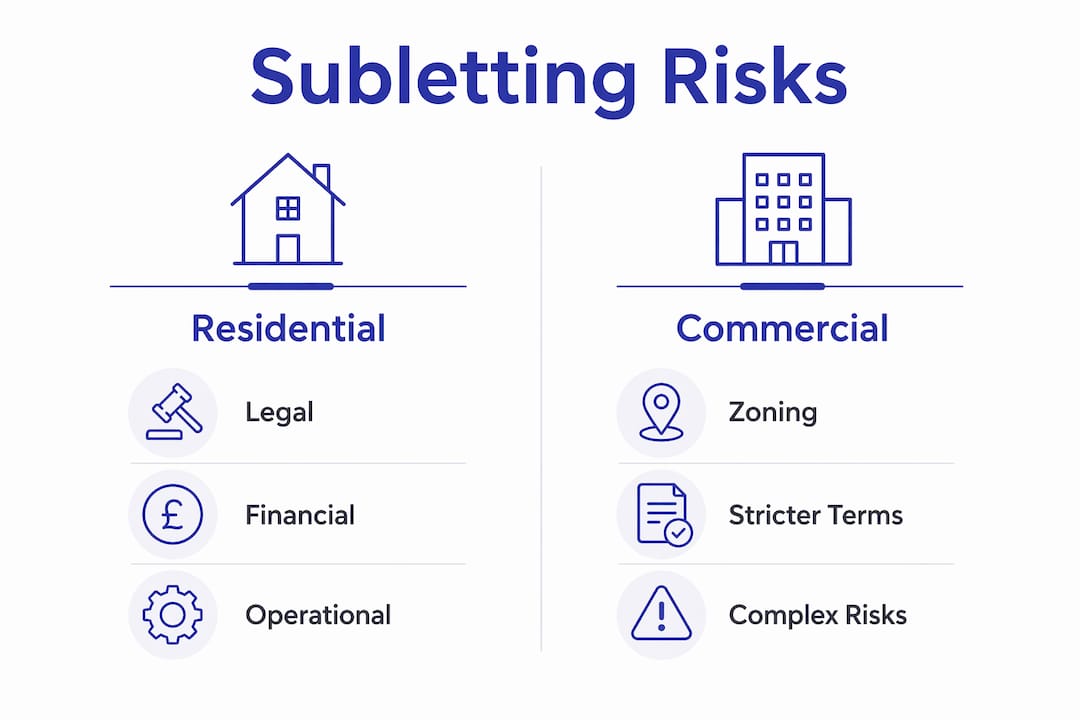
The risks of subleasing vary significantly depending on whether the property is residential or commercial. Understanding the distinction helps you apply the right protections.
| Factor | Residential leases | Commercial leases |
|---|---|---|
| Governing legislation | Rental Housing Act, Consumer Protection Act, PIE Act | Common law, lease agreement terms, zoning regulations |
| Subletting clause strictness | Typically prohibited unless landlord consents in writing | Often strictly prohibited; consent requirements are more formal |
| Eviction process | Court order required under PIE Act | Court order required; PIE Act may still apply to residential occupants on commercial premises |
| Operational disruption | Increased occupancy, wear and tear, noise | Zoning violations, business licence issues, reputational risk |
| Insurance implications | Voided cover if subletting undisclosed | Greater financial exposure; commercial policies have stricter occupancy conditions |
| Enforcement speed | Can be slow due to PIE Act protections | Potentially faster, but legal costs are higher |
Commercial leases generally impose stricter subletting conditions and carry the added complexity of zoning regulations. A subtenant operating a business that violates the property’s zoning classification can expose you to municipal enforcement action, fines, and reputational damage with neighbouring businesses.
Residential subletting risks are governed by a more protective legislative framework, which paradoxically makes enforcement slower. The PIE Act’s protections extend to subtenants who have established residence, even without your knowledge or consent. This means the eviction process can take months and cost considerably more than landlords anticipate.
Landlords who own both residential and commercial properties need separate risk management approaches for each. The legal requirements for South African landlords differ meaningfully across lease types, and a one-size-fits-all approach leaves gaps.
Key takeaways
Subletting risk is a legal, financial, and operational threat that landlords can manage effectively only through explicit lease clauses, consistent enforcement, and appropriate insurance cover.
| Point | Details |
|---|---|
| Legal process is mandatory | A 20-business-day breach notice is required before any lease cancellation for unauthorised subletting. |
| Self-help eviction is illegal | Changing locks or cutting utilities without a court order exposes landlords to criminal charges and civil claims. |
| Insurance can be voided | Undisclosed subletting gives insurers grounds to decline claims, removing your financial safety net. |
| Lease clauses are your foundation | Explicit subletting prohibitions and consequences must appear in every lease agreement you issue. |
| Insurance fills the income gap | Rentalincomeinsurance provides cover against non-payment and early termination linked to subletting situations. |
Why landlords underestimate subletting risk until it is too late
I have spoken with landlords who discovered a subtenant only when the original tenant disappeared and someone else answered the door. By that point, the deposit was gone, the property had been redecorated without permission, and the original tenant was unreachable. The sublease tenant had no agreement with the landlord and no obligation to pay rent directly. The landlord had no insurance claim because the occupancy change had not been disclosed.
The pattern repeats because landlords tend to focus on the original tenant relationship and assume the lease does the rest. It does not. A lease clause only protects you if you enforce it, and enforcement requires evidence, legal process, and time.
The biggest mistake I see is the rush to act. Landlords who discover subletting often want to resolve it immediately, and that urgency leads them toward self-help measures that create far bigger problems than the subletting itself. The formal legal steps feel slow and frustrating, but they are the only path that does not expose you to liability.
The second mistake is silence in the lease. Landlords who use generic templates often find their subletting clause is either absent or so vague it offers no real protection. A property attorney reviewing your lease once costs far less than a contested eviction.
My practical advice is this: treat subletting risk the way you treat fire risk. You do not wait for a fire to buy insurance or install a smoke alarm. You put protections in place before the problem arrives, because once it does, your options narrow considerably.
— Coert
Protecting your rental income against subletting risks
Subletting situations can leave landlords without income for months while legal processes run their course.

Rentalincomeinsurance is designed for exactly this scenario. Whether your tenant has sublet without permission, stopped paying rent, or abandoned the property, the cover responds to protect your income while you work through the legal process. The claims process is straightforward, and cover can be arranged before a problem arises. Request a quote today and find out how affordable it is to protect the income your property should be generating. You can also learn more about rental income protection and what it covers in full.
For a quick overview of how rental income insurance works, watch this short explainer:
https://youtu.be/ej04S_af4qM
FAQ
What is subletting risk for a landlord?
Subletting risk is the financial, legal, and property-related exposure a landlord faces when a tenant rents out the property to someone else without permission. It includes income loss, property damage, voided insurance, and costly eviction proceedings.
Can a landlord evict an unauthorised subtenant immediately?
No. Under the PIE Act, unauthorised subtenants retain occupier rights and can only be removed through a formal court eviction order, which can take months.
Does unauthorised subletting void my landlord insurance?
Yes. Insurance coverage can be voided when a change in occupancy is not disclosed to the insurer, leaving you without cover for claims arising during the subletting period.
What notice period is required before cancelling a lease for subletting?
Under the Consumer Protection Act, landlords must give tenants a 20-business-day rectification notice before they can cancel the lease for an unauthorised subletting breach.
How can I reduce subletting risks in my lease agreement?
Include an explicit clause prohibiting subletting without written consent, conduct regular inspections, and act promptly when a breach is suspected. Clear lease clauses and consistent enforcement are the most effective preventive measures available to landlords.
Recommended
- Rental property risk assessment guide for SA landlords – Rental Income Insurance
- Rental Property Risk Management Steps for SA Landlords – Rental Income Insurance
- Risk Assessment in Rental Insurance – Why It Matters for South African Landlords – Rental Income Insurance
- Tenancy risk assessment: a landlord’s guide to safer letting – Rental Income Insurance