
Landlords require rental income insurance because it protects cash flow when tenants stop paying, break leases early, or vanish mid-tenancy. It also covers the legal costs of eviction, a process that can drag on for months. With nearly one in four rental properties in South Africa affected by tenant default, Rental income insurance exists to help keep rent flowing while landlords resolve the underlying problem.
TL;DR:
- Nearly one in four South African rental properties experience tenant default, making rental income insurance crucial for protecting cash flow.
- Insurance typically covers up to three months of lost rent, legal eviction costs, and absconding scenarios, with proper documentation necessary for claims.
- Proper paperwork, including lease agreements and court notices, is essential to avoid delays in both eviction and insurance payout processes.
- Combining tenant vetting, clear lease clauses, and automated rent collection can significantly reduce the likelihood of claims and defaults.
- Rental income insurance is recommended for landlords relying on rent to meet mortgage obligations or managing multiple units with higher exposure.
Table of Contents
- Core reasons landlords require rental income insurance
- What rental income insurance typically covers and excludes
- How do claims, timing and eviction fit together?
- Cost and value: how premiums compare with likely losses
- Risk reduction measures that work alongside insurance
- What does renters insurance typically cover for tenants?
- How renters insurance benefits landlords directly
- Differences between renters insurance and landlord insurance
- Common lease clauses landlords use around renters insurance
- Can landlords legally require renters insurance from tenants?
- When we recommend rental income insurance
- Get a rental income quote that matches your risk
- Sources
Core reasons landlords require rental income insurance
Tenant non-payment is a sudden shock to a landlord’s finances. One month the rent lands as expected; the next it does not, and there is no warning built into the lease that tells you it’s coming. Industry data shows this isn’t a fringe problem. Nearly a quarter of South African rental properties experience tenant default at some point, which means most landlords with more than a couple of properties will run into it eventually.
The eviction process compounds the problem rather than resolving it quickly. Courts, notice periods, and procedural requirements mean a straightforward arrears case often takes months to conclude, and every one of those months is rent you are not collecting.
Several other exposures sit alongside non-payment:
- Early lease termination — a tenant leaves before the lease ends, leaving a gap until a replacement moves in.
- Absconding — a tenant disappears without notice, often owing rent and leaving the unit in an uncertain state.
- Property damage — a unit becomes temporarily uninhabitable, cutting off rent while repairs happen.
- Legal costs — attorney fees and court costs stack up even before a matter reaches a judgment.
Each of these hits the same target: your monthly income. A detailed breakdown of these landlord risks shows how quickly a single bad tenancy can erode a year’s profit margin on a property.
What rental income insurance typically covers and excludes
A typical rental income policy reimburses lost rent up to a set number of months, covers eviction-related legal costs, and often extends to absconding scenarios where a tenant leaves without warning. Some policies add temporary re-letting cover to bridge the gap between one tenant leaving and the next moving in.
Statistic worth remembering: insurers commonly allow a claim from the second consecutive month of non-payment, provided a proper letter of demand has been issued — cover typically runs for up to three months or until the unit is re-let, whichever comes first.
Common inclusions and exclusions look like this:
- Lost rent up to a monthly cap and a maximum number of months.
- Legal and eviction cost cover, often bundled into the same policy.
- Absconding cover, usually with proof requirements (unanswered communication, unpaid utilities, an empty unit).
- Exclusions for self-help eviction, wilful damage, and certain unapproved uses like short-term letting on platforms without confirming acceptance with your insurer.
One detail landlords often miss: if a tenant later pays the arrears after a claim has been settled, some policies require you to reimburse the insurer for that amount. Read the recovery clause before you sign, not after you claim.
How do claims, timing and eviction fit together?
Insurance does not replace the legal eviction process. It runs alongside it, cushioning your cash flow while the courts do their work. South African eviction law follows the PIE Act, and that process is deliberately thorough, which makes it slow. Skipping steps to speed things up is the single most damaging mistake a landlord can make.
Insurers generally ask for a specific paper trail before paying out:
- The signed lease agreement.
- A formal breach notice or letter of demand.
- An arrears ledger showing exactly when payments stopped.
- Court papers, once the matter has been filed.
Small errors in the breach notice, or a missing demand letter, routinely delay both the eviction and the insurance payout, so getting the paperwork right the first time matters more than most landlords realise.
Pro Tip: Never change locks, cut utilities, or remove a tenant’s possessions yourself, no matter how far behind they are on rent. Self-help eviction is unlawful in South Africa and can expose you to criminal charges and civil damages that dwarf the unpaid rent you were chasing.
The claims process for rental income insurance is built to work within these legal timeframes, not around them.
Cost and value: how premiums compare with likely losses
The maths behind rental income insurance is straightforward once you run it against a real scenario. Insurance industry commentary cites an example of a R500 monthly premium against a R10,000 rent, where three months of lost rent alone would total R30,000, before legal fees are even added.
That gap between premium and potential loss is the entire case for cover:
- A modest monthly premium versus months of zero income plus attorney costs.
- Higher sum insured and lower deductible suit landlords with tight cash flow.
- Lower sum insured with a higher deductible suits landlords who can absorb a short gap themselves.
Cover tends to earn its keep the fastest on properties where a missed rent payment would strain your own finances, or where eviction costs in your area run high. A comparison of rental insurance options is worth reviewing before settling on a sum insured that matches your actual exposure rather than a generic default.
Risk reduction measures that work alongside insurance
Insurance handles the financial fallout, but the measures that stop defaults before they happen sit outside any policy. Thorough tenant vetting, reference checks, and guarantors remain your first line of defence, and landlords who apply them consistently tend to see fewer claims over time.
A few practical habits reinforce this:
- Require a security deposit that reflects real risk, not a token amount.
- Write clear breach and remedy clauses into the lease, so a default triggers a defined process rather than confusion.
- Use automated rent collection to catch a missed payment on day one, not day thirty.
- Inspect the property regularly and fix small issues before tenants use them as leverage to withhold rent.
None of this replaces insurance. It reduces how often you need it. Insurers sometimes reward landlords who combine vetting with clear lease terms with better terms, because disciplined landlords file fewer, cleaner claims. Tenant reputation platforms such as DWELR can add another layer of screening on top of standard reference checks, particularly for landlords managing several units at once.
What does renters insurance typically cover for tenants?
Renters insurance is a separate product from rental income insurance, and it’s worth understanding the distinction because tenants sometimes confuse the two. A renter’s policy protects the tenant’s own belongings and liability inside the unit, not the landlord’s rental income.
Typically, a tenant’s policy includes cover for personal property such as furniture, electronics, and clothing against theft, fire, or water damage. It usually adds liability protection too, covering the tenant if someone is injured inside the rented unit or if the tenant accidentally damages the landlord’s property, such as flooding a bathroom or scorching a kitchen counter.
None of that touches your rent roll directly. If a tenant’s policy pays out for a burst pipe they caused, that settlement goes toward replacing their belongings or covering repair liability, not toward the months of rent you lose while the unit is unusable. That gap is exactly why landlords still need their own dedicated cover.
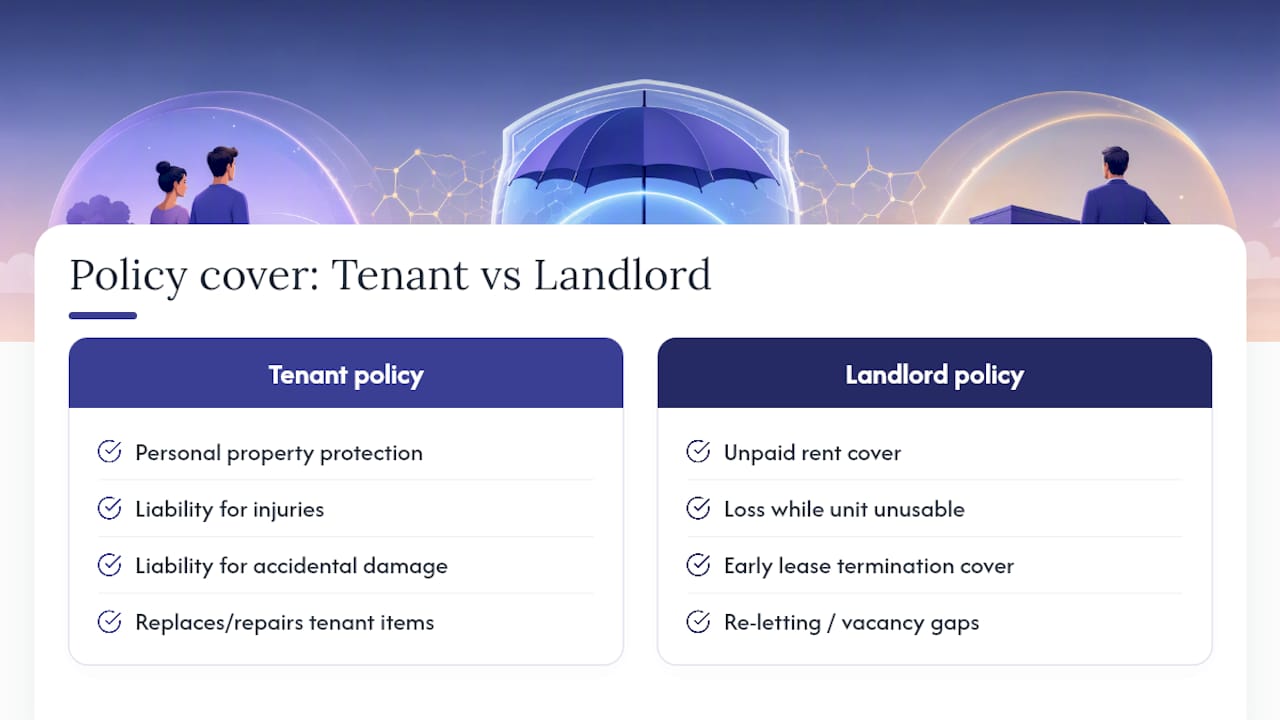
Where tenant policies do help landlords indirectly is in reducing disputes. If a tenant has liability cover and causes accidental damage, there’s a funded route to resolve the repair cost without a drawn-out argument or a deposit deduction fight. It rarely covers the income side of the equation, though, which sits squarely with rental income insurance.
How renters insurance benefits landlords directly
The direct benefit to landlords is less about their own cash flow and more about reducing friction. When a tenant carries their own liability cover, a damage incident becomes a claims conversation rather than a stand-off over who pays and how much.
That shift matters more than it sounds. Disputes over deposit deductions are one of the most common sources of tension between landlords and tenants, and a tenant with liability cover has a funded way to make the landlord whole without haggling over a deposit that was never meant to cover major repairs.
There’s a secondary benefit too: landlords who ask tenants to hold renters insurance are signalling, and reinforcing, a culture of responsibility. Tenants who take out cover tend to be more organised about paperwork generally, which can translate into steadier rent payment habits, though that’s an indirect correlation rather than a guarantee.
None of this replaces a landlord’s own protection. A tenant’s liability policy pays for a damaged carpet or a scalded neighbour’s ceiling. It does nothing for the three months of rent lost while a non-paying tenant works through the eviction process, which is precisely the gap Rental Income Insurance is built to close.
Differences between renters insurance and landlord insurance
The two products protect entirely different interests, and landlords who assume one substitutes for the other are exposed in ways they don’t discover until it’s too late.
| Feature | Renters insurance (tenant’s policy) | Landlord rental income insurance |
|---|---|---|
| Who buys it | The tenant | The landlord or property owner |
| What it protects | Tenant’s belongings and personal liability | Landlord’s rental income and legal costs |
| Covers unpaid rent | No | Yes |
| Covers eviction legal fees | No | Often, depending on policy |
| Covers tenant absconding | No | Often, depending on policy |
| Covers building structure | No | Not typically; separate buildings cover applies |
Landlord insurance, broadly, sits in a different category again from rental income cover. Building and contents policies for landlords protect the physical structure and fixed fittings, while rental income insurance protects the revenue stream. A landlord can hold all three types of cover, on the tenant’s side and their own, without any overlap, because each answers a different question: what happens to the tenant’s things, what happens to the building, and what happens to your bank balance when rent stops.
Understanding where landlord insurance and home insurance diverge helps clarify which gaps still need filling once a renters policy and a buildings policy are both in place.
Common lease clauses landlords use around renters insurance
Many landlords write a renters insurance requirement directly into the lease agreement, treating it as a standard condition of tenancy rather than an optional extra. The clause typically requires the tenant to hold an active policy for the duration of the lease and to provide proof of cover, sometimes annually, sometimes at signing only.
A typical clause will specify:
- A minimum liability limit the tenant’s policy must carry.
- A requirement to name the landlord as an interested party, in some cases, so the landlord is notified if the policy lapses.
- Proof of renewal at each lease anniversary.
- Consequences for non-compliance, ranging from a formal warning to treating it as a lease breach.
None of these clauses give the landlord a claim on the tenant’s payout. They exist to reduce the odds of an unresolved damage dispute and to push some of the liability risk for tenant-caused incidents onto the tenant’s own insurer rather than the landlord’s pocket or the security deposit.
It’s worth noting these clauses work best when paired with clear breach and remedy language elsewhere in the lease, so that a missing renters policy is treated the same way as any other lease violation, consistently and on paper, rather than as a verbal reminder that gets forgotten.
Can landlords legally require renters insurance from tenants?
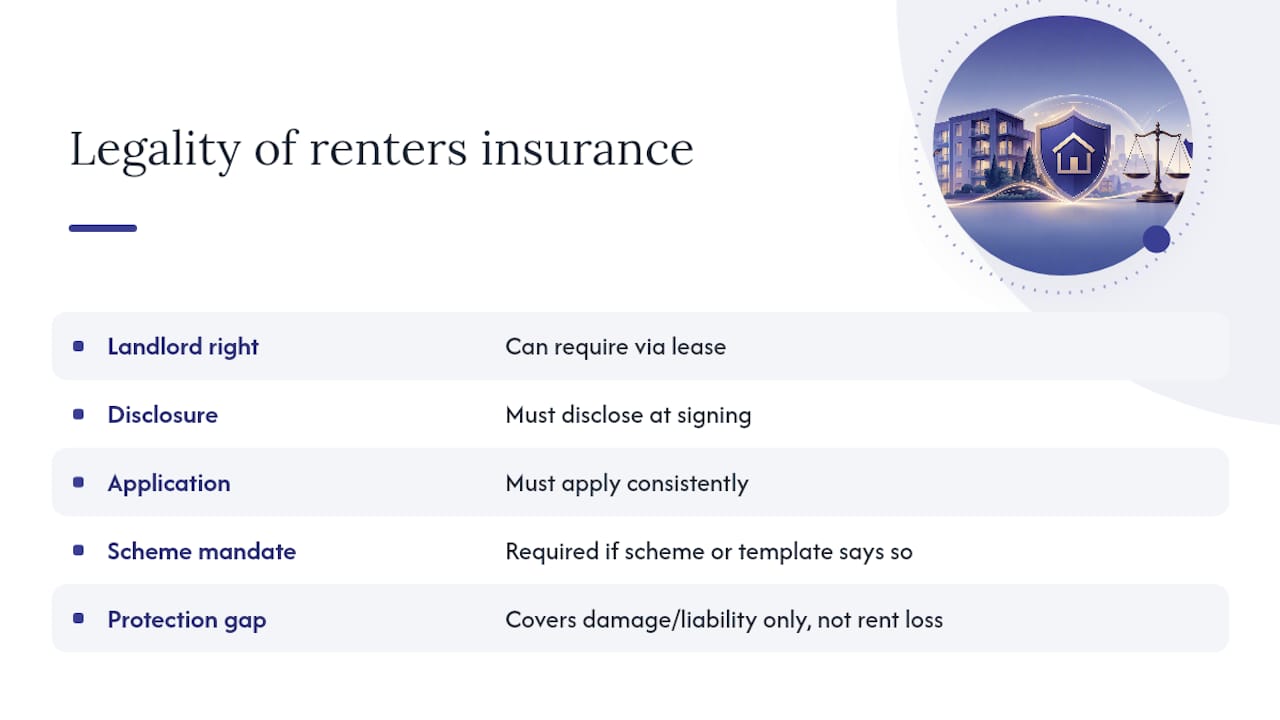
In general, landlords can include a renters insurance requirement as a condition of the lease, provided it’s disclosed clearly at signing and applied consistently across tenants. This is a contractual obligation rather than a statutory one. There is no blanket law compelling every landlord to demand it, and no law preventing a landlord from asking for it as a lease condition, subject to the lease being fair and not applied in a discriminatory way.
Where it becomes a firmer obligation is when a body corporate, sectional title scheme, or a specific lease template mandates it as a condition of occupancy. In those cases, the requirement flows from the scheme’s own rules rather than general landlord discretion, and a landlord who skips enforcing it may be in breach of their own management agreement.
None of this changes the core point for cash-flow protection. Requiring a tenant to hold renters insurance protects against damage disputes and liability incidents. It does nothing to protect the landlord against the tenant simply not paying rent, breaking the lease early, or disappearing. That risk sits entirely with the landlord, which is why rental income insurance remains a separate, necessary layer regardless of what the lease requires of the tenant.
When we recommend rental income insurance
We recommend rental income insurance to any landlord whose finances would suffer from two or three months of missing rent, which describes most individual landlords and many smaller property portfolios. If you’re relying on rent to cover a mortgage or your own monthly obligations, the case is not marginal. Landlords managing multiple units, or letting to first-time tenants without a long rental history, carry the highest exposure and see the clearest value from cover. Review the full rental income protection guide before deciding on a sum insured, and request a tailored quote once you know your numbers.
— Coert
Get a rental income quote that matches your risk
Rental income insurance is designed for landlords who need their rent protected. Cover typically addresses tenant non-payment, early lease termination, absconding, and the legal costs that come with eviction, providing a policy aimed at how landlords can lose income.

Watch a short explainer on how rental income protection works in practice:
. If you already know the exposure you’re carrying, whether it’s a single unit with tight cash flow or a portfolio spread across several tenants, the next step is to request a tailored quote and see what cover would cost against your actual rent roll.
Sources
- Securing your investment: why rental insurance is essential in South Africa’s recovering property market
- Property rental insurance: insuring rental income against risk of tenant default | Insurance Biz
- How to evict a tenant in South Africa | A landlord’s guide | Burgerhuyser Attorneys