
TL;DR:
- Monitoring tenant reliability is essential for South African landlords to prevent financial losses from rent arrears, property damage, and legal disputes. Implementing systematic screening and ongoing payment tracking, while ensuring compliance with POPIA and FICA, protects income and reduces risks. Combining thorough processes with modern verification technology enhances rental income security and sustains long-term property value.
Unexpected rent arrears sting hardest when they come from a tenant you trusted completely. You checked their smile, liked their story, and handed over the keys. Then month three arrives without payment. For South African landlords, understanding why monitor tenant reliability is not a nice-to-have consideration but a financial necessity. Unreliable tenants cost property owners thousands in lost income, legal fees, and repairs every year. This guide explains exactly what drives tenant risk, how to spot it before it becomes your problem, and what the law requires you to do about it.
Table of Contents
- Why monitoring tenant reliability matters for landlords
- Key methods to monitor tenant reliability effectively
- Legal compliance and risk mitigation in tenant monitoring
- Practical impact of tenant monitoring on rental income security
- How technology and services help landlords monitor tenants
- A landlord’s perspective on tenant reliability monitoring
- Secure your rental income with expert support
- Frequently asked questions
Key Takeaways
| Point | Details |
|---|---|
| Protect rental income | Monitoring tenant reliability helps prevent rent arrears and property damage, securing your monthly earnings. |
| Ensure legal compliance | Tenant monitoring must comply with POPIA and FICA to avoid costly fines and legal risks. |
| Use effective screening | Identity verification, credit checks, and background references are key steps in assessing tenants. |
| Leverage technology | Digital services streamline tenant screening and help maintain up-to-date monitoring efficiently. |
| Combine monitoring with insurance | Rental income insurance adds a protective layer, maximising financial security for landlords. |
Why monitoring tenant reliability matters for landlords
The assumption that rent will arrive every month without incident is one of the most expensive beliefs a landlord can hold. Unreliable tenants do not always announce themselves upfront. They pass the initial gut-check, sign the lease, and then slowly become a problem. Arrears, damage to your property, and disputes over deposits are the visible results. The hidden cost is time: months spent chasing payments, arranging repairs, and navigating the Rental Housing Tribunal.
Monitoring tenant reliability means systematically checking a tenant’s ability and history of meeting their obligations, from the screening stage right through to the end of the lease. The earlier you identify a risk, the cheaper it is to manage. A tenant with a history of default identified before signing costs you nothing. That same tenant discovered after three months of non-payment costs you legal fees, lost rent, and potentially an eviction process that drags on for weeks.
As a starting point, tenant screening importance cannot be overstated. It is worth noting that “tenant screening is the first line of defense against potential rental issues”, and South African property owners who skip this step expose themselves to avoidable financial harm.
The core reasons to monitor tenant reliability include:
- Financial protection: Rent arrears disrupt your cash flow immediately. If your mortgage repayment depends on rental income, even one missed month creates a domino effect.
- Property preservation: Reliable tenants maintain your property. Unreliable ones frequently cause damage that exceeds the deposit.
- Legal protection: A documented, compliant screening process protects you if a dispute reaches the Tribunal or court.
- Lease compliance: Monitoring during the tenancy allows you to catch breaches early, such as unauthorised subletting or pets, before they escalate.
- Insurance benefits: Demonstrating tenant reliability can improve your secure rent payments position and influence the terms of your rental income cover.
Landlords who screen tenants consistently report fewer disputes, lower vacancy rates, and more predictable income. The discipline of monitoring is what separates landlords who build wealth from those who drain it managing crises.
Key methods to monitor tenant reliability effectively
Knowing you should monitor is one thing. Knowing how to do it lawfully and practically is another. South Africa’s legal environment, shaped by the Protection of Personal Information Act (POPIA) and the Financial Intelligence Centre Act (FICA), sets clear rules for how landlords may collect and use tenant data. Staying within those rules while still gathering enough information to make a sound decision requires a structured approach.
Here is a practical monitoring process that balances thoroughness with legal compliance:
- Verify identity documents. Request a certified copy of a South African identity document or valid passport. This satisfies both FICA and KYC (Know Your Customer) requirements and confirms the applicant is who they claim to be.
- Conduct a credit check with written consent. Obtain the tenant’s written consent before running any credit enquiry. Credit bureaus such as TransUnion or Experian will show you payment history, judgements, and existing debt levels. This is one of the clearest indicators of future payment behaviour.
- Check employment and income verification. Request recent payslips or three months of bank statements to confirm the tenant earns at least three times the monthly rent. This ratio is widely used in South Africa as a reliable affordability threshold.
- Contact previous landlords. Speaking directly to a former landlord tells you things no document can: whether the tenant paid on time, maintained the property, and left without incident. One phone call can save months of grief.
- Monitor payment behaviour during the tenancy. Set up a dedicated rental account and track payment dates monthly. Patterns matter. A tenant who pays on the 5th instead of the 1st for three consecutive months is showing you something worth noting.
- Conduct periodic property inspections. Quarterly inspections, with proper written notice, allow you to check the condition of the property and address issues before they become structural problems or deposit disputes.
- Secure and audit tenant data regularly. Under POPIA, you are obligated to protect tenant information. Store it securely, limit access, and audit what you hold at least annually.
For identity verification specifically, reliable verification platforms can help you verify identity documents quickly and efficiently, reducing the time between application and decision.
Pro Tip: Build a standard application pack that every prospective tenant must complete before you show them the property. This saves time, sets professional expectations, and ensures you collect the same information from every applicant, reducing any risk of discrimination claims.
Using a rental income protection checklist keeps your process consistent and helps you safeguard rental income from the very first interaction with a prospective tenant.
Legal compliance and risk mitigation in tenant monitoring
South African landlords operate within a specific legal framework when screening tenants. Getting this wrong does not just mean a missed risk. It can result in significant financial penalties and legal action against you personally.
POPIA: data minimisation and consent
POPIA requires that you collect only the information you genuinely need to make a rental decision. You cannot build a file on a tenant that goes beyond what is necessary. Identification, income verification, credit history, and references are all reasonable. Collecting sensitive personal information such as medical history or religion is not. Every piece of data must be stored securely and deleted when it is no longer needed.
FICA and KYC obligations
FICA applies to landlords when rental transactions could involve money laundering or financial crime. You are required to verify the identity of tenants, particularly for higher-value rentals. KYC processes must be documented and repeatable.
Non-compliance penalties can reach ZAR 10 million. The cost of not screening tenants properly is not just financial risk from unreliable tenants. It is also direct regulatory risk from getting the process wrong.
The table below summarises the key legal obligations and what they require:
| Regulation | Core requirement | Penalty for non-compliance |
|---|---|---|
| POPIA | Data minimisation, consent, secure storage | Up to ZAR 10 million or imprisonment |
| FICA | Identity verification, KYC documentation | Criminal prosecution, fines |
| Rental Housing Act | Fair screening, non-discrimination | Tribunal referral, damages |
Key compliance obligations for landlords include:
- Written consent before any credit bureau enquiry
- Secure storage of all tenant personal information
- Transparent data practices, communicated to tenants upfront
- Regular audits of what data you hold and why
- Destruction or deletion of data when it is no longer required
Refer to a tenant screening guide for a full walkthrough of compliant screening processes. Cross-referencing against your rental income protection checklist helps you confirm you have covered every legal requirement before signing any lease.
Pro Tip: Keep a written record of the consent you obtained from each tenant before their credit check. If a complaint or dispute arises later, this documentation is your first line of evidence.
Practical impact of tenant monitoring on rental income security
The financial argument for monitoring tenant reliability is clear in the numbers. Screened tenants carry a significantly lower risk of rent default and property damage than unscreened tenants. Effective monitoring can reduce non-payment risk by up to 40%, which for a landlord receiving R12,000 per month represents a meaningful difference in annual income certainty.
The impact of tenant reliability extends well beyond simply receiving rent on time:
- Lower legal costs: Eviction proceedings in South Africa can cost between R15,000 and R50,000 when legal representation is involved. Reliable tenants almost never require eviction.
- Reduced vacancy: Reliable tenants renew leases. Every vacancy costs you at least one month of rental income, plus advertising and turnover costs.
- Better insurance terms: Rental income insurance providers consider tenant non-payment risks when pricing policies. A documented screening process demonstrates lower risk and can result in more favourable premiums.
- Preserved property value: A tenant who treats your property well protects your most significant asset. Damage from a negligent tenant can cost far more than the deposit covers.
The comparison below illustrates what monitoring means in practice:
| Factor | With tenant monitoring | Without tenant monitoring |
|---|---|---|
| Non-payment risk | Reduced by up to 40% | Baseline risk, unmitigated |
| Average eviction frequency | Low | Significantly higher |
| Annual legal cost exposure | Minimal | R15,000 to R50,000 per incident |
| Property damage likelihood | Low | Materially higher |
| Insurance premium impact | Potentially reduced | Standard or higher |
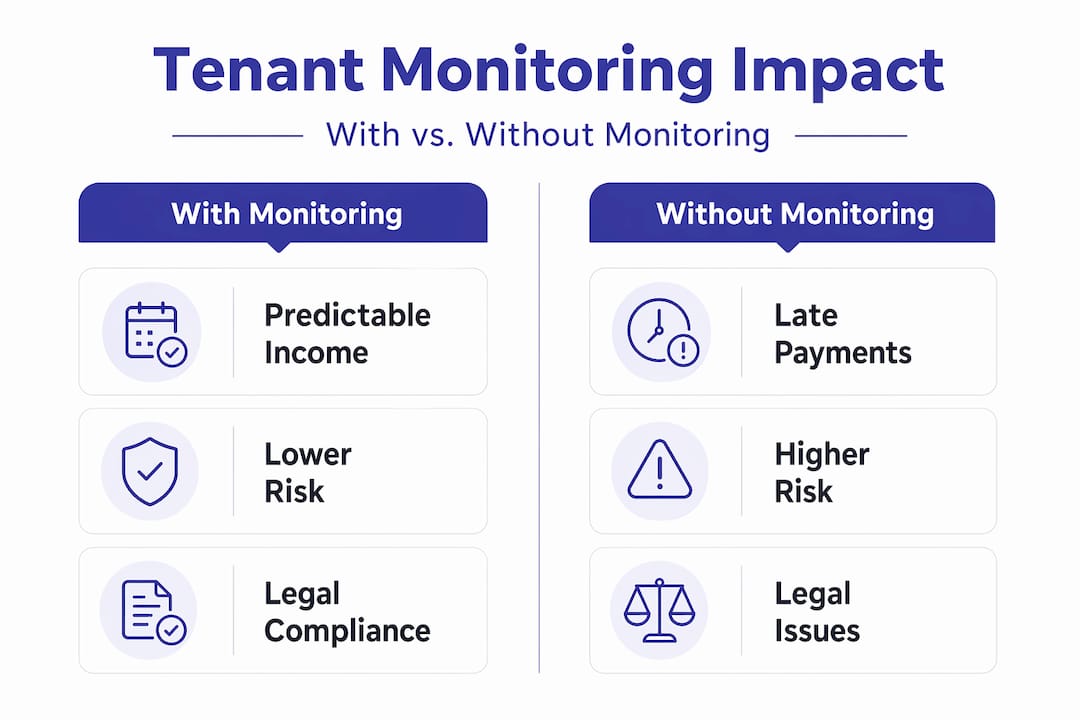
To actively prevent tenant non-payment, the most effective approach combines upfront screening with consistent monitoring throughout the lease period, not just at application stage.
How technology and services help landlords monitor tenants
Manual tenant screening is time-consuming and inconsistent. Technology has changed what is possible for South African landlords, even those managing just one or two properties. Online verification platforms now allow landlords to run identity checks, credit assessments, and background screening in minutes rather than days.
Modern tools offer landlords several practical advantages:
- Automated identity verification that cross-references national identity databases in real time
- Credit bureau integration that pulls reports with written consent already built into the digital workflow
- Reference check templates that standardise the questions you ask previous landlords and employers
- Cloud-based record storage that keeps tenant data secure and accessible, satisfying POPIA requirements
- Rental payment tracking tools that flag late payments automatically and generate audit trails
Reliable verification platforms such as VerifyNow allow you to verify identity documents quickly and efficiently, reducing manual errors and ensuring compliance at every step.
The benefit of technology goes beyond speed. When every tenant application passes through the same digital process, you eliminate inconsistency. Every applicant is assessed on the same criteria, with the same documentation requirements. This protects you against discrimination claims and builds a defensible screening record.

Pro Tip: Choose a verification platform that includes automated POPIA consent capture. This removes one of the most commonly missed steps in manual screening and creates an auditable record you can rely on if a dispute arises.
Use your tenant screening guide alongside technology tools to ensure nothing falls through the cracks. The combination of structured process and smart tools is how you protect rental income consistently over time.
A landlord’s perspective on tenant reliability monitoring
Here is something most landlords learn the hard way: the tenant who makes you feel guilty about asking for documents is often the one who will cost you the most. Reliable tenants understand screening. They have nothing to hide and appreciate a landlord who takes their property seriously. Reluctance to provide basic documentation is itself a signal worth noting.
The myth that all tenants deserve equal trust ignores the practical reality of rental management. Trust should be earned through evidence, not assumed because someone seems pleasant at a viewing. Emotional decision-making is the single biggest driver of landlord losses in South Africa’s residential rental market. A structured screening process removes that variable entirely.
What experience teaches is that consistency matters more than any single check. Landlords who screen thoroughly for the first tenant but skip steps for “a friend of a friend” or “someone the agent vouched for” expose themselves to the same risks as those who screen no-one. The process has to apply every time, without exception.
Thorough documentation throughout the tenancy is equally important. Record every inspection in writing. Log every late payment with dates and amounts. Keep copies of all correspondence. When disputes reach the Tribunal or require legal action, this paper trail is worth more than any verbal account. Refer to rental income best practices and lease agreement essentials to build the kind of documentation framework that stands up under scrutiny.
Building a reliable tenancy is not about being suspicious. It is about being professional. Tenants who know their landlord monitors the property and payment schedule tend to take both more seriously.
Secure your rental income with expert support
Monitoring tenant reliability is a powerful first step, but it does not eliminate every risk. Even thoroughly screened tenants can face sudden job losses, illness, or financial hardship that affects their ability to pay rent.

That is where rental income insurance closes the gap. At Rental Income Insurance, we offer cover designed specifically for South African landlords who want to protect their income against tenant non-payment, early lease termination, and property damage. Our cover works alongside your screening process, not instead of it. Together, they create a genuinely resilient income strategy. Whether you are managing one property or a portfolio, request a quote today and find out how affordable this peace of mind can be. Read our full rental income insurance guide to understand exactly what is covered, or explore the specifics of tenant non-payment risks protection to see how coverage applies in real-world scenarios.
Frequently asked questions
Why is tenant screening important for landlords in South Africa?
Tenant screening helps landlords identify reliable tenants, reduce rental arrears, comply with legal requirements, and protect their investments. As VerifyNow notes, screening is the first line of defence against potential rental issues.
What tenant information is legally acceptable to collect under POPIA?
Landlords must limit data collection to essentials such as identification documents and credit history, applying POPIA’s data minimisation principle to protect both tenant privacy and landlord compliance.
Can landlords perform credit checks on tenants in South Africa?
Yes, provided the landlord obtains written consent before proceeding. Credit checks are one of the most reliable tools for assessing a tenant’s financial reliability and history.
How does monitoring tenant reliability affect rental income insurance?
Tenant dependability influences the cost and conditions of landlord insurance policies, meaning landlords who monitor effectively may benefit from lower premiums and broader coverage terms.
What should I do if a tenant becomes unreliable after moving in?
Act early: document every breach, communicate clearly in writing, and follow legal procedures. As SD Law advises, the landlord should move quickly, record the breach, and decide on a strategy between recovery, settlement, or eviction without delay.
Recommended
- 7 Essential Tenant Management Best Practices for Landlords – Rental Income Insurance
- SA tenant screening guide: Secure reliable rental income – Rental Income Insurance
- Top tips for finding reliable tenants in 2026 – Rental Income Insurance
- Landlord Risk Assessment Workflow for Secure Rentals – Rental Income Insurance