
TL;DR:
- Most landlords focus on attractive rental yields without understanding what truly makes a yield good or how hidden risks can erode returns.
- Accurate analysis requires considering net yield, cash flow, vacancy rates, and financing, rather than relying solely on advertised gross yield.
Most landlords know they want a “good yield.” Far fewer can explain what makes a yield genuinely good, or why chasing the headline percentage without understanding what sits beneath it can quietly destroy returns. Why rental yields matter is not a simple question of maths. It touches cash flow, financing, portfolio strategy, and the long-term viability of your investment. Get the analysis wrong and a property that looks profitable on paper can drain your bank account every month.
Table of Contents
- Key takeaways
- Why rental yields matter: the foundation
- Beyond the percentage: yield, cash flow, and debt
- Yield as a strategic decision-making tool
- Common pitfalls in yield analysis
- My honest take on yield analysis
- Protect the yield you have worked for
- Common questions
Key takeaways
| Point | Details |
|---|---|
| Gross vs net yield | Gross yield is a quick benchmark only; net yield reveals what you actually keep after expenses. |
| Cash flow is the real test | Rental yield connects directly to monthly cash flow and your ability to service debt on the property. |
| Yield signals property value | Low yields can indicate overpricing; high yields may signal opportunity or elevated risk in a given market. |
| Vacancy distorts projections | Even a 5% vacancy rate can significantly reduce returns and affect debt coverage calculations. |
| Use multiple metrics | Cap rate, cash-on-cash return, and net yield together give a far clearer picture than any single number. |
Why rental yields matter: the foundation
Before you can use yield effectively, you need to understand what it actually measures. Rental yield is the percentage of income generated relative to a property’s value, and the distinction between gross and net yield is where most investors go wrong.
Gross rental yield is straightforward. Divide the annual rental income by the property’s purchase price (or current market value), then multiply by 100.
For example: a property worth R1,500,000 generating R12,000 per month in rent produces a gross yield of 9.6%.
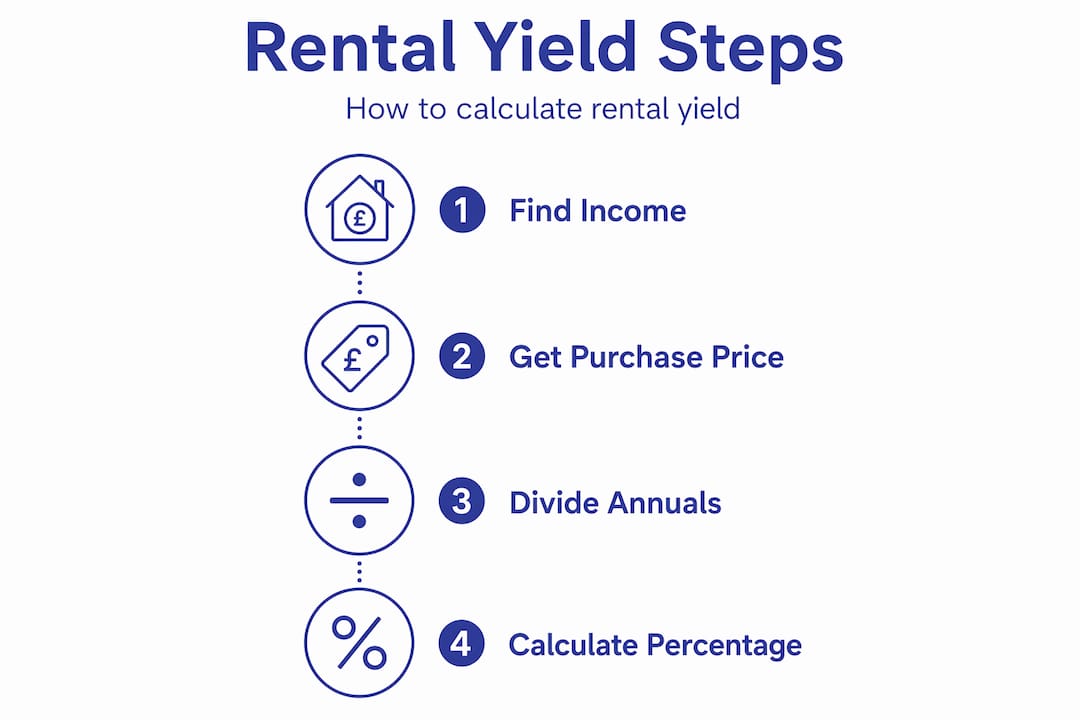
Calculation: (R144,000 ÷ R1,500,000) × 100 = 9.6%
Net rental yield takes that gross figure and deducts all your real costs. Those typically include:
- Property rates and taxes
- Insurance premiums
- Maintenance and repairs
- Property management fees
- Periods of vacancy
- Accounting and legal costs
If those expenses total R30,000 annually, your net income drops to R114,000. Net yield on the same property falls to 7.6%. That two-percentage-point gap is the difference between what the listing advertises and what you actually earn.
Gross yield is a quick benchmark; net yield shows true profitability after costs. Both matter, but they serve different purposes. Gross yield helps you filter properties quickly. Net yield tells you whether to buy.
Pro Tip: Always build your expense estimate before you make an offer. Use 30-40% of gross rental income as a conservative total expense allowance if you do not yet have property-specific figures.
Beyond the percentage: yield, cash flow, and debt
Understanding the importance of rental yields becomes most urgent when you introduce financing into the equation. Most landlords use a mortgage, which means yield does not just determine profit. It determines whether you can meet your repayments each month.
Here is a practical way to think about it:
-
Calculate your net operating income (NOI). This is annual rent minus all operating expenses, before any mortgage payments. A property earning R144,000 in rent with R30,000 in expenses has a NOI of R114,000, or R9,500 per month.
-
Check your debt service coverage ratio (DSCR). Lenders prefer properties where NOI covers mortgage repayments comfortably, typically at a ratio of 1.25 or higher. If your monthly bond repayment is R8,000, your DSCR is 1.19. That falls below the threshold, and many lenders will flag it.
-
Account for vacancy. Even a modest 5% vacancy can significantly change investment returns. On that same property, one month vacant per year drops your NOI by R12,000, pushing the DSCR below 1.0. You are now subsidising the property from your own pocket.
-
Consider the cap rate. Cap rate is a financing-independent metric that uses NOI divided by property value. It strips out the effect of your specific mortgage and lets you compare properties objectively. A cap rate of 7% means the property generates 7% on its value regardless of how it is funded.
-
Track cash-on-cash return. This metric measures your actual cash return on the money you personally invested (deposit, costs). It is the most personal of the yield metrics because it reflects your specific financing terms.
Pro Tip: When modelling a deal, run your numbers at 90% occupancy rather than 100%. Properties rarely stay fully tenanted all year, and projecting conservatively protects you from unpleasant surprises.
The impact of rental yields on investing extends well beyond a single percentage. It shapes whether your property is self-funding, whether a lender will approve your loan, and whether a vacancy sets you back for months.

Yield as a strategic decision-making tool
Once you understand the mechanics, the benefits of high rental yields become clearer. But so do the trade-offs.
The classic tension in property investment sits between income-producing assets and capital growth assets. High-yield properties tend to generate strong monthly cash flow but appreciate in value more slowly. Lower-yield properties in premium locations often grow substantially in value over time but may leave you funding a shortfall every month while you wait.
| Strategy | Typical yield | Capital growth | Best suited for |
|---|---|---|---|
| High-yield income property | 8-12%+ | Moderate to low | Cash flow-focused investors, early retirement income |
| Balanced portfolio property | 5-8% | Moderate | Investors building long-term wealth with income support |
| Capital growth property | 2-5% | High | Wealth-building investors with strong existing income |
Rental yield helps identify overpriced or undervalued properties depending on the relationship between market rents and asking prices. A property yielding 3% in a market where comparable properties yield 7% is either overpriced or located in a genuinely exceptional growth area. You need evidence to justify which one it is before committing capital.
Geographic variation matters enormously. Coastal holiday towns may offer seasonal yield spikes that look attractive on annual averages but collapse in the off-season. Secondary cities and towns sometimes offer superior yields because property prices are lower relative to local rents. Understanding rental yield as a key factor in balancing cash flow risk against capital growth goals means matching the right strategy to your personal financial position, not chasing the highest number on a spreadsheet.
For portfolio building, rental yield becomes a screening tool. Properties below a certain threshold simply do not proceed to due diligence. Most experienced investors set a minimum net yield of 6-7% before investigating further, which filters out the majority of overpriced or poorly performing stock quickly.
Common pitfalls in yield analysis
Even investors who understand the theory of rental yields still make avoidable mistakes. These are the ones that show up most consistently.
Trusting advertised gross yields without scrutiny. Listings routinely display gross yield because it is the highest number available. Investors misled by advertised gross yields may ignore the true cost impact until the property is already in their portfolio.
Overestimating rental income. Investors often overestimate rental income by as much as 10-15%, which materially reduces actual profitability. This happens when people model at peak market rates without accounting for the rate achievable on their specific property.
Ignoring the cost of vacancy timing. Vacancy affects not just income totals but the timing of net income, which directly affects debt coverage calculations. A two-month vacancy at the start of the year compounds quickly against annual repayment schedules.
Confusing cap rate with cash-on-cash return. Cap rate is financing-agnostic. Cash-on-cash reflects leveraged returns based on actual cash invested. Using cap rate to estimate your personal return ignores the cost of borrowing entirely.
Underestimating maintenance on older stock. A property with an attractive net yield today may require a new roof, electrical upgrades, or plumbing work within three years. Many investors model maintenance as a fixed percentage rather than assessing the actual condition of the asset.
“A $200/month rent overestimate equals $2,400 annually, reducing cash-on-cash return dramatically. Small assumptions compound into large outcome differences.”
The solution to most of these pitfalls is conservative modelling. Use verified comparable rents, not aspirational ones. Build in realistic vacancy. Apply conservative rent growth assumptions rather than the optimistic projections that make a deal look irresistible. The deals that still work under conservative assumptions are the ones worth buying.
My honest take on yield analysis
I have seen investors spend hours debating whether a property yields 7.2% or 7.8% while completely ignoring a $15,000 deferred maintenance liability that would wipe out two years of net income. That is where yield analysis goes wrong. The number is only as reliable as the assumptions beneath it.
In my experience, the investors who consistently outperform are not the ones who find the highest-yielding properties. They are the ones who build the most honest expense models. They stress test vacancy. They verify rents with actual comparable lets in the street, not the asking rents on portals. They understand the difference between insurance coverage limits and actual payout calculations before a tenant defaults, rather than discovering the gap when it matters most.
My view on yield as a metric is this: use it as a filter and a language, not as a conclusion. It tells you whether a property deserves further investigation. It does not tell you whether to buy. For that, you need vacancy assumptions, expense schedules, financing terms, local market dynamics, and a realistic view of tenant quality. Gross yield gets you into the room. Net yield, DSCR, and cash-on-cash return are what keep you honest once you are there.
The landlords I have watched struggle most are those who bought on yield alone and discovered that the yield was based on an optimistic rent, zero vacancy, and expenses that did not survive contact with reality.
— Coert
Protect the yield you have worked for

Understanding why rental yields matter is one side of the equation. Protecting the income that those yields represent is the other. A carefully analysed 8% net yield means nothing if your tenant stops paying rent mid-lease, abandons the property, or terminates early without notice. Those events do not just disrupt cash flow. They can push a well-structured deal into negative territory for months.
Rentalincomeinsurance exists to close that gap. Whether you are managing a single rental property or a growing portfolio, rental income insurance covers you against tenant non-payment, early lease termination, and tenant absconding. Your yield calculations assume income will arrive. Insurance makes sure it does, even when tenants do not hold up their end of the agreement. Request a quote today and find out how affordable it is to protect the returns you have worked to build.
{{youtube:
https://youtu.be/n2d9-6liqOU}}
Common questions
What is rental yield and why does it matter?
Rental yield is the annual rental income expressed as a percentage of the property’s value. It matters because it determines whether a property generates enough income to cover expenses, service debt, and produce a real return on your investment.
What is a good rental yield for an investment property?
Most investors target a gross yield above 7-8% and a net yield above 6%, though acceptable thresholds vary by market. The key is that net yield must cover all costs and leave a positive cash flow after mortgage repayments.
How do I calculate net rental yield?
Subtract all annual operating costs (rates, insurance, management fees, maintenance, and vacancy allowance) from gross annual rent, then divide by the property value and multiply by 100. This gives a far more realistic return figure than gross yield alone.
What is the difference between cap rate and rental yield?
Rental yield typically reflects income relative to purchase price, including financing effects. Cap rate divides net operating income by property value and deliberately excludes mortgage costs, making it useful for comparing properties regardless of how they are funded.
Can high rental yields indicate risk?
Yes. High yields can indicate potential opportunities or elevated risks, including areas with weaker capital growth, higher vacancy rates, or lower-quality tenant demand. Always investigate the reason for an above-market yield before treating it as a straightforward win.
Recommended
- Rental Yield Protection: Safeguarding Landlord Income – Rental Income Insurance
- Why Rental Income Fluctuates – Risks for South African Landlords – Rental Income Insurance
- What is rental yield protection? Guide for SA landlords – Rental Income Insurance
- Understanding How Rental Insurance Premiums Work