
TL;DR:
- Implementing a structured rental arrears workflow is essential for South African landlords to protect cash flow and reduce non-payment risks effectively.
- Consistent documentation, automated processes, and deliberate communication tone adjustments throughout stages ensure legal compliance and foster orderly rent recovery.
A structured workflow for dealing with rental arrears is the single most effective tool a South African landlord or property manager has to protect cash flow and reduce non-payment risk. Without a defined process, late rent becomes a pattern rather than an exception. This guide outlines the full rent arrears resolution process, from pre-due reminders through to legal escalation, with practical steps tailored to the South African rental context. Tools like Abode, automated notice systems, and rental income insurance all play a role in keeping your portfolio performing.
What are the essential stages in a rental arrears workflow?
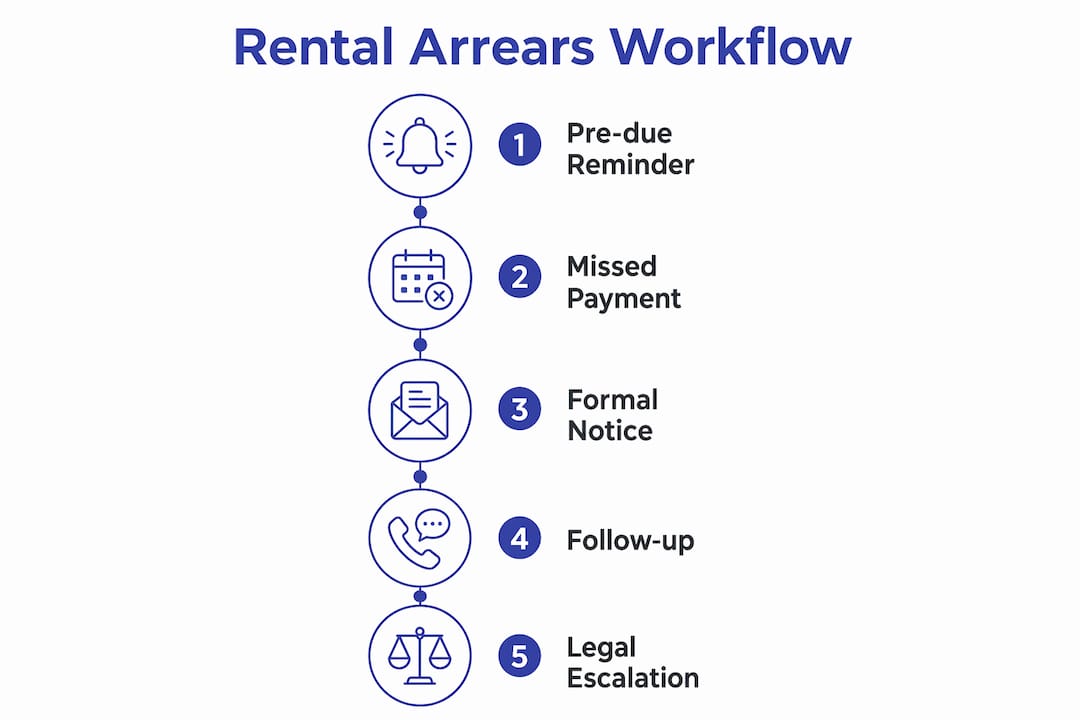
A 5-stage delinquency workflow is the industry standard for managing late rent from first warning through to possession proceedings. Each stage has a defined trigger, a required landlord action, and a documentation requirement. Skipping stages does not save time. It weakens your legal position and signals to tenants that lease terms are negotiable.
Here is how the stages break down for South African landlords:
-
Pre-due reminder (Days 5–7 before due date). Send an automated SMS or email reminder. Pre-due reminders sent 5–7 days before the rent due date reduce non-sufficient funds incidents significantly. This single step prevents a large proportion of late payments before they occur.
-
Early intervention (Days 1–7 after missed payment). Contact the tenant by phone and follow up in writing within 48 hours of the missed payment. A first missed payment notice within 48 hours, followed by a formal demand with a 7–14 day payment deadline, is the accepted best practice. Keep the tone firm but professional.
-
Formal escalation (Days 8–30). Issue a written notice of default. This document must state the outstanding amount, the deadline for payment, and the consequences of non-compliance. All notices must be delivered in a manner that creates a paper trail, such as registered post or email with read receipt.
-
Pre-legal negotiation (Days 15–30). Explore a repayment agreement if the tenant has a genuine short-term hardship. Any partial payment accepted during this stage must be covered by a written agreement. Accepting partial payments without a written “without prejudice” clause can unintentionally waive your legal rights to pursue the full outstanding balance.
-
Legal action (Day 30 onwards). If payment or a signed repayment plan is not received, proceed to formal legal channels under the Rental Housing Act and, where applicable, the Magistrates’ Court process.
| Stage | Trigger | Action required |
|---|---|---|
| Pre-due reminder | 5–7 days before due date | Automated SMS or email reminder |
| Early intervention | Day 1–7 after missed payment | Phone call and written notice within 48 hours |
| Formal escalation | Day 8–30 | Written default notice via registered post |
| Pre-legal negotiation | Day 15–30 | Repayment agreement in writing |
| Legal action | Day 30+ | Formal legal proceedings |
Pro Tip: Set your property management software to trigger each stage automatically. Manual tracking creates gaps, and gaps create disputes.
How to communicate effectively during rent arrears escalation
Communication tone must shift deliberately as arrears age. The first reminder is friendly and factual. By day 14, the tone is formal and consequence-focused. By day 30, every communication is a legal document. Mixing these tones at the wrong stage either damages the tenant relationship unnecessarily early or fails to convey urgency when it matters.
The communication cadence for a rent collection standard operating procedure includes:
- Day before due date: Automated reminder via SMS or email
- Day 1 after missed payment: Phone call followed by written confirmation
- Day 3: Follow-up SMS or email with outstanding balance stated clearly
- Day 7: Formal written notice with payment deadline
- Day 14: Final written warning before legal escalation
- Day 30: Notice of intent to proceed with legal action
Every written communication must state the outstanding amount, the payment due date, and the consequences of non-payment. Vague notices do not hold up in dispute resolution.
One frequently overlooked situation involves tenants receiving housing benefits or government grants. Proactive engagement with welfare caseworkers can resolve arrears without legal action in many cases. Contact the relevant authority directly if a tenant’s payment is delayed due to a benefit processing issue. This approach is faster and cheaper than a possession claim.

Pro Tip: Always send formal notices via a method that generates proof of delivery. A WhatsApp message, however convenient, does not constitute formal notice under South African tenancy law.
What are the best practices for tracking and documenting rental arrears cases?
A delinquency ledger is the operational backbone of efficient rent arrears management. It goes beyond a standard accounts receivable record. Every arrears case requires its own documented history.
Your delinquency ledger must capture:
| Data point | Why it matters |
|---|---|
| Tenant name and unit details | Identifies the case unambiguously |
| Payment history with dates and amounts | Establishes the pattern of non-payment |
| Communication log with timestamps | Proves notices were sent and received |
| Copies of all formal notices issued | Supports legal claims |
| Current escalation stage and next action date | Keeps the workflow moving |
Detailed records and timestamps of all communications and notices are decisive in legal disputes. A landlord who cannot produce a complete communication history is at a significant disadvantage in the Rental Housing Tribunal or Magistrates’ Court.
Automation removes the risk of human error in tracking. Platforms like Abode generate timestamped records automatically and send escalation notices at predefined intervals. This means your workflow runs consistently regardless of how many units you manage.
Pro Tip: Never accept a partial payment without a signed written agreement that explicitly states it does not waive your right to pursue the remaining balance. One informal acceptance can compromise your entire legal position.
How to legally escalate rent arrears in South Africa
Legal escalation under South African law follows a defined sequence. Deviating from this sequence delays proceedings and can result in a case being struck from the roll. The Rental Housing Act 50 of 1999 and the Magistrates’ Courts Act govern most residential tenancy disputes.
Follow these steps when proceeding to legal action:
-
Issue a Section 5(3) notice. This formal written notice informs the tenant of the breach and gives them a reasonable opportunity to remedy it. The notice must specify the amount owed and the deadline for payment.
-
File a complaint with the Rental Housing Tribunal. The Tribunal is a free dispute resolution body. It is the required first step for most residential tenancy disputes in South Africa. Proceedings typically take 30–90 days depending on the province.
-
Apply for a Magistrates’ Court summons. If the Tribunal does not resolve the matter, or if the arrears exceed the Tribunal’s jurisdiction, proceed to the Magistrates’ Court. The court can issue a judgment for the outstanding amount and, separately, an eviction order.
-
Apply for an eviction order under PIE. The Prevention of Illegal Eviction from and Unlawful Occupation of Land Act (PIE Act) governs all residential evictions in South Africa. A court order is mandatory. Self-help evictions, such as changing locks or removing belongings, are illegal and expose landlords to significant liability.
-
Enforce the court order. Once granted, the eviction order is executed by the Sheriff of the Court. The landlord cannot participate directly in the physical eviction process.
A well-documented workflow is your strongest asset at every stage of this process. Courts and Tribunals look favourably on landlords who followed a clear, consistent, and documented escalation process before applying for relief.
What tools and insurance options reduce rental arrears risk?
The right tools reduce the manual burden of arrears management and improve consistency. The right insurance removes the financial risk entirely.
Software platforms like Abode automate pre-due reminders, generate timestamped communication records, and track each case through escalation stages. Automation for reminders and arrears tracking significantly improves collection performance. Manual tracking, by contrast, creates gaps that tenants and their legal representatives can exploit.
Rental income insurance is the financial safety net that sits alongside your workflow. Rental income insurance covers unpaid rent and reduces risk exposure for landlords across portfolios. It does not replace a strong arrears workflow. It protects you financially while the workflow runs its course.
| Protection type | What it covers | Best suited for |
|---|---|---|
| Rental income insurance | Unpaid rent, early termination, absconding | All landlords with residential tenants |
| Tenant default insurance | Arrears and legal costs | Landlords with higher-risk tenant profiles |
| Rental income protection | Loss of income during vacancy or dispute | Portfolio landlords |
Key benefits of integrating insurance with your arrears workflow:
- Claims can be initiated at a defined stage in the workflow, typically after formal notices have been issued
- Insurance removes the pressure to accept poor repayment terms just to recover some income
- Coverage for non-payment protection means your mortgage and expenses are covered while legal proceedings run their course
- Some policies also cover legal costs associated with eviction proceedings
When choosing a policy, confirm the trigger point for claims, the waiting period, and whether the policy covers the full monthly rental or a capped amount. Review the rental insurance comparison options available in South Africa before committing to a product.
Key takeaways
A consistent, documented workflow for dealing with rental arrears is the most reliable way to protect rental income and maintain legal standing throughout the recovery process.
| Point | Details |
|---|---|
| Start before the due date | Pre-due reminders sent 5–7 days early reduce missed payments before they occur. |
| Document every step | A delinquency ledger with timestamps is decisive in Tribunal and court proceedings. |
| Shift tone deliberately | Communication must move from friendly to formal as arrears age, with no mixing of stages. |
| Follow the PIE Act | All residential evictions in South Africa require a court order; self-help evictions are illegal. |
| Pair workflow with insurance | Rental income insurance covers unpaid rent while legal proceedings run their course. |
Why I believe most landlords make this harder than it needs to be
Most landlords I speak with treat rent arrears as a personal problem rather than a business process. They hesitate to send the formal notice because they do not want to upset a long-standing tenant. They accept a partial payment over the phone without documenting it. They skip the pre-due reminder because it feels unnecessary when things have been fine for months.
Skipping documented processes signals to tenants that lease terms are optional. That is the uncomfortable truth. Inconsistent enforcement does not preserve a relationship. It creates a pattern of recurring late payments that becomes progressively harder to break.
The landlords I see managing arrears most effectively treat rent collection the same way a business treats accounts receivable. The process runs regardless of the personal relationship. The notices go out on schedule. The ledger is updated after every interaction. There is no ambiguity about what happens next if payment is not received.
The other mistake I see regularly is waiting too long to involve insurance. Rental income insurance is not a last resort. It is a tool you activate at a defined point in your workflow, typically after formal notices have been issued and payment has not been received. Waiting until you are three months into arrears and facing an eviction application is too late to get the full benefit of coverage.
Build the workflow once. Run it consistently. Let the process do the work.
— Coert
Protect your rental income with Rentalincomeinsurance
Even the most disciplined arrears workflow cannot eliminate the financial impact of a tenant who simply stops paying. That is where Rentalincomeinsurance steps in.

Rentalincomeinsurance provides South African landlords with cover against tenant non-payment, early lease termination, and absconding. When your arrears workflow reaches the formal escalation stage, your insurance claim can run in parallel, keeping your income protected while legal proceedings take their course. You do not have to choose between preserving a tenant relationship and protecting your cash flow. Request a quote today and find out how quickly you can add a financial safety net to your existing arrears process.
Watch this short overview to see how rental income protection works in practice:
https://youtu.be/ej04S_af4qM
FAQ
What is the first step in a rental arrears workflow?
The first step is a pre-due reminder sent 5–7 days before the rent due date. Automated reminders at this stage reduce non-sufficient funds incidents and prevent many late payments before they occur.
How soon should a landlord issue a formal notice after a missed payment?
A formal written notice should be issued within 48 hours of a missed payment. The notice must state the outstanding amount and include a 7–14 day deadline for payment.
Can a South African landlord evict a tenant without a court order?
No. The PIE Act requires a court order for all residential evictions in South Africa. Self-help evictions, including changing locks or removing a tenant’s belongings, are illegal and expose the landlord to civil and criminal liability.
What happens if a landlord accepts a partial payment during arrears?
Accepting a partial payment without a written “without prejudice” agreement can unintentionally waive the landlord’s right to pursue the remaining balance. Always document partial payment arrangements in writing before accepting any amount.
How does rental income insurance fit into an arrears workflow?
Rental income insurance is activated at a defined stage in the workflow, typically after formal notices have been issued and payment has not been received. It covers unpaid rent while legal proceedings run their course, removing the financial pressure to accept poor repayment terms.
Recommended
- Rental Income Recovery Process: South African Landlords Guide – Rental Income Insurance
- Rent default management guide for South African landlords 2026 – Rental Income Insurance
- How to manage rental disputes as a SA landlord – Rental Income Insurance
- Effective issue resolution workflow for SA landlords – Rental Income Insurance