
TL;DR:
- The correct sum insured for South African rental properties is based on full replacement cost, not market value, and must be reviewed annually to account for construction inflation. Underinsuring triggers the average clause, which reduces claim payouts proportionally, risking significant financial loss. Professional valuation and timely policy updates are essential to ensure comprehensive protection against property damage and income loss.
The sum insured is the maximum amount your insurer will pay to rebuild your rental property from the ground up, based on replacement cost, not market value. This distinction is the foundation of every sound landlord insurance decision in South Africa. Get it wrong and you risk triggering the average clause, which can slash your claim payout by tens of thousands of rands at the worst possible moment. With construction inflation running at 9% annually in South Africa, the choice of sum insured explained correctly is not a once-off exercise. It is an annual obligation for every landlord who wants genuine protection.
What is sum insured and why is replacement cost the right basis?
The sum insured is the industry term for the ceiling amount your insurer will pay in the event of a total loss. For rental properties, this figure must reflect the full replacement cost of the building, meaning the cost to demolish, clear, and rebuild the structure to its current specification at today’s prices.
Market value is an entirely different figure. It includes land value, location premiums, and demand factors that have no bearing on what it costs to reconstruct a building. Insuring for market value leads to over-insurance of land and under-insurance of rebuilding costs, which creates disputes at claim time and leaves landlords exposed. Land does not burn down. Land does not flood. Land does not need to be rebuilt. It therefore has no place in your sum insured calculation.
Replacement cost, by contrast, covers every rand required to restore the physical structure. This includes:
- Materials and labour at current market rates
- Demolition and rubble removal costs, which are frequently overlooked
- Professional fees for architects, engineers, and project managers
- VAT on all construction costs
- Compliance upgrades required by current building regulations
Each of these components rises with inflation. South Africa’s 9% annual construction inflation means a property correctly insured in 2023 could be underinsured by more than 25% by 2026 if the sum insured has never been reviewed. That gap is not theoretical. It is the difference between a full rebuild and a landlord funding the shortfall personally.
Pro Tip: Ask your insurer directly whether their valuation methodology is based on replacement cost or market value. If the answer is unclear, commission an independent quantity surveyor report before renewing your policy.
What happens if you choose the wrong sum insured?
Choosing an insufficient sum insured triggers underinsurance, and underinsurance activates the average clause. Understanding this mechanism is non-negotiable for any landlord with a bond or a rental income stream to protect.
The average clause works as follows. If your property would cost R2 million to rebuild but you have insured it for only R1.4 million, you are insured for 70% of the true replacement cost. When you submit a claim, whether for total loss or partial damage, the insurer applies the same 70% ratio to the payout. A R500,000 partial damage claim becomes a R350,000 settlement. You absorb the remaining R150,000 yourself.
Here is the step-by-step logic of how the average clause reduces a payout:
- Determine the true replacement cost of the property at the time of loss.
- Calculate the ratio of sum insured to true replacement cost.
- Apply that ratio to the claimed loss amount.
- Pay only the proportional amount, regardless of the actual damage.
The average clause applies to partial claims just as it does to total loss claims. This surprises most landlords, who assume underinsurance only matters if the property burns to the ground. A burst geyser, a fire in one room, or storm damage to a roof can all trigger proportional reductions if the sum insured is inadequate.
Research shows the average clause reduces payouts by 30 to 50% for underinsured properties. That is not a rounding error. It is a structural financial loss that no landlord can afford to ignore.
“The average clause is designed to ensure fairness among policyholders by preventing under-insured owners from receiving full payouts at the expense of those who insure correctly.”
The clause is not punitive by design. It is a mechanism to maintain equity across a pool of policyholders. But its effect on an underinsured landlord is severe, and the remedy is straightforward: insure for the correct replacement cost from the outset.
Pro Tip: A cheap insurance policy that saves R300 per month in premiums can cost you R200,000 or more at claim time. The maths never favours underinsurance.
How to accurately determine and update your sum insured
Accurate sum insured calculation is not guesswork. It requires a structured approach that accounts for current building costs, recent improvements, and the relentless upward pressure of construction inflation.
The most reliable starting point is a professional quantity surveyor assessment. A registered quantity surveyor calculates the precise cost of rebuilding your property at current rates, factoring in materials, labour, professional fees, and VAT. This report gives you a defensible, accurate figure that your insurer cannot reasonably dispute. Professional quantity surveyor reviews are the gold standard for maintaining accurate sums insured, and they are particularly valuable for landlords with multiple properties or recently renovated buildings.
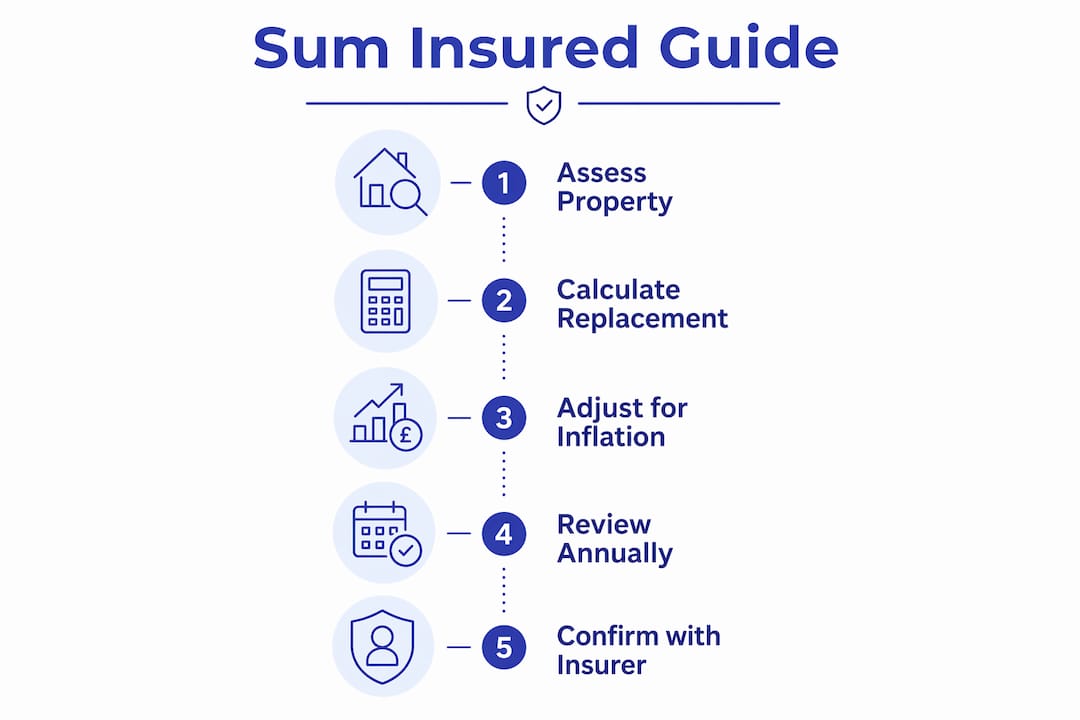
Beyond the initial assessment, the following steps keep your sum insured current:
- Review annually. Set a calendar reminder to reassess your sum insured at every renewal, not just when something changes.
- Apply inflation escalation clauses. Many South African insurers offer inflation-linked adjustments of between 5% and 10% annually. Activate this clause if your policy includes it.
- Declare renovations immediately. A new kitchen, additional bathroom, or extended living area increases the replacement cost. Notify your insurer as soon as work is complete.
- Account for unregistered additions. Wendy houses, carports, and boundary walls added without council approval still have replacement value and must be included in your sum insured.
- Reassess after major market shifts. Steel, cement, and timber prices in South Africa fluctuate significantly. A sharp rise in material costs can outpace standard escalation clauses within a single policy year.
The fluctuations in South African construction costs require landlords to treat sum insured reviews as a recurring business task, not a once-off administrative formality. Landlords who set their sum insured once and never revisit it are, statistically, the ones who discover their underinsurance at the worst possible moment.
Pro Tip: Cross-reference your insurer’s escalation percentage against the actual Producer Price Index for building materials published by Statistics South Africa. If the PPI outpaces your escalation clause, top up your sum insured manually.

For a broader view of how to protect your investment, the landlord insurance checklist from Rentalincomeinsurance covers the full range of cover decisions beyond the sum insured alone.
How does rental property insurance differ from standard home cover?
Standard homeowner insurance and landlord insurance share a common structure but diverge sharply on the extensions that matter most to property investors. The sum insured for a rental property must account for risks that simply do not exist in an owner-occupied home.
| Cover element | Standard home insurance | Landlord insurance |
|---|---|---|
| Building replacement cost | Yes | Yes |
| Loss of rental income | No | Yes, as an extension |
| Tenant malicious damage | No | Yes, as an extension |
| Landlord liability | Limited | Specific landlord liability cover |
| Vacant property cover | Often excluded | Available with conditions |
| Tenant default protection | No | Available via specialist products |
Rental property insurance includes specific extensions such as loss of rent coverage, tenant malicious damage, and landlord liability that are absent from standard home policies. Each of these extensions affects the overall insurance strategy and, in some cases, the sum insured calculation itself. Loss of rent cover, for instance, is typically calculated as a percentage of annual rental income and sits alongside the building sum insured as a separate limit.
Landlords frequently underestimate the need for these rental-specific extensions, which leads to coverage gaps that only become visible when a claim is submitted. A tenant who causes R80,000 of malicious damage before absconding is not covered under a standard home policy. Neither is the rental income lost during the three months it takes to repair the property and find a replacement tenant.
Proper landlord insurance must include loss-of-rent cover and tenant-related protections as part of a complete insurance strategy. The sum insured for the building is the foundation, but it is not the whole structure. For a detailed breakdown of what a landlord policy should include, the 2026 landlord insurance guide from Rentalincomeinsurance is worth reviewing before your next renewal.
Key takeaways
The correct sum insured for a South African rental property is the full replacement cost of the building, reviewed annually, and supplemented by rental-specific extensions to provide complete financial protection.
| Point | Details |
|---|---|
| Replacement cost, not market value | Base your sum insured on rebuilding costs, excluding land value, to avoid disputes at claim time. |
| The average clause is proportional | Underinsurance by 20% reduces every claim payout by 20%, including partial damage claims. |
| Annual review is non-negotiable | South Africa’s 9% construction inflation erodes sum insured accuracy within a single policy year. |
| Rental extensions change the picture | Loss of rent, tenant damage, and landlord liability cover must sit alongside the building sum insured. |
| Professional valuation is the safest method | A quantity surveyor report gives you a defensible replacement cost figure your insurer cannot dispute. |
Why most landlords get this wrong, and what I have learned
From working with South African landlords across a range of portfolio sizes, the single most consistent financial oversight I encounter is underinsurance. Not by a small margin. By 20%, 30%, sometimes more. And almost always because the sum insured was set at inception and never revisited.
The reasoning is understandable. Premiums feel like a cost with no immediate return, and reducing the sum insured reduces the premium. But this logic collapses the moment a claim is submitted. I have seen landlords with well-maintained properties, good tenants, and sensible financial habits absorb six-figure shortfalls because their sum insured had not kept pace with construction costs. The average clause does not care how responsible you are in other areas of your financial life.
My strongest recommendation is to treat the sum insured review as a fixed annual business expense, not an optional administrative task. Commission a quantity surveyor report every three to five years, and apply your insurer’s escalation clause in the years between. If your insurer does not offer an escalation clause, find one that does. The professional advice from experienced brokers is not a luxury for large portfolio landlords. It is a practical necessity for anyone with a rental property and a bond to service.
The other mistake I see regularly is treating rental property insurance as identical to home insurance. It is not. The risks of rental investment extend well beyond the physical building, and a policy that does not reflect those risks leaves you exposed in ways that the sum insured alone cannot fix.
— Coert
Protect your rental income with the right cover

Rentalincomeinsurance specialises in insurance solutions built specifically for South African landlords. Whether you need clarity on your current sum insured, want to add loss-of-rent cover, or need protection against tenant malicious damage and non-payment, the team at Rentalincomeinsurance can assess your situation and recommend cover that matches your actual risk. Getting your sum insured right is the starting point. Building a complete landlord insurance policy around it is what genuinely protects your investment. Request a tailored quote today and find out whether your current cover would actually hold up when it matters most.
You can also watch this short overview to understand how rental income protection works in practice:
FAQ
What does sum insured mean for a rental property?
The sum insured is the maximum amount your insurer will pay to rebuild your rental property following a total loss. It must be based on the full replacement cost of the structure, not the market value or the bond amount.
Why is market value the wrong basis for sum insured?
Market value includes land value, which does not need to be rebuilt after a loss. Using market value as the basis for your sum insured leads to under-insurance of the actual building and over-insurance of land, creating a coverage gap at claim time.
How does the average clause affect my claim payout?
The average clause reduces your claim payout proportionally if your sum insured is lower than the true replacement cost. If you are insured for 70% of the replacement cost, you receive only 70% of any claim, including partial damage claims.
How often should I review my sum insured in South Africa?
Review your sum insured at every annual renewal. South Africa’s construction inflation of approximately 9% per year means a sum insured set even two years ago may already be materially below the current replacement cost of your property.
What cover extensions should a landlord policy include beyond the sum insured?
A landlord policy should include loss-of-rent cover, tenant malicious damage protection, and landlord liability in addition to the building sum insured. These extensions address risks specific to rental properties that standard home insurance does not cover.
Recommended
- Understanding insurance deductibles: smart guidance for SA landlords – Rental Income Insurance
- Explaining direct loss insurance for SA landlords – Rental Income Insurance
- Best landlord insurance for SA rentals: 2026 guide – Rental Income Insurance
- Insurance claims explained: guide for South African landlords – Rental Income Insurance